Anti-sex feminism? by Linn Marie Tonstad

Linn Marie TonstadLori Gottlieb’s article in the February 9 New York Times magazine, “The Egalitarian-Marriage Conundrum,” was yet another tired entry in the New York Times’s annual clickbait misogyny Olympics. Who doesn’t remember the supposed opt-out revolution, and the sadness of the decade-later follow-up demonstrating every single consequence that any feminist could have predicted? Or the weekly gender terrorism spewed by Maureen Dowd, who somehow gets people to believe that constant belittling and feminizing male Democratic politicians counts as incisive, progressive political commentary? To name just a few of the most memorable, and most infuriating, examples.  

Gottlieb’s article rehashed the studies – I’ve lost count of how many times I’ve read about them in one version or another – that suggest that equality in household labor leads to decreased frequency of intercourse among married heterosexual couples. The most revolting lines in the article – among many contenders – start with a quote from Julie Brines, the author of the study in question: ‘”The less gender differentiation, the less sexual desire.’ In other words, in an attempt to be gender-neutral, we may have become gender-neutered.” It is possible that Brines may be quoted out of context, or that what she intended to say was something quite different, but as the quotation stands, it implicitly suggests that so-called “traditional” gender differentiation is necessary for sexually satisfying heterosexual relationships. (For, of course, there are plenty of other ways in which gender differentiation might be present in heterosexual relationships. Gender differentiation is here being equated with a very particular set of decisions about ‘housework’, a notion that arguably exists only to render some parts of women’s work invisible.) That’s before getting into the implications of the word “neutered” used in the second sentence. Why would egalitarian distribution of household labor be considered “gender-neutral” to begin with? Continue reading “Anti-sex feminism? by Linn Marie Tonstad”

Love and Happiness by Elise M. Edwards

Elise EdwardsAs Valentine’s Day approaches, it seems normal to think of love, perhaps with cynicism or hope or a mix of conflicted emotions.  Last year, I wrote a post on this site about Valentine’s Day, and I’m happy to contribute this year around the same time.  But this year I’ve been doing a different kind of reflection.  Maybe it’s because I just took my artificial Christmas tree down this past weekend, but I’ve been a little slow to get in the Valentine’s spirit, more specifically to reflect on the idea of a holiday dedicated to love.

It’s not that I haven’t been talking about love and relationships—I’ve been doing a lot of that lately.  I’m teaching a class that is currently in the middle of a unit on Christian sexual ethics, I’ve been conversing with friends about their upcoming weddings and future plans, and I have spent a lot of time on the phone navigating the terrain of a long-distance relationship.  But all this talk hasn’t left me too much time to reflect.  It wasn’t until last night, as the church choir rehearsal I was attending was ending, that my thoughts of devouring chocolate hearts were interrupted by a litany prepared by two choir members in honor of Valentine’s Day. Continue reading “Love and Happiness by Elise M. Edwards”

Seriously?! Let’s Blame Feminism for the Creation of a “Wimpy” Nation by Michele Stopera Freyhauf

FreyhaufIt is so easy to blame feminism for the ills of the world – mainly because of continued misconceptions and misunderstandings about the definition or meaning of feminism. Feminism is responsible for poverty, bad leadership, wars, the polar vortex, the list goes on. Feminism is still considered a derogatory term that serves to incite prejudice against those who label themselves as one.  In fact, negative connotations surrounding feminism are exacerbated in today’s culture, especially in the media.  Fox News seems to be the poster child of “femiphobia” – a term coined by Stephen Ducat and defined as “wanting to repress every man’s feminine side and demonize the feminine and gay wherever we see them.” Elisabeth Hasselbeck and Nick Adams, in a recent interview, illustrate this femiphobic viewpoint by blaming feminism for raising a culture of “wimps” and “wussies” and thus compromising the U. S.’s national security and weakening its global presence.  In other words, feminism is to blame for the problems of the world.

According to Adams, men around the world are no longer allowed to be “manly” and that this phenomenon is a “dangerous” problem:

American men are of course very susceptible to it. It’s really important particularly in America given the leadership role that America has in the world that American men be allowed to be men.

What does in mean to be a man and how is Adams defining that stereotype? While I am aware of the discussion of gender identity and roles even gendered stereotypes, this post is not about what those roles mean.  Rather, for this point of discussion, I want to address the issue of masculinity, feminism, and what it means to be a “wimp” as portrayed by popular media.

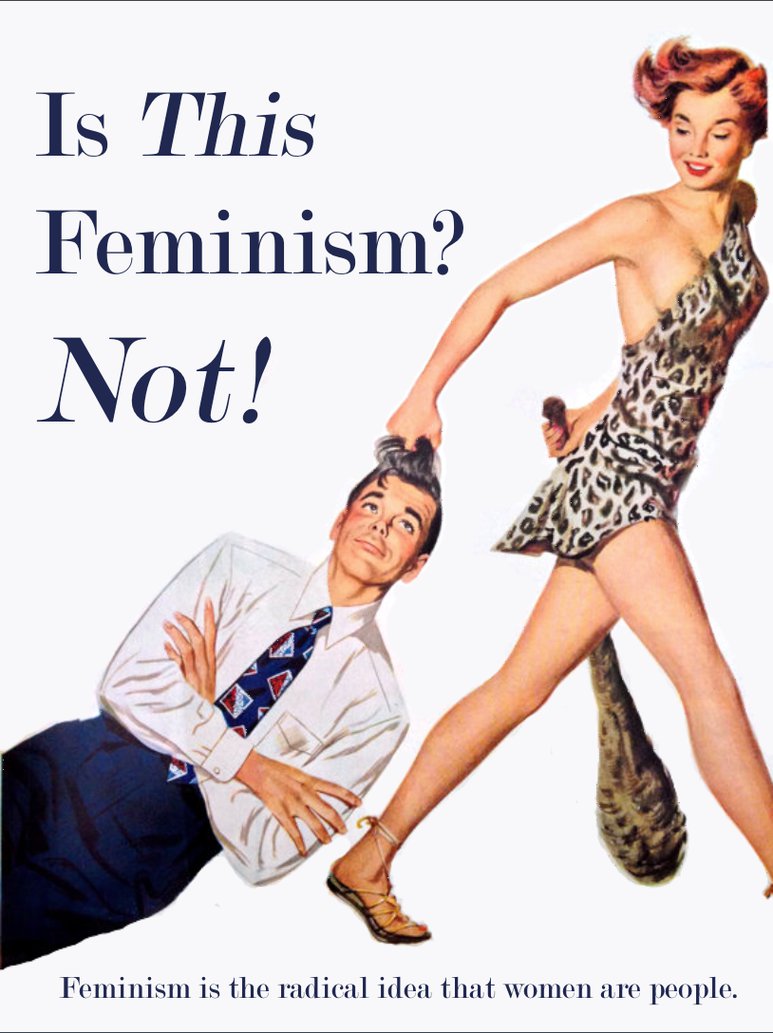
Original photo: http://poasterchild.deviantart.com/art/Feminism-Not-406854334

With that caveat in mind, I ask the following questions:

  • Is the author suggesting a move to a “hypermasculinity”?
  • Is Adams identifying masculinity with aggression and violence in a world where feminists and perhaps all women are demonized?

In a society dominated by the “alpha male” character trait,male  honor and pride are paramount. Is Fox News telling men to replace so-called passive behavior with pride, abrasiveness, authoritarianism, and arrogance–in such a world if where women are demonized, then assaultand rape will follow.  The call for “real men” or “hyper-masculinity” therefore provides a real potential to move us further towards a misogynistic rape culture of violence–in the direction of barbarianism.

Continue reading “Seriously?! Let’s Blame Feminism for the Creation of a “Wimpy” Nation by Michele Stopera Freyhauf”