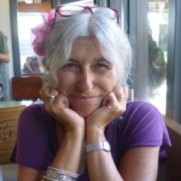
The Personal Book of Shadows: Compendium of Sacred and Scientific Knowledge, Wisdom, and Evolving Experimentation by Elisabeth Schilling

I’m the type of insecure wallflower who has deleted social media accounts, blogs, photos, poems, and journals because 1. I am not good at commitment or planning, 2. I shame myself for being eclectic and lacking consistency, and 3. a sentiment I have either created or exists in some form externally prods me to brand myself, something I cannot do well (see no.1 and no.2). Oh, that doesn’t mean I don’t find the brand smart, and maybe calling it a “brand” condemns it to consumerism and commodities, when really it is being focused where I am distracted and a frivolous sensationalist.
On the whole, currently, I suppose I’m experimenting with accepting this all-over-the place eclecticism that has seemed to follow me my entire non-linear life and trying to commit to embracing whatever mess I create, even if it feels disjointed and that I can never have a nice, clean, mono-personality. Who am I? About 8 different people. Can anyone relate? Okay, maybe I just need to grow up. I have a feeling it will just have to happen in my next life. Continue reading “The Personal Book of Shadows: Compendium of Sacred and Scientific Knowledge, Wisdom, and Evolving Experimentation by Elisabeth Schilling”

On a Friend’s Departure by Vanessa Rivera de la Fuente

photo

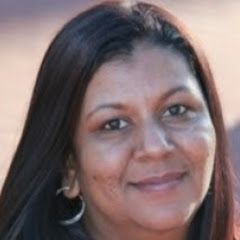
On June 25th, I received the news that my friend Zubeida Shaikh had passed away in South Africa. This took me by surprise. The last time Zubeida and I exchanged communication, she was as always, strong, determined and full of life, ready to realize her dreams. Zubeida Shaikh was an avid reader of feminism and religion. I would like to remember her in this space, thanks to which she and I met in life. In 2015, a little before my trip to South Africa, Zubeida sent me an email. She had read my article “Enemy of Islam” and it “was speaking to her”.

So, few weeks after my arrival in Cape Town, we met in the Parliament of the Republic of South Africa, her place of work until 2017, where I visited her in her office and we talked at length about feminism, violence against women and resilience, putting our own stories with patriarchy and abuse on the table. Then we spent the afternoon together. She was the first person from South Africa that I met. She was my first friend in South Africa. Continue reading “On a Friend’s Departure by Vanessa Rivera de la Fuente”

Women Can Change the World by Judith Shaw

judith shaw photoThese are dark days for those of us who believe in democracy, social justice, environmental stewardship/protection, and connectivity.  A rise in authoritarian rulers – from the U.S. to pockets of Europe to Turkey and beyond – are threatening the values upon which democracies are founded.

Continue reading “Women Can Change the World by Judith Shaw”

Swan – Guide to Love and Spiritual Evolution by Judith Shaw

judith shaw photoSwan glides gracefully across the mirror-like surface of the lake, stirring sensibilities of purity, loyalty and love in our hearts. Her long, curved, delicate neck reflects in the water as gentle ripples spread out behind her. Swan evokes feelings of peace and can signify self-transformation, intuition, sensitivity, and the soul.

Continue reading “Swan – Guide to Love and Spiritual Evolution by Judith Shaw”

Celebrating Pride: Honoring the Spiritualities of Queer Holy Women of Color by Angela Yarber

With rainbow colors erupting from even the big box stores, I find my super queer-feminist-self scratching my head at the way Pride has transformed into a capital enterprise. I mean, I’m pretty stoked that the cultural climate seems to be slightly more affirming of queer people, but as queer culture is commodified, I cannot help but think of what is being lost or forgotten. And I want to shout from the rooftops that the rich spiritual history of Pride rests firmly on the shoulders of queer women of color who have marched and meditated, prayed and protested long before rainbow Pride headbands were available at chain stores across the land. It is for this reason that, in honor of Pride Month, the Holy Women Icons Project (HWIP) has launched a 7-Day Online Queer Spirituality Retreat that celebrates seven different queer holy women of color.

HWIP’s 7-Day Online Queer Spirituality Retreat is an opportunity to subversively queer your spirituality, and for the LGBTQ+ community to celebrate our spirituality without having to translate it through the lens of heteronormativity. Open to everyone, the Queer Spirituality Retreat features seven different queer women of color: Pauli Murray, Frida Kahlo, Perpetua and Felicity, the Shulamite, Marsha P Johnson, Guanyin, and Gloria Anzaldúa. Each retreat day takes about 20 minutes and includes an inspirational quote, an icon image, a reflective essay, a guided writing exercise, a ritual exercise, and a closing blessing. The most important part of the retreat is, of course, the revolutionary queer women who make it possible. So, allow me to briefly introduce you to seven queer women of color who should make us all proud…

Continue reading “Celebrating Pride: Honoring the Spiritualities of Queer Holy Women of Color by Angela Yarber”

Spiritual Ideas, Existential and Eastern, in Jonathan Livingston Seagull by Elisabeth Schilling

Peaceful Solitude

After my year of teaching high school students, I found a kinship with them in their frustrations, longing, apathy, hopelessness, and hope. Fortunately, we studied together Jean Paul Sartre, whom I want to get to know more intimately, but we, the teens and myself, could take the spiritual answer to our questions about the meaning of life (is there one? What is it?): The meaning of life is to give it meaning.

I am not sure about their generation, but adolescence for me, in mine, was about discovering, not necessarily creating. Of course, now I think it is a little of both.

Sometimes I wonder if there is also a lesson. Being an academic, perhaps I love learning and teaching. I demonstrate my love as Jonathan Livingston Seagull does, by offering to others, perhaps a specific community of others, those who have chosen or must be in a state of learning (easily found in institutions of high school and college), the truths I have gathered (59). Of course ‘truth’ is a word that tastes a bit tannic, for it needs to be rolled around by the tongue a bit to be cleansed; perhaps to mitigate its toxic potential, we can never consume it undigested, but must gestate it and transform it within our warm bodies, just at the cliff, before we allow it to permeate our organs in a chemical structure that serves us.

Continue reading “Spiritual Ideas, Existential and Eastern, in Jonathan Livingston Seagull by Elisabeth Schilling”

Celtic Myth, Moon Blood, and the White Beauty Standard by Marisa Goudy

My woman’s body is entering the dark time of the moon, even with blinding white snow lashing the windows, even with a full moon tracing its way far above thick clouds. My mood is black and soon I’ll be flowing red, and the snow will just drive on white, white, white.

In The White Goddess, Robert Graves tells us: “…the New Moon is the white goddess of birth and growth; the Full Moon, the red goddess of love and battle; the Old Moon, the black goddess of death and divination.”

The Celt in me feels cradled by this imagery, even if, as Judith Shaw and Carol P. Christ have pointed out elsewhere on this site, the idea of maid, mother, and crone is a modern invention, not gift from the past. I agree with Christ:  “My suggestion is that we give up the idea that the details of contemporary Goddess Spirituality are rooted in and authorized by tradition. We can instead acknowledge that though we are inspired by the past, we are the ones who are creating contemporary Goddess Spirituality.”

Continue reading “Celtic Myth, Moon Blood, and the White Beauty Standard by Marisa Goudy”

Bless This House: Creating Sacred Space Where You Live, Work & Travel by Mama Donna Henes – A Book Review by Joyce Zonana

“There is no such thing as a bad blessing,” Mama Donna tell us, “no rules . . . no recipes, no prescriptions, no instruction manuals,” no “one-size-fits-all” House Blessing. Yet it’s not so much “anything goes” as “everything matters”: “The only thing you can do wrong in a ritual is to not pay attention to your true intentions.”

jz-headshotDonna Henes, familiarly known as “Mama Donna,” is a national treasure. From her “House of Many Altars” in what she mischievously calls “Exotic Brooklyn,” she serves as an exuberant, irrepressible urban shaman: holding outdoor public rituals at each solstice and equinox for over forty years; blessing and leading New York City’s annual Halloween Parade; creating meaningful, personalized ceremonies for funerals, weddings, new babies, new homes, and new businesses. In 2009, the governor of New York State called on her to bless the fleet during the quadricentennial celebration of Henry Hudson’s voyage to the New World. She is the author of five books, including The Queen of Myself  and Celestially Auspicious Occasionsand publishes a monthly e-newsletter, The Queen’s Chronicles, that offers “meaning, moxie, and magic for midlife women.”

In her most recent book, Bless This House: Creating Sacred Space Where You Live, Work & Travel (Ixia Press, 2018), Mama Donna generously shares her house-blessing “secrets”—revealing that they are not secrets after all. Demystifying the blessing process, the book details everything you need to know to “claim and consecrate” your own house with “authority and aplomb.” Continue reading “Bless This House: Creating Sacred Space Where You Live, Work & Travel by Mama Donna Henes – A Book Review by Joyce Zonana”

Creating Women’s Circles that Heal and Enrich Our Lives by Anne Yeomans and the Women’s Well

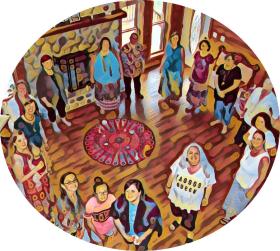
From 1994 until 2012, the Women’s Well, based in Concord, Massachusetts, offered thousands of women the opportunity to participate in women’s circles of all kinds. In the first and second parts of this series, Anne Yeomans, a co-founder of the Women’s Well, and others who co-created the Women’s Well, shared about their experiences with the power and wisdom of the circle and the use of altars and ritual. (Part I and Part II).  This third part, explains the guidelines that the Women’s Well developed for their circles. This post is adapted from the Women’s Well website at www.womenswell.org.

We often used the guidelines in our circles. Sometimes the facilitator or holder of the circle would speak of them and then place them around the circle on printed cards, to remind us of the quality of listening and speaking that we were trying to invite in.

These guidelines were originally drawn from the work of Tom Yeomans who developed a way of working in groups, called the Corona Process. It was an approach to group dialogue that came to him in a dream the night after attending a meeting with the great physicist David Bohn, who at the end of his life became interested in dialogue and world peace. Continue reading “Creating Women’s Circles that Heal and Enrich Our Lives by Anne Yeomans and the Women’s Well”

Ritual Theory: Sharing Stories by Molly Remer

“Ritual that is alive encourages each person to touch what is sacred in their own way, in their own time, through their own unique experience. So there evolves a dynamic dance between guiding and shaping the group’s experience and encouraging and supporting the individual’s experience, so there is a smooth and cohesive flow to the ritual.” –Suzanne Reitz and Sandy Hoyt (Celebrating, Honoring, Healing)

As a practicing priestess, one of the dynamic dances that I engage in is with the power of story. I both find that women’s stories are the vital lifeblood of conscious engagement and power-building with one another and that they can be one of the elements that bogs down a ritual and makes it lose power and magic. This is partially because the dominant culture may teach us to bond using stories in a way that actually drain our energy through “venting,” swapping complaints, trading to-do lists, and through describing behavior, motives, and character of other people. In women’s ritual space, I encourage people to dig deep, but also to share a here-and-now connection of shared experience rather than a ­there-and-then­ rendition of past experiences.

Chameli Ardagh in her Create Your Own Women’s Temple manual from Awakening Women explains:

To hold the group and space as sacred is one of the most important guidelines, and the guideline that may bring up the most questions or protests. It goes against our habits as women and against our identification with the small self; we are quite used to creating intimacy through sharing our wounds and problems. The Temple Group is not a place for processing wounds, analyzing ourselves, solving problems, complaining about our lovers, healing our addictions or sharing the stories of the personality. Many women’s circles (and support groups or sharing circles) are focused mostly on the personality. The Temple Group is, in a way, impersonal because it focuses on the larger vast nature of our true self. In the Temple Group we focus not so much on our identity as separate women, but on the whole group as one feminine divine body and expression. The impersonal guideline may sound uncaring at first, but as you explore new ways of being intimate and nourish each other as women, beyond the words, you discover that those are infinitely more fulfilling and caring than the personality talking and processing (p. 61).

I believe that we live in a storied reality and that we are constantly in the process of 22338975_2058326864379525_7570131764764457268_ostorying and re-storying our lives and that seeing our lives, and the lives of others, through a mythopoetic lens, can have a radically transformative impact on our experiences and our relationships. I have written about this for FAR in the past and noted that my personal lived experience is that stories have had more power in my own life as a woman than most other single influences. The sharing of story in an appropriate way is, indeed, intimately intertwined with good listening and warm connection. As the authors of the book Sacred Circles remind us “…in listening you become an opening for that other person…Indeed, nothing comes close to an evening spent spellbound by the stories of women’s inner lives.”

So, what is special about story as a medium and what can it offer to women that traditional forms of education cannot?

Stories are validating. They can communicate that you are not alone, not crazy, and not 23319504_1994649147413964_2818983018590835346_nweird. Stories are instructive without being directive or prescriptive. It is very easy to take what works from stories and leave the rest because stories communicate personal experiences and lessons learned, rather than expert direction, recommendations, or advice. Stories can also provide a point of identification and clarification as a way of sharing information that is open to possibility, rather than advice-giving.

Cautions in sharing stories while also listening to another’s experience include:

  • Are you so busy in your own story that you can’t see the person in front of you?
  • Does the story contain bad, inaccurate, or misleading information?
  • Is the story so long and involved that it is distracting from the other person’s point?
  • Does the story communicate that you are the only right person and that everyone else should do things exactly like you?
  • Is the story really advice or a “to do” disguised as a story?
  • Does the story redirect attention to you and away from the person in need of help/listening?
  • Does the story keep the focus in the past rather than the here and now present moment?
  • Is there a subtext of “you should…”?

Several of these self-awareness questions are much bigger concerns during a person-to-person direct dialogue such as at a women’s retreat rather than in written form such as blog. In reading stories, the reader has the power to engage or disengage with the story, while in person there is a possibility of becoming stuck in an unwelcome story. Some things to keep in mind while sharing stories in person are:

  • Sensitivity to whether your story is welcome, helpful, or contributing to the other person’s process.
  • Being mindful of personal motives—are you telling a story to bolster your own self-image, as a means of pointing out others’ flaws and failings, or to secretly give advice?
  • Asking yourself whether the story is one that will move us forward (returning to the here and now question above).

This work is beautiful. It is complex. It is multilayered. It is simple. It is hard. It is easy. It is rich and rewarding. It is dynamic and evolving and flowing. It is never the same.

May you be blessed with many stories together.

mollyatparkNote: there is a detailed audio exploration of the themes of this post available here.

Molly has been “gathering the women” to circle, sing, celebrate, and share since 2008. She plans and facilitates women’s circles, seasonal retreats and rituals, mother-daughter circles, family ceremonies, and red tent circles in rural Missouri and teaches online courses in Red Tent facilitation and Practical Priestessing. She is a priestess who holds MSW, M.Div, and D.Min degrees and wrote her dissertation about contemporary priestessing in the U.S. Molly and her husband Mark co-create Story Goddesses, original goddess sculptures, ceremony kits, and jewelry at Brigid’s Grove. Molly is the author of WomanrunesEarthprayer, and The Red Tent Resource Kit and she writes about thealogy, nature, practical priestessing, and the goddess at Patreon and at Brigid’s Grove.