Passover is a holiday of remembrance, of ritual re-enactment: this, we say, is what our ancestors experienced. This is what they felt and knew, what they tasted in their blood. The movement from slavery to liberation, from the soul’s winter to spring. We must never forget, we say, we must always remember, be thankful for our freedom, never take it for granted. “In each generation,” the Haggadah enjoins, “we should feel as if we personally had come out of Egypt.”
This year, I celebrated the Jewish feast of Passover on March 31st–almost three weeks before the holiday’s official start on the evening of April 19th, the 15th of Nissan. It turned out to be my best Passover yet.
Because I’d been accepted for a residency at an artists’ colony beginning on April 17th, I had known since last Fall that I would not be home for the holiday. Given Passover’s importance for me–a Jew who left Egypt in her own lifetime, part of what some have called the “Second Exodus”–I had thought I might postpone the residency and even considered turning it down. But the colony could not change the dates, and, after much deliberation, I decided that my work as a fledgling translator was worth missing my usual gathering of family and friends. I told myself I could mark the arrival of Passover internally.
In March, my husband drove our daughter into town to work at her Girl Scout cookie booth and released me to prepare for an all-day Red Tent retreat for my local women’s circle. After I packed my supplies for ritual, I set off on a walk in the deepening, rain-dark twilight. As I walked, I sang a song of sanctuary over and over, until I felt transported into a different type of consciousness, my feet steady on muddy gravel, the leafless branches stark against grey sky, moss and stones gleaming with sharp color against the roadside. A fallen tree absolutely carpeted with enchanting mushrooms caught my eye and invited me off the road and into its arms. As I stood there, feeling as if I had stepped out of ordinary reality and into a “backyard journey,” the spring peepers in the ephemeral pool in our field began their evening chorus. It has been so cold out with below freezing temperatures, snow, and ice for days since first hearing them in early March that I actually wondered if they would survive to continue their song.
I often say I am a theologian who is uncomfortable with prayer and does not have a relationship with God. What I mean is that I am still trying to figure out how I understand the divine; conventional prayers feel exclusionary and that is not something I want to participate in. Instead, I believe there is so much more to these concepts than traditional theology offers.
I find comfort in Mary, mother of Jesus, Mary of Magdala, Maria Goretti, my grandmothers, and my own mother — in communing with the saints. I feel connected to them. I know what it means to be a woman, a mother, a daughter, and to live in a misogynistic world. Growing up with patriarchal imagery of God continues to influence my perceptions about the divine and I have not yet found a way to develop a sacred relationship with a being I have struggled to view as anything other than oppressive. I am on a journey, and one that often gets pushed to the side in favor of teaching, grading, parenting, writing, cooking, cleaning, laundry…and when I can get it, sleep.
It seems that my nine-year old daughter is also on a journey and having her first crisis of faith. She has come to me with many questions about God lately. Initially she asked if God is real and how we can know. Then she moved on to other questions…and then assumptions. Last week, Sarah came home from school and told me that God is a white man. My heart broke a little. I asked her why she thought that and she responded, “Haven’t you seen all the pictures of God? Duh.”Continue reading “Who is God? by Gina Messina”
Happy Valentine’s Day! I know, I know… so many of us do not like this holiday. It’s too commercialized, we say. We don’t need card-makers or florists to tell us how or when to show affection. Some of us don’t like Valentine’s Day because it reminds us of loves we have lost or never found. I get it. This day can seem shallow, overhyped, and falsely sentimental. It can be lonely. And yet, I won’t let today pass without celebrating and honoring love. Love is too important to concede to commercial interests.
Love, in its many forms, keep us alive and able to endure. Love is powerful because it is expansive, growing in unexpected places and ways. We tend to separate our celebrations of romantic love, friendship, familial love, self-love, and religious devotion. We make distinctions between our valentines and “galentines.” Rarely do we shout for joy in ecstatic worship while also celebrating the passionate longings of our innermost desires. But occasionally, in my religious tradition, we let our disparate loves come together. We unite them on holy feast days, enjoying the sensual pleasures of good food and company to mark spiritual occasions. So that’s my inspiration. Today, I’m celebrating love by reflecting on various forms of love merged together and sharing insight from poets and mystics about the power and beauty experienced in love.
There are things that ask to be remembered
or, is it that I ask to remember?
The everyday enchantments
of our living
words forming slices of
memory.
A white squirrel watching
from a sycamore tree
the sounds of black
crows calling
from within the secret
passages
between oak tree
and neighborhood
footprints of a shy orange
coastal fox in the sand.
Rays of sunlight
forming individual white rainbows
stretching from cloud
to water.
I no longer feel like I have anything
to teach
I just want to tell you about the
shell I found today
the sandy pink color
of its wave-shaped spiral
the way the pine needles
form a canopy under
which orange monarchs dance
the surprising softness and bright
green hue of thin fingers of grass
the pretty purple pollen cones
of a longleaf pine.
The colors of a morning woven
into a tapestry of devotion.
That is the word for this feeling
in my chest.
Devotion
to noticing.
Devotion is not a word that I have previously felt particularly inspired by or connected to. Perhaps it is too heavy, too responsible, or even “too religious”—carrying connotations of dogma or roteness. However, in the last month or so, something has opened up for me to consider the word, and the process, in a different way. Continue reading “Devotion by Molly Remer”
In November, my paternal grandmother passed. She was five days away from her 93rd birthday. As I was/am going through the grieving process, I started to actively recall all the studies I have done regarding death and grieving practices across the globe and throughout the centuries. Mixed with the grieving process was constructing a January term class called “Goddesses Around the World.” As I marked each culture, religion, and goddesses we would be studying I kept coming back to an interesting fact. In many ancient cultures, it was the divine feminine who oversaw death, not only at times as the bringer of death but more importantly, as the guardian of the dead, the protector of all those that have gone from the earthly realm. Continue reading “The Goddesses Ereshkigal and Epona and Their Help in My Grief by Anjeanette LeBoeuf”
We’re nearly a week into the new year. I almost wish I were a prophet and could predict with assurance that 2019 will be better than 2018—less filled with hate, name-calling, lies, and all-round trumpery (pun intended: “trumpery” is “worthless nonsense”).
When I wrote my daybook, Pagan Every Day, here’s how I began today’s essay:
The Saxons of northern Europe called the first Monday after January 6 Plough Day and honored Freya, “the Venus of the North.” As a goddess who engages in indiscriminate sex, Freya is the spirit of the earth’s fertility. Like Persephone, she is in the underworld during the winter, but early in January we already see hints that she might be rising. We’ll soon set our ploughs into the earth and plant our crops.
Yeager Empress
We can think of planting our crops in both literal and metaphorical ways, but my best guess is that we’d best think of them metaphorically, at least in the so-called developed world, because our part of the world is mostly urban now and if there’s literal planting, it seems to be mostly done by agribusiness. If we’re not farmers literally broadcasting seeds, how do we plant metaphorical crops for 2019?
We can start with numerology, which I studied back in the early 1980s about the same time I was reading books on metaphysical and occult topics, learning the tarot, and reading every book about the Goddess I could find. (There were already lots of them.) As you no doubt know, numerology is based on the meaning of numbers. Whether we’re working with a name, a birth date, or a situation, we use a chart (which you can find online) to convert letters to numbers, then we add the numbers and reduce them to one number that becomes a kind of prediction. It’s important to remember, of course, that true divination does not forecast a fixed and permanent future. Instead, it notes what is likely to happen if things keep going along the path they’re on.
According to my numerology teacher, 1 means creation and individualization; 2 means love, gentleness, service, harmony; and 3 means self-expression, personal creation, optimism, inspiration. One is also the beginning of a new cycle (year, life, experience, adventure), and 9 is “complete expression,” or the end of a cycle, life, experience, or adventure. It’s interesting that 9 + 1 = 10 = 1. The end always leads to what we call a new beginning.
So let’s do some numerology with 2019. We add the numbers and reduce them to one number that will characterize the year: 2019 = 2 + 1 = 3 + 9 = 12 = 1 + 2 = 3. This means that 2019 is a “3 year,” which can (and may) lead to self-expression, optimism, inspiration, talent, sociability, friendliness, and kindness. (Note that there are two 3’s in the calculation; maybe they reinforce the idea of 3-ness.)
Self-expression, optimism, etc. are good crops to be planting this month! These are crops that need to be growing here. If we think politically, as so many of us have been doing for two years, we can hope that the new diverse and Democratic majority in the House of Representatives will grow and harvest these crops and bring an end to trumpery. What do you think might happen this year? Where are these metaphorical crops best planted? How will we feed and fertilize them? How and where will they grow?
Motherpeace Empress
Several years ago, I moved into what I call tarot numerology. Our new year’s 3 corresponds to Card III of the major arcana: The Empress. You know of course that there’s a nearly infinite number of decks with their own illustrations, but most of them show Card III as The Empress. She is the Earth Mother, Mother Nature, the Great Goddess. My tarot teacher said The Empress advises, among other things, “as above, so below,” and when we get The Empress in a reading, she’s usually telling us that new things will be born, there will be productivity and creativity, there will be good crops.
Gaian Tarot Gardener
Our reading of 2019, therefore, is that we are possibly entering a new year of good crops—those metaphorical ones I listed earlier: self-expression, optimism, inspiration, talent, sociability, friendliness, and kindness. A couple months ago, we elected 100 women to a U.S. Congress that is more diverse than any Congress has ever been before. Can these women, perhaps individually, more likely collectively, embody the Goddess?
Rider-Waite-Smith Empress
I’m going to stop writing now because I want you all to finish this post for me. Give me—give us—your ideas and plans for planting new crops in 2019. How can we bring self-expression, optimism, inspiration, talent, sociability, friendliness, and kindness into our weary society? We can keep voting, of course, but what else? Organizing? Marching? Writing? Please think about this new year and then tell us what you’re thinking. What’s gonna happen??
Note: The cards are from the Tarot of Meditation, drawn by Marty Yeager; the Motherpeace Tarot, created by Karen Vogel and Vicki Noble; the Gaian Tarot, drawn by Joanne Powell Colbert; and the Rider-Waite-Smith Tarot, drawn by Pamela Coleman Smith (who did not receive any credit for her work for nearly a century. Oh, look—it’s the patriarchy in action again).
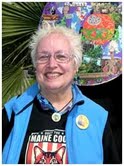
Barbara Ardinger, Ph.D. (www.barbaraardinger.com), is a published author and freelance editor. Her newest book is Secret Lives, a novel about grandmothers who do magic. Her earlier nonfiction books include the daybook Pagan Every Day, Finding New Goddesses (a pun-filled parody of goddess encyclopedias), and Goddess Meditations. When she can get away from the computer, she goes to the theater as often as possible—she loves musical theater and movies in which people sing and dance. She is also an active CERT (Community Emergency Rescue Team) volunteer and a member (and occasional secretary pro-tem) of a neighborhood organization that focuses on code enforcement and safety for citizens. She has been an AIDS emotional support volunteer and a literacy volunteer. She is an active member of the Neopagan community and is well known for the rituals she creates and leads.
Mantras are not just the prescribed sound formulas or sentences found in Eastern religions, but they can also be thought of as the words or phrases that we continually repeat to ourselves. The word mantra comes from Sanskrit and its roots are manas-, meaning “mind,” and -tras, which can be translated as “tool.” Thus, mantra is a tool to protect the mind.
How often do we engage in negative self-talk like “It’s my fault” or “I’m to blame for what’s happened to me” or “No one loves me”? These expressions can become mantras, as we believe their messages from constant repetition. In hospice and hospital settings, one often finds patients who have convinced themselves that “This is God’s punishment” or “Everyone has forgotten me” or “I’m so scared.” These phrases, rather than protect the mind, become what is believed by the mind and may lead to increased anxiety, stress, and depression, and consequently the need for spiritual and emotional support.
Chaplains, as members of the care team in hospice and hospitals, provide spiritual and emotional support to patients and their families. Most often, chaplains attentively listen to patients and their caregivers (often family members) about the patients’ life story, their relationships, their dreams unfulfilled, and their wishes for those whom they are leaving behind. Chaplains take part in family meetings where decisions are made about patients’ care, sometimes interjecting to ask for clarification of medical terms and to ensure that the family understands. Sometimes, the chaplain will lead prayer with the patients and their families, and at other times, the chaplain will pull other tools from her toolbox such as mantra meditation.
Sitting in front of the computer, I slowly and intentionally insert earbuds, click to start my favorite writing playlist, and open up Microsoft Word. I feel the tips of my fingers resting lightly on the keys, and notice the slight give of each printed square, glossy in the middle from months of 80 words per minute. I lightly tap my fingers on the keys, not pressing enough to type a letter, body motionless except my fingers, watching the absolute stillness of the screen, exploring the edge between pressure and performance with slow, shallow breaths, finally noticing the moment when the edge is breached, the key catches, and a letter appears on my screen, taking it in with satisfaction.
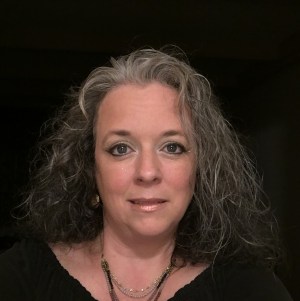
This is how all my writing starts, with a ritual of simple pleasure and partial attempt at channeling. My partner recognizes this move when he sees it. It’s one I repeat throughout the writing process, as I’m waiting (hoping) for the next words to come to me. I’ll stop, lift my head and close my eyes, and allow my fingers to wiggle lightly over the keyboard as if inviting the unseen to move through me and write my piece. If that still doesn’t produce words, I might run my hands from thigh to knee, fingers pressing with increasing depth into denim-covered flesh. Or I might bring my hands up to my face, fingers resting on my hairline, palms lightly covering my eyes, as I experience the instant soothing of darkness and warming effect over closed eyelids, connecting to the me-within so she can help me bring forth missing concepts.Continue reading “Pleasure, Touch, and Spirituality by Chris Ash”


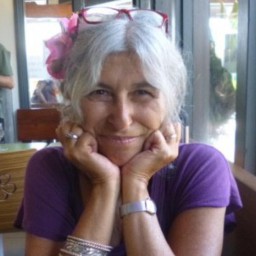 This year, I celebrated the Jewish feast of Passover on March 31st–almost three weeks before the holiday’s official start on the evening of April 19th, the 15th of Nissan. It turned out to be my best Passover yet.
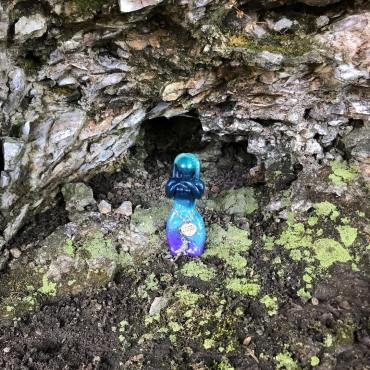 “Please prepare me
 I often say I am a theologian who is uncomfortable with prayer and does not have a relationship with God. What I mean is that I am still trying to figure out how I understand the divine; conventional prayers feel exclusionary and that is not something I want to participate in. Instead, I believe there is so much more to these concepts than traditional theology offers.
 Happy Valentine’s Day! I know, I know… so many of us do not like this holiday. It’s too commercialized, we say. We don’t need card-makers or florists to tell us how or when to show affection. Some of us don’t like Valentine’s Day because it reminds us of loves we have lost or never found. I get it. This day can seem shallow, overhyped, and falsely sentimental. It can be lonely. And yet, I won’t let today pass without celebrating and honoring love. Love is too important to concede to commercial interests.
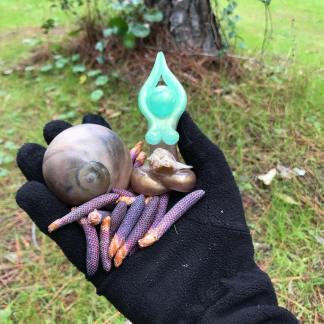 to be remembered
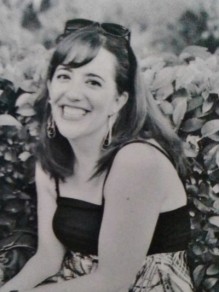 In November, my paternal grandmother passed. She was five days away from her 93rd birthday. As I was/am going through the grieving process, I started to actively recall all the studies I have done regarding death and grieving practices across the globe and throughout the centuries. Mixed with the grieving process was constructing a January term class called “Goddesses Around the World.” As I marked each culture, religion, and goddesses we would be studying I kept coming back to an interesting fact. In many ancient cultures, it was the divine feminine who oversaw death, not only at times as the bringer of death but more importantly, as the guardian of the dead, the protector of all those that have gone from the earthly realm.
  We’re nearly a week into the new year. I almost wish I were a prophet and could predict with assurance that 2019 will be better than 2018—less filled with hate, name-calling, lies, and all-round trumpery (pun intended: “trumpery” is “worthless nonsense”).


 Sitting in front of the computer, I slowly and intentionally insert earbuds, click to start my favorite writing playlist, and open up Microsoft Word. I feel the tips of my fingers resting lightly on the keys, and notice the slight give of each printed square, glossy in the middle from months of 80 words per minute. I lightly tap my fingers on the keys, not pressing enough to type a letter, body motionless except my fingers, watching the absolute stillness of the screen, exploring the edge between pressure and performance with slow, shallow breaths, finally noticing the moment when the edge is breached, the key catches, and a letter appears on my screen, taking it in with satisfaction.
