IN THE NEWS: Wives – Silent, Hidden, and Unnamed

“Jesus said to them, ‘My wife…'”

It is now public news that there is a fragment of ancient text in which Jesus makes reference to a wife. Based on testing of the papyrus fragment the text is calculated to have been from 150 years after Jesus died, a time when Jesus followers are still discerning how they should live and what practices they will keep. Though scholars all agree that this does not prove Jesus actually had a wife, it does reflect the liveliness of the debate nonetheless: Karen King explains, “This fragment suggests that some early Christians had a tradition that Jesus was married…There was, we already know, a controversy in the second century over whether Jesus was married, caught up with a debate about whether Christians should marry and have sex.”

The fragment also makes reference to a female disciple. Continue reading “IN THE NEWS: Wives – Silent, Hidden, and Unnamed”
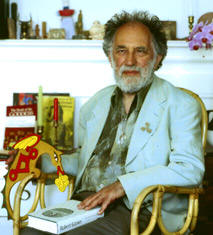
THE INTERPRETER; or An Introduction to Hermeneutics by Daniel Cohen

 He showed us that every text contains two messages, one formed by the ink and the other by the spaces left between the inked letters, the material included and that which was excluded, and that the message was never complete if only the first text was read.

(Hermeneutics: The art or science of interpretation, especially of scripture. Oxford English Dictionary)

It was all the interpreter’s fault.

He came to our city looking for employment. It was soon clear that he had a wide knowledge of many languages, and most of our merchants began to employ him in their dealings with foreign traders. We saw him speeding from one to another, in those sandals of his with the odd widening at the heels, often pausing to tell one merchant of a recent purchase of interest by another. It seemed that trade prospered with his coming. Our merchants became wealthier and busier than they had ever been. Continue reading “THE INTERPRETER; or An Introduction to Hermeneutics by Daniel Cohen”

Working to Bring about the End by Elise M. Edwards

I was reminded that the idea of eschatological reversal can be a powerful image in the promotion of justice if we believe that we already are, or that we should be moving towards the ultimate end that remedies current injustices.

I started teaching a course in Introduction to Christian Ethics a couple weeks ago for a class of graduate students who are pursuing their M.Div. and other Masters in religion degrees.  We are spending some time talking about the use of Scripture in ethics, so I reviewed Richard Hays’ 1996 text The Moral Vision of the New Testament: A Contemporary Introduction to New Testament Ethics.  It got me thinking a lot about the role of eschatology in ethics. (Eschatology is the area of theology concerned with “last things,” like the end of the world, heaven, hell, death and eternal judgment.)

Continue reading “Working to Bring about the End by Elise M. Edwards”

8 Simple Rules for Being a Queer Godfather by John Erickson

Becoming a Godfather was more than just a reentry into the Catholic traditions I had long given up but rather a journey back in time that would grant me the ability to rewrite the wrongs I felt as a kid growing up in a tradition I not only didn’t understand but also didn’t feel like I belonged in.

I often wondered why I wasn’t asked to be the Godfather of my niece and nephew.  It made perfect sense to me that I would be the best person to guide and provide spiritual care for either of them as I was the only member, in both my family and my brother-in-law’s, getting a PhD in Religion.  I didn’t think there would be much to it.  I would go, hold my nephew, and watch a priest pour water over his head, and then go and enjoy some very sugary cake in my sister’s backyard.

On August 18th, 2012 my wish came true and I became the Godfather to my sister’s second child, Drew.   I had always believed that there was nothing to being a Godfather.  That it was a title in name only and a tradition that many individuals bestowed upon members of their family as ritualistic habit rather than a sacred institution of spiritual care and upbringing.  Boy, was I wrong. Continue reading “8 Simple Rules for Being a Queer Godfather by John Erickson”

How literal is too literal? My Experience with Tallit Katan. By Ivy Helman

I tried a new spiritual practice yesterday.  I wore a tallit katan.  It is commonly worn by Orthodox, Hasidic and other Ultra Orthodox men and boys from the age of 3 onward and usually not worn by women within these communities.  Occasionally, one can see Jews (mostly men) from Conservative shuls wearing these garments and rarely from Reform congregations.  They seem to be a marker of a more observant Jewish practice that reads much of the Torah literally.  One is commanded to wear fringes (tzitziyot) when wearing four-cornered garments as reminders of the covenant between G-d and the Jews and more specifically of the 613 commandments.

There are a number of reasons women and men from Orthodox and ultra Orthodox communities give for discouraging women from the wearing of tallit katan and tallit gadol.  First, women are said to be exempt from time-bound mitzvot, or commandments .  Wearing tzitziyot are considered time-bound because the Torah says one should be able to see them which has been interpreted to mean that they be worn during the day.  The reason given that women are not held to time-sensitive mitzvot has to do primarily with their childcare responsibilities.  Children and fulfilling their needs often requires much time and may not allow one to complete a task within a given time frame.  A related ideology says that women are often generally thought to be more spiritually attuned, and therefore do not need such physical reminders to follow the mitzvot. Continue reading “How literal is too literal? My Experience with Tallit Katan. By Ivy Helman”

Silencing Miriam: Prophetess, Liberator, and Leader By Michele Stopera Freyhauf

The prophetess Miriam, Aaron’s sister, took a tambourine in her hand, while all the women went out after her with tambourines, dancing; and she led them in the refrain: Sing to the LORD, for he is gloriously triumphant; horse and chariot he has cast into the sea.”(NAB, Exodus 15:20-21)

The Song of Miriam is not a story of death and destruction, but rather liberation.  It is a poetic celebration of God’s liberation of the Israelites from the oppressive Egyptians, which, according to Bernhard W. Anderson in “The Song of Miriam Poetically and Theologically Considered,” marks the beginning of the Israelite tradition (292).  Phyllis Trible in “Bringing Miriam out of the Shadows” states that this act marks the end of the Exodus, which was started by Miriam, not Moses (169, 172).  The act of liberation reveals God’s action in humanity.  Gerald Janzen in Exodus believes this act also moved the Israelites “to fear the LORD and believe in the LORD and in his servant Moses” (109).  The uniqueness of this passage is that the most unlikely person leads – this person is not a man but rather a woman.

This brief passage in the Hebrew Scriptures is revelatory – Miriam is revealed for the first time.  She is a prophetess, Aaron’s sister, and the role of leader of the victory dance to honor the Divine Warrior.

Continue reading “Silencing Miriam: Prophetess, Liberator, and Leader By Michele Stopera Freyhauf”

Back to Beginnings by Elise M. Edwards

I wasn’t reading it to find out about the origins of the earth in the way the big bang theory explains it.  I was reading it to find out what an ancient people thought about the connection between God, the heavens and the earth, and all the creatures and creations in between.

For years, I’ve been fascinated by creation myths.  Yet as a feminist, I was taught to be suspicious of the biblical creation myths in Genesis.  The creation of man from dust and the subsequent creation of woman from his rib have often been interpreted to support claims about women’s inferiority to men.  And obviously, the accounts of Eve and the serpent and her role in “tempting” Adam have been used to justify claims of women’s susceptibility to evil and their wanton natures which lead men astray.

So it was a bit of relief when in my first weeks of study in seminary, my Hebrew Bible professor pointed out that there are two creation myths in the opening chapters of Genesis.   I was relieved because Chapter 1 and the first few verses of chapter 2 told a creation story I enjoyed reading.  Continue reading “Back to Beginnings by Elise M. Edwards”

Get Your Laws off my Body! by Elise Edwards

After considering Virginia’s Transvaginal Utrasound Bill in light of the womanist critique, I wonder if religiously-motivated lawmakers considered that they alone do not have access to God’s intentions, but that the divine spirit is operative in a pregnant woman as well, would they be so willing to negate her moral agency?

On Tuesday, the senate in Virginia approved a law that would require women to get an external ultrasound before an abortion.  This is a scaled-back version of an original bill that mandated transvaginal ultrasounds prior to abortions. According to this Washington Post article, opponents like Sen. Janet D. Howell describe the measure as “state rape,” since it is the state, not the woman and her doctor who decides that she must undergo this procedure  requiring the insertion of a probe into the vagina.  Although proponents of the bill say that it is designed to give women more information about a fetus’ gestational age and development, most would agree that it is ultimately intended to discourage the women from having an abortion.  This is why bloggers like Kendra Hamilton believe that religion is the moti­va­tion behind this and the other 5 abortion-related bills introduced in the Virginia General Assembly connected to issues of women’s sovereignty over their bodies.  Yet, as I heard about these bills, another religious response came to mind – one that expresses horror and condemnation of coercive practices regarding women’s childbearing. Continue reading “Get Your Laws off my Body! by Elise Edwards”

Practice What You Preach by Corinna Guerrero

The underlying principle that links a feminist critique to every other critical lens since the rise of feminist discourse is the “hermeneutic of suspicion.” Essentially,  a hermeneutic of suspicion identifies the disconnect between rhetoric and a lived reality. The lived lives of women are different than the pontifications espoused directly and indirectly by the traditionally patriarchal social, political, cultural, religious, and educational structures in which individuals participate.

I like to think that I live my life bucking these structures whenever possible because the roles a woman plays in her own life should: 1) be determined by her; and 2) if she negotiates more “traditional practices” (e.g. marriage, motherhood, etc.) then these practices do not limit her to traditionalist practices (e.g. staying at home, spousal servitude, etc.). Granted, I used the two most generic examples of traditional and traditionalist practices, but the point is still valid. When I go to holidays with my extended family there are very few questions or comments about my PhD program, but many comments about the fact that I do not make a plate of food  for my husband.   Continue reading “Practice What You Preach by Corinna Guerrero”

Well-Behaved Women Seldom Make History, But Obedient Ones are Rewarded in Heaven: An Examination of the Re-Invention of the Bengali Tradition of Sati By Michele Stopera Freyhauf

Well-Behaved Women Seldom Make History is a book authored by Laurel Thatcher Ulrich.  This has become a well-known phrase used by most feminists to imply a meaning of disobedience or stance against the patriarchal structure of society.  Often in error, the credit of the invention of this phrase is attributed Eleanor Roosevelt and Marilyn Monroe.  Their image, and especially the image of Monroe, will often appear with the slogan on merchandise as a means of marketing and raising revenue.  Ironically, reinvention or reuse is prevalent in history when it comes to tradition or ritual for the same reason – monetary gain.  This practice is common and the benefit of reinventing or reinterpreting an old tradition is an automatic connection to the past giving continuity, which, according to Eric Hobsbaum, instills strong “binding social practice,” (p. 10) including loyalty and duty in the members of the group.  This is especially effective in manipulating the poor and uneducated who usually display strict obedience and blind acceptance of tradition. The Bengali reinvented tradition of satî is an example of this. Continue reading “Well-Behaved Women Seldom Make History, But Obedient Ones are Rewarded in Heaven: An Examination of the Re-Invention of the Bengali Tradition of Sati By Michele Stopera Freyhauf”