
Moving Toward an End: The Role of the Faith Community in the Struggle to End Domestic Violence by Katie M. Deaver

I have used my last few posts here on Feminism and Religion to begin unpacking the three primary understandings of atonement theology, the feminist critiques of these understandings, and how the relationship between power and violence influences how Christian women view the atonement.  This post will consider the role that faith communities are called to play in situations of domestic violence.

Personal faith often has a huge impact on the lives of survivors of violence.  This impact, unfortunately, as can be seen in the other posts as well as in the comments on those posts, is not always a positive one.  In her book, Redeeming Memories: A Theology of Healing and Transformation, Flora A. Keshgegian envisions communities of faith as communities of remembrance.  A community of remembrance does not ignore or suppress the negative experiences of its members but strives to  enable us to embrace personal identity, form our faith, and to nurture hope in order to heal and transform after such experiences.

One question that my dissertation set out to answer was how we might begin the difficult work of moving our communities of faith in this direction.  Sadly, the biggest difficulty seems to be the lack of awareness, or the downright denial, that domestic violence is an issue for the average faith community.  So many congregation members assume that if their pastor is not talking about an issue then it must not be a problem in their particular community.

Continue reading “Moving Toward an End: The Role of the Faith Community in the Struggle to End Domestic Violence by Katie M. Deaver”

A Middle: Understanding the Relationship between Violence and Power by Katie M. Deaver

In my last post here on Feminism and Religion I unpacked the three primary understandings of atonement theology as well as some of the feminist critiques of those understandings.  In this post I’d like to focus a bit more on how the relationship between power and violence influences how Christian women view the atonement.

In her book, On Violence, Hannah Arendt puts forth a new analysis of the relationship between power and violence.  Arendt’s analysis, though primarily focused around concepts of the potential for worldwide destruction and war following major global occurrences such as the Second World War and the struggles for civil and women’s rights within the United States context, supplies an interesting framework with which to consider this relationship as it relates to domestic violence.    Continue reading “A Middle: Understanding the Relationship between Violence and Power by Katie M. Deaver”

A Beginning: Atonement Theology and the Feminist Critique by Katie M. Deaver

Since many of the comments on my last post expressed interest in my dissertation topic I will use my next couple of posts to talk a little bit more about my work and research in that area.  When we talk about theories of the atonement we are trying to describe a narrative structure of what took place within the Christian cross event.  Generally speaking, Christians believe that atonement serves at the reconciliation between God and humanity and that this reconciliation is realized through the person of Jesus Christ.  The three primary theories that try to explain this event are Substitutionary/Satisfaction, Moral Influence, and Christus Victor.

The Substitutionary/Satisfaction theory of atonement suggests that Christ takes on the guilt and punishment that humanity deserves because of our sinfulness and so becomes our substitute, paying the debt we owe for our sins.  Because of humanity’s sinfulness we deserve death, but instead of giving us what we deserve God instead offers God’s son as a sacrifice to pay our debt, to atone for our sinfulness, and to save us from the eternal punishment of death.

The Moral Influence theory of the atonement focuses primarily on the life and ministry of Christ rather than on his suffering and death.  This theory is centered on the belief that God loves God’s creation so much that God would hold back nothing from us, God would even give God’s own Son in order to save us and remain in relationship with us.  As a result this theory encourages Christians to live as Christ lived and focuses on imitating his life and ministry in order to bring about justice in our own world.

Continue reading “A Beginning: Atonement Theology and the Feminist Critique by Katie M. Deaver”

Becoming Myself by Katie M. Deaver

Last weekend was a special one for me.  After many years of study and dedication I graduated with my Ph.D. and am now, officially, Dr. Katie Deaver.  The weekend was filled with celebrations to mark the completion of a milestone that I have spent years working toward.  The amazing outpourings of love, support, and care that I have experienced throughout the last few days is quite humbling.  The happiness and pure joy of my family, friends, professors, mentors, and multiple church communities have left me in awe.  As I reflect on this love and support it helps to heal the wounds and scars that have accumulated throughout the process of earning this degree.

The undertaking of a Ph.D. program is significantly more difficult than anyone tells you.  This difficultly lies not necessarily in the course work or the dedication to constant reading, writing, and learning but rather in the personal growth and vocational affirmation that takes place within the process.  My dissertation explored the primary understandings of the doctrine of atonement and addressed how this doctrine can, and has, been used in ways that perpetuate, and in some cases even encourage, domestic violence.

My own fascination with the topic of atonement and its links to domestic violence was brought about at the suggestion of one of my undergraduate professors at Luther College, Dr. Jim Martin-Schramm.  From the moment that Dr. Martin-Schramm explained the links between theologies of the cross and domestic violence I knew that I had found my new passion.  Writing a dissertation on the topics of domestic violence, theology and women of faith was an extremely personal, and intimate experience for me.  This topic forced me to accept my own lived experience.  To claim myself… out loud… as a survivor of domestic violence. As a result the writing of my dissertation was particularly personal, and painful, as well as extremely life giving.

Continue reading “Becoming Myself by Katie M. Deaver”

The Dangers of Learning Your Lesson by Abigail Smith

Abigail TreeIt’s been almost two years since I lost someone I loved. The relationship was short, tortured, unhealthy (as all my romantic relationships have been, but that’s another story…) However, I fell particularly hard for this one. When we separated, the pain was unthinkable. I was surprised by how deep it ran. I didn’t know until he was gone how much I really cared about him.  I became physically sick, and even now there are days when I only have to bring him to mind to conjure a familiar pressure behind my eyes and in my throat.
Why did he leave? Why did I love him so much? What went wrong?  How can I stop suffering from this? I’ve discovered that satisfactory answers are nonexistent.

All I could find were platitudes. “It’s his loss.” “Now you know his true colors.” “You’ll find someone else eventually.”  And then there are the hollow religious comforts like, “God has someone better.”  Unsurprisingly, these flippancies don’t help much, but they are predictable and forgivable. Continue reading “The Dangers of Learning Your Lesson by Abigail Smith”

The Flesh Made Word: Colm Toibin’s “The Testament of Mary” on stage and in print By Joyce Zonana

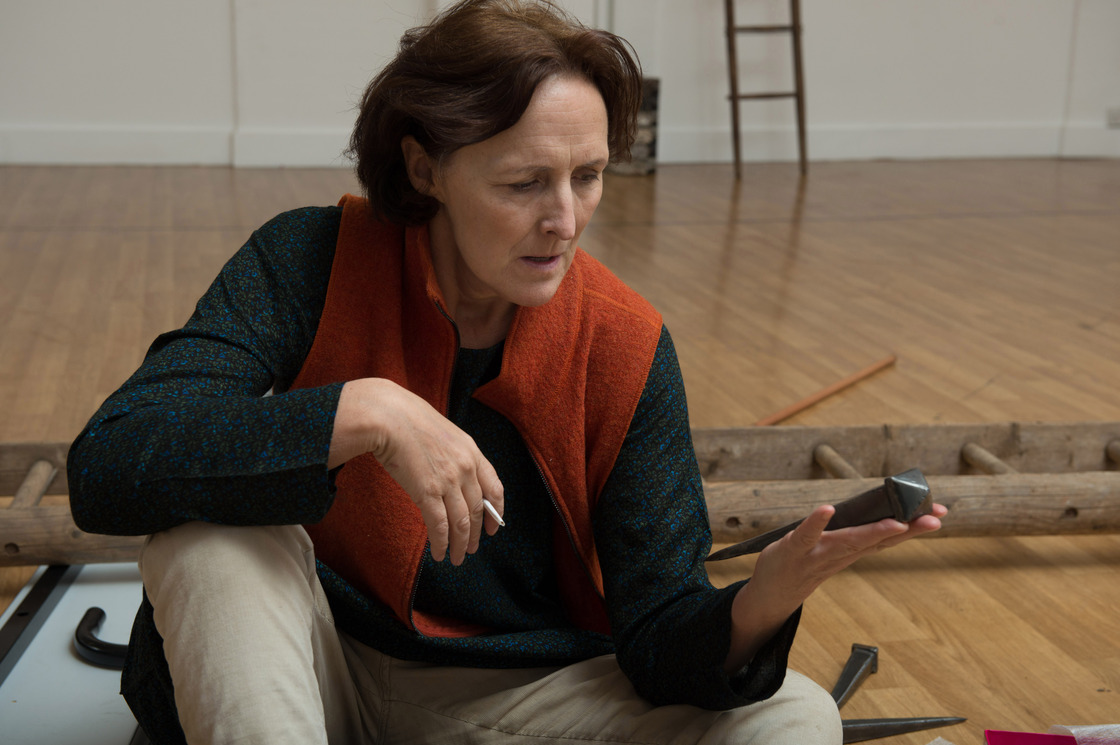
Colm Toibin Fiona Shaw Testament of Mary Ephesus Artemis House of the VirginBefore the play begins, the audience is invited on stage; we walk around, not quite knowing what to do, gazing at the props, uncertain.  A few chairs, scattered jars of honey, jugs of water beside a free-standing waist-high faucet, a tall ladder, a long table, a stripped tree trunk with a wooden wheel at the top suspended from the rafters, a menacing roll of barbed wire, and a live turkey vulture occasionally spreading wide its iridescent blue-black wings: such is the set for Deborah Warner’s searing production of Colm Toibin’s The Testament of Mary, a one-woman show currently in previews at the Walter Kerr Theater in New York.  In a large open-sided box, stage left, the actress Fiona Shaw, draped in blue from head to toe, arranges herself, then sits perfectly still, holding a lily and an apple.  We know this woman.  The Virgin Mary.  The Icon.  Incarnate.

Fiona Shaw rehearses for her role as the Virgin Mary in The Testament of Mary. Irish novelist Colm Toibin's one-woman play opens April 22 at Broadway's Walter Kerr Theater.
Shaw in rehearsal. Photo by Hugo Glendinning

But when we are all back in our seats, Mary casts off her robe to stand before us in a simple black shift, flowing easily over narrow brown pants. Her hair is cropped, her face haunted; wearing short leather boots, she fumbles as she searches for a hand-rolled cigarette to steady herself.   “I remember everything.  Memory fills my body as much as blood and bones.”  No longer an icon, hardly a virgin, this Mary addresses us with the piercing directness of the passion she has suffered: to have seen her only son crucified despite her efforts to save him. Now, interrogated by two unnamed apostles (John and Luke?) who want to fix the story of her son’s life and death and resurrection, Mary insists on reporting only what she knows:  “I was there.  I fled before it was over but if you want witnesses then I am one and I can tell you now, when you say that he redeemed the world, I will say that it was not worth it.  It was not worth it.”

Continue reading “The Flesh Made Word: Colm Toibin’s “The Testament of Mary” on stage and in print By Joyce Zonana”

Reflections on Good Friday by Kathryn House

Tomorrow is Good Friday on the western Christian calendar, the day when western Christians remember Jesus’ death on the cross. The day is often memorialized in ways that recall Jesus’ last moments, from his final steps to his final words, with great specificity. For as many traditions to observe the day, there are theologies to interpret just what, if anything, the cross “means.” In the past few years, I have found myself moving further and further away from identifying this day as one that saves. If I am honest, it has been, and continues to be, an exercise and practice in theological freedom. For me it started with the moment in my first year of theology class when my professor spoke about Anselm and Abelard, of transactions, of debt satisfaction. Something about seeing this formula within its feudal context – of seeing it for the first time as a deeply contextual rather than eternal or primordial or absolute theology – struck a chord and disrupted some sediments I considered unshakeable.

This fissure and subsequent reimagining has continued as over the years I’ve engaged the work of womanist and feminist theologians. There was sister FAR contributor Xochitl Alvizo’s post last year disrupting the spectacle of Good Friday, of re-imaging new rituals that do not dwell on death. There is the work of JoAnne Terrell, the books Proverbs of Ashes and Saving Paradise by feminists Rebecca Parker and Rita Nakashima Brock, and my professor Shelly Rambo’s work on spirit and trauma. I suppose if I am anywhere on the topic, I am just no longer sure that Jesus paid a debt he did not owe because I owe a debt I cannot pay. I am unconvinced that suffering redeems, that blood atones, that the death of a son – of anyone’s daughter or son – brings satisfaction. Certainly feminists and womanists hold diverse beliefs, but here is where I can stand, for now.

Continue reading “Reflections on Good Friday by Kathryn House”

Son of Man: An Updated Gospel Story of Jesus Set in South Africa by Michele Stopera Freyhauf

January 12, 2012

Son of Man is an updated story of the life of Jesus set in the fictional State of Judea that is modern day South Africa – complete with warlords and child soldiers.    It could easily be mistaken for modern day Rwanda or Darfur with its modern issues and political overtonesRoger Ebert stated, “The secret of the movie is that it doesn’t strain to draw parallels with current world events – because it doesn’t have to.”  The director draws parallels between the gospels and 21st century Africa.  According to Dartford-May, “we wanted to look at the Gospels as if they were written by spin doctors and to strip that away and look at the truth.”  The director “captures the rhythms of African life in both rural settings and sprawling townships.”  “Feather-clad young angels offer an eerie echo and reminder of Africa’s lost generations.”

The movie also sticks with what Eric Snider calls “Traditional African trial music, dance, and costumes” as a type of worship or or allusion to Jesus’ godhood.  Judea is in flux; warlords and corruption take center stage.  Poverty, violence, and oppression affect the all of the people.  The key idea is that Jesus is a freedom fighter – one that fights injustice and oppression.  The director does not emphasize “Jesus’ divinity so much as his leadership, good sense and compassion.”  Jesus is not violent and his followers, most of whom were former child soldiers, are encouraged to respond non-violently, which goes against their upbringing and training. Continue reading “Son of Man: An Updated Gospel Story of Jesus Set in South Africa by Michele Stopera Freyhauf”

Loving Harry Potter By Xochitl Alvizo

I went to the movies with a group of friends last Friday to watch the final Harry Potter movie, Harry Potter and the Deathly Hallows Part II. It was a great movie, fun and action-filled, and the energy of opening night only made it better. Afterward we all went out to eat and exchanged notes on our favorite scenes – talking about every little detail. At one point, one of my friends commented on the strong role women have in the Harry Potter movies/books. She said the story is carried by the women – that if it wasn’t for them Harry Potter would not exist. She made specific mention of Harry’s mom as having sacrificed her life for him. Lily dies so Harry can live.

This of course is when my brain comes to a screeching halt.

Women sacrificing their lives for others – I become suspicious and my defenses go up. Sacrifice = suffering. Suffering must not be glorified. Sacrifice must not be sacralized. I see red flags everywhere. Wait, though; haven’t those of us who are Christian-identified heard the opposite affirmed a million times? Jesus suffered and died – was sacrificed – for our sins. Further, Christians’ most sacred ritual, communion, includes reference to Jesus’ broken body and spilt blood. So, isn’t that what people do for love, sacrifice, as Harry’s mom did?

No. I don’t think that’s actually what people (or God) do for love. Continue reading “Loving Harry Potter By Xochitl Alvizo”