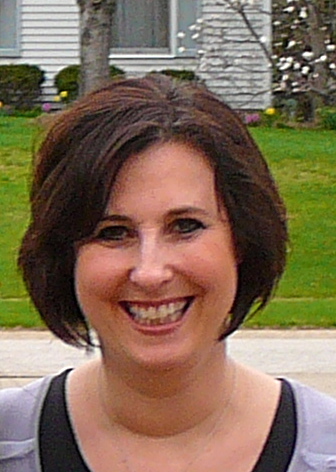
Resurrecting Scars by Shelly Rambo

What does it mean to be created through the scars of a (m)other? And what does it mean to be made new—to be recreated—by them?

It is my first Easter without my mother. My sister Jody reminded me of how much my mother loved religious holidays, especially Easter. One of my striking last moments with my mother was in the hospital operating room when the nurse was preparing her for a surgical procedure. As the nurse opened up the back of the hospital gown, she exclaimed: “What beautiful markings you have.” She was referring to the scars on my mother’s back from a previous heart surgery. “It’s like a work of art.” My mother never viewed them like that. Instead, she often kept her multiple scars hidden from us. But there were moments, as a young girl, when I would glimpse them, those in the front between the buttons of her tightly starched blouses, and those on her back when she’d be ironing her Sunday dress in her satin slip. I was both intrigued and scared by these tracks on my mother’s body, just as I was by the ticking of her mechanical heart valve that I could hear when I stood next to her, the traffic in the house at a standstill. Both were reminders to us that her life was sustained yet fragile.

Much of Western literature tells the stories of fathers and son. And the dominant Christian storyline has also been patrilineal. Continue reading “Resurrecting Scars by Shelly Rambo”

Mary, Mother of God or Godd/ess?

While I have always intuitively seen Mary as more than Theotokos, my training in orthodoxy came to overshadow my orthopraxis of Mary. But today I hold a different stance because  I have come to view my Marian practice as indeed worship of the Divine Godd/ess. 


At a surprisingly early age, perhaps ten or eleven years old, I became the author of my own religious narrative, meaning, I took it upon myself to initiate and pursue the deep mysteries of my Catholic faith. Weekly Mass became an event, not an obligation, and something to which I attended independent of my large, Irish-American Catholic family.  The singleness of my worship at such a young age drew stares and whispers from those families that arrived intact.  And while I was not unaware of their curiosity, I found it easier to lose myself in the absolute wonder of my environment.  This environment of the tangible and non-tangible is what Andrew Greeley has since come to identify as “the Catholic Imagination,” where a Catholic sensibility is manifested in cathedrals and high art, but is also awash in the mundane of our daily lives. Additionally, our family’s dependence on Saint Jude, the patron saint of lost causes, was a close second to a strong devotion to the Blessed Virgin Mary.  By this I mean to suggest that she was our go-to heavenly figure when in need, and I, the appointed family petitioner. Continue reading “Mary, Mother of God or Godd/ess?”

Do Man-Made Laws Trump the Authority of Jesus? Reflecting on the Meaning of Humility, Priestly Service, and the Issue of Women’s Ordination by Michele Stopera Freyhauf

Maundy Thursday – the imitation of Jesus’ act of service and submission is re-created.  Controversy surrounds the “disciples” – must they be all men?  Are women allowed?  Who steps into Jesus’ role?  Men, women, or both?  Why, when it comes to imitating the act of  humility and priestly service (rooted in our baptismal call), does a distinction of gender need to made at all?

As I progressed towards the intersection, I looked up to witness a grand procession of men dressed in white albs with stoles that often contained subtle hints of gold, worn in a manner to distinguish their role as priests and deacons.  They moved slowly down the sidewalk entering the Cathedral to begin their celebration of the Chrism Mass – a celebration of priesthood and priestly service within the Diocese where all priests and deacons gather to celebrate and re-affirm their commitment to ministry and service to the Church.  It is also during this Mass that the oils used in sacramental celebrations, used by each church, are blessed by the Bishop.

As I continued to watch, I could not help but search the processional line for those with a hair color other than gray.  I wanted to see  how many young priests were in that processional line.  What I found was no surprise –  an aging group of men with the sporadic appearance of younger priests.   The numbers stood as a staunch reminder that we, as a Church, may be faced with a severe shortage of priests in the future.  Something already known and planned for by the Diocese in its campaign to consolidate and close parishes.

Another sad observation was put on public display  –  the absolute absence of women. Continue reading “Do Man-Made Laws Trump the Authority of Jesus? Reflecting on the Meaning of Humility, Priestly Service, and the Issue of Women’s Ordination by Michele Stopera Freyhauf”

My Feminist Perspective of Authority – Part 1 by Elise M. Edwards

I make a distinction between power and authority.  Authority is a personal characteristic based on a relationship of trust between me and a text, a person, or their work.  Power, on the other hand, is operative with or without trust.

This past weekend, I had the honor of participating in a workshop on Living Texts: Celebrating Feminist Perspective and Theo/alogy, Authority, and the Sacred in the Academy.  The workshop was organized for the Women’s Caucus of WECSOR, a regional association of national organizations who study religion.  I was delighted to connect with new friends, mentors and sisters interested in feminism and religion, including some of my co-contributors on this site –Theresa Yugar, Sara Frykenberg, and Corinna Guerrero .  There were two panels that shared our reflections about authority from either student perspectives or diverse professional perspectives.  I shared my experiences as a student.  This workshop was a gathering where women scholars in religion could discuss the challenges and promises of our voices in the academy.  Because our dialogue was so inspiring to me, I thought I’d continue the discussion here. Continue reading “My Feminist Perspective of Authority – Part 1 by Elise M. Edwards”

Breaking Up with Bad Stories by Sarah Sentilles

Writing a memoir meant denying stories about myself that are no longer true.

Note: This post is part of  a Religion Roundtable where the authors of three prominent faith memoirs were asked to write about their views on—and experience of—female spirituality. Check http://www.patheos.com to read the discussion between Jana Riess, Lauren Winner, and Sarah Sentilles on the unique religious questions facing women today.

Dear Jana and Lauren,

Jana writes that “Mormon women don’t yet have the luxury of taking their own voices for granted,” and while I recognize that Mormon women are in a different political/theological position than other women, especially in demonimations that ordain women, I would like to expand her statement: No woman—anywhere, in any tradition, or on the outside of any tradition—has the luxury of taking her own voice for granted.

Jana worries that writing with a political agenda in mind could make our work smack of propaganda, and I think she is right, but I want to propose that all language is propaganda. Especially theological language. Our words about God are shot through with intentions and agendas; they convey people’s purposes and hopes and fears; and they have real effects. Continue reading “Breaking Up with Bad Stories by Sarah Sentilles”

ON NOT GETTING WHAT WE WANT AND LEARNING TO BE GRATEFUL FOR WHAT WE HAVE BY CAROL P. CHRIST

Many women’s dreams have not been realized. How do we come to terms with this thealogically?

Although I am as neurotic as the next person, I am also really wonderful—intelligent, emotionally available, beautiful (if I do say so myself), sweet, caring, and bold. I love to dance, swim, and think about the meaning of life. I passionately wanted to find someone with whom to share my life. I did everything I could to make that happen—including years of therapy and even giving up my job and moving half way around the world when I felt I had exhausted the possibilities at home.

For much of my adult life I have asked myself: What is wrong with me? Why can’t I find what everybody else has? Even though I knew that there were a lot of other really great women in my generation in my position and even though I knew that many of my friends were with men I wouldn’t chose to be with, I still asked: What is wrong with me? Continue reading “ON NOT GETTING WHAT WE WANT AND LEARNING TO BE GRATEFUL FOR WHAT WE HAVE BY CAROL P. CHRIST”

On Being in the Moment By Ivy Helman

Time.  We mark years, months, days, hours, minutes and seconds. We mark seasons.  We mark life events.  We live our lives in time: both circular and linear.  Time began before we did and time will continue after we cannot experience it any further.   Some say we repeat time with rebirth.  Others suggest that we only have one lifetime of which we should make the most.  Still others suggest there is existence outside of time with concepts like infinity and eternal life.  We sure do write, discuss and ponder time a lot, but do we ever really experience it?  Meaning: what would it be like to live in the moment, to be aware of and completely conscience within an instance of time, not thinking of the past, not worrying about the future, but being fully present in the here and now?

Sci-fi geek that I am, I often recall the Star Trek: The Next Generation movie entitled Insurrection when Captain Picard and Anij discuss experiencing a moment of time.  Anij explains to Captain Picard, “You stop reviewing what happened yesterday. Stop planning for tomorrow. Let me ask you a question. Have you ever experienced a perfect moment in time?”  A few lines of dialogue later, she picks up the topic again by describing what being present is like. ”We’ve discovered that a single moment in time can be a universe in itself. Full of powerful forces. Most people aren’t aware enough of the now to even notice.”  The visual effects show water stopping and a butterfly’s slow flight if I remember correctly.  Captain Picard is obviously caught up in these moments of time as well as being mesmerized by Anij herself.  The power of both the moments of time and Anij herself is palpable. Continue reading “On Being in the Moment By Ivy Helman”

Peace Begins at Home by Gina Messina-Dysert

I began my career in the field of social services as a woman’s advocate for rape and domestic violence survivors.  The motto for an organization I was employed with early on was “peace begins at home,” a significant point that must be acknowledged. While much attention around women’s involvement in peacebuilding efforts have been focused at the macro level, there has been little consideration of women’s efforts towards peace at the micro level.  Certainly, women’s involvement in formal peacebuilding processes at the larger public level is crucial.  This being said, we must not undermine the leadership roles that women play in their homes, their families, and their religious and immediate communities, and how those roles can have an incredible impact on greater society.

I would like to start off by defining “peace.”  It is a word that we all use quite frequently and often with different meanings.  Some would claim that peace equates the cessation of conflict.  However, within our world conflict is inevitable; daily life is riddled with internal, interpersonal, intergroup, and international conflict. Thus, when defining peace, we must understand it as being able to deal creatively with inevitable conflict.  According to Jean Zaru, “It is the process of working to resolve conflicts in such a way that both sides win, with increased harmony as the outcome of the conflict and its resolution.  Peace is based on respect, cooperation, and well being.  Peace is the presence of social justice” (Occupied with Non-Violence, p. 81-2).

Zaru’s comments here are important in that she acknowledges a clear relationship between peace and justice.  In the words of Pope Paul VI, “if you want peace, work for justice.”  Because peace is not only the absence of war, but also the absence of poverty and disease, the access to clean water, the freedom from slavery; peace is the affirmation of the full humanity of every person. Peace is salaam, peace is shalom, peace is the well being of all.  Thus, there are many elements that come together in the word peace.  It is not simply government initiatives, it is not a patchwork solution to the conflicts of the world, nor is it submission or silent acceptance, rather we must understand peace as justice. Continue reading “Peace Begins at Home by Gina Messina-Dysert”

Preying on Victims: Radical Christianity and Exploitation of Tragedy in the Name of God By Michele Stopera Freyhauf

It is our moral responsibility, whether we identify as Christians or not, to pray for not prey on the victims of tragedies.

Over the last month, dare I say years, society has witnessed or been subjected to an all out war from radical Christians across America deploying the wrath of God and reveling in the tragedy of others to perpetuate their apocalyptic message of rhetoric and terror.   As I hear the news over the last few months, an old Billy Joel song starts to play in my head “We didn’t start the fire.”  Whether we started the fire or not, we should not feed the flames of hatred but figure out a way to extinguish it.

Here is a brief synopsis of current events that reflect this hatred and radicalism perpetuated in the name of God – examples of Christianity terrorizing or preying on victims through their actions.

The Westboro Southern Baptist Church: Preying on Victims at Funerals and Thanking God for their Tragic Deaths

Original Picture found at http://www.newsnet5.com

Their web address says it all: www.godhatesfags.com.  This group, which one cannot call Christian but rather “hate-mongers,” threatened to burn the Qur’an, was banned from Facebook for spreading hatred against homosexuals, and recently had the audacity to picket funerals of Americans killed in natural disasters, most recently, a teen-age shooting victim, Daniel Parmertor (age 16), from Chardon, Ohio.  Thankfully, volunteers across Ohio and a local group of bikers formed a human barricade to keep these people away from the funeral and grieving family and community.

This group preys on tragedy.  They “praise God for sending a shooter to a High School in Ohio.”  They “praise God for killing a coast guard member.’  They praise God for killing UK Singer Davy Jones.”  They also picketed the funerals of the Arizona shooting victims where Congresswomen Gabrielle Giffords was shot and six others, including federal Judge John M. Roll was killed stating, “God sent the shooter to shoot you!  And He’s sitting in Heaven laughing at you!”  The article goes on into quite graphic detail, which you can read for yourself  but concludes with the statement “Thank God for his Righteous Judgments!”  This group picketed over 47,500 funerals and events to date. One has to wonder what bible they are reading and what God they are praying to. Continue reading “Preying on Victims: Radical Christianity and Exploitation of Tragedy in the Name of God By Michele Stopera Freyhauf”

On Cooking and Eating by Ivy Helman

In patriarchal heterosexist societies women do most if not all of the cooking for their families.  Women are also usually assigned the tasks of cleaning, raising children, tending the family garden, gathering water and anything else that is considered part and parcel of caring for the family.  These feminine tasks are often devalued compared to the activities men spend their time doing.  I wholeheartedly support the reevaluation of the significance of these tasks and the movement toward shared responsibility for family life among heterosexual couples, however that is not what I want to discuss today.

I want to explore the religious and spiritual significance of the food cooked by our mothers, grandmothers, aunts, sisters and female friends, especially those dishes we would consider to be comfort food.  Every person, every family has their own idea of what meals are comfort foods.  Bubbe’s matzah ball soup on Shabbat maybe?  Aunt Betsy’s Easter ham?  Mom’s turkey, gravy and oyster stuffing on Thanksgiving?  Your sister’s famous mac and cheese?    Continue reading “On Cooking and Eating by Ivy Helman”