The Czech Tradition of Čarodějnice (Witches).

This post is a follow-up, in a way, to the post I published here on September 11, 2016, entitled “Continuing Pre-Christian Traditions in the Czech Republic,” and will be a combination photo essay* and elaboration on one of the rituals mentioned in that first post.  On April 30th, I was in the small village where my partner’s family has their summer house.  Yes, that same village that has inspired posts like this.  There, we celebrated Čarodějnice, or Witches. This holiday seems to be related to what is called May Day or Beltane in other countries. What is unique about this tradition isn’t necessarily the májka (May Pole) although it is different than other places May Pole, but the burning of the witch.

Throughout the day, everything is gendered.  The women and girls have certain tasks; the men and boys have too.  The women and girls create and decorate.  First, they create a witch to be burned on a large bonfire; the construction and shape of both can vary.  After creating the witch, the women and girls (although it should be virgins – but no one really follows that tradition) decorate the top of a cut-down, very tall pine tree with strips of brightly colored fabric and crepe paper, tying them on to create what will become vertical streamers blowing in the wind, thus creating what is called a májka.  

Continue reading “The Czech Tradition of Čarodějnice (Witches).”

The Vows We Make, by Molly Remer

I make a vow of self-sovereignty,
a declaration of wholeness,
a promise to myself that I will keep:
I vow to listen to my heart,
to claim my power and my voice.
I vow to live my own magic,
to step into the center of my own life
and live from there.
I vow to live a life
that includes space for me,
to stand up for what I need,
to listen to my longings,
to honor my inner call,
to do my own work with trust.
I vow to never abandon myself.
I vow to inhabit my own wholeness
in all ways.

In February, I signed up for a Vow of Faithfulness class with WomanSpirit Reclamation. Guided by Patricia Lynn Reilly (of “Imagine a Woman” and A God Who Looks Like Me fame) and Monette Chilson, the class was based on Patricia’s book, I Promise Myself: making a commitment to yourself and your dreams. Structured as a seven week online women’s circle, the class took us on a deep dive into vow-making, culminating in a vow ceremony in which we made a public (to the class that is) declaration of our own vows to ourselves. As the class unfolded, I found myself reviewing past vows as well as sensing new vows bumping up against my consciousness, whispering to be heard.

Continue reading “The Vows We Make, by Molly Remer”

Vayak’hel-Pekudei: On the Contributions and Gifts of Women by Ivy Helman.

This week’s Torah portion is a double one, Vayak’hel-Pekudei (Exodus 35:1 – 40:38 and Exodus 12:1-20).   Vayak’hel covers the construction of the Mishkan, or the temple that traveled with the Israelites while in the desert, and Pekudel outlines the requirements for Pesach, particularly the sacrificial lamb, the blood on the doorposts, and the requirement to eat unleavened bread. For this post I will focus on Vayak’hel as it is the only portion that makes direct mention of women.  It reminds us of the ways in which religion and religious institutions would not be possible without the contributions of women.

 Vayak’hel centers on the construction of the Mishkan beginning with the general assumption that everyone (here men and women) will donate the items needed to construct the Mishkan.  The text also contains verses in which women are specifically mentioned.  They donate their gold jewelry (35:22) and mirrors (38:8) as well as  spin wool and linen into yarn to be used for the Mishkan’s copious amounts of curtains  (35:25-26).  

Continue reading “Vayak’hel-Pekudei: On the Contributions and Gifts of Women by Ivy Helman.”

From the Archives: Storytelling as a Spiritual Practice by Nurete Brenner

This was originally posted on April 10, 2019

“The master’s tools will never dismantle the master’s house.” Audre Lorde

Question: What tools do we have that are powerful enough to dismantle the Master’s house?

Answer: Storytelling.

Storytelling does not belong to the “master.” Storytelling is subversive because it belongs to the collective and not to the individual; it gives agency to the powerless; it is not dependent on time or money, and it makes visible those who are overlooked and ignored in our globalized industrialized system.

We are not seeking to overthrow the patriarchy or “master,” and replace him with a queen. We are seeking something which Riane Eisler (2002) would call a partnership society or a society in which polarities are well balanced, in which the masculine and feminine values which we all hold are given equal weight.  We have become so indoctrinated in the patriarchal master’s way of thinking that we think we need some show of force, some violence, some upheaval to create the more beautiful world. But – truthfully – it won’t look like that. It might actually look like a group of women and men gathering together in a circle, in community, to tell stories. Storytelling is subversive because it belongs to the community; it is a medicine to transmute the toxins of industrialized society; it is a spiritual practice. Storytelling is the antidote to empire.

Continue reading “From the Archives: Storytelling as a Spiritual Practice by Nurete Brenner”

Building Community:  Starting a Local Sacred Circle K & Letting It Go by Caryn MacGrandle

In January of this year, I put out the call for a Sacred Circle at a local Healing Arts Center. Over 150 people responded interested from a Facebook invite. Thirteen showed up.

From strangers, we have become friends and a community.

One was on the verge of checking herself in to a rehab. 

She celebrated six months sobriety the other month in Circle.

We’ve had our share of potential drama. Egos and self-esteem issues and the potential pitfalls of being human. But we’ve made it through. Returning again and again to love to hope to dreams.

We’ve watched each other change and grow and open up.

Continue reading “Building Community:  Starting a Local Sacred Circle K & Letting It Go by Caryn MacGrandle”

From Footbinding to Abortion and Beyond – This Has to Stop! by Janet Maika’i Rudolph

Children’s Museum of Indianapolis

My husband, Marty, is a retired podiatrist.  He worked in pockets of New York City that were poor and largely immigrant. When he first started his practice, he treated women from China whose feet had been bound. Despite being officially outlawed 1912, footbinding was still being practiced well into modern times. He saw these patients in the 1970s and 80s.

For those who don’t know what it is, young girls, as young as 3-5 would have the bones in their feet broken and then the feet bound with cloth strips. Every few years, the feet would be broken again until the desired result was created. To create that affect, the toes would be flattened against the bottom of the foot and arch would be so broken and damaged that the heel would curl back to the front of the foot. At each of the breakings the girl would need to learn to walk again.  One can only imagine that pain of walking on foot bones that had been repeatedly broken. And here is an especially chilling part. The mothers would do it to their own daughters. I won’t go into further gruesome details because they can be easily looked up on the internet.  It left the girls crippled for life.

Continue reading “From Footbinding to Abortion and Beyond – This Has to Stop! by Janet Maika’i Rudolph”

An ode to the old me: An ode to Roe v. Wade by Chasity Jones, M. Div 

Greetings Feminism and Religion family! It has been soooo long and I have missed you so much!!

I have been working on a few projects that were rudely interrupted by a heartbreaking divorce, decisions of survival, and the subsequent recovery that followed this period. I have spent the past at least 6 months healing from the shame, guilt, pain, and blame that was placed in my lap for the collapse of the marriage. Needless to say, that shit is heavy and it kept me in an endless and perpetual night- not the beautiful mysterious, infinite, expansive darkness that I have come to know but the night that I was afraid of when I was young. No one could save me from the ways that I tormented myself or questioned my womanhood, motherhood in particular. Even more, no one could save me from being an emotional punching bag from my ex-spouse, who also torments himself.

That being said, I am on the mend and am settled in my own apartment furnished with peace, wholeness, and healing for myself and my daughter. As an earth sign, stable ground and a comfortable home in which I can be myself means the world to me. I am a spiritual advisor at a recovery center in Massachusetts and therefore have studied the art of recovery in many ways. Recovery from loss and recovery of self are two procedures that I address in my upcoming book, Black Gold: The Road to Black Infinity!!

Continue reading “An ode to the old me: An ode to Roe v. Wade by Chasity Jones, M. Div “

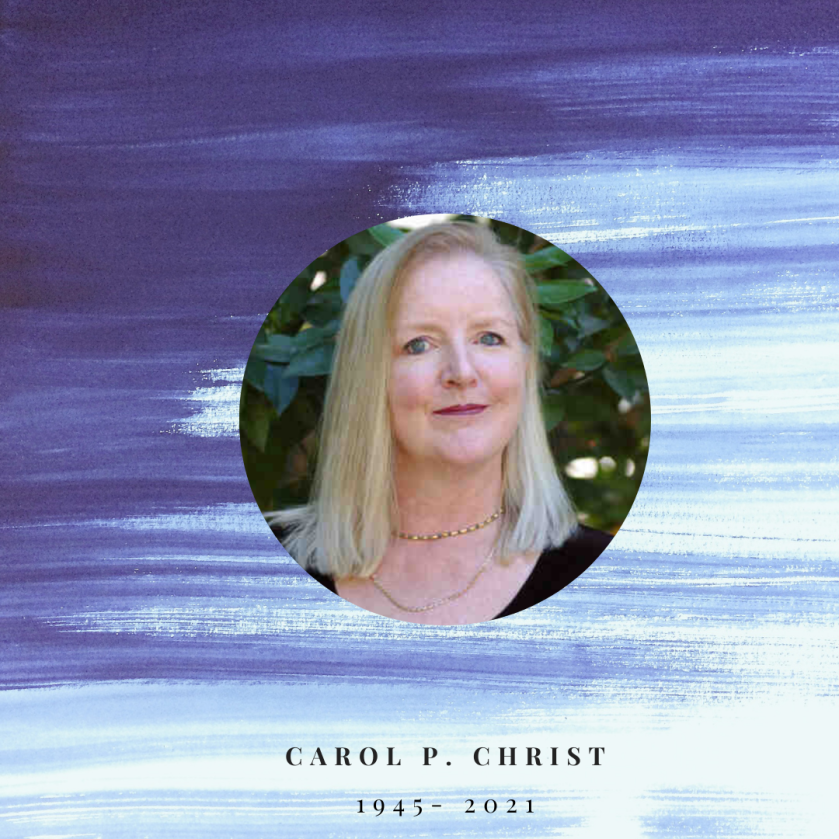
In Memoriam – Carol P. Christ by Joyce Zonana

“thea-logy begins in experience” –  Rebirth of the Goddess

It is hard to believe that Carol P. Christ – Karolina as she dubbed herself in her beloved Greece—has been gone for a year. She remains such a vivid presence in my life—in all of our lives. I think of her and draw strength from those thoughts daily, the way so many women say they think of and feel close to their deceased mothers. For Karolina was indeed a mother to me—a nurturing spiritual mother who initiated me into the ways of the Goddess she adored and, whom she so beautifully defined as “the power of intelligent love that is the ground of all being.”

I first met Karolina in June of 1995 on a bare hotel rooftop in Athens. I had just flown there from New Orleans to join the Ariadne Institute’s Goddess Pilgrimage Tour, a leap of faith inspired by my reading the previous year of Weaving the Visions: Patterns in Feminist Spirituality, a pioneering anthology edited by Carol and her long-time friend and collaborator, Judith Plaskow. That book, along with Carol’s Diving Deep and Surfacing and Judith’s Standing Again at Sinai had spoken to me more deeply than anything I had ever read before. I had grown up in a Middle Eastern Orthodox Jewish family. drawn to spirituality, I had never able to find a place for myself in the deeply patriarchal structures of synagogue or even family rituals … Carol and Judith offered me a way in, and I wanted immediately to embark on the paths they were clearing. I wanted to meet them, to know them,  to learn from them, to share with them. Boldly, I decided to join the Pilgrimage, signing up for my first trip overseas trip, the most costly vacation I had ever granted myself. How could I have known that it would transform my life and bless me with a miraculous, deep friendship?

Continue reading “In Memoriam – Carol P. Christ by Joyce Zonana”

Post-Roe Dirge by Liz Cooledge Jenkins

I have seen a sad thing.

Faces twisted in strange (un)righteous anger outside a clinic

Or sitting around the dinner table laughing

Like the world was not just shaken gravely beneath the feet of half of them

(No, all of them)

(No, all of us)

Or shouts of celebration when a wail of grief is due.

We played the pipe for you and you did not dance.

We sang a dirge, and you did not mourn.[1]

(What is wrong with them?

What has gone so wrong with us?)

Continue reading “Post-Roe Dirge by Liz Cooledge Jenkins”

Carol P. Christ’s Legacy: Does Belief Matter?

Moderator’s Note: Carol Christ died from cancer in July, 2021. Her work continues through her non-profit foundation, the Ariadne Institute for the Study of Myth and Ritual and the Goddess Pilgrimage to Crete. This blog was originally posted December 10, 2012. You can read it long with its original comments here.

In recent days I have been pondering the fact that some people and some feminists seem to see the issues of religious faith and belonging to be rooted in birth, family, and community, while for others the question of belonging to a religious community hinges on belief and judgments about the power exerted by religious institutions.  What accounts for this difference in the way we view religious belonging?

Recently I watched The Secret History of Sex, Choice and Catholics, a film featuring Roman Catholic feminists and ethicists who dissent from the Roman Catholic hierarchy’s views on contraception, abortion, and homosexuality.  At the beginning of the film those interviewed state almost univocally that for them being Catholic stems from having been born Catholic. These Catholic dissidents continue as Catholics, even though they disagree with major portions of Roman Catholic teaching.  It may have been because they were not asked, but most of them did not name reasons of belief for remaining Catholic.

Continue reading “Carol P. Christ’s Legacy: Does Belief Matter?”