Of Cruelty and Compassion: Jane Goodall: Messenger of Hope by Beth Bartlett

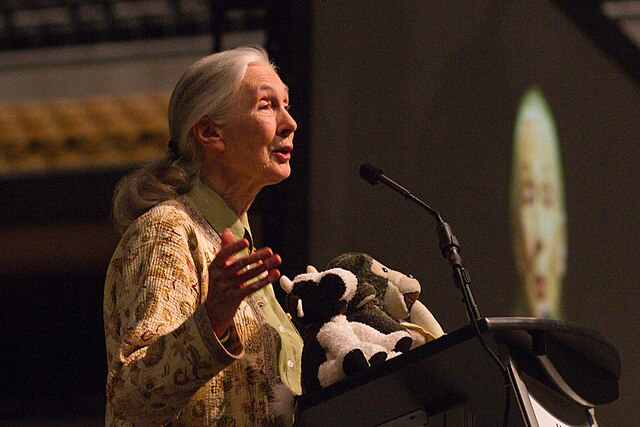
Mark Schierbecker, Wikimedia Commons

During the last week of September I had the opportunity to spend a few days in solitude in a place that is my soul’s home.  I spent part of my time reflecting on questions posed by ecotheologian Mary DeJong to mark the autumnal equinox.  The first question was “What is a desire you carry into the autumn season? What are you seeking?”  After much contemplation, the words that came were, “I wish for a change in government – to be rid of Trump and company – for freedom, equality, respect, for the dignity of all, for an end to the suffering in Gaza and the reign of terror of ICE in this country – the horrors of those being abducted and imprisoned – for an end to cruelty. Yes, for an end to cruelty everywhere.  Why is this country so cruel? I do not understand cruelty. Where does it come from? Why would anyone want to be cruel? How could anyone even stomach the suffering of another?  How does that happen? Yes, I desire an end to cruelty.”

A few days after writing those words, on October 1st, scientist, environmentalist, and humanitarian Jane Goodall passed away in her sleep, prompting me to re-read her book, Reason for Hope. There I found her words echoing my own, “To me, cruelty is the worst of human sins. . . “[i] And while she had not set out to study human cruelty, how we become cruel and how we might move beyond our worst impulses, her work with chimpanzees eventually would lead her to this.

Continue reading “Of Cruelty and Compassion: Jane Goodall: Messenger of Hope by Beth Bartlett”

Diana Beresford-Kroeger: Integrating Celtic Wisdom and Science, part 2 by Theresa Dintino

Part 1 was posted yesterday

Combining ancient wisdom and western science

At age sixteen Beresford-Kroeger was graduated from her mentorship of the Lisheens and went on to become a scientist, learning medical biochemistry and botany. Eventually she saw that many of the things she learned from the Lisheens elders could be scientifically proven. This offered her delight and reassurance.

One of the first of these was the plant Chrondrus crispus or seaweed named Irish moss. Her Great-Aunt Nellie taught her that it cured tuberculosis and how to prepare and use the gel-like mucilage it released upon being boiled.

In the lab Beresford-Kroeger later discovered that this mucilage has antibiotic properties.

“The feeling this confirmation of Nellie’s teaching gave me is hard to describe. I loved my teachers in Lisheens, but I hadn’t completely ruled out the idea that the things I’d been taught there were just old superstitions. I needed to confirm them for myself. There was always the chance that there would turn out to be nothing of import in the plants they’d emphasized to me, and nothing more to the ancient knowledge than beautiful clouds of vapor”(96).

She began to understand that what she had been taught was an oral tradition and that it existed in no other format and that she was meant to be a bridge between “the ancient and the scientific”(97).

“My teachers in the valley might have indicated that a particular plant was good for poor circulation, which I’d taken to mean heart trouble. I would then know to keep a particular eye out for the presence of any chemical known to benefit the heart. “Well, Diana,” they might have begun, while cradling a small, five-pointed yellow flower in the crook of two fingers. “St. John’s Wort, as you see here, has a strong medicine for nervousness and mental problems.” I would later find out that St. John’s Wort contains phytochemicals such as hyperforin, which increase the effectiveness of dopamine and serotonin in the brain. The plant is as effective as many prescription anti-depressants, and may in some cases be more effective”(98).

Continue reading “Diana Beresford-Kroeger: Integrating Celtic Wisdom and Science, part 2 by Theresa Dintino”

The Future of Sorjuanista Studies in the Americas: Challenges and Possibilities by Theresa A. Yugar

I had nearly resolved to leave the matter in silence;
yet although silence explains much by the emphasis of leaving all unexplained, because it is a negative thing, one must name the silence,
so that what it signifies may be understood.
Failing that, silence will say nothing,
for that is its proper function, to say nothing.[i]
La Respuesta/The Answer (al Soldado, or The Soldier)
Sor (Sr.) Juana Inés de la Cruz
(November 12, 1651 – April 18, 1695)

Today, I honor the legacy of mid-17th century Mexican Catholic nun, scholar, and poet Sor Juana Inés de la Cruz. She was born in the central valley of Mexico in the Viceroyalty of New Spain, now in modern-day Mexico. She was the daughter of Doña Isabel Ramírez de Santillana and Don Pedro Manuel de Asbaje. They had three daughters: María, Juana, and Josefa. Doña Isabel also had three other children – Antonia, Inés, and Diego – with Diego Ruiz Lozano. Sor Juana Inés was raised with her siblings on their family’s hacienda of Nepantla which was managed by their strong-willed mother Doña Isabel.

Continue reading “The Future of Sorjuanista Studies in the Americas: Challenges and Possibilities by Theresa A. Yugar”

Legacy of Carol P. Christ: Forty Years and Counting: Women and Religion in the Academy

This post was originally published on Oct. 21st, 2011

Carol P. Christ is a founding mother in the study of women and religion, feminist theology, women’s spirituality, and the Goddess movement.  She teaches in the Women’s Spirituality program at CIIS and through Ariadne Institute offers Goddess Pilgrimages to Crete. Her books include She Who Changes and Rebirth of the Goddess and the widely used anthologies Womanspirit Rising and Weaving the Visions.

The receipt of an invitation to the Fortieth Anniversary Celebration of the Women’s Caucus in the American Academy of Religion and the Society for Biblical Literature this week, takes me back to the summer of 1971.  At the first meeting of Women Theologians at Alverno College (which was followed up at Grailville in succeeding years), I proposed that we form a feminist caucus in the field of religion, as had already been done by feminists in several other fields.

Since I was one of the few women at Alverno who had attended the annual meetings in the field of religion, I was delegated to call Harry Buck, then director of the AAR, to ask for space on the program. Harry, who continued to support the work of women in the field through lecture series at Wilson College and the magazine Anima which he founded, offered not only space at the meetings, but a print-out of the names and addresses of all of the members of the AAR who were not obviously male. I invited all of them to come to a feminist meeting at the AAR in Atlanta. It is hard to imagine now, but before 1971, the women who attended the AAR in any given year could probably have been counted on one hand. Continue reading “Legacy of Carol P. Christ: Forty Years and Counting: Women and Religion in the Academy”

Your Body Knows Before You Do by Andrea Penner

Our interstate move of 325 miles due east on U.S. Highway 40, formerly Route 66, that iconic highway through the American Southwest, took us from one rental home to another. A month later, I sat in a closed graduate seminar, having received a coveted “yellow card.” By some stroke of magic, the professor had read my master’s thesis.

“I know your work,” he said, signing the over-enrollment waiver.

For the next several years, I studied, wrote, taught, ate, slept, and moved through marriage and motherhood (and one more rental)—all toward the goal of completing the PhD in English while my then-husband cycled through professional jobs and both of us recovered from eight years of cross-cultural Christian ministry.

Continue reading “Your Body Knows Before You Do by Andrea Penner”

Advancing Our Feminist and Womanist Theologies by Xochitl Alvizo

I recently completed a chapter for a book on Latinx theologies; it’s the second edition of the Wiley-Blackwell Companion to Latino/a Theology, edited by Orlando O. Espín, but this time with the slightly changed title of Companion to Latinoax Theology—aiming to be more inclusive in its umbrella term. The project has 35 contributors and covers everything from interreligious dialogue and care for creation, to race, racism and latinoax cultures, as well as chapters on such subjects as Christology, the bible, and ecclesiology. My particular chapter was about the intersection of gender, feminisms, and Latinoax theologies—not surprising. But what I loved in the process was a particular emphasis that emerged—decoloniality, like a thread woven throughout the chapter as it evolved; and this I now see as a necessity for Christian theologies. Let me explain.

Continue reading “Advancing Our Feminist and Womanist Theologies by Xochitl Alvizo”

From the Archives:“Vaginas are Everywhere!”: The Power of the Female Reproductive System by John Erickson

Moderator’s note: This marvelous FAR site has been running for 10 years and has had more than 3,600 posts in that time. There are so many treasures that have been posted in this decade that they tend to get lost in the archives. We are beginning this column so that we can all revisit some of these gems. Today’s blogpost was originally posted June 19, 2012. You can visit it to see the original comments here.

I have a beautiful picture of vagina hanging on my wall.  However, for the longest time it was in the back of my closet, with a plastic bag covering it.  I wasn’t ashamed of it but my ex-boyfriend, like most gay men, refused to have it on the wall where he could see it.  He is now long gone; the vagina is now out and proud.

I bid on the picture one fall during a showing of the Vagina Monologues at Claremont School of Theology.  One of my best friends was in the show and I had always loved its powerful message.  I walked out of the theatre, waiting for my friend, and there it was: the picture of the vagina.  I found myself caught up in its beauty.  Its gaze had mesmerized me.  The outlying layers of red, the contours of its shape, they all began to mold into a figure before my eyes.  While I have never thought of myself as a religious person, I realized that at that moment I was no longer looking the old photo but rather I was staring at the outline of the Virgin Mary.  At that moment, I realized that I had to have the picture.

Continue reading “From the Archives:“Vaginas are Everywhere!”: The Power of the Female Reproductive System by John Erickson”

The Practice of Bearing Witness by Stephanie Arel

She looked away and stared out the window, trying to hold back the tears in her eyes. “The tents,” she said and shook her head looking down at the ground. The tears were coming, but softly. I asked her what the tents represent. She shrugged her shoulders and said into the camera phone: “The bodies I guess. They don’t have enough room for the bodies.”
In this time of the coronavirus, as in Italy and Spain, New York City has room neither in the hospitals nor the morgue for the bodies that are dying. Up from 25 a week, to 24 a day, bodies are being buried on Hart Island, or City Cemetery, where the unclaimed and unidentified have been interred for decades. Others are waiting in refrigerated trucks for friends and family members to collect them. This New Yorker along with thousands of others have seen the stark reality, one that left even Trump sick at heart.

We are witnessing a global pandemic. Evidence of the ravages of the coronavirus lies all around us. The response to the virus has made physiological, economic, and psychological impacts on our lives. We have changed our working styles, dealt with lowered income, or lost our jobs. Staying secluded at home, we have taken on new roles for which we were not prepared; many of us have become sick, and some have died. We are together witnessing a major world disaster.

What does it mean to be a witness? What will it mean to carry that witnessing forward to future generations to mark this historic event so that when something like it happens again, future generations will have the tools they need to respond more quickly, adapt more easily, recover more rapidly? For this generation, just as those who researched and learned from the Spanish Flu, we bear witness. Continue reading “The Practice of Bearing Witness by Stephanie Arel”

Mary Daly and Simone de Beauvoir: Sister Diagnosticians by Xochitl Alvizo

Xochitl Alvizo; Photo by http://www.chrispinkham.com/

Mary Daly still causes me awe. I think about the way she was so keenly able to diagnose the Catholic Church’s collusion in creating, sustaining, the oppressive structures that directly impact women (and men, as she always affirmed). Mary Daly knew that the situation of women’s second-class status, outlined at the time most powerfully by Simone de Beauvoir in her book The Second Sex,[1] was in great part made possible by the Catholic Church. The church used Christianity to justify the creation of gender hierarchies (for it can be used otherwise), and regarded a category of humans as having greater value and worth than others by default. So much so that it comes to be understood as “god ordained” or “natural” – the right order of things.

At the time of her early writing, Mary Daly still identified as part of the Catholic Church – but she did not hesitate to call out her church. Building on the work of existentialist philosopher Simone de Beauvoir, Daly made a powerful case against the church. She described the antagonism between the Catholic Church and women as based on the fact that the Church’s teachings perpetuated a “traditional view of woman” that both “pretends to put woman on a pedestal but which in reality prevents her from genuine self-fulfillment and from active, adult-size participation in society.”[2] She drew on insights from de Beauvoir to make her case and wrote her book The Church and the Second Sex with the conviction that there were “harmful distortions of doctrine and practice” in the Catholic Church. Continue reading “Mary Daly and Simone de Beauvoir: Sister Diagnosticians by Xochitl Alvizo”

No Offense by Esther Nelson

What a pleasant surprise to become acquainted with Samar Habib when she appeared on my newsfeed the other day.  According to her biography, she “is a writer, researcher and scholar” as well as “[a] tireless advocate of human rights.” She is also “an expert of international standing on Gender and Sexuality in the Arab world, with unparalleled publications on same-sex love and desire among women and the juncture of Islam and homosexuality.”  The Ted Talk I stumbled upon, titled “Let the Scholar Speak, Even if it Scares You,” explores the modern university’s difficulty navigating that murky space between academic freedom (based on scholarship and inquiry) and giving offense (based on fear of decimating a student’s belief system).

Samar is Palestinian, raised in a secular, but nominally Christian, household.  Initially, her research focused on the study of sex and gender in the Arab world and gradually incorporated the more specific topic of homosexuality in Islam.  At 27 years old, she began teaching her research, showing how the emergence of homophobia in the Arab/Muslim world starkly contrasts with the acceptance of gender and sexual diversity enjoyed in 9th century Baghdad, a vibrant center of scholarship, commerce, and the arts.. Continue reading “No Offense by Esther Nelson”