August 11th saw Democratic Presidential Candidate Joe Biden announce his pick for Vice President. This pick broke open the history books; California US Senator Kamala Harris. Kamala has been steadily rising as a political force for over ten years. Her nomination is groundbreaking on so many levels. So, let us talk about Senator Harris.
I hope you are each doing well – that you are holding up ok during these trying times. It’s Xochitl here. I’m the behind-the-scenes co-weaver keeping things afloat (to varying degrees!) on this collaborative endeavor we call Feminism and Religion.
You may have noticed some gaps in our postings these last couple of months; I want to reassure you that it’s all ok. The gaps are an indication that we are giving one another a lot of pandemic grace. These are tough times and we are all doing what we can to make it through.
FAR will keep publishing as our contributors are able to submit their pieces. We always also welcome new voices and contributions to join in. I will do my best to keep up with the correspondence, but I do appreciate your patience. We are an all-volunteer project and everything we do is done out of our heartfelt commitment. And for all of it, I am grateful.
May we all be well, may we be safe, and may we find our peace.
Rage on, friends!
~ Xochitl
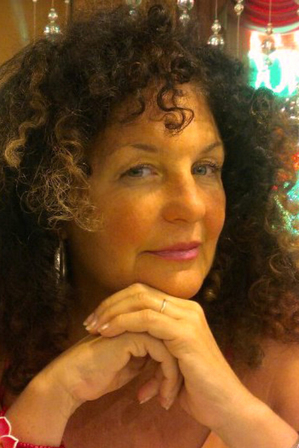
P.S. I’m growing my hair out! I figured quarantine time was a good time to experiment…we’ll see how it goes :)
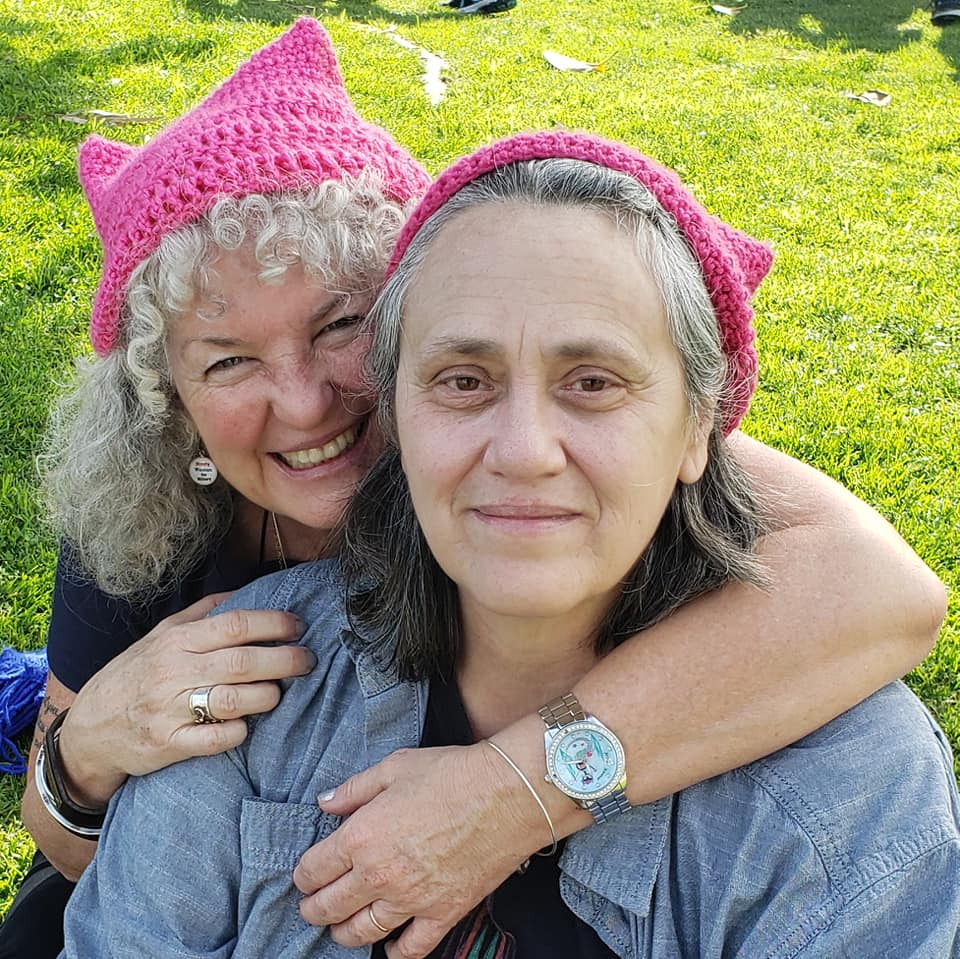
Photo of the author (left) and her wife Kimberly Esslinger
Here we are at the fourth now annual Women’s March. I have done a photo essay of the March every year for Feminism and Religion (FAR), the first two from the Los Angeles March, and the last two from Orange County.
I’m taking a break this month from the series “In These United States” poems I have been delivering to FAR (back with more poems next month) to showcase some of the activism, commitment, humor, and courage that showed up at the March I attended in Santa Ana in Orange County, California, January 18, 2020.
In this part of these United States the marchers chanted, danced, laughed, and were very serious. Santa Ana is a densely populated city where almost 62% of the population is Mexican. This evidenced itself in the March where for the first time I saw ballet folkloric by a company dressed in traditional folkloric costumes, in suffrage colors. Continue reading “2020 Women’s March by Marie Cartier”
We protect ourselves by saying it wasn’t that bad.

It only happened once, twice, when I was little, when I was older, when I was drunk, when I was the only one not drinking, when I was alone, when I was out with friends, when I was in the break room at work, when I was in the military, when I was unemployed, when I asked for a raise, when I was silent, when I…
When you can’t change it, you change yourself. Because it’s better than thinking you can’t change anything. It’s epidemic, people say. So it’s better than thinking it’s epidemic—the abuse of women.
So, you think, if I blame myself, maybe there’s hope.
As a follow up of my June FAR post, I am writing about soccer and the Women’s World Cup. The final aired on Sunday July 7th and saw the USA women beat the Netherlands 2-0. This historical win was the fourth time the USA women have won the World Cup since its inception. It was also the highest watched sporting event of the year.
The Sabarimala Temple has received an influx of global attention since last October. In my last FAR post, I researched the origin story of the Sabarimala Temple and its dedicated deity, Ayyappan. Ayyappan’s unusual parentage and chosen attributes and patronage made him adverse to all forms of sexual activity and more importantly, not very keen in having female devotees.
Ayyappan, also known as Dharmasastha, is devoted to protecting the dharma, living a yogic life, and more importantly, a celibate life. Ayyappan demands that all his followers when undertaking his pilgrimage, take a vow of celibacy for the duration. No form of sexual impurity must enter Ayyappan’s Sabarimala temple. This is where the problematic elements really start to come to head. Due to the restriction of sexual impurities, females from the age of 10-50 are denied access, as their very biological state of being female, makes them sexually impure. Their ability to menstruate makes them vessels of this apparent sexual impurity that the god Ayyappan does not want. Continue reading “The Modern Problematic Nature of the Sabarimala Temple, Part 2 by Anjeanette LeBoeuf”
You’ve probably seen the following meme circulating on social media:
This meme is designed to be evocative. Specifically, it plays into the concept of the sanctity of motherhood that so often oozes into a popular sentimentality about children. In Christian-majority countries, we read and hear the story of the Virgin Mary acquiescing humbly and readily to her pregnancy when the angel of the Lord tells her she is with child, something done to her by the Holy Spirit. “And Mary said, Behold the handmaid of the Lord; be it unto me according to thy word. And the angel departed from her” (Luke 1:38). Mary is often elevated in Christian circles as a role model for women.
Putting aside the question (for now) that asks when life begins, let’s consider this “sad sight” the meme talks about—“women marching for the right to kill their own children.” Abortion aside (for now), there are many examples—both in literature and history—of women having killed their children. I offer the following two:
The Sabarimala Temple in Kerala, India has been recently thrown into the news. It has made world news due to the two centuries long tradition of denying females from the age of 10-50 entrance into the Temple. As of September 2018, the Indian Supreme Court ruled in favor of allowing women entrance into the Temple. Needless to say, this ruling was met by both large numbers of supporters and protestors. But what makes the Sabarimala Temple so controversial?
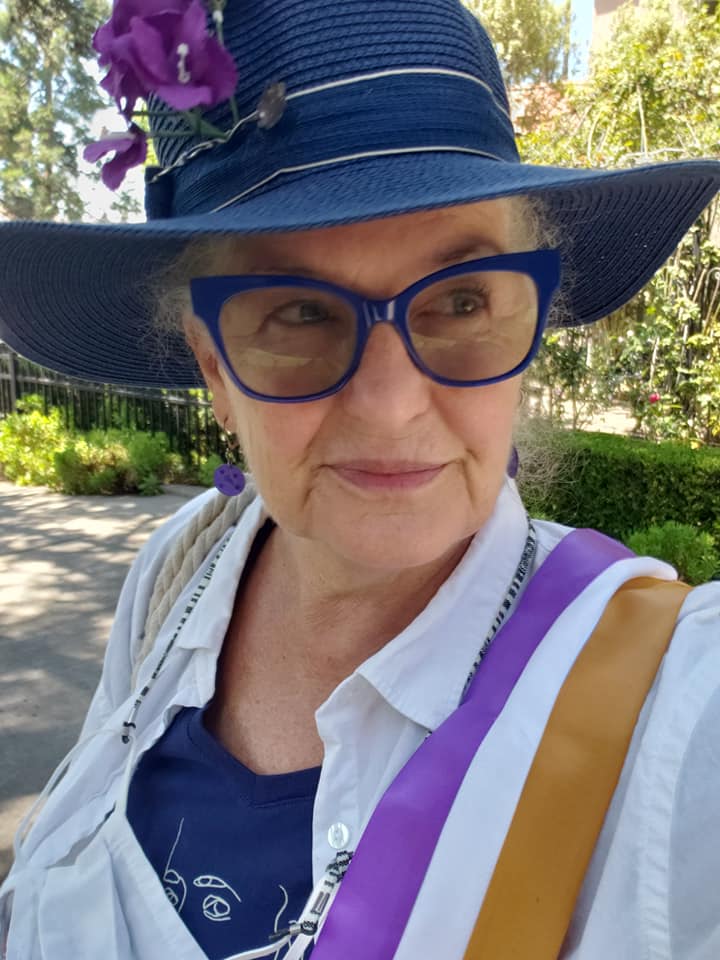
Author (Marie Cartier) pictured on right Photo by: Kimba Wild All other photos by the author.
As I have done in 2017 and 2018, I am showcasing photos of protest and resilience from The Women’s March, which began as a response to the “election” of 2016, and was a show of solidarity of women, especially in response to Trump’s remarks overheard from an Access Hollywood tape that he was entitled to “grab pussy” because he was “a star.” Hence the creation of the iconic “pussy hat” and the many signs which read then and now, “pussy grabs back.” He lost the popular vote by over 3 million, but was still elected. Women grabbed back.
The country erupted with a march that was the largest protest march the US had ever seen, with Los Angles having the largest of those marches. In 2017 organizers had planned for 100,00 and over 750,000 showed up—over three quarters of a million people.
In the previous photo essays you can see what women and others were saying in Los Angles (and mirrored around the globe).
This year, I went to Orange County, CA. Famously in the 2018 midterm election, the Orange Curtain came down—and now Orange County of California is blue! Many protesters celebrated this new blue wave. Since Santa Ana is a city with a huge Latinx population, many protesters held signs illustrating solidarity with immigrants and an embedded protest was staged against deportations. Also showing was what is happening with the “promise” of DACA, the health of Ruth Bader Ginsberg, the upcoming elections, and overall girlhood. These were all some of the rather recent illustrations of protest at this year’s Women’s March.
Rachel Fassler was in so much pain that she couldn’t remain still long enough for the emergency room nurses to take her blood pressure. After hours of being overlooked, dismissed, and misdiagnosed (she was initially treated for kidney stones) by two male doctors, Fassler was finally treated appropriately by a third physician, a woman, and rushed into emergency surgery to have a swollen ovary removed.
The details of Fassler’s horrific experience in the hospital that day was told by her husband Joe Fassler in The Atlantic back in 2015. The piece “How Doctors Take Women’s Pain Less Seriously” opened the floodgates for women to share their stories of having their pain ignored sometimes for years by mostly by male doctors, though not exclusively. Rachel Fassler refers to this as “the trauma of not being seen.”