Author (Marie Cartier) pictured on right Photo by: Kimba Wild All other photos by the author.
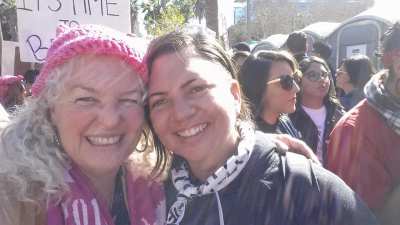
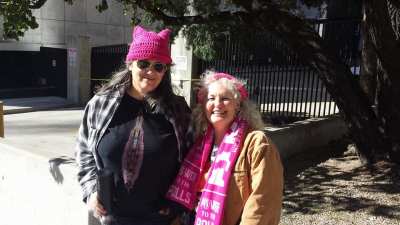
As I have done in 2017 and 2018, I am showcasing photos of protest and resilience from The Women’s March, which began as a response to the “election” of 2016, and was a show of solidarity of women, especially in response to Trump’s remarks overheard from an Access Hollywood tape that he was entitled to “grab pussy” because he was “a star.” Hence the creation of the iconic “pussy hat” and the many signs which read then and now, “pussy grabs back.” He lost the popular vote by over 3 million, but was still elected. Women grabbed back.
The country erupted with a march that was the largest protest march the US had ever seen, with Los Angles having the largest of those marches. In 2017 organizers had planned for 100,00 and over 750,000 showed up—over three quarters of a million people.
In the previous photo essays you can see what women and others were saying in Los Angles (and mirrored around the globe).
This year, I went to Orange County, CA. Famously in the 2018 midterm election, the Orange Curtain came down—and now Orange County of California is blue! Many protesters celebrated this new blue wave. Since Santa Ana is a city with a huge Latinx population, many protesters held signs illustrating solidarity with immigrants and an embedded protest was staged against deportations. Also showing was what is happening with the “promise” of DACA, the health of Ruth Bader Ginsberg, the upcoming elections, and overall girlhood. These were all some of the rather recent illustrations of protest at this year’s Women’s March.
Rachel Fassler was in so much pain that she couldn’t remain still long enough for the emergency room nurses to take her blood pressure. After hours of being overlooked, dismissed, and misdiagnosed (she was initially treated for kidney stones) by two male doctors, Fassler was finally treated appropriately by a third physician, a woman, and rushed into emergency surgery to have a swollen ovary removed.
The details of Fassler’s horrific experience in the hospital that day was told by her husband Joe Fassler in The Atlantic back in 2015. The piece “How Doctors Take Women’s Pain Less Seriously” opened the floodgates for women to share their stories of having their pain ignored sometimes for years by mostly by male doctors, though not exclusively. Rachel Fassler refers to this as “the trauma of not being seen.”
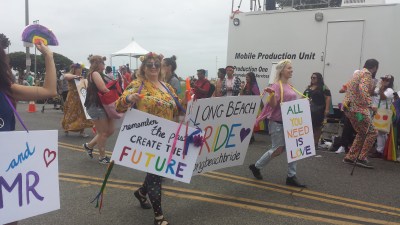
Last year I published a photo essay with pictures of Long Beach, CA’s Pride week-end. You can see last year’s photo essay here. I also published a photo essay of the Los Angeles Resist March from last year here.
It feels more important than ever to re-member/ re-attach ourselves to the normality of resistance, freedom, solidarity, courage and joy. I hope the pictures here help you FAR family to re-member your activist selves and re-invigorate them if they are in need of it. I know mine was before the past week-end. Here are photos from the Long Beach Dyke March on Friday night, and the Long Beach Gay Pride parade on Sunday morning.
A month ago, the Hollywood Chapter of the National Organization for Women (NOW) and the City of West Hollywood presented the Vagina Monologues. The event was a complete success and we raised over $5,000 for Planned Parenthood Los Angeles! While the cast and crew worked together and formed a community in West Hollywood, communities were being ripped apart by senseless gun violence that took the lives of 17 beautiful souls at the Marjory Stoneman Douglas High School in Parkland, Florida
The cast and crew began to have discussions over a specific monologue and whether or not the audience, or cast members, would be triggered by its use of gun specific language in relation to the power of the vagina.
Happy International Women’s Day! I hope it is a happy day for you as we recognize women’s achievements throughout the world. Our FAR community is not only for or about women, but as feminists in some form or another, collectively we support women, their growth, their health, and their contributions to the world. On a day like today, we should take note of what still needs to be done and recommit ourselves to our work. But let’s not rush past an opportunity for joy and celebration. Many generations of women have fought for equal rights and participation in all sectors of society, and we have made progress. To commemorate that legacy today, I am highlighting just a few of the women who inspire me with their lives and with their work. They are my “womenspiration.” My hope is that you join me in recognizing them and that as you read about them, you reflect on the women who inspire you.
Aasiya Zubair Hassan was an architect and business woman of Pakistani origin, resident in the United States, motivated to contribute to the end of cultural stereotypes about Muslims and to a better coexistence in post-9-11 American society. For this reason, together with her husband Muzzamil Hassan, she decided to found Bridges TV in 2004, a satellite channel to connect the life of Muslim communities with American society.
The couple had been married for 9 years and had two children. But the reality between Aasiya and Muzzamil was not exactly that of an ideal marriage, as of those in novels and TV series. Aasiya Zubair lived between her career, community activism, the TV channel and the spiral of domestic violence. On February 12, 2009 her body was found beheaded in New York State, after his own husband informed the police where to find it.
Prosecutors argued that Hassan was abusing his wife and planned to attack her in a Bridges TV hallway. He was arrested in 2009 after he entered a police station in the city of Buffalo, in the state of New York, and told officers that his wife was dead. Muzzamil was found guilty and sentenced on February 7, 2011 to 25 years to life in prison.
In February 2010, and while Hassan was waiting to be sentenced, American Muslim women began the Purple Hijab Day, that since 2011 has become international, commemorated in Canada, England and Libya. It is a day of remembrance and support for victims of domestic violence and femicide, but it is more than that: it is a struggle to eradicate violence against women in Muslim communities and to challenge the patriarchal religious narratives that support it.
The date is commemorated each year between the 12th and the 16th of the month with different activities such as prevention talks, vigils, community education days, and cyberactivism through social networks such as Facebook or Twitter. It is a tradition to wear the hijab or Islamic headscarf in purple, but it is also possible to wear any purple garment.
Prevention of domestic violence is just as important as denouncing misogynistic narratives that enable it, because as Amina Wadud says:“To define religion is to have power in it.” One of the most widespread and disastrous stereotypes that exists about Islam is that which holds that religion legitimizes violence against women and authorizes husbands to punish their wives and dispose of the lives of the women in their households.
While these prejudices are held by voices outside of Islam and part of the narrative of Islamophobia, it is no less true that there are some currents within Islam that encourage men to punish their wives and for many Muslim men these interpretations are believed to be an almost un-appealable form of justification for the abuses they commit against women.
Memory is important when it comes to counting women. Not only because our presence has been historically invisible, but also because language that erases our lives still exists. Every act of violence that has a woman as a target is treated as an isolated event and the victim as anonymous. “A woman was found dead” is the recurring headlines in the news of the world. The reality is that we women do not appear dead, we are murdered. And, although society treats us as serialized and replaceable elements, our unique subjectivity is summed up in our names. Speaking our names is to make visible our struggles, hopes, and pains.
“Aasiya Zubair, a career woman, community’s value and mother was murdered by Muzzamil Hassan” and almost 10 years later there is still outrage and sadness because every day somewhere in the world, another Aaziya adds her name to the list.
The International Purple Hijab Day is an initiative started by Muslim women, but it does not belong only to them. It belongs to all women and everyone who is in the side of women rights. It is a day of activism and memory, an opportunity to find new ways to end gender violence in a context of its acceleration and increase in all parts of the world, because no civilization has the exclusive privilege of misogyny.
Vanessa Rivera de la Fuente is a specialist in training and community outreach in Gender, Communication and Interculturality. She’s also a learning and social projects designer and a qualitative researcher; an awarded activist for women’s rights who too does independent scholarship in Religion, Gender and Social Discourses. Nomadic writer. A woman with stories and geographies, lover of books, cats and spicy Chai.
Like many in the FAR community, I participated in the world-wide 2017 Women’s March. So did Madge, the bodacious cartoon character who took me by surprise in 1990 and went on to become the narrative character of The Maeve Chronicles. Her life in print, as the first century Celtic Magdalen, satisfied her until….November 8th, 2016 when Madge returned, mouthy as ever, to rejoin us in our own times.
On the first anniversary of the historic march, I’d like to share a little of Madge’s millennia-spanning story and a few images from her two books of cartoons, now published in one volume.
Madge first appeared to me in 1990 as a line drawing of an ample woman sitting naked at a kitchen table drinking coffee. I had recently finished writing a novel, The Return of the Goddess, A Divine Comedy, and felt I had nothing more to say. I decided to play with magic markers for a while. Madge, as the naked woman introduced herself, was far from done with words. Fleshed out with peach magic marker, Madge told me she wanted “fiery neon orange” for her hair color. She also required speech balloons for her theological queries. (For example: If we are all members of the body of Christ, who is the twelve-year molar, the kneecap, the colon?) Enchanted with her sass, I invited her to be in my next novel. I pitched ideas to her. She rejected them all as too dull and said, “I want my own book of cartoons first.” Continue reading “Happy Anniversary, Women’s March, with love from Madge by Elizabeth Cunningham”
I watched this short video on facebook about Sisa, an Egyptian woman who spent forty years a man in order provide for her family. There is a longer version on YouTube. Sisa, a widow, decided to work to feed her children, and consequently grandchildren. In Egypt, a woman can only do unpaid jobs within a home. So Sisa had to pretend to be a man by wearing male clothing and head wear. She takes casual jobs, such as shoe shining or brick laying.
Then Sisa made the news and was honoured by governmental officials. There is footage in the report of Egyptian men watching that footage. Apparently, the men were impressed by Sisa’s efforts and they developed respect for her. One man, who knows Sisa personally, says for camera: “I treat her like a man, because she works like a man”.
The implication being, I assume, that Sisa is only worthy of respect because she acts like a man is expected to act. And another implication is that Sisa is an exception. He only prepared to treat her differently, as all the rest of the women in Egypt apparently cannot work as men.
I am so frustrated that we are still fighting to affirm women’s place in leadership. I’ve been thinking about this struggle in the context of church ministries (especially preaching) and social activism, seeing a stark contrast between the way institutional churches and universities promote and subvert women’s authority and the ways movements like Black Lives Matter do.
Particularly, I’ve been struck by the ways that more radical movements employ language and practices that are based in spirit more than hierarchical authority. I have found a theme emphasizing equality in humanity’s access to spirit in both historical and contemporary movements and writings about religious experience. I’m certainly not the first one to notice or discuss how appeals to Spirit have empowered those excluded from dominant systems of power to challenge constrictive social structures, but I would like to share how this dynamic has become more visible to me so that, together, we might find encouragement, inspiration, and food for thought.







 Like many in the FAR community, I participated in the world-wide
 I watched this short video on facebook about
 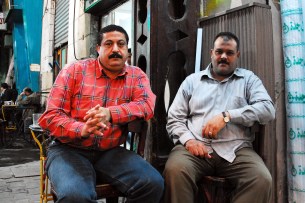 Then Sisa made the news and was honoured by governmental officials. There is footage in the report of Egyptian men watching that footage. Apparently, the men were impressed by Sisa’s efforts and they developed respect for her. One man, who knows Sisa personally, says for camera: “I treat her like a man, because she works like a man”.
 Feminism and Religion