Sailing For The Darkness by Mary Gelfand

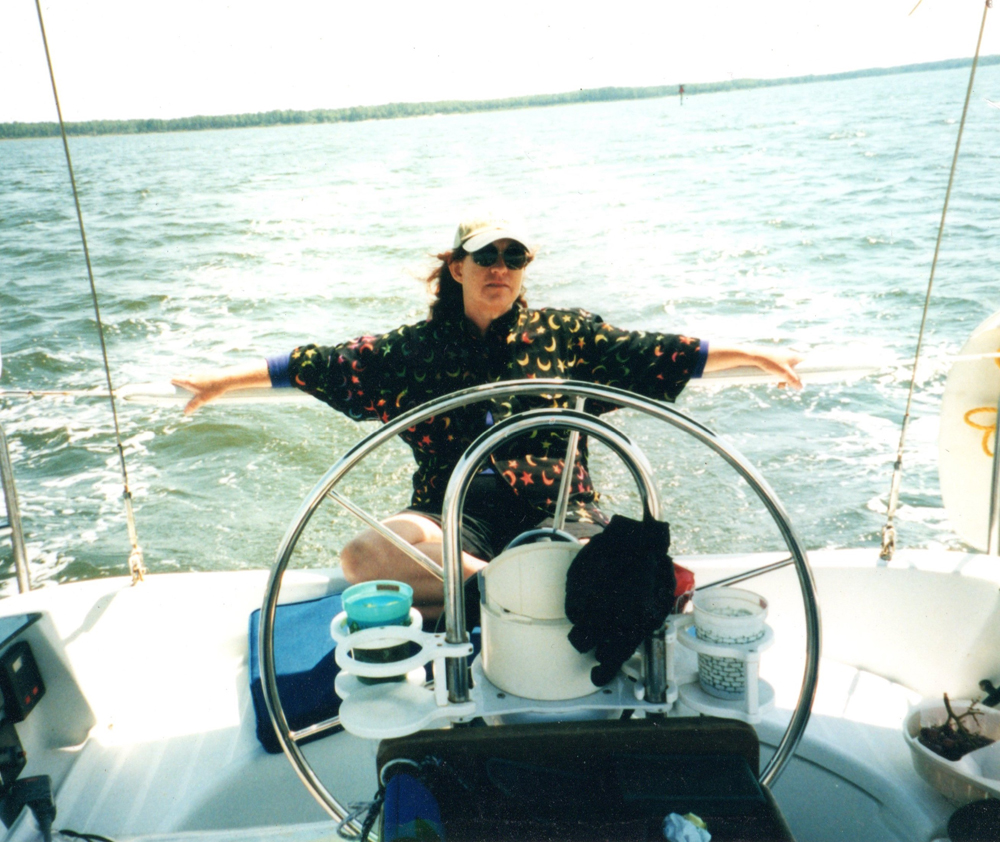
As I write this, it is August and very much high summer. This time of year always reminds me of my old life in New Orleans, before I moved to Maine.  David, my first husband, and I were sailors. I never planned on becoming a sailor, but once I mastered the basic skills I found I quite enjoyed it.  Furthermore it became an unexpected source of spiritual insight. I’m inspired to share a piece of that here.

One spring over 25 years ago, David and I and a group of sailing buddies made our usual summer passage in the Gulf of Mexico, from New Orleans, Louisiana to Pensacola, Florida.  By car this trip was 200 miles. By sail it took two to three days. Around midnight, as we were entering the last leg of this journey, I took the wheel.  We were exiting Mobile Bay, heading east, and this should have been a fairly simple passage. There was plenty of depth, adequate wind, the boat was sitting in the water well, and I had Barney, a dear and trusted friend, as my navigator. I’d been at the wheel for fifteen minutes or so when I noticed the many lights we were approaching and asked Barney what was going on.

Continue reading “Sailing For The Darkness by Mary Gelfand”

A Healing Shrine by Joyce Zonana

From October 5, 2023. Joyce posted the blogpost which she titled: Nineteen months and Counting: Experiencing  the Web of Life

On February 28, 2022, I unknowingly drove into a deep snowbank, shortly after finding myself in  a strangely  unfamiliar landscape. Suspecting a TIA, my primary care physician  urged me to go to an emergency room for a possible CAT scan. There, a lesion in my right parietal lobe was quickly discovered.

Continue reading “A Healing Shrine by Joyce Zonana”

How the Nineteenth-Century Spiritualist Movement Gave Voice to American Women -Part 2 by Theresa Dintino

Moderator’s Note: This post is presented as part of FAR’s co-operation with The Nasty Women Writers Project, a site dedicated to highlighting and amplifying the voices and visions of powerful women. The site was founded by sisters Theresa and Maria Dintino. Part 1 was posted yesterday

Spiritualism began with two young girls, the Fox sisters, hearing knocking sounds in their home near Rochester, N.Y . They determined the knocking to be coming from a man who was murdered and buried under their home. The knocking was soon categorized into an alphabet out of which seances began. In seances groups of people gathered and put their hands on a table while asking questions of ancestors who made themselves known by rapping and knocking in response. Next, mediums in the form of young women speaking the answers of the dead as the bereaved asked them questions, emerged. Instructions were disseminated on how to be a medium and how to run a seance. The movement took off.

The movement was largely white, northern Protestants but other ethnicities were  involved. The Black population may have influenced the arising of these practices with traditions brought with them from West Africa.

Continue reading “How the Nineteenth-Century Spiritualist Movement Gave Voice to American Women -Part 2 by Theresa Dintino”

How the Nineteenth-Century Spiritualist Movement Gave Voice to American Women -Part One by Theresa Dintino

Moderator’s Note: This post is presented as part of FAR’s co-operation with The Nasty Women Writers Project, a site dedicated to highlighting and amplifying the voices and visions of powerful women. The site was founded by sisters Theresa and Maria Dintino.

Throughout history women have found power and position in spiritual communities. They have acted as leaders, priestesses, oracles, mediums, disciples, saints, preachers and more. And yet these roles and positions of power are often overlooked in the story of women, and the general story of humans.

Still today many women function as leaders in a variety of spiritual disciplines, yet they do not receive the attention, respect and clout that men in similar positions do. More often women who hold roles of power in spiritual communities are dismissed or discredited.

If their spiritual community is not considered a formally accepted religion where their position was bestowed to them by a man ranking above them, women spiritual leaders are often ignored. This marginalization goes unquestioned.

Continue reading “How the Nineteenth-Century Spiritualist Movement Gave Voice to American Women -Part One by Theresa Dintino”

Who Speaks Into Your Life by Michelle Bodle

An occupational hazard for a woman in a religious setting is having people try to claim authority to speak into my life that they simply do not have. Two recent examples were so blatant that they caused me to pause and reflect on the underlying dynamics that led to these unrealistic expectations.

            In the first event, I was out with a friend for coffee, and someone from her congregation approached. They wanted to pray for an upcoming service, but then, during the prayer, he started to pray against the “confusion” at our table. His sudden praying against this “confusion” is notable in that it only arose after my colleague introduced me as the lead pastor at a church (not an associate) in a denomination where this particular gentleman’s church broke off. After the prayer ended, he tried to explain his “prophetic gift” and how he arrived at praying against any confusion, which was tied to his own confusion during the prayer. However, the truth was, there wasn’t any, and he thought he had authority, during prayer, to speak into my life in a way that he did not. 

Continue reading “Who Speaks Into Your Life by Michelle Bodle”

Queering the American Dream by Angela Yarber, Book Review by Janet Maika’i Rudolph

I love stories about journeys or pilgrimages. They are quests that take us out into the world even as we are forced to face our innermost selves. They are sure to be filled with adventure, challenges, and unexpected beauty. Such a journey has the ability to rip apart our world and reform it in new and unexpected ways. Like I said an adventure. Each journey not only affects us personally but changes corners of the world and all the people that it touches.  Angela Yarber’s book is one such journey. Reading it changed my world.

Rev Ang traveled with what she calls her “queer little family;” herself, her wife Elizabeth and their toddler son Ru. They set off into the country where they could not take for granted they would be accepted. They knew they might be seen as other and have to face down hatred. It is a vulnerable place to be, and it can be frightening, especially in the backcountry where being queer can be seen as an invitation for violence. That takes even an extra level of courage.

Rev Ang speaks with an honesty that is remarkable.

Continue reading “Queering the American Dream by Angela Yarber, Book Review by Janet Maika’i Rudolph”

Priestesses of the Shtetl? The Jewish Women Spiritual Leaders of Eastern  Europe by Annabel Gottfried Cohen

‘Four thousand years ago, in the ancient Near East, women were poets, drummers, scholars, dancers, healers, prophets and keepers of sacred space.’ In The Hebrew Priestess (2015), Rabbi Jill Hammer argues that as the Israelite cult became more centralised, leadership roles were restricted to men and women’s spiritual leadership was gradually repressed. Yet, as Hammer and co-author Taya Shere demonstrate, ‘the remnants of the priestesshood remain for those who seek them out.’ Combining a close reading of biblical and rabbinic texts, alongside other contemporary sources and archaeological evidence, Hammer has identified thirteen models or netivot of feminine Jewish leadership, which she argues persisted, albeit in altered and marginalised forms, into the medieval, early modern and even modern periods. My own research supports these conclusions, suggesting that Hammer’s netivot framework provides a useful lens by which to better understand Jewish women’s traditions that, in a patriarchal culture, have often been marginalised.

Continue reading “Priestesses of the Shtetl? The Jewish Women Spiritual Leaders of Eastern  Europe by Annabel Gottfried Cohen”

Summer Emergence by Molly Remer

Sometimes I wonder what I do in a year. Then I remember that I watch nighthawks migrate and coneflowers go to seed. I find Monarch caterpillars small and brave on persistent milkweed. I travel over miles of stone and moss, sometimes on my knees, seeking mushrooms and cackling with glee. I kneel in the violets, purple and white and yellow, and inhale great breaths of wild plum. I keep dates with as many sunsets as I can. I walk and walk and walk, carry leaves of mullein, crow feathers, bits of chicory, coreopsis, evening primrose, and wild rose home to press into the pages of my prayers. I pick blackberries with the bees and feel butterfly tongues on the skin of my wrist. I reach for wild raspberries under both thunder and sun. I slide down hillsides with muddy feet and antlers in my hands. I make eye contact with hummingbirds and turtles and deer and raccoons. I watch both fawns and nestlings grow. I learn how woodpeckers talk to their babies and the purring sound crows make at the compost pile when they think they’re unobserved. I lose and recollect myself more times than I can count, hold myself steady and let myself dissolve. I create new things with a wild veracity of devotion that sometimes threatens to consume me. And, I learn over and over again every day, how much it matters to bear witness, to what means to sit with myself in the temple of the ordinary each day, calling my attention back, recommitting to being here for it all, settling back into center again and again, rebuilding and renewing, witnessing and weaving, losing and finding, laughing and crying, refusing to surrender my joy and trusting that somehow it matters to be here, to see everything I can.

Continue reading “Summer Emergence by Molly Remer”

The Impresa of Great Mystery by Janet Maika’i Rudolph

The Fibonacci series has been called the fingerprint of god. That is because they are a sequence of numbers found ubiquitously in nature. I’ve been thinking up new names for it. It is a progression created by adding each number to its previous number after starting with the number one. It looks like this:

1, 1, 2, 3, 5, 8, 13, 21, 34, 55 and so on to infinity.

The Fibonacci Sequence was first described in the 12th century by Leonardo Pisano Bigollo, an Italian mathematician. His nickname was Fibonacci, which translates to “son of Bonacci.” He has been called the Leonardo of Pisa, the city of his birth. The series is unique. When you take the ratio of any two successive numbers in the series (after the three), the resultant numbers have a pattern. They fall into an increasingly narrow range with the sequence revolving around a ratio called the Golden Mean, the golden ratio, or the golden number. It is 1.618. Below is an example of how the number sequence works:

5 / 3 = 1.666
8 / 5 = 1.600
13 / 8 = 1.625
21 / 13 = 1.615
34 / 21 = 1.619
55 / 34 = 1.617

Continue reading “The Impresa of Great Mystery by Janet Maika’i Rudolph”

Processing my experiences of patriarchy has changed my faith for the better by Liz Cooledge Jenkins

As my first book, Nice Churchy Patriarchy, approaches six months of being out there in the world, I find myself reflecting on the journey. The process of unpacking all the ways patriarchy shows up in faith communities—and, in particular, the ways patriarchy has impacted my experience of church—has been a long one, and a winding one. It is no easy path.

How could a person travel this road and have their faith remain unscathed? Or perhaps a better question is this: How could one’s faith remain unchanged? And is this even a desirable goal?

After spending eleven years in “complementarian” (that is, explicitly patriarchal) evangelical church spaces and then two years in evangelical spaces that were egalitarian in theory but still had a long way to go to reach full gender equity—and, especially, after spending four years intentionally reflecting on these experiences and writing about them—I certainly see questions about gender roles and women in leadership differently. But it’s not only that. I see everything differently.

Continue reading “Processing my experiences of patriarchy has changed my faith for the better by Liz Cooledge Jenkins”