

 Anyone who has seen dolphins frolicking in the sea, understands the allure of these mysterious creatures who live in the water and yet are not fish. Highly intelligent and communicative, Dolphin inspires a sense of joy in our hearts. Often seen leaping and swimming beside boats, stories of rescue and friendship abound. Continue reading “Dolphin – Friendly Guide, Ambassador of Peace and Play by Judith Shaw”
Mother Tree Meditation by Sara Wright
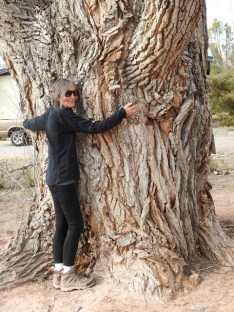 A couple of days ago after an exhausting day of chores I lay out in the sun in my snow pants against the tree I call the “Mother Pine” because she shelters so many creatures from birds to bears. It was late afternoon and the sun was sparkling like a cracked diamond through a myriad of branches over my head. I closed my eyes and listened to an evergreen symphony. The songs produced by pines and other conifers as needles sway and touch soothed me. How much I loved the sound of light winds slipping through the trees.
I had recently returned from the desert where these sounds are totally absent. Instead, ferocious west winds hurl and churn dust and dirt in my face making it impossible to be outside in the winter and spring on many days. Because I have emphysema, I am too often trapped in my house by polluted desert winds… To be present in this precious breezy moment allowed me to feel a deep abiding gratitude for the songs of trees I love… and Maine in general, although the rape of our forests continues unabated. Continue reading “Mother Tree Meditation by Sara Wright”
Safe Hands in the Moria Refugee Camp in Lesbos: A Starfish Project
 Imagine that you are a young mother of three from Syria, and that after fleeing your home with your husband and family, you arrived in Lesbos and have been waiting for months to have your asylum papers processed. You don’t know when that will happen, it could take more than a year, you have been told. You are staying in a tent with other families because the containers are full. You have no privacy. When it is cold you are cold, and when it rains you get wet. You try to keep your family clean and healthy, but there are not enough toilets and showers for everyone. In addition, you are afraid to leave the tent at night because some of the men without families drink too much and harass you and the other women.
You have heard that a strange new disease is killing people all over the world. It has a name but you cannot remember it. You don’t know what the symptoms are, and you don’t know what to do to protect yourself and your family. What you do know is that the camp is on lockdown, which means that no one can leave. This is especially hard on the men, including your husband. They have been used to feeling at least a little bit free when they walked outside the camp. Now they feel like they are in prison. They get angry easily, and this makes life harder for you and the other women. Continue reading “Safe Hands in the Moria Refugee Camp in Lesbos: A Starfish Project”
Self-calming with Syllable Counting and Rhyme Finding by Elizabeth Cunningham
 In times of stress, I like to count syllables. It soothes me the way the click of knitting needles might soothe others. Finding rhymes is also calming. Below are poems in forms that require syllable count and/or rhyme, the last three written recently. I hope you are all sheltering well.
Villanelle: 10 syllables to a line. A, B rhyme scheme, with repetition of the 1st and 3rd lines.
noon
I have come to love the silence of noon
the cars have all gone wherever they go
I can hear the bees hum their tuneless tune
the noon of the day is the sun’s full moon
listen, the air is still, the wind lies low
I have come to love the silence of noon
the chainsaws silent, no wood to be hewn
no scratching the dirt, it’s too hot to hoe
I can hear the bees hum their tuneless tune
each shadow cast, now drawn close, is a rune
thickets conceal spotted fawns and a doe
I have come to love the silence of noon
this refuge from noise, a sweet daily boon
a full body blessing, crown to tiptoe
I can hear the bees hum their tuneless tune
each noon is a moment, passing so soon
the wild meadow flowers before we mow
I have come to love the silence of noon
I can hear the bees hum their tuneless tune Continue reading “Self-calming with Syllable Counting and Rhyme Finding by Elizabeth Cunningham”
When the Tomb Feels Safer than the Garden by Tallessyn Zawn Grenfell-Lee
 I have always loved Lent and Holy Week. When I was young, I enjoyed the challenge of fasting. Holy Week was the powerful culmination of it all, so I would try to make the fast even harder then, like a sprint at the end of a marathon. Chocolate quickly got boring, so once I gave up all desserts. Another year, I gave up lying. (I’m a PK – Preacher’s Kid; enough said.) And then there’s the famous year sometime in my 20s when I decided I’d better give up swearing. (PK, remember?) Both my sister Trelawney and my husband just love to remind me of how I literally swore while walking out of the Ash Wednesday service. And didn’t even notice. And when they finally explained why they were laughing at me, I, of course, immediately cursed again. Sigh. Well, I respond each time, that’s why I decided to give it up in the first place!
My kids and I have also had a lot of fun observing Lent and Holy Week. Each year, it teaches us something new about abundance – especially amid the wealth of intensity and ritual during the last week. We are not legalistic about it; we just want to learn and grow together. One year, we limited plastic as much as possible. And I’ll never forget the year we gave up paper products. That was the first year we didn’t get sore noses, because we used handkerchiefs instead of tissues. As Trelawney likes to say, we finally stopped blowing our noses on a tree. Continue reading “When the Tomb Feels Safer than the Garden by Tallessyn Zawn Grenfell-Lee”
Canada Goose by Sara Wright
 Canadian Geese have been on my mind a lot lately. This past winter I have missed the skeins of geese that fly back and forth up and down the river appearing every single morning like clockwork. In Abiquiu when winter turned to spring I noted that the geese were behaving in much the same way the Sandhill cranes did before they migrated, splitting into pairs or groups of three and flying erratically. I was puzzled. I didn’t recall witnessing such behavior before this year. I wondered about migration patterns. Were the geese shifting their flight patterns too? Or perhaps the small groups I saw were staying year round? Some days it almost seemed as if these water birds were confused by something.
I saw three Canadian geese on the last predawn walk I took to the river/Bosque in New Mexico – just an hour or two before leaving for Maine. I knew that a perilous journey was ahead because we were driving cross-country from NM to ME. The C/virus was a frightening threat even though I brought all food, and planned to camp/use woods as bathroom. The first morning after my arrival at home I saw and heard three geese honking over my head. I was struck by the odd synchronicity remembering the mother goose tales of my childhood – and later as a graduate student when I learned about their mythology. Continue reading “Canada Goose by Sara Wright”
The Practice of Bearing Witness by Stephanie Arel
 She looked away and stared out the window, trying to hold back the tears in her eyes. “The tents,” she said and shook her head looking down at the ground. The tears were coming, but softly. I asked her what the tents represent. She shrugged her shoulders and said into the camera phone: “The bodies I guess. They don’t have enough room for the bodies.”
In this time of the coronavirus, as in Italy and Spain, New York City has room neither in the hospitals nor the morgue for the bodies that are dying. Up from 25 a week, to 24 a day, bodies are being buried on Hart Island, or City Cemetery, where the unclaimed and unidentified have been interred for decades. Others are waiting in refrigerated trucks for friends and family members to collect them. This New Yorker along with thousands of others have seen the stark reality, one that left even Trump sick at heart.
We are witnessing a global pandemic. Evidence of the ravages of the coronavirus lies all around us. The response to the virus has made physiological, economic, and psychological impacts on our lives. We have changed our working styles, dealt with lowered income, or lost our jobs. Staying secluded at home, we have taken on new roles for which we were not prepared; many of us have become sick, and some have died. We are together witnessing a major world disaster.
What does it mean to be a witness? What will it mean to carry that witnessing forward to future generations to mark this historic event so that when something like it happens again, future generations will have the tools they need to respond more quickly, adapt more easily, recover more rapidly? For this generation, just as those who researched and learned from the Spanish Flu, we bear witness. Continue reading “The Practice of Bearing Witness by Stephanie Arel”
A Time for Reflection by Gina Messina
We are experiencing much grief and fear in this moment. Many of our loved ones have become ill, or passed on. We struggle with theodicy questions; why would God allow such devastation to occur? However, instead of asking why, as our eyes are being opened to the realities of our world, this is a moment that calls for deep reflection.
 This Easter was a challenging time for many of us. I could never have imagined that my daughter Sarah and I would end up spending the holiday at home alone — or that we would have hot dogs and tater tots for Easter dinner (I let Sarah pick – I should have seen that coming!). Although we were physically separated from family, we connected in other ways. I am grateful for the many suggestions on opportunities to remain engaged with each other even though we are not sharing the same physical space.
Easter is a celebration of Resurrection; it is a time of new beginnings and I can’t think of a more relevant theme for this moment. We’ve been told to stay home, to rethink the ways we live our daily lives, and to do so knowing that our individual actions have life and death consequences. We’ve found that much of what we thought we couldn’t live without is actually insignificant and that our choices do matter beyond our own purview.
I Am a Progressive because of Not in spite of My Feminist Spirituality by Carol P. Christ
 Feminist spirituality is often disparaged in academic feminist and progressive communities. Many of the strongest critics are Marxists, but there is a general agreement that religion is the opiate of the people, a false belief system that diverts energy from the difficult work of creating justice in this world. This view is rooted in the habit of thought known as classical dualism in which spirit and nature, spirit and body, and this world and the next are viewed as antithetical. From this, it would seem to follow, feminist spirituality focuses attention on an imagined spiritual world as opposed to the material world in which real people live and interact with each other. Nothing could be farther from the truth.
Feminist spirituality is rooted in a strong critique of classical dualism, which sets mind above body, spirit above nature, and male above female. Feminist Goddess spirituality asserts that the female body has been especially disparaged in traditional theologies rooted in classical dualism. This can be seen in the image of the naked Eve as the source of evil, sin, and temptation. In contrast, Goddess spirituality is inspired by images of the female body of the Goddess as a symbol of the Source of Life. Goddess spirituality understands nature (or the world) to be the body of the Goddess and affirms this world as our true home. This world is understood to be an interconnected web of life shared by humans and other than human beings. Continue reading “I Am a Progressive because of Not in spite of My Feminist Spirituality by Carol P. Christ”
Monotheism and the Shema: Lessons on Oneness and Unity by Ivy Helman
 In my last blog post, I explained what we lost when the Israelites became monotheists. That post looked at the move to monotheism from a more historical, feminist perspective. In this post, I want to understand monotheism from a more modern, feminist lens. Using the Shema as a starting point for modern Jewish monotheistic thinking, my question is: how do we honor the deity based on who we understand that deity to be? In my opinion, Jewish monotheism requires we honor G-d by moving away from one-sided gendered depictions of the deity and think about how we act in light of the interconnectedness of life.
Judaism highlights the Shema as the description of the divine. It reads, “Hear, O Israel! The L-rd is Our G-d, The L-rd is One!,” (Deut. 6:4). The key aspect of this verse is twofold. First, we have a relationship with the deity hence the description of the deity as “our,” and, second, this deity is one.
Oneness used to imply that no other deities count, and perhaps also that no other deities literally exist. For example, if one were to read the Torah, one would understand the deity differently. On the one hand, the deity is one of many possible deities one could worship. On the other, it is quite clear that no matter what the deity is called, there is one specific deity that chose to help the Israelites. In the Torah, the divine is always referred to as he, using only masculine pronouns for the deity. In addition, he is often called king, lord, and master. G-d is depicted as powerful, wrathful, jealous, and even scary. Continue reading “Monotheism and the Shema: Lessons on Oneness and Unity by Ivy Helman”

