Three poems by Rebecca Rogerson

Don’t Take Me to Church

He never let me eat communion because I wasn’t a catholic, but it was okay for me to eat his dick. My tiny palms forced to stroke him, the same dextrous hands that coloured in the lines. 

I knew his God wasn’t my God. I knew she saw everything there was to see and that he wouldn’t reach salvation; no matter how many Hail Marys he said at mass in Ireland.

The Virgin Mary knew what he stole from me, what they steal from all of us.

I couldn’t fall apart on Sundays at noon when he took me to church—before he took me home after he did what he did—to the little Jewish girl who didn’t know she was Jewish.

I couldn’t remember it because I buried it in Survive, until, it was resurrected by nightmares and demons who professed caring and brought me to altars of despair to vomit up all the darkness, and when there was no more left to cleanse or tear out; light ripped in.


No one talks about the embarrassment that goes along with the telling, sharing and surfacing of sexual violence. How it comes up, how it comes back. How we’re always haunted by the deadbeat dead and grabby grandfathers who try to reach from there into here, pretending they are made of heaven.

I fled a friend’s choir concert because perpetrators keep stealing time, moments, sleep, joy, and friendship, in churches and baths. On my flight, I hunted for nature, soil and anything else that felt most alive in the hilly town of Nelson. Pretending I was like everyone else, I hid the panic that strikes broken hearts.

Continue reading “Three poems by Rebecca Rogerson”

Two Poems by Rebecca Rogerson

ROSE WATER

I am the holy place somewhere in the stars of eternity,
 someone’s daughter who seeks reprieve somewhere.

Yetta changed her name to Mary. She tried to erase her past, not as a Jew, well maybe some of that, but more as a Jew molested by her father—a frum[1], “Monster”, his daughters called him.

On my altar sits my tallit alongside a Menorah with seven brass holders. No stars of David—before or after the decimation of Gaza. Can rose water sweeten our hearts? We pour it graciously in our hands, hoping the lost petals heal our guts and brighten our thoughts. She searches hungrily for hope in glass bottles adorned with Farsi, that cost $4.29 each.

Continue reading “Two Poems by Rebecca Rogerson”

Veiled by Michelle Wahila

Photos by Paige Gribb Photography
 https://paigegribbphotography.com/

Springtime in Paris brings the magnificence of cherry blossoms, the scent of sweet crêpes, and an influx of tourists eager to capture their own moment of passion on the cobblestone streets of the world’s most romantic city. I may be biased because Paris is my home, but there’s no denying its magic. With its art, history, cuisine, fashion, and architecture, the city offers extraordinary experiences. It’s no wonder so many couples choose to marry in the City of Light.

Years ago, when I entered the wedding industry, I did so reluctantly, only after leaving the one profession I had ever known – ministry. What I didn’t expect was that I would become a bridge for couples navigating the ever-widening gap between love and institutional religion. The so-called “rules” of tradition are often mislabeled as matters of faith but are more accurately named as remnants of the heteropatriarchy. They place enormous pressure on engaged couples. It’s no surprise that many of the eloping couples I meet in Paris have chosen their path simply because it is less stressful than trying to appease tradition, religion, family, or friends (or all of the above).

Continue reading “Veiled by Michelle Wahila”

‘Willowing’ at the Turning by Sara Wright

My relationship with and time spent with Indigenous peoples reinforced my intuitive sense that seasonal turnings like the Spring Equinox need to be honored and experienced when the ‘time’ is right. Time, in the Indigenous sense is fluid. Because of this learning I have come to understand that although it is important to write a little ceremony that includes guardians, elements, prayer, gratitude, framing intentions/release that I also need to allow the powers of nature to determine when the actual passage occurs. Indigenous people dance their ceremonies which helped me understand that any experience that transpires around these turnings may become the body of the ceremony if it feels right though the words were written earlier. This year around the equinox darkness reigned in every sense of the word. Having set my intentions, I waited, wondering when the door would open… yesterday it did, and this is the story of what happened. Only afterwards did I realize that in every sense we had honored and experienced the beginning of spring and the rising of clear waters.

My Vet and dearest friend made one of his unscheduled visits. The moment after I got the text my little dogs began to bark. This is normal behavior for both animals who adore their Uncle Gary and are tuned into him on levels that defy explanation (he lives more than a half an hour away). They bark until he arrives, regardless of whether this is a regular visit, or one that’s a surprise. We keep track of the exact timing of his leave – taking, their behavior and his arrival for fun.

Continue reading “‘Willowing’ at the Turning by Sara Wright”

Legacy of Carol P. Christ: “Mermaid, Goddess Of The Sea”

carol-christ

This post was originally posted on Nov. 4th, 2013

On the recent Goddess Pilgrimage to Crete, I visited the Historical Museum in Heraklion where I saw a beautiful embroidered silk panel of a mermaid identified only as having come from Koustogerako, a village in western Crete. As it is unlikely that a man in a Cretan village would have been talented in embroidery, in this case “Anonymous” most definitely “was a woman.”

In this thread painting a mermaid surrounded by fish is holding the anchor of a ship in one hand and a fish in the other. In Greece the mermaid is the protectress of sailors. In a well-known legend, a mermaid said to be the sister of Alexander the Great, emerges from the sea in front of a ship during a storm and asks: “Is Alexander the Great still living?” If the sailors answer, “Yes, he lives and reigns,” the ship is saved.

mermaid greek0001

In this image the mermaid–who does not much resemble “the little mermaid” of recent lore—is identified by the woman who embroidered her as: “GORGONA, H THEA TIS THALASSIS,” MERMAID GODDESS OF THE SEA.” Assuming that the woman who created this embroidery was probably a Christian, I was surprised to see that she nonetheless referred to the mermaid as a Goddess. Was this phrase passed on to her down to her from pre-Christian times? Did she see any contradiction between her Christian beliefs and the “Goddess of the Sea?” Continue reading “Legacy of Carol P. Christ: “Mermaid, Goddess Of The Sea””

Herstory Profiles: Tending the Flame with Pema Chödrön By Anjeanette LeBoeuf

While the early days of the nation of America is seeped with Christianity, the West has also had an illustrious relationship with Buddhism. Western Buddhism and especially American Buddhisms has grown exponentially since the 1960s. One of the benefits of American Buddhism is the inclusion, reintegration of Women Religious. One of the most known Buddhist nuns is that of Pema Chödrön.

Pema Chödrön was born Deirdre Blomfield-Brown in 1936 in New York City to Catholic Parents. She would receive her English Literature Degree from Sarah Lawerence College and a Master’s in Elementary Education from University of California, Berkeley. She would be an elementary teacher for many years in New Mexico and California. Deirdre was married and divorced twice. She has two children and three grandchildren. In the 1970s. Deirdre would start to study and practice Buddhism under Lama Chime Rinpoche. This would be the start of her journey to become Pema Chödrön. Under the guidance and practice of Chögyam Trungpa, Deidre was given a new name, Pema Chödrön which means ‘lotus torch of the dharma’ when she took the refuge vows.

Continue reading “Herstory Profiles: Tending the Flame with Pema Chödrön By Anjeanette LeBoeuf”

33 Years of Wisdom by Chaz J.

As the celestial clock turns towards Sunday, April twenty-seventh, at the luminous hour of 9:12 PM, I shall step into the sacred circle of my thirty-third year. And for a soul who once walked the hallowed halls of the church, as I did, the echoes of a profound resonance surely sound. For Jesus proclaimed his divine lineage and embarked on his earthly ministry around his thirtieth spring, only to ascend three years later, at the very age I now approach?

Thus, this year unfolds as my very own ‘Jesus year,’ a time ripe with potent transformation, reinvention, remembrance, and the blossoming of my inner wisdom. I present this wisdom, aligning it with the seven sacred wheels of energy, the chakras that map the landscape of my being. Each chakra, a vibrant note in the symphony of my soul, accompanied by a song that, for me, hums with the exquisite harmony of its balanced state. This is a profound and poetic offering of the journey I have walked and the radiant being I am becoming.

Continue reading “33 Years of Wisdom by Chaz J.”

Long Live Queer Nightlife! by Amin Ghaziani – Book Review by Marie Cartier

I was invited to be on a panel for the Pacific Sociological Association (PSA) in San Francisco this past March for a new book by Amin Ghaziani, Long Live Queer Night life (Princeton University Press, 2024).

Since I wrote Baby, You Are My Religion – Women, Gay Bars, and Theology Before Stonewall and have discussed aspects of this work here I thought the FAR family would also enjoy this conversation on where queer nightlife is now.

The book is interspersed with visits to club nights, something Ghaziani says helps widen the possibilities for communities—different communities can have their own nights and these chapters where he visits these various hot spots are exciting and first person.

Continue reading “Long Live Queer Nightlife! by Amin Ghaziani – Book Review by Marie Cartier”

Presenting Feminine Courage by Cheryl Petersen

Madam C.J. Walker was born Sarah Breedlove in 1867, to sharecroppers who had been slaves before the American Civil War. Sarah married at age fourteen. Six years later Sarah was a widow with a daughter. For income, Sarah did laundry and cooked. In 1905, she remarried and became Madam C.J. Walker. With little more than a dollar, she began her own line of hair products for African American women and prospered humanity beyond imagination or expectation.

Nearly two decades back, I read “On Her Own Ground: The Life and Times of Madam C.J. Walker,” by A’Lelia Bundles. The author describes Walker’s journey from desperation to inspiration. The narrative impressed me with an exacting respect for the womanhood that embraces other women.

Continue reading “Presenting Feminine Courage by Cheryl Petersen”

Pandora/Gaia—Bringer of Gifts by Judith Shaw

As we move deeper and deeper into full autocratic rule, the timeless themes found in mythology help me find my way. 

My first thought for these days was of Pandora, whose story in the myth of Pandora’s Box serves as a powerful metaphor for the complexities of human choice—relevant today by the choice of many to elect Trump, resulting in multiple destructive consequences. 

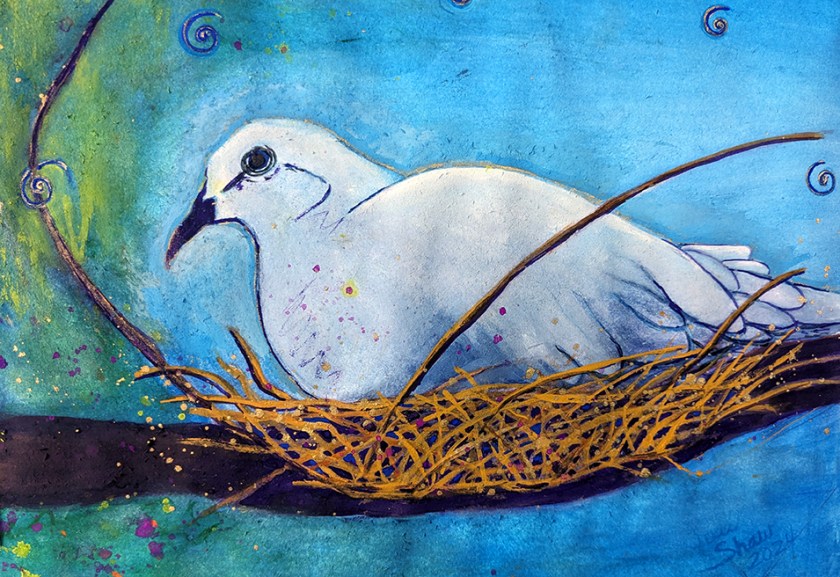
Hope Endures, by Judith Shaw, gouache on paper, 7.5″x10″
Continue reading “Pandora/Gaia—Bringer of Gifts by Judith Shaw”