

A coupl e of months ago I did a day trip to visit the historical site of one of the 10 internment camps which were formed due to Executive Order 9066 issued on February 19, 1942. Manzanar Relocation Camp is located between the Sierra Nevadas and the Owens Valley. Manzanar held over 11,070 Japanese Americans from 1942–1945. EO 9066 forced 120,000 American citizens to leave everything and become in all accounts prisoners; two-thirds of those were native-born American citizens. This executive order largely focused on people living on the West Coast of the United States to eliminate the possible threat of a secondary attack. They were relocated far inland and the majority of the camps were outside of the West Coast. While this was done in the 1940s, our current climate is looming to make it seem like there are forces in this world that are attempting to perform different forms of subjugation and confinement. Continue reading “Preserving the Complete History: Remembering Japanese Internment Camps By Anjeanette LeBoeuf”
Recalling the Courage of Shamima Shaikh by Vanessa Rivera de la Fuente

Shamima Shaikh’s name may be unfamiliar for you and many who are not deeply informed about Islam and gender issues in South Africa or who tend to identify Muslim women and/or activism for women’s rights in Islam with the Arab region. Why should you know about her? Because Shamima Shaikh was one of the most notable Muslim anti-apartheid activists and advocates for the rights of Muslim women in her country—a prominent feminist, journalist, radio producer, movement builder, trailblazer, and fearless activist.
This year—2017—marks the 20th anniversary of her death, and I think it’s a special occasion to recall her brave legacy, not only because twenty is a special number. In the context of violence against women in South Africa and worldwide—in particular the violence against and exclusion of Muslim women in Syria, Palestine, Yemen, and Saudi Arabia—as well as the gendered Islamophobia that targets our sisters in Europe, claiming the courage and spirit of resistance of Shamima Shaikh as part of our ethos as women living in a patriarchal world that hates us is absolutely necessary. Continue reading “Recalling the Courage of Shamima Shaikh by Vanessa Rivera de la Fuente”
Gay Pride and Gay Resistance by Marie Cartier
 Welcome to the resistance, Feminism and Religion family. This month is Gay Pride Month in many cities, including mine—Long Beach, California—where we just celebrated our 34th gay pride parade and our annual “Dyke March.”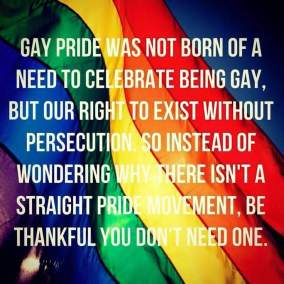
This blog is primarily a photo essay of those events and past pride events I have been in—a celebration of pride and gay family during the spring months which commemorate the first televised gay uprising against police harassment by the gay and lesbian and transgender family on June 28, 1969 at the Stonewall inn in New York City, NY. Continue reading “Gay Pride and Gay Resistance by Marie Cartier”
Becoming Myself by Katie M. Deaver

Last weekend was a special one for me. After many years of study and dedication I graduated with my Ph.D. and am now, officially, Dr. Katie Deaver. The weekend was filled with celebrations to mark the completion of a milestone that I have spent years working toward. The amazing outpourings of love, support, and care that I have experienced throughout the last few days is quite humbling. The happiness and pure joy of my family, friends, professors, mentors, and multiple church communities have left me in awe. As I reflect on this love and support it helps to heal the wounds and scars that have accumulated throughout the process of earning this degree.
The undertaking of a Ph.D. program is significantly more difficult than anyone tells you. This difficultly lies not necessarily in the course work or the dedication to constant reading, writing, and learning but rather in the personal growth and vocational affirmation that takes place within the process. My dissertation explored the primary understandings of the doctrine of atonement and addressed how this doctrine can, and has, been used in ways that perpetuate, and in some cases even encourage, domestic violence.
My own fascination with the topic of atonement and its links to domestic violence was brought about at the suggestion of one of my undergraduate professors at Luther College, Dr. Jim Martin-Schramm. From the moment that Dr. Martin-Schramm explained the links between theologies of the cross and domestic violence I knew that I had found my new passion. Writing a dissertation on the topics of domestic violence, theology and women of faith was an extremely personal, and intimate experience for me. This topic forced me to accept my own lived experience. To claim myself… out loud… as a survivor of domestic violence. As a result the writing of my dissertation was particularly personal, and painful, as well as extremely life giving.
Earth Dreaming, Water Dreaming: How Elemental Dreams Offer Healing for the Earth and Us by Jill Hammer

I once dreamed I was giving a lecture on a spiritual philosophy called magmatheism. The literal meaning, I thought when I awoke, would be something like “belief in the divinity of molten rock.” I had the sense this dream was trying to tell me something about what I had come to believe and know. When I asked my friends what they thought magmatheism was, they gave answers that delighted and intrigued me.
One said: “the belief that God/Goddess dwells below the ground and every once in a while erupts out gloriously.”
Another said: “By studying the ways in which rock is liquid, we can understand the oneness of all things… Our separation is an illusion. We are part of the whole.”
A third said: “Honoring the magnetic pull to earth.”
A fourth said: “The unmanifest that creates the foundation of all life.”
The dream told me something real about the power of dreaming. It let me know that a life physically and spiritually connected to the earth—the life I was trying to live and to encourage others to live—did not only occur when I was awake, but when I was asleep. The dream told me that the earth was speaking to me in my dreams. As dream tender Stephen Aizenstat writes, “Dream images are not representations of our personal nature only, but are also informed by the subjective inner natures of the things and creatures out there in the world. (Aizenstat, S. Dream Tending: Awakening to the Healing Power of Dreams. New Orleans, LA: Spring Journal, Inc. (2011), pp. 149-150).
The Mountain Mother: Reading the Language of the Goddess in the Symbols of Ancient Crete by Carol P. Christ
 Before he told the story of how his people received the sacred pipe, Black Elk said:
So I know that it is a good thing I am going to do; and because no good thing can be done by any man alone, I will first make an offering and send a voice to the Spirit of the World, that it may help me to be true. See, I fill this sacred pipe with the bark of the red willow; but before we smoke it, you must see how it is made and what it means. These four ribbons hanging here on the stem are the four quarters of the universe. The black one is for the west where the thunder beings live to send us rain; the white one for the north, whence comes the great white cleansing wind; the red one for the east, whence springs the light and where the morning star lives to give men wisdom; the yellow for the south, whence come the summer and the power to grow.
But these four spirits are only one Spirit after all, and this eagle feather here is for that One, which is like a father, and also it is for the thoughts of men that should rise high as eagles do. Is not the sky a father and the earth a mother, and are not all living things with feet or wings or roots their children? And this hide upon the mouthpiece here, which should be bison hide, is for the earth, from whence we came and at whose breast we suck as babies all our lives, along with all the animals and birds and trees and grasses. And because it means all this, and more than any man can understand, the pipe is holy. [italics added]
In this passage Black Elk illustrates the multivalency of symbols: the sacred pipe does not have a single meaning, but many meanings, in fact, more meanings than anyone can understand. Continue reading “The Mountain Mother: Reading the Language of the Goddess in the Symbols of Ancient Crete by Carol P. Christ”
Shapeshifting Goddesses by Judith Shaw

Magic, divine intervention, shapeshifting – what do these things offer the modern mind, concerned with time clocks, definitive proofs and skeptical disbelief? Yet to the ancients, shapeshifting was a well known tale, found in stories and mythologies across the world.
Ending Suffering for the Sake of Others by Oxana Poberejnaia
 I have recently noticed an interesting thing: just like the Buddhist goal of ending suffering requires consideration of others, so often feminist change requires thinking about other women.
I often had conversations with people on both these subjects. I heard actual people say: “I do not want to end my suffering, the reason being…” And the reasons can differ. Some consider suffering to be part of genuine human experience, some find a spiritual advantage in having suffered. While some simply say that they are fine with their suffering; they are used to it; change would bring even more suffering. Continue reading “Ending Suffering for the Sake of Others by Oxana Poberejnaia”
Sexuality and Spirituality: Convergence or Alienation? by Stephanie Arel
 I just finished reading for review The Bloomsbury Reader in Religion, Gender, and Sexuality, edited by Donald L. Boisvert and Carly Daniel-Hughes. Targeting an undergraduate audience, the text explores ways that religion, gender, and sexuality intersect and interact in a variety of religious traditions.
The book’s essays traverse a wide sampling of religious inheritance including indigenous traditions, Christianity, Judaism, Islam, and various Asian religions. The topics examined range from the culture of male love in Japanese Buddhism to various themes of love in Haitian Voodoo, from sexual desire in Beguine communities to Gandhi’s experiments in sexual chastity, and from the passion of St. Pelagius to the transgender performance characteristic of the Hijra identity in India. Among other things, the book offers a wide array of interpretations regarding how sexuality emerges in particular traditions and contexts. One is left with a feeling that nearly anything goes depending on which set of rules or religious mores a particular group of people follow. The variations presented in each chapter related to the interpretation of sexuality’s embeddedness in spiritual expression problematize the notion of the “normal” emerging in sexual desire and expression. Continue reading “Sexuality and Spirituality: Convergence or Alienation? by Stephanie Arel”
Leadership in the Kali Yuga by Elisabeth Schilling
 Since the U.S. has elected a reality TV show billionaire to represent our nation, we should be no longer be able to shy away from the ignorance, violence, and frivolity that is within us. Happiness and peace in humanity seem to be in short supply. How many of us experience continuing bliss, or do we only fantasize and find brief reprieves in our suffering? Even the more extreme privileged among us most likely share the same emotional landscape.
In Indian cosmology, Hinduism specifically, there are four stages (yugas) of humanity that occur in a cycle. They represent the ascending and declining spiritual, psychological, and physical well-being of humanity. The Satya Yuga is first (descending) and last (ascending) era, where people are without strife, disease, or fear. Satya means “truth.” Life increasingly deteriorates through out the Treta Yuga to the Dvapara Yuga to the Kali Yuga.
Continue reading “Leadership in the Kali Yuga by Elisabeth Schilling”

