

 The last young adult fantasy book series I will be looking at is Sarah Maas’s Throne of Glass. Sarah Maas’s Throne of Glass is a combination of all the elements which we have looked at in the previous two series, Girl of Fire and Thrones and Daughter of Smoke and Bone. Throne of Glass was originally conceived of as a remake of Cinderella but mingled with action. It is so much more than, weaving fantasy with gripping action, hard emotions, and love stories to revel any romance novel. And like the previous two series, it has been picked up to be turned into a TV series. Continue reading “Part Three: Magic, Destiny, and Acceptance by Anjeanette LeBoeuf”
Viśākhā: Surrogate Mother of Buddhism by Oxana Poberejnaia
 Viśākhā is often called the greatest female lay follower of the Buddha. She prompted the Buddha to give numerous teachings. She also donated generously to the Sangha (monastic order). Her crowning contribution was building a monastery called Migāramātupāsāda.
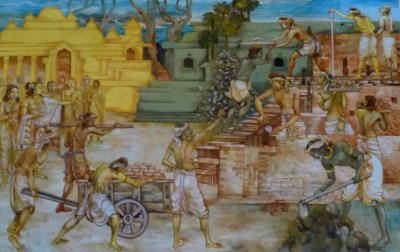
She is said to either die as a “stream-enterer” (a person who will definitely become enlightened, no matter how many life times it will take). Another account about her afterlife says that she would live for eons in happiness in one of the divine realms before achieving the final Liberation there and then.
Viśākhā appears in numerous Suttas of Theravadin Canon. From the modern feminist point of view, the content of these discourses reinforces patriarchal gender stereotypes. In particular, Viśākhā is portrayed as a caring Mother for her relatives, Bhikkhus (Buddhist monks and nuns), and other people.
Continue reading “Viśākhā: Surrogate Mother of Buddhism by Oxana Poberejnaia”
Alice Paul & the Women Who Will Keep Marching by Kay Bee

The day before Woodrow Wilson’s inauguration, the 1913 Women’s Suffrage Parade took place in Washington, D.C. to demand the attention of the incoming administration and advance the cause of suffrage. Organized primarily by Alice Paul, 8,000 women marched on Washington on March 3, 1913.
Alice Paul is an often overlooked figure in American suffragette history. She’s no longer as common a name as Susan B. Anthony or Elizabeth Cady Stanton. Her early feminist contemporaries weren’t always very fond of her, for that matter. Many found her “too radical,” especially after her return from training with the British suffragettes, where she was arrested multiple times. But Alice Paul knew how to get things done. Continue reading “Alice Paul & the Women Who Will Keep Marching by Kay Bee”
It Takes a Village: Responding to the Needs of Rosemary Radford Ruether by Cynthia Garrity-Bond
 As many of you may already know, on August 24, 2016, feminist theologian and scholar Rosemary Radford Ruether suffered a significant stroke. There has been some speculation from those who know or have known Rosemary about her current condition. Here is the short of it. While Rosemary has made progress, her doctors and therefore Medicare feel it is insufficient to warrant continued physical and speech therapies. Those who interact with Rosemary on a daily or weekly basis disagree with this medical prognosis. The stroke damaged the part of Rosemary’s brain that allows for communication, therefore she, at this time, is not able to speak. That said, Rosemary recognizes individuals, is able to respond to some commands and engage in therapeutic exercises. The more attention and care she receives the greater her capacity grows for a more meaningful life that includes a level of agency.
The first year of a stroke demands ongoing therapies in order to truly assess a clear diagnosis. To what degree Rosemary will recover from her stroke is uncertain, but at the minimum ongoing therapies will prove beneficial towards her overall quality of life. Unfortunately, Rosemary does not have secondary health insurance that will cover the cost of these badly needed therapies. For example, one month of Physical Therapy at 3x/week and Speech Therapy 2x/week amounts to $3,289.00. Put another way, 15 minutes of physical or speech therapy costs $41.00. To be effective, Rosemary should have, at the minimum, five hours of combined therapy per week. Continue reading “It Takes a Village: Responding to the Needs of Rosemary Radford Ruether by Cynthia Garrity-Bond”
Confronting the White Christian Vote for Trump by Gina Messina
 This week a politician from Connecticut reached between a woman’s legs and pinched her genitals saying that he loves this new world where he doesn’t have to be politically correct. Sadly, this is just another act of violence among many perpetrated based on the example of our President Elect, Donald Trump.
While many have been very troubled by Trump’s candidacy and ultimate election to the highest office in the nation – and the world – more than 80% of Evangelicals and 60% of Catholics gave their vote to Trump. Continue reading “Confronting the White Christian Vote for Trump by Gina Messina”
Encountering Spirit: A Ritual of Blessing for an Abortion Clinic by Katey Zeh
For the last year I have had the honor of serving as Chair of the Board of Directors for the Religious Coalition for Reproductive Choice (RCRC). This leadership role often requires great personal and professional sacrifices and yet blesses me tenfold in return. At this moment in history I can think of no more important organization to offer my time and gifts than on behalf of RCRC.
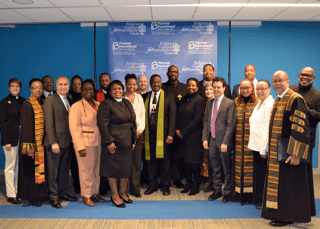
Last week RCRC partnered with Planned Parenthood of Metropolitan Washington (PPMW) to hold an Interfaith Unity Ceremony to honor their brand new health center in southeast D.C. I had the privilege of joining more than sixty clergy, justice leaders, and clinic staff as were led by the Reverend Doctors Dennis and Christine Wiley, co-pastors of the Covenant Baptist United Church of Christ, through an interfaith service of blessing. There was drumming from the all female percussion band Balatá, testimonies from providers and patients, poetry, liturgical dance, a Hindu chant, and a ritual of healing from the shame and stigma surrounding abortion.
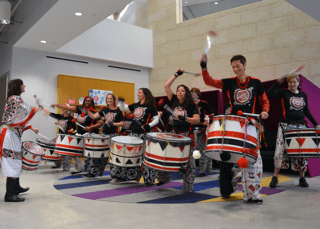
At one point during the service a colleague of mine turned to me and whispered, “I’ve got goose bumps. Something is happening here, isn’t it?” I said, “Yes, Spirit is here.”
Many might find an encounter with the sacred at a Planned Parenthood surprising to say the least. It might have been for me had I not experienced something quite similar ten years ago. At the time I was a seminary student at Yale, and I had recently participated in RCRC’s pastoral care training on how to walk alongside women making decisions about their unplanned pregnancies. Before I offered any kind of counseling I wanted to see for myself what went on in abortion clinic. After taking a tour of the local Planned Parenthood health center I was so moved by the love and kindness of the doctors and support staff that I decided to volunteer on days when abortions were provided. Through that experience I felt the holy nudge to dedicate my ministry to supporting the work of abortion providers like Planned Parenthood and standing up for the rights and dignity of those who need access to safe, legal abortion care.
Now, almost a decade later, I found myself back in a health center. That time of being amongst my people, surrounded by words and sounds of truth affirming the sacred decisions of women about their bodies and lives, felt like I had tasted my first bite of food after a long, difficult fast. I didn’t realize how much over these last few months I had been starving for hope, love, and life-giving energy until that ritual of blessing held within the walls of the Planned Parenthood health center.
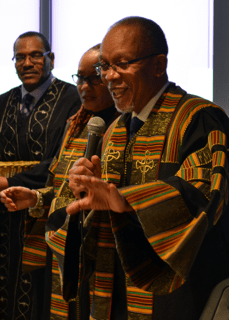
Later that night on my drive back to the airport I found myself repeating the same simple prayer, “Thank you, thank you, thank you.” I felt an overwhelming sense of gratitude for the way that ritual had restored my spirit and affirmed my call to ministry. For the first time I felt prepared to take on the heavy burden of the next four years. I am ready. Are you?
Katey Zeh, M.Div is a thought leader, strategist, and connector who inspires intentional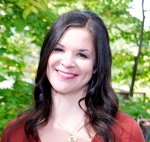 communities to create a more just, compassionate world through building connection, sacred truth telling, and striving for the common good. She has written for outlets including Huffington Post, Sojourners, Religion Dispatches, Response magazine, the Good Mother Project, the Journal for Feminist Studies in Religion, and the United Methodist News Service. Her book Women Rising will be published by the FAR Press in 2017. Find her on Twitter at @kateyzeh or on her website kateyzeh.com.
The Women’s March on Washington: I’ll Be There in Spirit by Carol P. Christ
 The Women’s March on Washington has released its statement of vision and principles, and what a stunning testimony to intersectional feminism and collaboration it is! The statement is woman-centered, while at the same time addressing a multitude of issues that affect women’s lives: from access to abortion for all, to an equal rights amendment to the constitution, to the rights of women as domestic and farm workers, to police reform, and so much more.
I was thrilled to read the list of women honored as foremothers to the march:
Bella Abzug*Corazon Aquino*Ella Baker*Grace Lee Boggs*Berta Caceres*Rachel Carson*Shirley Chisholm*Angela Davis*Miss Major Griffin Gracy*LaDonna Harris*Dorothy I. Height *bell hooks*Dolores Huerta*Marsha P. Johnson*Barbara Jordan*Yuri Kochiyama*Winona LaDuke*Audre Lorde*Wilma Mankiller*Diane Nash*Sylvia Rivera*Barbara Smith*Gloria Steinem*Hannah G. Solomon*Harriet Tubman*Edith Windsor*Malala Yousafza
Many of these women have inspired me, particularly (but not only): Bella Abzug, Rachel Carson, Shirley Chisholm, Malala Yousafza. I have taught books by or about many of them, including: Rachel Carson, bell hooks, Audre Lorde, Harriet Tubman, Barbara Smith.
I hope these names will be read at the beginning of the ceremonies, followed by an invitation to all present to speak, shout, or whisper—all at the same time–the names of all the women, known and unknown, who have inspired their own activism for women’s rights. In this way, no one’s name is left out. We have a similar ritual on the Goddess Pilgrimage to Crete, and it is incredibly powerful.
I first heard the Women’s March on Washington discussed at the meeting of the Feminist Liberation Theology Network held in conjunction with the meetings American Academy of Religion and Society of Biblical Literature ten days after the (so-called) election of Donald Trump. At that time a number of women asked if this march would be a white women’s march. Would women of color feel called or able to come? In the interim, women of color have become leaders of the Women’s March on Washington and it is definitely not “for white women only.” It was suggested that women of color might feel safer at local marches. These have been organized as well: learn about Sister Marches here. At the time of this writing 370 Sister Marches had been organized—in all 50 states and in more than 40 countries.
If, like me, you are feeling weary and despondent these days, the statement of the Women’s March on Washington may help to re-inspire your commitment to all women’s rights:
The Women’s March on Washington is a women-led movement bringing together people of all genders, ages, races, cultures, political affiliations and backgrounds in our nation’s capital on January 21, 2017, to affirm our shared humanity and pronounce our bold message of resistance and self-determination
Recognizing that women have intersecting identities and are therefore impacted by a multitude of social justice and human rights issues, we have outlined a representative vision for a government that is based on the principles of liberty and justice for all. As Dr. King said, “We cannot walk alone. And as we walk, we must make the pledge that we shall always march ahead. We cannot turn back.”
Our liberation is bound in each other’s. The Women’s March on Washington includes leaders of organizations and communities that have been building the foundation for social progress for generations. We welcome vibrant collaboration and honor the legacy of the movements before us – the suffragists and abolitionists, the Civil Rights Movement, the feminist movement, the American Indian Movement, Occupy Wall Street, Marriage Equality, Black Lives Matter, and more – by employing a decentralized, leader-full structure and focusing on an ambitious, fundamental and comprehensive agenda. Read more.
Learn more about the march. Readers of FAR might want to participate in the march with WATER (Women’s Alliance for Theology, Ethics, and Ritual). I’ll be there in spirit from Molivos, Lesbos, Greece.
***
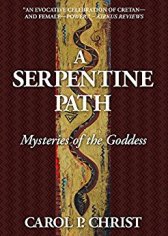 Be among the first to order A Serpentine Path, Carol P. Christ’s moving memoir of transformation. Carol’s other new book written with Judith Plaskow is Goddess and God in the World: Conversations in Embodied Theology. Carol also wrote the first Goddess feminist theology, Rebirth of the Goddess.
Join Carol on a Goddess Pilgrimage to Crete in 2017. Save $200.
Read two of the chapters in the book: Mysteries and Dionysian Rites.
Thanks to Judith Shaw for the cover art “Downward Serpent.”
The Book of Earth & Other Mysteries: a book review by Elizabeth Cunningham
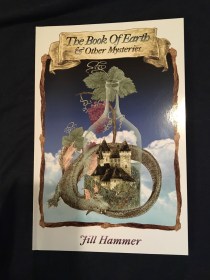 When a poem shows me something in a strange and wonderful light and at the same time awakens some bone-deep knowing of my own, I feel more alive, I feel less alone. My soul is stirred and satisfied. The Book of Earth & Other Mysteries by Rabbi Jill Hammer, author, teacher, midrashist, mystic, poet, essayist, and priestess, is a whole collection of such poems.
Collection is not a vivid enough word. The structure of this book is more like a fairy palace, a sandcastle blazoned with shells, a dragon’s lair, a bold work of art in itself. The book begins with a five part prose piece called “Intentions,” the first four invoking an element and the last one holding open the door for us to enter the world of the poems. Here are a couple of sentences excerpted from each. Continue reading “The Book of Earth & Other Mysteries: a book review by Elizabeth Cunningham”
Painting Lilith, Queering Lilith by Angela Yarber
 Lilith has been a misunderstood, appropriated, and redeemed woman throughout the ages. Many feminists claim her as an empowering figure in Jewish mythology, her story reclaimed by contemporary artists such as Sarah McLachlan, who created the all-women music tour, “Lilith Fair.” Some queer scholars have surmised that Lilith had a romantic relationship with Eve. Others have claimed that Lilith was a demon who seduced men and strangled children in the night. Quite a disparity, isn’t it?
The first time I painted her, I wrote about my subsequent leaving of the church here on Feminism and Religion. Based almost entirely on Judith Plaskow’s beautiful midrash, “The Coming of Lilith,” I’ve painted a second Holy Woman Icon rendition of Lilith. In the Jewish tradition, midrash is akin to climbing inside the story—inside the Torah—and imagining what happened in the places where the text offers no description; it is the space between the letters, the creative imagination within the narrative that makes the story come alive.
According to Plaskow’s midrash, God created Adam and Lilith from the same earth. Tired of Adam demanding that she be subservient to him, Lilith left the Garden of Eden. She was later befriended by Eve and her legacy of empowering women continues today. Adding a queer twist to this feminist midrash, some claim that Lilith and Eve became lovers, as well. Continue reading “Painting Lilith, Queering Lilith by Angela Yarber”
A Time of Reckoning: The SCE and John Howard Yoder By Grace Yia-Hei Kao

How does a professional society—a Christian one, no less—come to terms with the sexual abuse perpetrated over decades by one of its most vaunted members?
At the recently concluded annual meeting of the Society of Christian Ethics, this question was at the forefront of many conference participants’ minds.
Continue reading “A Time of Reckoning: The SCE and John Howard Yoder By Grace Yia-Hei Kao”

