 I live in Cleveland, and I am writing at the end of the World Series. I don’t know how it will conclude, but like most of the people in my city, I’m holding my breath. As I write, I literally just left the cardiac ward of one of the Cleveland Clinic hospitals, where patients’ lives actually seemed to hang in the balance of the game, according to one of the nurses who was monitoring heart rates from a central station in the hallway.
I, who never cared about baseball and avoided Cleveland sports, am more than a little surprised at myself. For, I have grown to care about the outcome of these games. Why so, I ask myself. Why am I sitting with my mom in the hospital, watching a game, when she’s ill, and neither of us has ever cared about sports? I’ve been thinking about this recently, and believe I have landed on the right answer.
You see, when you are from Cleveland, it is not uncommon to have this precise conversation or some permutation thereof:
Self: Hi.
Stranger: Hello there. Nice to meet you.
Self: Where are you from?
Stranger: Denver
Self: Denver is a lovely city. I visited for my friend’s wedding once.
Stranger: Yes. We love it out there. Great weather; friendly people. What about you… where are you from?
Self: Cleveland
Stranger: (chuckling) I’m sorry. Mistake on the Lake. River’s on Fire. Etc.
Clevelanders are made to feel shame about our city, whereas, by contrast, Chicago is heralded for its architecture, food, and skyline, and so one. Now, I have lived in Chicago. It is beautiful and all that, and, more importantly, Chicago is not what I am writing about. What I have come to observe about myself is that I actually love Cleveland for what it has to offer, which primarily includes people. Hard workers, brilliantly talented musicians, artists, actors, educators, physicians, architects, and more.
I have grown to appreciate the people and stories that built the city’s heritage, culture, ethnic churches, diverse neighborhoods, beautified lakefront, museums, international airports, colleges and universities, rivers, parks, gardens, and on and on. There is persistent and nearly inevitable derision that is glibly tossed our way here in the Two-One-Six. I realize, it has worn me down over the years.
And, especially when I travel for academic conferences and chat over drinks at the receptions, I am tired of playing Justin Martyr to the city, in large measure to defend my own merit as a scholar and educator. Continue reading “The Real World Series by Natalie Weaver”


 There are days I find myself so overwhelmed with sadness concerning the state of our world that I break down crying. Last week, I saw an episode of Mars, a scripted documentary shown on the National Geographic channel about human colonization of the red planet in 2033. One of the astronauts “interviewed” prior to leaving was asked why she was taking such a risk to inhabit Mars. She said something like, “We will give everything for this.” Why not give everything for Earth?
 Many women are drawn to the image of the Sacred Marriage—perhaps especially those raised in Roman Catholic or Protestant traditions where sex is viewed as necessary for procreation but nothing more, and who learn that the naked female body as symbolized by Eve is the source of sin and evil. In this context, the positive valuing of sexuality and the female body found in symbols of the Sacred Marriage can feel and even be liberating.
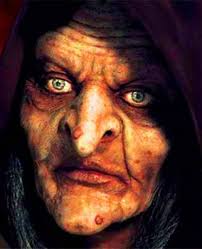 “My goodness!” she said. “I look like an old wicked witch!” She gave this some thought. “Well,” she finally said, “why not? I’m alone and friendless. I have barely enough to eat. I remember hearing about other old women who lived alone. People thought they were wicked witches. Hunh! I guess that’s what I’ll do now. Go into the wicked witch business.” She thought some more. “Well, maybe semi-wicked. My grandmother taught me stuff her grandmother taught her—how to mix potions to heal or kill. How to read the cards. All I need to do is remember those lessons. Then I can go into the wicked witch business.”
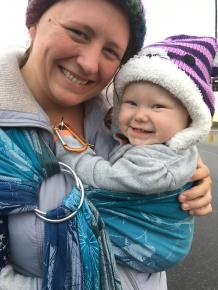 This month I turn one as a mother. My daughter, consequently, is also turning one—a first birthday I am excitedly planning. Specifically, I want to make Hazel a rainbow cake with lots of colored layers and white frosting. I’m not even sure she’ll be able to eat the cake (avoiding lots of sugar for a one-year-old and all), but among those family pictures I treasure, my mother held a cake for her little ones. I want to be like my mother. I am going to make a cake.
 The Soul of Gaia is the numinous earth beneath my feet, her soil cradling the bones and the stories of the ancestors who have died into the land and become part of the ever-living spirit of the place.
 In my other writing for Feminism and Religion, I’ve discussed how a key focus of my spiritual path involves
 I have been following the statistics on the
