In late August, I wrote an article about the Tjet or the Knot of Isis, also called the Blood of Isis. I thought it a good idea to come back and write about the festival, now ended. We gathered in the live oaks and ashe-juniper trees, just outside of Dripping Springs, Texas. It is private land where we could be free in our choices of clothing, or not. The Festival of the Goddess is in its 24th year and going strong. We had close to 100 women and 28 little girls. Our Goddess this year was Isis, Goddess of 10,000 names. We came with the intent to reclaim Her name from the hatred and violence perpetrated by those the media calls by Her name.
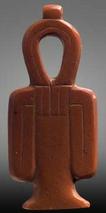 Friday night, I served as co-priestess in the opening rite which amazingly elevated every woman there. We called the Quarters, invoked the Elements and tied the Knot of Isis, with nine-foot-long, red sashes, on to bamboo poles cut with a cross bar, made to resemble ankhs. Each woman invoked her Element and the Power and Magic of Isis to guard and protect the space where we were gathered. We then called to Isis to join us. With doumbeks playing, Isis – yes, a real live Isis – walked into our Circle. She had two escorts who assisted Her up onto a platform where She spoke to everyone present.
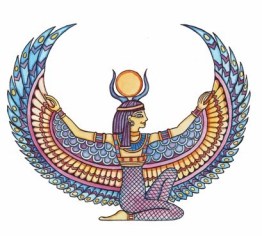 She was dressed, as you can imagine, in Egyptian robes with Her regal crown of horns and sun. On Her arms were Her beautiful wings. They were made by sewing men’s ties together with the small ends flapping in the breeze at the back. They stretched from Her shoulders to Her finger tips. Every woman and maiden there was able to come forward to receive a blessing from Isis. Many were enfolded in Her wings. Our Isis was a beautiful African American woman with long black hair, braided in knots. She completely embodied the spirit of Isis. This was her first time to ever come to a Goddess festival and I am sure when she agreed to her role in the ritual she thought it was going to be like a theatrical performance but she truly aspected Isis. It was amazing. I talked to her later and she told me that she never anticipated the intense emotional experience she had.
Once the blessings were completed, the women at the Quarters brought their Tjet-tied, bamboo poles to the center where a large piece of fabric was tied at the corner of each pole and then lifted to be carried over Isis as they processed up the hill to the Temple where She then moved to sit on Her throne.
We placed a basin of water at Her feet in which were the Waters of the World and asked for the blessings of Isis to purify and bless all of our waters, so polluted by mankind and to help all become more mindful of how important it is for our waters to be clean. From there we installed the four poles, knotted with the Blood of Isis, to stand guard at the Temple.
Everyone went from there to the large fire circle for drumming and merriment. (I went to bed.) Later, in the dark of night when no one was in the Temple, a life sized Isis was placed on the Throne. She was made with a wire frame, stuffed and dressed. Her Styrofoam head was painted to have dark skin and her hair and headdress were identical to those of our “live” Isis. She was amazing!
The next day I offered a Croning Rite, to mark that Passage for eight women, ready to be known as Crones. I was assisted in the ritual by the women who were serving as Crone Guardians for the weekend. I took them on a spiral of their lives from Girlhood, to Maiden, to Mother and to Crone. We all cried together with all the memories shared! That afternoon I did two workshops, back-to-back. The first was Yoni Printing and the other, to share what the Tjet means, as well as to teach women how to tie it. There were many other workshops – Intuitive Tarot – Breast Casting – Sacred Dance – Tara Dancing, to name just a few.
Once my part of the day was completed, I sat with good friends in the Crone Camp to enjoy the beautiful land, the shade and cool breeze – and to rest. My old bones were tired!
Saturday night was the big talent show. This festival started out 24 years ago for women to come together and share their talents – artistic (as vendors) singers, dancers and musicians – to perform for their Sisters in a safe and beautiful environment. When we first started this it was held on a piece of property owned by Genevieve Vaughn who gifted the use of the land to us. It was an incredible space that even had indoor accommodation for women who needed beds. All of the performances Saturday night were wonderful. I will have to say that I enjoyed what the maidens offered the best of all. Such amazing talent – and those little girls up on the stage – fearless!
Sunday, I once more served as co-priestess to offer a closing ritual in which we honored all Women’s Blood Mysteries by asking Maidens who started their moon cycles this past year to come forward for a blessing. Then all who had carried a child in the past year and finally all who had stopped bleeding.
We offered our gratitude to all who had organized and made this festival such a success. It certainly does take a village! One of the women on the Planning Circle made a small ceramic Knot of Isis made into a necklace with cording, for every woman who came to the festival.
 My own part, in addition to what I did on-site, was to take all incoming email messages with questions and respond with answers. I organized the first Crone Camp ever. We offered a tent already in place as well as cots to sleep on. It was the first time since we moved from Stonehaven that beds were offered. Our Crone Guardians helped by erecting and taking down our large tent. They were also there to help when needed. I also got to be the one who took care of all the women seeking scholarships. I told everyone that I definitely had the best job in the Planning Circle as I got to speak to so many marvelous women! I came home with new friends and a happy glow from being surrounded by so much love.
Deanne Quarrie. D. Min. is a Priestess of the Goddess. She is the author of five books. She is the founder of the Apple Branch where she teaches courses in Feminist Dianic Witchcraft, Northern European Witchcraft and Druidism. She mentors those who wish to serve others in their communities. She is also an Adjunct Professor at Ocean Seminary College and is the founder of Global Goddess, a worldwide organization open to all women who honor some form of the divine feminine.



 Regardless of bigotry and hate spewed by the Republican candidate for President of the United States, the American Christian Right has been among his strongest supporters. Following the disturbing video of Donald Trump discussing sexually assaulting women, many Republicans have jumped from the Trump Train and openly condemned his comments. While some supporters continue to cling to the derailing campaign, particularly Evangelicals including Vice Presidential candidate Michael Pence, one must question, what would lead them to disavow this candidate? Many thought a Trump Contrition was coming during the October 9th debate; and it was a true repentance that would allow Christians to overlook his bad behavior.
 Young Adult Fantasy provides a new realm for exploring feminism and religion. It provides an avenue to which female characters can achieve and influence change. What is Young Adult Fantasy within literature? YA fantasy is a sub-genre of Young Adult Fiction, which is a category of literature whose audience can range from 12-18 years. Recently studies and publishing houses believe that now, YA can consist of an audience from 12-45. The majority of YA readers are female. Interestingly enough, females also are the majority of authors. It is a booming enterprise.
  I suddenly felt sad. Not depressed, but low and sorrowful. I realised that it must have been because I had just exploded and answered my husband in an angry, tense voice. He had said something and I reacted in this overblown manner. What he said could have been construed as an encroachment on my rights as a woman and a human. Whether this was the case or not, I was saddened by my own violent reaction.
 for our daughters coming of age. What about our sons? Where are their ceremonies and welcomes into manhood? Where are their stories in the desert? Is it a mother’s job to provide the container for those stories? Can I call the circle for my son and then step back? I know what it means to be a girl reaching into womanhood. I know what it means to circle with other women. Does it have to be different for boys and men?
 what I found. The circle was called, held at dusk, and each person was instructed to bring a rock for the newly fledgling boy. They were to go around the circle and share what they learned, what they were imbuing into the stone…so far, so good, right?…and then, throw it into the darkness and say, “find it for yourself.” When I read this, I had an epiphany. If this was a ceremony for girls, we each would have handed her the stone and welcomed her into the circle with our wisdom, we would have made sure she knew that she was strong, powerful, and capable, but also that part of that power meant that we were standing with her and offering our wisdom in support. She would not have to crawl in the darkness alone looking for rocks, because we’re there. And, that is the core message of most women’s circles and ceremonies for girls. We’re there. You are not alone. So, then I knew…a ceremony for a boy need look no different. Maybe I do not know the stories from the men’s desert, but I do know what it is like to celebrate someone for their unique gifts and strengths, look them in the eye and affirm their power, and sing to them with love of my support of their dreams. This is not a gendered thing, this is humanity. How do we want to welcome boys into the world of adults? By casting away our wisdom and telling them to search in the darkness for themselves? Or by standing next to them, shoulder to shoulder, hand in hand, and offering all that we have, all that we are, in support, and trust, and honor of their evolving selves?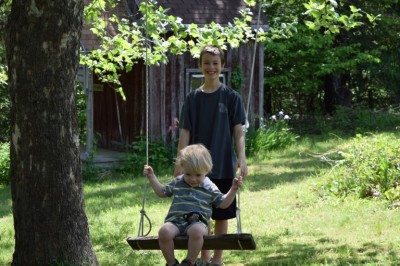
 I had planned to write my October post about the election. Out of respect for everyone’s election fatigue, I’ll give the subject one paragraph only. I voted for Bernie Sanders in the primary. Like Bernie himself, I will vote for Hillary Clinton in November. To Bernie supporters who intend to vote for a third party candidate or abstain, because they cannot in good conscience vote for Hillary, my own conscience prompts me to make one appeal. Forget Hillary. Vote for the people and the principles she is pledged to represent. Flawed as the two party system may be, there are stark differences between the Democratic and Republican platforms in this election. Reproductive rights hang in the balance as well as whether this nation will address or deny climate change, just to name two of a host of critical issues. Enough said.
 What if it really is as simple as changing our minds?
 We live in a dystopia. This world is filled to the brim in dichotomies: poverty and extreme excess, hunger and mountains of food, disease and cutting-edge medicine, materialism and an immense environmental crisis, and hour-long walks for water and hour-long luxurious baths. There are so many parts of our world that are not just unfair, unequal, broken and undesirable, but violent, traumatic and deadly. And, sometimes it feels like it is only getting worse, or at least, again teetering on the edge of yet another catastrophe.
