One of my morning practices is Lectio Divina, divine reading. Instead of reading scriptures, I read poems. The practice calls on me to be alert and contemplative. Recently, I have been reading The Shambhala Anthology of Women’s Spiritual Poetry, an extraordinarily diverse selection of poems from 2300 BCE to the late 20th century. I won’t be quoting from the collection, but I do recommend it to FAR readers as a sample of our literary, religious and feminist legacy.
Writing has always been one of the more accessible forms of expression for women. You don’t need expensive paints or canvas, clay or stone. To complete your work, you don’t need access to a theatre or an orchestra. Just a scrap of paper, a writing implement, a stolen moment, and, yes, the opportunity to be literate, not easily come by in many times and places for women or men. If you are literate, the act of writing itself does not require even Virginia Woolf’s much-to-be-desired room of one’s own. Jane Austen is said to have written at the dining room table surrounded by the chaos of family life. Continue reading “Celebrating National Poetry Month by Elizabeth Cunningham”
While Buddhism generally encourages investigation, it is still easy for a Buddhist practitioner to become complacent. This complacency can be caused by the feeling of safety that your particular school of Buddhism provides. How your mind works, how the world works are all explained, all is well, just keep practising in the assigned paradigm, there is no need for thinking outside the box.
However, Buddhists often forget that it is exactly outside the box where the Buddha has been pointing with his every teaching, ever since he got liberated. When a Buddhist practitioner is stuck, the vigour of Feminism can provide inspiration. Feminists simply never stopped, do not intend to stop now.
For several weeks now, I’ve been going through and disposing of stuff that has accumulated in my house over the past three or four decades. One of the more interesting finds was the following letter, written by my husband, when we lived in Saudi Arabia from 2000 – 2004:
May 1, 2001
Travel Letter
To Whom It May Concern:
My wife, Esther Ruth Nelson, has my permission to travel to Bahrain, Iran and other countries on May 1 – 30, 2001.
In my previous post, I wrote about my participation in planning a memorial event for the lynching of a man named Jesse Washington in Waco, Texas one hundred years ago. It prompted me to reflect on the challenge of faithfully remembering a conflicted past. It’s important that we don’t just remember past events, but that we remember them appropriately.
I’m convinced that when we remember the past, we must avoid oversimplifying the stories of what occurred to suit our present day agendas and sensibilities. We have to acknowledge the complexity, tension and conflict in what occurred, and perhaps even our own guilt and complicity in what is still occurring. As a black feminist Christian ethicist, I face this challenge when one aspect of my identity seeks to address a particular issue through a narrative that implicates or denigrates another aspect of my identity. Uncomfortable as it is, I recognize Christianity’s complicity in its defenses of chattel slavery. I recognize women’s support of patriarchy.
I went to a lecture a few weeks ago by Walter Brueggemann, a well-respected Old Testament theologian, titled “The Risks of Nostalgia.” Brueggemann warned us of the dangers of mis-remembering the past. Pointing to texts from the prophets and Psalms, he demonstrated how the people of Israel remembered a past before exile without remembering the difficulties, the exploitative conditions, and the tensions of that time. Excluding these harsher realities allowed them to gloss over the differences among them to unite in hatred and distrust in a common enemy—the one responsible of their present situation. By misremembering, they lamented a version of past that didn’t belong to all of them because it didn’t include their diverse histories. But the singular narrative served a purpose—it furthered their cause, their yearning and motivation to return to the way things were before. Did this cause really serve all those who were yearning for it? It’s a question that comes to mind when I hear women yearn for a pre-feminist era or Christians yearn for an era of Christendom.
Like the Old Testament people of exile, we are in moral danger when we remember the past with a nostalgia that sweeps over the real stories of what happened in the past. We risk buying into a narrative that harms us in its oversimplifcation. A simple solution will suffice if we believe we have a simple problem.
Lynching was not a simplistic problem and the Waco Horror is not a simplistic story. A black man was lynched for raping and murdering a white woman named Lucy Fryer. I’ll admit it. The realities of the story make me uneasy. Jesse Washington confessed to a crime and was found guilty in the court proceedings that preceded his murder. It makes sense to question whether the criminal proceedings were biased and whether his confession was coerced or illegitimate in some other manner. But even if we question his confession or conviction, we shouldn’t gloss over them as if they never occurred. To present him as a purely innocent victim would be to distort the past to serve a cause – and even a cause as noble as community unity or racial justice should not be attained through lies. People of integrity must guard against distorting the past for “the good” because the distortions themselves cause pain and harm.
Fryer’s family is still experiencing pain over her murder which precipitated the lynching. Sadly, their pain is made worse by the remembrances of Jesse Washington. Their pain does not mean we should not remember, but it does mean we cannot, as people of good conscience, romanticize violence or idealize its victims. Some people might make Washington out to be a hero or a martyr, but the organizers of the memorial service didn’t remember him that way. We didn’t cast him as a blameless victim. But we remembered him as a victim, nonetheless.
We didn’t romanticize the lynching crowds and their pursuit of justice, either. Washington was brutally tortured and killed before a crowd of thousands. If Christians are a people who embrace the love and mercy of a God who forgives the worst of sinners, they have to condemn even those crimes committed in the name of justice; crimes committed against criminals.
Noble causes, if they are just, must stand in the truth – the messy, complicated truth that resists casting all our heroes as saints, all our villains as irredeemable sinners. Real humans aren’t characters who wear the white hats and black hats of the old Westerns (or even the white hats of Olivia Pope & Associates on ABC’s Scandal).
When we resist remembering simplistic, nostalgic stories, we can begin to grapple with the reality of how difficult it really is to achieve justice. We can see humankind for who we really are. And maybe then we can ask for help.
We can ask victims to help us heal the wounds that persist. We need their help to understand their pain and the underlying causes we seek to solve.
We can ask for the help of those who study the various aspects of our world and culture—the economists, the sociologists, the historians, the artists, the theologians and ethicists, the criminologists, and the scientists. We can be humble enough to learn what we don’t know about what’s really going on.
And I hope we also ask for divine assistance. Despite their own complicated histories, wrongs, and imperfections, our faith traditions can enable us to do more than merely rightly remember, consider, and observe the problems in the world. They can embolden us with the courage of Harriet Tubman, Sojourner Truth, and Ida B. Wells-Barnett to speak a complicated truth and yet still dare to fight to make this a better world.
Elise M. Edwards, PhD is a Lecturer in Christian Ethics at Baylor University and a graduate of Claremont Graduate University. She is also a registered architect in the State of Florida. Her interdisciplinary work examines issues of civic engagement and how beliefs and commitments are expressed publicly. As a black feminist, she primarily focuses on cultural expressions by, for, and about women and marginalized communities. Follow her on twitter, google+ or academia.edu.
A friend once laughed to hear me describe picking wild raspberries as a “holy task,” but it is. A task earthy, embodied, mundane, and miraculous at once. Each year, I sweat and struggle, am scratched and stung, but I return home once again with my bounty.
As I returned, red-faced, sweating, and after having yelled much more than I should and having said several things I instantly regretted, I was reminded of something that I manage to forget every year: one definition of insanity is picking wild berries with a toddler. In fact, the closest I ever came to spanking one of my kids was during one of these idyllic romps through the brambles when my second son was three. While still involving some suffering, this ramble was easier since I had a nine and a half year old as well as the toddler. This time, my oldest son took my toddler daughter back inside and gave her a bath and put her in new clothes while I was still outside crawling under the deck in an effort to retrieve the shoes and the tiny antique ceramic bluebird that my girl tossed over the railing and into the thorns “for mama.”
While under the deck, I successfully fished out the shoes (could not find the tiny bird) and I found one more small handful of raspberries. Since the kids were all safely indoors, I took my sweaty and scratched up and irritable self and ran down to my sacred sanctuary in the woods. I was thinking about how I was hot, tired, sweaty, sore, scratched, bloody, worn, and stained from what “should” have been a simple, fun little outing with my children and the above prayer came to my lips. I felt inspired by the idea that parenting involves uncountable numbers of small, wild adventures. I was no longer “just” a mom trying to find raspberries with her kids, I was a raspberry warrior. I braved brambles, swallowed irritations, battled bugs, sweated, swore, argued, struggled, crawled into scary spaces and over rough terrain, lost possessions and let go of the need to find them, and served as a rescuer of others. I gave my blood and body over to the task.
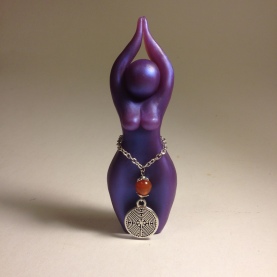
Like Inanna, I faced thorny gates and descended into darkness, crawled on my knees, and gave up things that I cherished, and in the process discovering things about myself, and then returned with a renewed sense of purpose and an awareness of my own strengths.
Now this year, I set out to make homemade marshmallow fondant icing for our daughter’s fifth birthday party. My goal: to make little fondant pandas for her birthday cake. I began with my two pounds of powdered sugar, my melted marshmallows, and my all-natural $12 jar of black food pigment. As I kneaded and kneaded the stiff and difficult dough, my journey became more arduous. I ended up yelling at my lovely children who were leaning over my shoulders to watch the adventure unfold. I said, “just get out of the kitchen!” to the birthday girl herself and I hollered for my now 12 year old to come peel the one year old away from my legs as he attempted to scale my body and reach my arms while my hands were covered with black-icing cement. I ranted and raved briefly about how this is an example of my own life-long tendency to overdo and overperform. Making these pandas wasn’t necessary. I do it to myself. Why do this to myself, I lamented over and over. What is the point? What am I teaching my kids—the cost of having fun and doing something nice and neat for each other is yelling and feel strained and tense? What didn’t I just buy lard-frosting, I lamented (meaning slimy hydrogenated oil frosting from the store). Why aren’t we eating Chicken McNuggets and a cake from Wal-Mart right now? Wouldn’t that be better than yelling at my kids and forcing myself to spend hours kneading panda dough? Shouldn’t we just eat frozen taquitos and watch TV all day and never, ever invite anyone to come to a birthday party ever again?
Then, I fell into a rhythm with the fondant. The sugar started to incorporate. The black started to knead in. I could see it coming together. This is a Hero’s Journey, I thought, this is an Inanna’s Descent. I heard the call to adventure, or fondant, as it were, and I answered. I set forth with my tools and my optimism. I was challenged on my journey. I came face to face with my own shadows. My fingernails became stained with effort. I cast away expectations and judgments. And, then I started to emerge, coming back from my trek, bearing my prize, carrying my treasure, offering my sweet elixir to my people. When I realized it was actually going to work, I started to feel a sense of exhilaration and glee. It is empowering to make your own dang fondant. I called out to my husband with a slightly manic bark of laughter, this is another one of those small adventures! Parenting involves hero’s journeys and Inanna’s Descents every day. What if I’d given up when the fondant got tough? Doesn’t that teach my kids to quit, to not bother, to not learn, experiment, do, and try? I thought about giving birth to my children—how the going gets difficult, how you feel like giving up, and then you emerge, tender and strong, a new human in your arms. I did that! I can do anything! My parenting is stronger, richer, and deeper from knowing that I can face difficult tasks and do them anyway, from knowing that I can draw upon my own strength, my own body wisdom, my own power, and succeed. I am a better person, a better mother, for having hit my own limit and then, incredibly, realized I could go beyond it, that I actually still had the will and courage left in me to do it. Those pandas, while less earth-shaking and life-changing than giving birth to children, were birthed from my own love and effort into my black-icing hands, and my willingness to do it myself, for the ones I love.
I’ve said before that I’d rather be the mom that does cool and fun stuff with her kids and sometimes yells while doing it than a mom who doesn’t yell, but who doesn’t do cool stuff because she’s afraid she might yell or worse yet, because she doesn’t have any fun ideas. (Of course, an awesomer option, would be to be the mom who does cool stuff and also doesn’t yell, but I’m not holding my breath on that one!) After I constructed the first tiny panda and seeing how cute it was and how excited my daughter was about her cake, I felt such a sense of thrill and triumph. I thought that if I hadn’t decided to do it and make it easier on myself, sure, I wouldn’t have yelled, but I also wouldn’t have felt the empowering sense of having done exactly what I imagined doing. When you do hard things and encounter shadows and keep going and come out the other side, you are strengthened. You learn something about yourself. You realize your own capacities and power. If you are unwilling to embark, you stay safer, and maybe even are a nicer person, but you do not experience the overwhelming satisfaction of accomplishment. The pairing—the difficultywith the triumph—is what makes the journey worth it. This is it, I told my husband, this is The Return. I have returned to my people and I come bearing bears. It feels good to be home.
Each child at her party made a panda to add to the cake.
Molly has been “gathering the women” to circle, sing, celebrate, and share since 2008. She plans and facilitates women’s circles, seasonal retreats and rituals, mother-daughter circles, family ceremonies, and red tent circles in rural Missouri and teaches online courses in Red Tent facilitation and Practical Priestessing. She is a priestess who holds MSW and M.Div degrees and recently finished her dissertation about contemporary priestessing in the U.S. Molly and her husband Mark co-create original goddess sculptures, ceremony kits, and jewelry at Brigid’s Grove. Molly is the author of Womanrunes, Earthprayer, and The Red Tent Resource Kit.She writes about thealogy, nature, practical priestessing, and the goddess at her Woodspriestess blog.
It seems that Pope Francis has finally read Margaret Farley’s Just Love; and while he is taking steps in a positive direction, he still needs to spend time processing Farley’s words. With his new statement,Amoris Laetitia (The Joy of Love), Francis has called for us to begin to change our attitudes towards “the other” but is still unwilling to change the man made rules of the Vatican. He refuses to acknowledge that LGBTQ relationships are in fact just and maintains the idea of complementarity rejecting women’s roles and capabilities outside of the home. Continue reading “Pope Francis’ “The Joy of Love” Falls Short by Gina Messina”
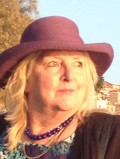
I am Carol Patrice Christ, born in Pasadena, California, daughter of Janet Claire Bergman, born in El Paso, Texas in 1919, daughter of Lena Marie Searing, born in Lyons, Michigan in 1891, daughter of Dora Sophia Bahlke, born in Lyons, Michigan in 1858, daughter of Maria Sophia Catherina Hundt, born in Parum, Mecklenburg in 1827, daughter of Catherina Sophia Elisabeth Schoppenhauer, born in Pogress, Mecklenburg in 1798, daughter of Anna Sophia Seehasse, born in Zulow, Mecklenburg in 1756 in the clan of Tara. I come from a long line of women, known and unknown, stretching back to Africa.
In our ritual on the Goddess Pilgrimage to Crete this May, I will have two new names to add to my mother line. The name Sophia was passed down through the maternal line for at least four generations. I am sorry it was not handed down to my grandmother, my mother, and me.
When I left for Germany a little over a month ago, I knew that Dora Sophia Bahlke was the mother of my grandmother Lena Marie Searing and that Dora Sophia’s parents were Anton Bahlke and Maria Hundt, immigrants from the small towns of Parum and Dummerhutte, in Mecklenburg, Germany. I did not have their parents’ correct names, and I had very little information about their lives in Germany. I have now put some flesh on the bones. Continue reading “An Illegitimate Child in Mecklenburg, 1850 by Carol P. Christ”
Despite all of the ways Western society has separated the spiritual pursuit from the material and deemed spirituality superior to physicality, the religious holiday of Pesach doesn’t. In fact, it is the physical liberation of the Israelites from slavery in Egypt that starts them on their path toward the covenant and an even deeper spiritual connection to the divine. The Exodus story overflows with images, tales and situations in which: bodies are not ignored; nourishment, comfort and care is addressed spiritually as well as physically and the divine’s spiritual gift, so to speak, to the Israelites is not some other-worldly paradise but a this-worldly land flowing with milk and honey.
Of course, this doesn’t mean that the story is perfect: it is replete with war, murder, militarism, forms of colonialism and other manifestations of patriarchal violence. Patriarchal influences encourage androcentric tellings of events and sexism as well. Three examples are the all-male priesthood, the tenth plague “death of the first-born” (of course the only first born that counts are boy children), and the over-the-top covenantal concern about women as menstruators, adulterers, untrustworthy and so on. These aspects are important to acknowledge and critique, but we cannot stop there. We must cherish the story for its insights as well. Continue reading “Pesach, Toilets, and Clean, Local Water: Seemingly Mundane Yet Necessary Components of an Embodied Liberation by Ivy Helman”
I knew I’d paint her from the moment we discovered that we would spend three months of our Year of Volunteer Travel Discernment in Hawai’i. Little did I know how Pele would turn our world inside out, destroying what needed obliteration and recreating new life that we never could have imagined. Pele is the Hawai’ian Volcano Goddess who governs fire, lightening, volcanoes, and the flow of lava. According to legend, she lives in the Halema’uma’u crater of Kilauea on the Big Island.
For over a year, I’d corresponded with a retreat center on the Big Island for my wife and I to be Scholars in Residence, while I also taught yoga and my wife worked on the organic farm. We were beyond excited and arrived in Hilo this January with open hearts and minds, eager to begin our work. Pele had other plans for us. The retreat center where we were planning to work turned out to be a complete disaster: dengue fever, mosquitoes biting my child within five minutes inside our living quarters, proprietors clearly on drugs. We’ve roughed it with no running water in the middle of the woods for months at time, but this was squalor. My wife and I took one look at each other and knew that there was no way we were keeping our child in this environment. Continue reading “Drawing Pele, Retreating to Hawai’i by Angela Yarber”
Reza Aslan says in his book “No God But God” that religions are myths. He explains that “religion” is a set of stories fluctuating between truth and fantasy that serve to explain and answer questions about human fate. Taking this idea as base, I think “religion” is a historical product that enables other mythical stories and must be addressed critically about its truth and meanings.
Patriarchal religious discourses, currently mainstream, have a common element that often is left outside the reading of equality and is part of the myth: Heterosexual belief.
Feminisms in Religions aim at challenging patriarchal readings. However, questioning the nature of God is not enough if we don´t challenge heterosexual belief that may or may not include the idea of a God Father/Male. In Islam, Allah has no sex or gender, is not masculine nor feminine. However, the heterosexual belief exists in the Islamic religious narrative. Continue reading “Islamic Feminism and Heterosexual Dogma by Vanessa Rivera de la Fuente”


 One of my morning practices is Lectio Divina, divine reading. Instead of reading scriptures, I read poems. The practice calls on me to be alert and contemplative. Recently, I have been reading The Shambhala Anthology of Women’s Spiritual Poetry, an extraordinarily diverse selection of poems from 2300 BCE to the late 20th century. I won’t be quoting from the collection, but I do recommend it to FAR readers as a sample of our literary, religious and feminist legacy.
 Although it can be said that the Buddhist teaching can benefit all, including feminists, it can also be argued that Feminism has a lot to teach Buddhist practitioners. Rita M. Gross made this point brilliantly in her “
 For several weeks now, I’ve been going through and disposing of stuff that has accumulated in my house over the past three or four decades. One of the more interesting finds was the following letter, written by my husband, when we lived in Saudi Arabia from 2000 – 2004:
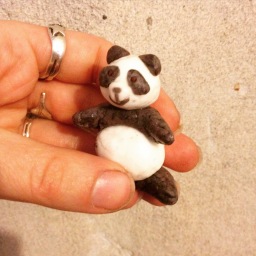 goal: to make little fondant pandas for her birthday cake. I began with my two pounds of powdered sugar, my melted marshmallows, and my all-natural $12 jar of black food pigment. As I kneaded and kneaded the stiff and difficult dough, my journey became more arduous. I ended up yelling at my lovely children who were leaning over my shoulders to watch the adventure unfold. I said, “just get out of the kitchen!” to the birthday girl herself and I hollered for my now 12 year old to come peel the one year old away from my legs as he attempted to scale my body and reach my arms while my hands were covered with black-icing cement. I ranted and raved briefly about how this is an example of my own life-long tendency to overdo and overperform. Making these pandas wasn’t necessary. I do it to myself. Why do this to myself, I lamented over and over. What is the point? What am I teaching my kids—the cost of having fun and doing something nice and neat for each other is yelling and feel strained and tense? What didn’t I just buy lard-frosting, I lamented (meaning slimy hydrogenated oil frosting from the store). Why aren’t we eating Chicken McNuggets and a cake from Wal-Mart right now? Wouldn’t that be better than yelling at my kids and forcing myself to spend hours kneading panda dough? Shouldn’t we just eat frozen taquitos and watch TV all day and never, ever invite anyone to come to a birthday party ever again?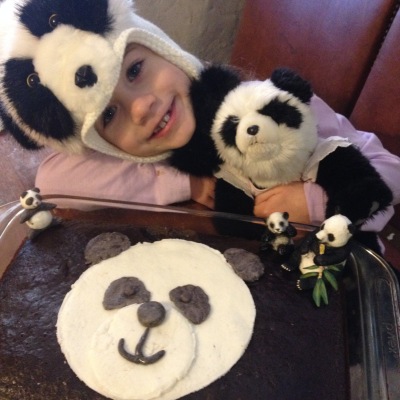


 It seems that Pope Francis has finally read Margaret Farley’s
  I am Carol Patrice Christ, born in Pasadena, California, daughter of Janet Claire Bergman, born in El Paso, Texas in 1919, daughter of Lena Marie Searing, born in Lyons, Michigan in 1891, daughter of Dora Sophia Bahlke, born in Lyons, Michigan in 1858, daughter of Maria Sophia Catherina Hundt, born in Parum, Mecklenburg in 1827, daughter of Catherina Sophia Elisabeth Schoppenhauer, born in Pogress, Mecklenburg in 1798, daughter of Anna Sophia Seehasse, born in Zulow, Mecklenburg in 1756
 I knew I’d paint her from the moment we discovered that we would spend three months of our