In January 2015, I presented at the LGBT Faith Leaders of African Descent‘s third annual forum in Harlem, NYC. As an ally, I was honored to be invited. The theme of the forum was “Ain’t No Hurt Like Church Hurt.” I spoke about becoming an ally as wekk as about sexuality in Islam and among Muslims. However, what I learned while listening to other speakers and audience members will stay with me for life.
I have Christian family members who are gay and have dealt with church hurt because of it. Yet, it is not something I ever witnessed up close or spoke in depth about with them. Being Muslim, heterosexual and cisgender at the conference made me feel like an outsider yet everyone treated me as an insider. I felt as if I were witnessing pain I had no business seeing yet I felt obliged to witness and testify to it. So many people stood up to talk about their church hurt. There were so many tears of great pain and rejection shed during the conference. Everyone there was a great example of resilience. Throughout the day, I just kept thinking how blessed I was to be in the company of such wonderful, embattled, yet humble and loving people. Continue reading “LGBT Faith Leaders of African Descent by Jameelah X. Medina”
I almost got in a big fight with my son on Facebook yesterday. I posted a link to an article talking about the work that Miley Cyrus is doing for homeless teenagers. He immediately responded to my post by calling her a “skanky-ho.” Whoa!
I feel I need to do some qualifying here for a moment. I am not always a comfortable when I watch her performances. I am sure it is my age (73) and coming up in a far different time and mindset from what we have now. I feel a bit embarrassed watching some of her movements that have been labeled lewd by many and clearly so by my son on Facebook. I try very hard to not be judgmental or to place negative labels on anyone just because I may not always enjoy what they do. I do recognize that our perceptions are driven by our religious beliefs, our cultural backgrounds and our own inhibitions. I have to confess, I am even a bit jealous that she can be so open with her own sexuality in such a public way. I can tell you, however, I really like her voice and see her as an amazing performer! Continue reading “Miley Cyrus and the Happy Hippie Foundation by Deanne Quarrie”
The word “nun” can conjure images from traditional to irreverent in terms of gender. The gender of those who call themselves nuns can range from feminine to masculine, from a woman who looks like a woman dressed as a woman, a contemporary sister or “nun,” who does not wear the traditional black habit, but contemporary female clothing and perhaps a short veil or “wimple” and a cross around her neck; to a man dressed as nun in extremely sexual female garb, a “drag queen” nun; to the traditionally dressed nun, whose habit is a full-length black gown, and full veil covering everything but her face and hands, who means to conceal gender and become something else – a “nun.”
The physical space of “nun” then has opened the realm of gender for women, and recently men, since the creation of the category “nun” was established with the first order of female religious. Cloistered orders of women began in the fifth century, with the more liberated orders of “sisters” forming in the sixteenth century. The Encyclopedia of Catholicism lists approximately twelve Roman Catholic religious orders of sisters, or as they are commonly called, “nuns.” However, this terminology should be amended to allow for the difference between “sisters”- non-cloistered orders, and “nuns”- cloistered orders. Most traditionally the word nun officially refers to Roman Catholic nuns – those who take solemn vows of chastity, poverty and obedience, and live cloistered lives of silence, and prayerful meditation. Choir nuns, such as that of the famous convent headed by Hildegard de Bingen, (1098-1179), German nun, mystic and composer, chant the Liturgy of the Hours daily – consisting of a set order of readings and prayers, including Morning, Evening, Daytime and Night Prayers. Continue reading “Thoughts on Nuns and Sisters and Perpetual Indulgence by Marie Cartier”
Last week I was touring the capital of my country, Chile, for conferences and workshops on Islam, Gender and Human Rights. One of the issues I address there was the tyranny of stereotypes Muslim women carry with us and the difficulties we women in general face in order to embrace our spirituality, and to accept ourselves and each other just as we are. It was a nice weekend and a great joy to meet people and make new friends. I learned a lot from colleagues and attendees. One of the happiest moments in my life is talking about Islam outside of religious spaces with non-Muslims – especially with women.
After the event on Queer Spiritualities, I was approached by a young woman who told me:
I attended one of your lectures on women in Islam last year. I came from my town (two hours away) just to listen to you today and thank you. Last year, I left your conference with a lot of motivation for finding my spiritual path, my head free of prejudices and my heart full of joy. I did what you said: To read by myself and reflect in my heart. Today I came to tell you that two weeks ago I CONVERTED TO ISLAM. I AM NOW A MUSLIM. Thank you for introducing Islam in such a beautiful way, thank you for your words that gave me confidence, thank you for your passion and honesty. Thank you. Blessed you always be.
Something similar happened the next day, at the end of the workshop on ¨Muslim Women and Stereotypes.¨ Several of the female attendees approached me to ask: ¨Where can I learn more? Can you recommend books on Islam?¨ And, ¨Is there a Mosque I can visit? – I see you so happy, so free, your smile comes from the heart, I want this joy for me too.¨ ¨I am in my spiritual search, that’s why I came…¨ Continue reading “Islam Is Out There, Among Women by Vanessa Rivera de la Fuente”
I got the idea to write Femmevangelical: The Modern Girl’s Guide to the Good Newsafter a desperate search during a difficult time for a helpful Christian women’s devotional. Yeah, you remember those books that are meant to inspire and comfort, teach and instill spiritual conviction. But I was unable to find a devotional that spoke to me where I was: on a winding, decade-long spiritual journey and finishing my last semester of seminary, clumsily sounding out a feminist theology drastically different from my fundamentalist evangelical upbringing. In a low place, I wondered if my religious tradition even had the ability to raise my hope anymore, much less empower me. Continue reading “Femmevangelical: The Modern Girl’s Guide to the Good News by Jennifer Crumpton”
I was trying not to fidget as I sat on the hard, unforgiving walnut pew. It was a gorgeous summer day out, and I was locked inside breathing stale air and with nothing to look at but the dreary speaker, and, behind him, a life-sized, picture of a sweet-looking man about to be hung from nails driven through his hands. I was visiting my parents, who love to take me to church, and I just wasn’t able to say no.
As I sat I daydreamed about our indigenous European ancestors. They did “church” outdoors, in fragrant, airy forests with wild bluebells, warbling birds, and gentle breezes caressing their skin, ears and eyes. Instead of doing hard time on walnut benches, they got to dance, chant, hold hands and jump through fires.
A friend who is a spiritual teacher speaks often “bringing back the values associated with the Divine Feminine.” For her this has to do with helping women to understand the beauty of our bodies and the importance of ways of being such as giving and caring for others that have been associated with the undervalued so-called “feminine” side of the masculine-feminine polarity. Though she also speaks about the Goddess, I think she prefers the term “the Divine Feminine” because of the implication that men too have their “Divine Masculine.”
This friend has a wonderful husband who is a teacher in his own right and who often ends up spending a lot of his time among powerful women who enjoy talking about the Goddess. In these conversations he sometimes speaks of the need for men to “recover the Divine Masculine” if they are to become whole.
I was reminded of these conversations when a two other friends, in different contexts, recently voiced their concern that Goddess imagery is problematic if it repeats sex role stereotypes. My response to them was that in the West, the feminist association of femaleness with power and value in Goddess symbolism automatically shatters the most important sex role stereotype: the notion that women are less powerful and less valuable than men. But, I said, after that, problems may arise.
I added that (for me) the categories of Divine Feminine and Divine Masculine are problematic because (it seems to me) that at their core these concepts are rooted in the notion that males and females are fundamentally different, and that the so-called “feminine” is relational, loving, giving, while the so-called “masculine” is independent, rational, aggressive, and sometimes violent and warlike. Those who speak of the Divine Feminine and Divine Masculine as oppositional categories usually try to avoid categorizing men and women by stating that “we all have our masculine and feminine sides.” Still it is hard to avoid the implication that men are more masculine and women are more feminine.
Though I agree that men need new images of what it means to be men as much as women need new images of what it means to be women, I hesitate to speak of these as new images of the Divine Feminine and Divine Masculine for two reasons. Although I recognize that others are inspired by images of the Sacred Marriage, for me it has been more important–and more possible–to find power within myself and in a wide variety of relationships, than to find it in a male-female heterosexual couple relationship in which the opposites are “joined.”
More importantly, I find that images of Divine Feminine and Divine Masculine often do justify patriarchal sex-role stereotypes. An internet search for “Divine Masculine” validated this fear. The first (and therefore most popular) website defined the Divine Masculine through six archetypes: God, King, Priest, Warrior, Lover, Sage.
The site’s author seems to want to help men learn new ways to interact with powerful women—as neither dominant over them nor submissive to them. The author writes: “The Divine Masculine represents an archetypal ideal, the best and most inspiring, elevating, and restorative aspects of masculine expression and manifestation in the universe. For those seeking an expanded understanding of the Self, the Divine Masculine is not a distant, detached, jealous and vengeful male deity. The Divine Masculine (along with the Divine Feminine) acts as a shining mirror of the Self, revealing aspects that need compassionate attention and support to become one’s highest potential.”
Following this insight, he redefines the God archetype as “unconditionally loving, inclusive, open, welcoming, heart-centered, spiritually focused, supportive and inspirational.” For him, the King archetype is “benevolent, evenhanded, calm, caring and thoughtfully present.” And the Warrior “finds his place in collaborative projects, being fulfilled and contented with the collaboration and not by ambition or competition.”
While I appreciate the ways in which this man redefines masculinity and male strength in terms that in the past have been associated with “the feminine,” I am concerned that he continues to view the six “archetypes” that include the King and Warrior as universal. He does not explicitly name patriarchy as a system of male dominance enforced through violence as the reason for redefining the meaning of the “archetypes.” I also worry that a good king is still a king, and that a warrior who fights for the good of others is still a warrior. From a feminist perspective, these archetypes are not universal, but rather are the product of patriarchy. Perhaps instead of redefining them, we should discard them.
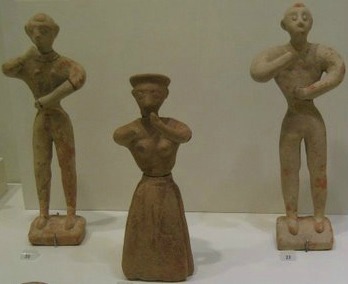
Male and female figures from ancient Crete are not strongly differentiated.
New research suggests that in matriarchies, there is no divine masculine per se, because though men have their own important roles, both males and females are encouraged to embody the values associated with mothers and mothering—in other words to be loving, giving, caring, and generous. In this context there is no opposition or sharp contrast between the divine masculine, the divine feminine, and any other divine gender or transgender.
I believe that that we need a multiplicity of images for divine power that express the diversity and differences of our bodies and all bodies in the web of life. We also need new images of how to be strong and powerful, yet loving and caring above all, in male, female, and other bodies.
However, if the “highest” values are the same for both—and all–genders, then perhaps it is time to retire the oppositional binary of Divine Feminine and Divine Masculine and to speak instead of images of divinity in male, female, and other bodies.
It has been over a year now that I haven’t been actively a part of my interfaith community. I find that especially odd since I graduated last May from the Claremont School of Theology with a Masters in Religious Leadership. I had hopes that I would be empowered by new education to go out and do more for my community, be invited to be a guest speaker at local houses of worship, or sit on panels; all the things I used to do more frequently and now have all stopped.
I am mostly to blame. Although my personal life has definitely changed with the birth of my son, two new businesses for my husband and me, and the ongoing pressure I put on myself to study for the bar exam any free moment I get (I really don’t have any leisure time to study, but thinking about it takes a lot of energy!), and now expecting my second child, I stopped attending my monthly meetings– whether it be with the Interfaith Youth Council of Orange County, the Muslim-Jewish forum of Los Angeles, or my own beloved organization “I Am Jerusalem.”
I sometimes feel a bit awkward about not having read a lot of feminist books and not knowing a lot of feminist theory. However, I draw support from the example of Zen, “the teaching beyond letters.”
The number and scope of different Buddhist traditions might overwhelm non-Buddhists reading my ramblings or any other writings about Buddhism. Even Buddhists, as those who come to Manchester Buddhist Convention, of which I am a co-organiser, every year discover new Buddhist groups that have been hitherto unknown to them.
All these traditions claim to be an authentic form of Buddhism and those that are concerned with such things, trace direct lineage of teaching coming all the way from the Buddha. As the editor of the volume “Buddhist Scriptures” Donald S Lopez Jr notes (Penguin Classics, 2004), such diversity requires certain means of ensuring that this school’s particular teachings are still in line if not with the letter, then with the spirit of the historic Buddha’s teaching.
I find a whole lot of hoopla swirling around this thing we call “diversity.” By and large, these days people readily admit to being “for” diversity. A former colleague of mine, though, became exasperated with the trite, mechanical way many people rally around the concept, claiming to be firmly planted in the “diversity camp.” He would say, “Diversity? How can you be against it? It just is.”
So, what do we mean when we say we are “for” diversity? I think, at least in part, we are saying we want to see the variety of genders, races, ethnicities, and classes living in our communities permeate every aspect of our institutions. People’s “particularities”–their background (education, sex/gender, race, ethnicity, dis/abilities, and class)–shape and color their perspectives. By incorporating the wide swath of humanity into the public sphere, making room for everybody to contribute to society what is uniquely theirs, not only enriches us, but makes for a more equitable world. After all, when your voice is “heard” and when you see yourself reflected in the wider culture (legal rulings, the arts, economic policies), you are less likely to feel disenfranchised.




 I was trying not to fidget as I sat on the hard, unforgiving walnut pew. It was a gorgeous summer day out, and I was locked inside breathing stale air and with nothing to look at but the dreary speaker, and, behind him, a life-sized, picture of a sweet-looking man about to be hung from nails driven through his hands. I was visiting my parents, who love to take me to church, and I just wasn’t able to say no.
 It has been over a year now that I haven’t been actively a part of my interfaith community. I find that especially odd since I graduated last May from the Claremont School of Theology with a Masters in Religious Leadership. I had hopes that I would be empowered by new education to go out and do more for my community, be invited to be a guest speaker at local houses of worship, or sit on panels; all the things I used to do more frequently and now have all stopped.