#BringBackOurGirls is Making an Impact by Gina Messina-Dysert

Gina Messina-Dysert profileIt has been more than a month since Boko Haram militants kidnapped nearly 300 girls from their school in Nigeria.  The social media cry for justice #BringBackOurGirls has fostered global attention; however some have criticized the campaign claiming it is low level information that does not offer any real purpose.  It has been argued that hashtag activism is lazy, frictionless, and functions more as a self-serving public acknowledgment of concern rather than an act for justice.  Likewise, it has been stated that it is the privileged outsider rather than those who need help that launches campaigns like #BringBackOurGirls.  I won’t deny that such critiques do have a basis; however we must also acknowledge that #BringBackOurGirls is making an impact.

Continue reading “#BringBackOurGirls is Making an Impact by Gina Messina-Dysert”

Theological Reflection: Outward, Not Inward by Kelly Brown Douglas

Rev.-Dr.-Kelly-Brown-Douglas - Version 2I was asked recently what frustrates me most about theology. I am a theologian, and love doing theology. Nevertheless, I do have my moments of frustration with the theological enterprise. I am most frustrated when theology loses its dynamic edge and focus. Too much of theological reflection has become “navel gazing” falling prey to the infamous accusation of Medieval theology, that is, wondering “how many angels can dance at the end of a pin.” It seems to me, that we must not lose sight of the fact that the foundation of theological reflection is the revelation of god, which is nothing less than god’s movement that is god’s dance, in human history. All that we know about the transcendent reality is made known to us by that reality making itself known by entering into our world. The best of theological reflection, then, is a response to that revelation, wrestling with the meanings and challenges of god’s revelation to us. Again, far too often our theology is consumed by intellectual strivings as opposed to struggling with god. We, as theologians and religious thinkers, find ourselves debating the essence of god—who god is in god-self, what we call the godhead—as opposed to who god is in relationship to us and our world. Too often we focus our attention on the appropriate pronouns and nouns that we should use to define god as opposed to the verbs that describe the very movement of god in our world. And so, despite the fact that we do not know god in “god-self” or in the god head, theological reflection is spent debating it, and has a long history of debating it. In the meantime, the world stays just as it is—which is anything but a reflection of the gods/goddesses we claim to follow. Even as we can assume that who god reveals god-self to be is a reflection of the very essence of god, theological reflection is best served not by this upward, inward turn to god, but by following god outward into our world. As god moves toward us and into our world, so too are we to move toward one another and into the world, for this is where we will find god. Theological reflection must not be about who god is in god-self, but rather about who god is for us and who we are to be for god. Theology, as it is essentially grounded in the notion that god acts first, is at best an attempt to discern how god is acting so that we can act back in a responsive and responsible way. So what does this mean? Continue reading “Theological Reflection: Outward, Not Inward by Kelly Brown Douglas”

WHY I AM RUNNING WITH THE GREEN PARTY IN ANOTHER ELECTION IN GREECE by Carol P. Christ

carol christOn Sunday May 18 the first round of Municipal and Regional Elections were held in Greece, and I ran for office again. A month or so before the 2010 Regional Elections were held in under a newly reorganized electoral system, my friend Michael Bakas sent me an email saying simply: “You are running with the Green Wind in the upcoming elections.”  Michael asked me to run because we had worked together to save the wetlands in Lesbos and he had supported me as I wrote an official Complaint to the European Commission documenting the failures of national and local authorities to uphold European laws.

I did not know what I was supposed to do as a candidate on a Greek parliamentary-system list, but in the end I passed out flyers in my village and the adjoining one. My name was mentioned in a newspaper article because I was foreign-born. To everyone’s surprise, I came in 3rd of 18 candidates for the Green Wind in Lesbos, and we elected our first councilor in the regional government. After the election Michael told me that we were going together to Chios to meet with candidates to celebrate our victory. There I met an amazing group of green activists and despite being a “foreigner” was warmly received.

In 2012, I ran again in the national elections, that time passing out flyers in more than 20 villages and towns.  As I have been pretty busy campaigning, I thought I would share translations of 2 statements from me that were posted in Greek on the blog and facebook page of the Green Wind. Continue reading “WHY I AM RUNNING WITH THE GREEN PARTY IN ANOTHER ELECTION IN GREECE by Carol P. Christ”

A Love Poem for My Mother, On Earth Day by Candice Rose Valenzuela

Candice Rose Valenzuela teaches English Literature at Castlemont High School in East Oakland, California, and she has been teaching and organizing inner-city youth for the past eight years. She is currently pursuing a Masters in East-West Psychology at the California Institute for Integral Studies, and desires to bring indigenous healing methodologies into teaching and learning in the inner-city.

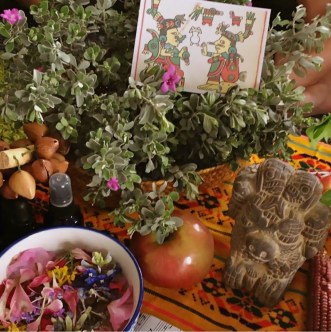
I wrote this poem in observance of Earth Day, April 22nd 2014, and it was inspired by the work of Audre Lorde, Starhawk and Christine Hoff Kraemer in their discussion of the powerful erotic pulse underpinning our connection with ourselves and with all beings on Earth. 

as a child, i spent a lot of time wondering what love is.
and this was because

expressions of it around me were unclear, inconsistent, fleeting or unnamed

but mostly because no one

could teach me to see

what they themselves were blind to.

this is for my Mother. To let her know I see.

Continue reading “A Love Poem for My Mother, On Earth Day by Candice Rose Valenzuela”

Meditating on Woman by Oxana Poberejnaia

oxanaI decided to run a little experiment and to explore the notion “woman” from inside meditation. I practice Anapanasati Meditation, or mindfulness of breath. I learnt it from Theravada teachers. However, through my Buddhist career I have studied in various Buddhist centres and from various schools. The latest one with which I went on retreats is the Western Chan Fellowship (Chan is one of the Chinese schools of Buddhism, from which Japanese Zen developed).

BodhidharmaYoshitoshi1887 Anapanasati meditation involves mindfully staying with your breath and following it as it goes in and out of your body. It is supposed to both quieten the mind and to lead to more clear vision, or insight. In Chan tradition there is also a practice of asking one simple question in meditation, for instance: “What is this?” or “Who am I?” Sometimes exploration of other topics from within the mind which has been quietened and made clearer by meditation is also practiced.

Continue reading “Meditating on Woman by Oxana Poberejnaia”

No Parenting Anxieties (Yet?) About Passing Down the Faith by Grace Yia-Hei Kao

Grace Yia-Hei KaoI’ve recently read Jim Belcher’s In Search of Deep Faith: A Pilgrimage into the Beauty, Goodness, and Heart of Christianity (2013). Even though I had several issues with the book, I couldn’t put it down once I started reading and finished it in the space of one day.

What’s the book about?

Continue reading “No Parenting Anxieties (Yet?) About Passing Down the Faith by Grace Yia-Hei Kao”

Who’s Got the Money by amina wadud

amina 2014 - croppedAfter doing my usual pre-travel research (expected weather, electrical plug usage and currency exchange rates) I tried to amply prepare for a continuous trip between India and Switzerland on one ticket: not too many clothes in my suitcase, but enough for the climate disparity. At the time I checked in, that disparity was something like 90 to 60 degrees (F) respectively. I opted for cotton clothes with layers and sandals with or without socks. As it turned out, India got hotter (nearly 100F) and Switzerland got colder (45F) with biting rain and winds. So I spent a LOT of my down time in my hotel room.

I had stuff to read, casual and work related and managed to keep myself busy. On occasion, I would turn on the TV. All the stations in Fribourg were in French or German with one exception: the financial news channel. I could only take that news for so long. My last day in Fribourg, there was a break in the news and instead they played back-to-back episodes of some program about the “super rich”. It turned out to be more distressing than the news. You’d expect people with so much money to have one thing you might wistfully dream about. But nope, I really have no interest in private planes or huge yachts with custom fitted gold faucets, or Ferraris and Lamborghinis. Yes, I would like to live near the beach, but a small bungalow would do me just as well—no need for the 25,000 square feet vacation home they were showcasing. Continue reading “Who’s Got the Money by amina wadud”

Gray is the New Black by Jamila Sumra

1-jamilasumra 043 I am 47 and I have gray hair.  I decided to stop coloring my h​air some months ago. A decision that was and should be a personal one, set me up, like a badly dressed starlet in the pages of a fashion magazine, for commentary from everyone.

This includes my mother  and assorted sisters in law, cousins and stepson, friends and even salespeople.

Perfect strangers.

I was prepared for my mother’s reaction who is in her late 60s and starts getting restless when a minuscule amount of hair roots begin to show their natural colour every couple of weeks. Who still has her eyebrows threaded in that ultra thin style that was (thankfully) only fashionable in the 1970s.  Obviously then, when I first announced to her that I was going to abandon the hair dye, she wasn’t thrilled.

Imagine being confronted with a powerful and disturbing image illuminating the vagaries of time beside a daughter, your child, with a head of gray hair, when your own is burgundy brown.

Or at least that is what it says on the box.

A stranger, a woman in hijab, stopped me in a supermarket aisle and told me I was ‘brave’.

“I wear the hijab and I wouldn’t ever stop coloring my hair,” she further stated.

A gorgeous friend, always perfectly manicured, expressed confusion, “but why, baby?”

One of my cousins, to whom I sent a selfie, text back, aghast, “Ya Allah!”

In Cape Town, a fashion conscious young woman who works for my mother in law caught me alone one day and approached me warily.

“Can I ask you a personal question?” she asked.

“Yes”

“Is your hair natural or did you pay to get it done?” she continued.

“It’s all natural”

Continue reading “Gray is the New Black by Jamila Sumra”

Christian Sex Ain’t So Vanilla by Andreea Nica

Andreea Nica, pentecostalismMy recent literary digests have included memoirs and nonfiction audiobooks on sex, relationships, and non-monogamy. A recent listen, Open: Love, Sex and Life in an Open Marriage by feminist activist Jenny Block, provides insight into the paradigmatic features of open marriage drawing on the personal experiences of a bisexual woman. Currently, I’m musing over my latest read: The Ethical Slut: A Practical Guide to Polyamory, Open Relationships & Other Adventures written by psychotherapist Dossie Easton and author and sex educator Janet W. Hardy. Through my literary adventures, I can’t help but reflect on my own sexual conditioning and upbringing in the Pentecostal church.

The authors of these feminist-friendly, sex-positive books and social movements did not exist in the church I grew up in, and I feel quite saddened by this. While my sexual conditioning in the church was far from liberating, these reads have helped me realize that the religious community wasn’t as mundane as I thought. My early sex education which was conservative consisted of the anatomical and biological basics (Arizona education system, need I say more?) and early conditioning of sex morals and ethics in the church. The latter was more influential to my perception of sex, gender, and relationships. Of course the media and my peers constructed my views of sexual culture and gender norms, but the church had the greatest impact during my childhood and adolescence. Continue reading “Christian Sex Ain’t So Vanilla by Andreea Nica”

COMPLICATIONS AND CONFUSIONS IN DISCUSSIONS OF THE GODDESS by Carol P. Christ

carol christAlthough writing in patriarchal Greece from a patriarchal perspective, Hesiod said in his Theogony or Birth of the Gods that Gaia or Earth alone was the mother of the Mountains, Sky, and Sea. With the male Sky she gave birth to the next generation of deities known as the “Titans,” who were overthrown by Zeus. Hesiod’s was a “tale with a point of view” in which “it was necessary” for the “forces of civilization”–for him represented by warrior God and rapist Zeus–to violently overthrow and replace earlier conceptions of the origin life on earth and presumably also to overthrow and replace the people and societies that created them.

With the triumph of Christianity in the age of Constantine in the 4th century AD, Christus Victor replaced Zeus in the cities, while the religion of Mother Earth continued to be practiced in the countryside. Over time, many of the attributes of Mother Earth were assimilated into the image of Mary, and priests began to perform rituals earlier dedicated to Mother Earth, such as blessing the fields and the seeds before planting. In the Middle Ages “the Goddess” re-emerged within Western Christianity in devotion to the Virgin Mary, the female saints, and figures such as Lady Wisdom, at the same time that the history of the Goddess was being erased.

In the middle of the 19th century, in Das Mutterrecht (The Mother Right), J. J. Bachofen stunned the scholarly world with his theory that matrilineal kinship, matrilineal inheritance, and reverence for the Great Mother were to be found at the origins of civilization. Bachofen challenged the view that patriarchy and the worship of male Gods had existed “from the beginning .” Continue reading “COMPLICATIONS AND CONFUSIONS IN DISCUSSIONS OF THE GODDESS by Carol P. Christ”