Painting Miriam by Angela Yarber

 We are your subtlest instruments:
no music branches to your breast
that does not sound in us,
no music dies away from you,
that in us lives not,
and even in your absence
your cadence journeys…

Allen Mandelbaum, Chelmaxioms

The path to freedom is often muddy.  Water sloshes through your sandals and the soles of your shoes stick, clinging to the past, weighing down the future.  No one said dancing in wet sand was easy.  But it is very holy.  Just ask the brave prophetess who celebrated liberation by dancing on the shores of a reedy sea.

Often relegated to the submissive role of sister, the character of Miriam is typically overshadowed by the triumphs of her younger brother. Like many of her canonical contemporaries, Miriam receives little attention in scripture. Her name is only mentioned twice and the story of her song is left unsung by the writers of Exodus.  Yet she is there, her song hidden in the crevices of the canon, her dance demanding that we notice the ritual event of liberation, her courageous voice prophesying, leaving a legacy for all the dancing women who will follow in her intrepid food steps. Continue reading “Painting Miriam by Angela Yarber”

Coming out as a Cosmic Cowgirl by Jassy Watson

For the Love of Gaia Jassy WatsonFor the past two months I have been participating in a teacher training called the Colour of Woman (COW) method, an intensive healing and transformational program of sacred painting and intentional creativity founded by visionary artist, teacher, author, and publisher, Shiloh Sophia McCloud. The course is designed for women who want to infuse their lives and work with the mysterious and ancient powers of the creative principles of the Sacred Feminine; she who is known by many names and forms; She who is the mysterious source of life that births both the feminine and masculine; She who has been honoured and deified by many ancient cultures as the bringer of life, growth, decline, death and re-birth; She who is the wellspring of creativity. Continue reading “Coming out as a Cosmic Cowgirl by Jassy Watson”

Genetic Testing: The Ethical Implications of Expanded Newborn Testing – Who Benefits? (Part One) by Michele Stopera Freyhauf

Freyhauf, Feminism, Religion, Durham, Old Testament, Blogger, Bible, Gender, Violence, Ursuline, John CarrollWith Angelina Jolie’s electing to have a double mastectomy because she carried the BRCa Gene, and her mother and aunt died at a very early age of the disease, the issue of genetic testing is in the forefront again.  This is a three-part essay explores genetic testing when it comes to newborn testing (part one and part two) and concludes with exploring personal choices, availability, and psychological ramifications of genetic testing.

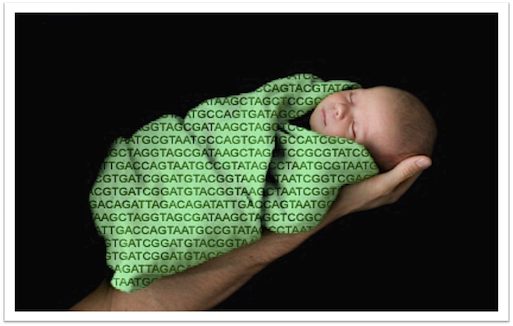
BabySeq
Picture originally found at http://www.ngsleaders.org/blogs.aspx

After nine months of worrying and diligent pre-natal care, the day to meet your unborn child is here.  Labor is long and for hours you lie in the birthing suite riding out contraction after contraction.  The moment finally arrives and you discover you have a son; ten fingers, ten toes and seemingly healthylungs by the cry that you hear.  He is then quickly taken over to the nurse’s station and a drop of blood from his heel is placed into a machine that in seconds will decode his entire genome. Soon your son’s future will be written in stone; he has a life expectancy of 30.2 years and has a 99% chance of dying from heart failure.  In that instance, your son has been labeled as an in-valid and he is now doomed to exist within a lower class of society, one that will prohibit him from pursuing his dreams. Society has discriminated against your new baby boy based solely upon his DNA.  A new form of eugenics is born.

This was the opening scene of the 1997 science-fiction movie called “Gattaca.” Besides pushing the bounds of human imagination, science fiction can serve as a warning about a future caused by the abuses of humankind.  The opening birth scene in this movie is quickly becoming a potential reality.  Now, a person’s entire genome can be decoded and in an instant, a person knows whether he or she will be susceptible to Parkinson’s disease, Alzheimer’s disease, Cancer, or other life threatening conditions.  Proponents of genetic sequencing believe that this is the holy grail of medical care and tout phrases like “personalized medical care” and “significantly reduced costs of healthcare.”  There is a rapid movement towards this goal through the proposed expansion of newborn screening for eighty-four conditions, most of which are not understood or have no known treatment. Continue reading “Genetic Testing: The Ethical Implications of Expanded Newborn Testing – Who Benefits? (Part One) by Michele Stopera Freyhauf”

Selfish Working Mothers Destroying the Natural Order? by Gina Messina-Dysert

Gina Messina-Dysert profileIt was nearly twelve years ago when I sat before my then pastor in pre-cana counseling and was told “how nice it is that you are trying to help women by working in a domestic violence shelter, but now that you are going to be married your role is to be a wife and mother.  Working outside the home will no longer fit into your life.  Your duty is to have children and care for your family.”

Our conversation continued and according to my pastor, God was not concerned with what I had to offer my community, but rather with how many children I could bear and raise as Catholic.  In that moment, I was told that my life and my efforts were of little value and that having children was the one thing I could do as a woman that would make my life worthy.  How funny – or sad – that in the 21st century, women’s worth continues to be tied to her womb and all other efforts are not valued.

Just this last week Pew Research released a report stating that 4 in 10 households have mothers who are either the main or sole breadwinners for the family.   Continue reading “Selfish Working Mothers Destroying the Natural Order? by Gina Messina-Dysert”

Unblocking Abundance: A Ritual by Sara Frykenberg

Sara Frykenberg

Rather than release the sadness, heartache and struggle we put into the bowl out into the world, we meditated …to transform what we could of this energy, re-membering the parts of ourselves that had helped to create these blocks and are responsible for transforming them.  We took the transformed energy back into ourselves.

As I have written about many times before, I believe that contemporary Western society operates within a largely abusive paradigm.  I often think of oppression in terms of an abusive cycle.  Theologians like Cater Heyward and Rita Nakashima Brock describe the impact of the theologies that generate such abusiveness, noting how we become smaller to ourselves and smaller to one another.  We do not believe that we are enough, nor are the people or the planet around us ‘enough’ to fill the vacuous alienation that substitutes itself for real relational need in an abusive context.  Judith Shaw wrote eloquently about the environmental impact of conflating need with greed in her Friday post, “Can We Honor Inanna and Her Gifts?”

Shaw writes, “At first glance we appear to be abundant with things, energy, experiences.  But in our mad desire for more and more and always more we neglect the balance of the very earth who provides us with all.”  Many people, particularly in industrialized nations, have been taught to fill the need for a sense of abundance, connection and ‘enough-ness’ with more stuff: more things, more money, more food, more land, etc.  And yet, ironically, this quest for ‘more’ can also prevent us from experiencing the very abundance we seek.  We can create blocks to abundance by trying to fill the vacuum instead of our actual needs: and difficultly, abusive patterns and cycles can prevent us from seeing the difference between the two.  Continue reading “Unblocking Abundance: A Ritual by Sara Frykenberg”

Leaving Behind My First Love by Andreea Nica

Andreea Nica, pentecostalismDuring these realizations, the words of Sue Monk Kidd permeated my mind, “The truth may set you free, but first it will shatter the safe, sweet way you live.”

When most people inquire who my first love was, I’m reluctant to give an honest answer. At times, I just uttered the first boy’s name that would come to mind. As I matured and developed into a confident young adult, I decided to provide a more honest answer. “My first love was God. Jesus. You know, the Trinity.” I would receive puzzled looks, quizzical faces, and frazzled exits. Given the multitude of embarrassing responses, I began to rephrase my answer in a way that prompted them to further question my response. “I fell in love with God as I grew up in a charismatic, Pentecostal religious community. During my college years I left Pentecostalism, my family unit, and the community.” Responses were drastically different with this answer. Many people desired to know more about my transition and how I found the inner strength to embark on an alternative path. I quickly realized I didn’t have all the answers. Although my B.A. in Psychology aided me in understanding aspects of the psychological implications of my departure from the religious institution and a family that identified as Pentecostal, there was still much to uncover. Continue reading “Leaving Behind My First Love by Andreea Nica”

June—a Month Ruled by Feminine Principles by Barbara Ardinger

Let’s celebrate the Matronalia in the 21st century by demanding money from our male relatives, our male religious leaders, and the men in our local, state, and federal governments to support causes that help women—young girls, married women, new mothers, poor and oppressed and abused women, artists and actors and other performers, philosophers and scholars…all of us. Let us seek out and use Juno’s powers to improve the lives of modern women.

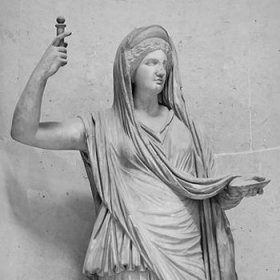
June, Juno, Hera, Barbara Ardinger, marriage, honeymoon, Rome, Hellenistic Period, MatronaliaJust as each Roman man had his genius, or guardian spirit of masculinity, so did each woman have her juno, or guardian spirit of femininity. Juno rules every woman’s entire life and every feminine occasion. In fact, it’s because she’s in charge, so to speak, of married life that we have our June weddings and our honeymoons. Our modern “honeymoon” dates perhaps back to the fifth century and is based on the custom that the newly married couple sweetening the beginning of their life together by drinking a lot of mead (which is made with honey) and making merry. (Honey is sometimes considered to be an aphrodisiac.) Continue reading “June—a Month Ruled by Feminine Principles by Barbara Ardinger”

“Free-Speech or Speech-Free?” by Kile Jones

Kile Jones, atheist[This post is written in response to the chilling effect taking place in the U.K. since the Woolwich Attack.  It is also in response to the uses of the Public Order Act of 1986.]

In any “liberal democracy” that has constitutional protections for “free speech,” there will also be laws against “inciting violence,” “hate speech,” “threats,” “slander,” “libel,” “harassment,” and other “speech codes.”  This is because the government, or those who voted on the passing of such laws, worry about the potential threat un-regulated speech will have on the levels of violence and disharmony in society.  They worry about people being able to yell “fire!” in a theatre, which can cause (which is a key word here for legal reasons) physical harm, not being held liable for such speech.  As much as I understand these worries, I am of the opinion that the potential evils brought about by a lassez-faire approach to speech morally outweigh the evils of blasphemy laws and censorship. Continue reading ““Free-Speech or Speech-Free?” by Kile Jones”

Can We Honor Inanna and Her Gifts? by Judith Shaw

Judith Shaw photoSpring has arrived and my garden begins to emerge once more.  The world greens and blooms all around, reminding me that Mother Earth remains constant in Her desire to bless us with Her bountiful abundance. I am also reminded of Inanna and Her love for humanity.

Inanna, Goddess of Heaven and Earth, a Sumerian Goddess who encompasses all aspects of life, was greatly revered by the  people of Uruk as she brought them the gifts of civilization.

Inanna painting by judith shaw
Inanna in Her Boat of Heaven, pastel and beeswax on paper

This part of her story begins when she visits her father, Enki, God of Wisdom.   As they share drinks and a meal, Inanna proceeds to drink Enki under the table.  Once he’s well into His cups He gives Her the sacred me, the gifts of civilization.   Inanna rejoices as she claims these gifts for Her people, gifts such as:
kingship, the divine queen priestess,
the art of the hero, the art of treachery,
the rejoicing of the heart, the art of lovemaking,
the craft of the builder, the perceptive ear,
fear, dismay,
the kindling of fire, the making of decisions.

Continue reading “Can We Honor Inanna and Her Gifts? by Judith Shaw”

Cells in The Body Of Earth: Living with Violence, Part 2 by Candice Valenzuela

Candice Rose Valenzuela teaches English Literature at Castlemont High School in East Oakland, California, and she has been teaching and organizing inner-city youth for the past eight years. She is currently pursuing a Masters in East-West Psychology at the California Institute for Integral Studies, and desires to bring indigenous healing methodologies into teaching and learning in the inner-city.

In a previous blog, I wrote about the feelings that have engulfed me and the students I teach at Castlemont High School in East  Oakland, California, following the shooting death of “one of my own,” Olajumon Clayborn.

An indigenous elder told me that I needed to go to the ocean in order to heal. I needed to go to nature, the source, to find the sustenance that will strengthen me in these times.  I went to the ocean yesterday evening after school, though my body was exhausted after running up and down Macarthur Avenue trying to dissuade students from fighting with each other in their anger and grief.

As the waves crashed up and down, back and forth on the shore, and came up steadily to meet me, I suddenly found myself knee deep in water, but I was not cold. And I could see clearly from that place. What I saw was this: Continue reading “Cells in The Body Of Earth: Living with Violence, Part 2 by Candice Valenzuela”