Dusk was falling and mist rising as I drove sadly across the Somerset Levels – a liminal place which once formed the huge marshy lake out of which the Isle of Avalon majestically rose. When I rounded a bend to see a large swan walking straight up the centre of the road in the same direction I was going, my first thought was for its safety. I expected it to take flight or veer off at any moment, but the swan continued on its path, seemingly determined to walk just where it was. The road was narrow and all I could do was respectfully follow until it widened a little, eventually managing to squeeze carefully past before starting to flash my headlamps at oncoming traffic to warn them of the swan’s unlikely presence.
Only later that evening did I remember the last time I saw such a stately walk in front of a moving vehicle – when a formally-dressed funeral director led off the hearse which carried my father from his home and on his last journey in this world. I was thunderstruck. Could the swan be marking this new loss, making me mindful and slowing me down? Continue reading “Death of a Priestess by Geraldine Charles”
Is it just me, or does anyone else feel like we’re all in Junior High or High School again with the Petraeus scandal? There is drama at every turn with boundaries crossed and accusations slung across every lunch table there is.
When I was a teenager we didn’t have emails, Facebook , and Twitter (thanks be to God). We passed notes. I remember getting a really mean one scrawled in deliberately messy handwriting to maintain anonymity about how annoying I was to the “populace” (yes I remember that word was in there) because I didn’t wear make up and I thought I was “so smart.”
Just like today’s cyber detectives who figured out Paula Broadwell’s identity from the fingerprints we all leave behind in the online lives we lead, I traced this note back to its source. I did it the old fashioned way—I asked around. Unfortunately I found out it was from a “friend” and teammate of mine. When I went to her house and confronted her she admitted it. Turns out she was envious about a boy. Little did she know at the time that the boy she wished for was abusive and I was living in my own secret hell. I remember thinking to myself “you can have him.” The stakes seemed so high back then—friendships, acceptance, one’s whole sense of self were hopelessly tangled up in tenuous, even dangerous, relationships. Continue reading “The David Syndrome? By Marcia Mount Shoop”
I’ll be giving a presentation in a panel that I organized in one session and serving as the invited respondent in another. I’ll also be spending approximately one-third of my total conference time interviewing candidates with my colleagues for a faculty position at my institution.
This is all to say that I’ll be attending the AAR with a modicum of status and power.
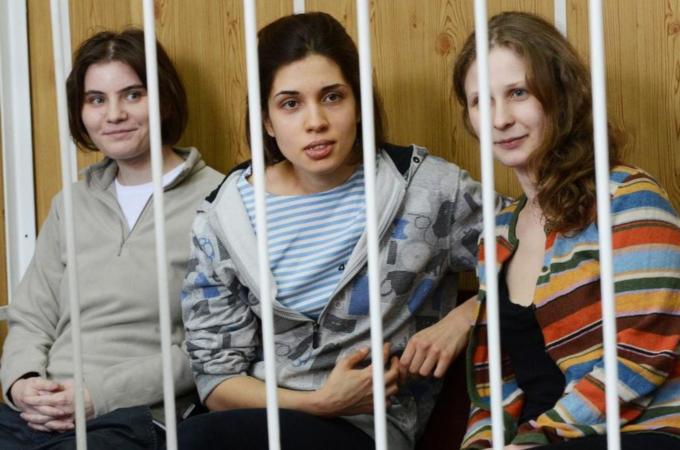
In a country that was willing to [sic] its secular court on a “religious” cause, Pussy Riot are true revolutionaries. Nonetheless, it was not until they delivered these closing statements that their supporters—and opponents—heard what these three brave women stand for. Although they are being crushed in the jaws of the system—and know it!—their courage and steadfast sincerity are sufficient cause for (impossible) hope. If not for the Russian state, then at least for the Russian people. —Bela Shayevich
“When religion puts people in jail it’s unjust” – David Gross
The intermix of religion and politics are familiar, especially after this year’s presidential election. Many supported Mitt Romney out of concern for religious freedom; a stance that had the potential to marry religion and politics in a dysfunctional union. We also witnessed a veiled attempt by the Catholic Church to emphasize and sway the faithful to vote for the one true moral candidate; a stance contradicted by Obama’s ability to carry the Catholic vote. I believe what we see in Russia is a shining example that shows what happens when regulations and laws do not segregate between secular law and church law. Freedoms do not exist, rather, rules and restrictions are imposed creating an institutional prison.
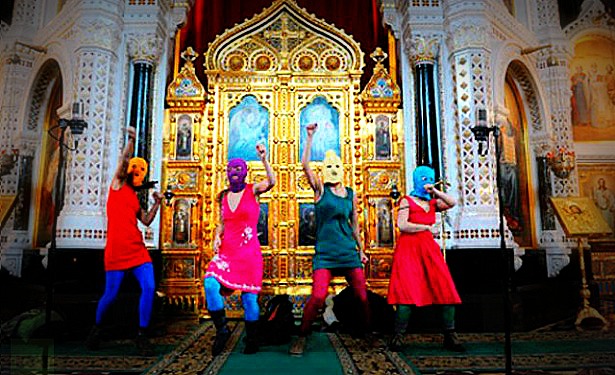
The prosecution of an all girl punk band named Pussy Riot [i] demonstrates a “complete fusion of the institutions of the state and church,” which devalues “women’s rights and freedom of speech.”Members of Pussy Riot are serving a two year sentence of hard labor for “hooliganism motivated by religious hatred.” What was their crime? They went into a Cathedral in Moscow and started singing a punk prayer – “Mother of God, Chase Putin Out!”
They danced, kneeled, and crossed themselves in front of the Church’s high altar. This occurred the day before the re-election of Vladimir Putin. While I do not support going into a sacred space with relics to make a protest, what I find problematic is their harsh sentence. However, it should be noted that with the coverage of the trial and the outpouring of support received from many organizations, and musicians, they did manage to bring to the forefront issues surrounding the government and the Church.
Empowered? I thought so. At least sometimes. I was barely an adult when I entered the sex industry at the young age of eighteen. I had little life experience, was high school drop out, and was forced out on my own a year earlier. I quickly found that the fast food industry offered me little chance of survival. After working seven days a week (with 3-4 of those days being double shifts), barely making my bills, and living off of a tub of expired granola I took from work (and the one meal a day I was provided on the job), I could not help but be enticed by the idea of making hundreds of dollars a day for simply taking off my clothes.
It was a woman I worked with who introduced me to the idea. Her sister was a “stripper” and dating the manager of a local club and she suggested I audition to be a dancer. The wages were more than I had ever imagined earning and I was tempted on many levels to take her advice. Being able to support myself comfortably seemed the answer to my problems, even if it meant violating my moral code. Continue reading “Confessions of a Former Sex Worker by Anonymous”
Male feminists must be aware that we not only engage in an ongoing struggle against sexual and gender inequality, but more importantly an ongoing fight with ourselves.
I have often struggled with that little voice, call it my conscience if you will, that speaks to me during times of distress. Although I consider myself a proud feminist, I still struggle with aspects of what I call, internalized misogyny, or more aptly defined as a male born characteristic trait that imparts the idea that men are not only dominant but also more powerful than the other 50% of the species.
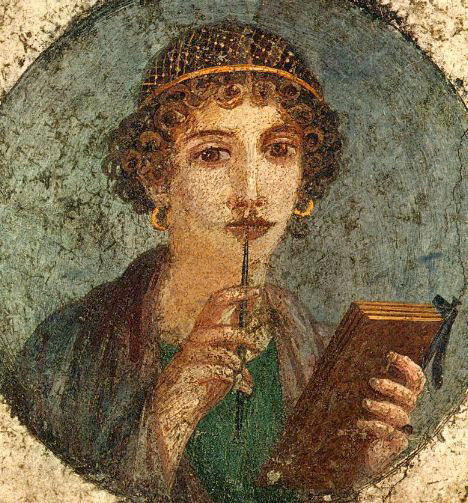
We have been taught to speak of war and the heroes of war in hushed tones. We have been told that evil Helen’s choice was the cause of the Trojan war. 2600 years ago Sappho, known as the greatest lyric poet of ancient Greece, spoke truth to power and unmasked the lies told at the beginning of western tradition.
*
In a poem addressed to Anactoria, Sappho writes:
Some say a cavalry corps
some say infantry, some, again,
will maintain that the swift oars
of our fleet are the finest
sight on dark earth …
Here, Sappho invokes the heroic tradition celebrated in the epic poems of Homer that shaped the values of ancient Greek culture and all the cultures that followed it, including our own. This tradition tells us that to serve in a war and to be remembered as a hero is the highest goal to which a man can aspire. Sappho does not agree:
On Tuesday, President Obama’s acceptance speech included the following statement about coming together as a country across differences of opinion. He said, “We will disagree, sometimes fiercely about how to get [toward the future we hope for]…by itself, the recognition that we have common hopes and dreams won’t end all the gridlock or solve all our problems or substitute for the painstaking work of building consensus and making the difficult compromises needed to move this country forward…”
How do we really do this work? How do we come together across difference to make change? How do we foster productive dialogue that produces genuine and real results? In this dialogue, what principles do we use? What values do we honor? What criteria do we use to judge opinions of others? When is an opinion wrong or when is an opinion just different from our own? Continue reading “Building a Bridge toward the Future: Will You Meet Me in the Middle? By Ivy Helman”
Each month I focus my article on one of my Holy Women Icons with a folk feminist twist. Virginia Woolf , the Shulamite, Mary Daly, Baby Suggs, Pachamama and Gaia, and Frida Kahlo have reputations that match their lived realities relatively closely, so my paintings have attempted to reflect these realities. The subject of this month’s article, however, has been misrepresented and misunderstood throughout the ages. Her “name” is Salome and we read of her dancing story in the Gospels of Matthew and Mark.
If you carefully read Mark 6:17-29 or Matthew 14:3-11, you’re probably wondering why this article features an icon of someone named Salome. There was no mention of anyone named Salome in the text. Rather, in the Markan text both the dancing daughter and her mother are named Herodias. In Matthew’s text, the daughter is nameless. It wasn’t until later when Josephus, a Jewish historian, named her Salome and stated that she was responsible for the beheading of the John the Baptist. Continue reading “Painting Salome By Angela Yarber”
From there he (Jesus) set out and went away to the region of Tyre. He entered a house and did not want anyone to know he was there. Yet he could not escape notice, but a woman whose little daughter had an unclean spirit immediately heard about him, and she came and bowed down at his feet. Now the woman was a Gentile, of Syrophoenician origin. She begged him to cast the demon out of her daughter. He said to her, “Let the children be fed first, for it is not fair to take the children’s food and throw it to the dogs.” But she answered him, “Sir, even the dogs under the table eat the children’s crumbs.” Then he said to her, “For saying that, you may go–the demon has left your daughter.” So she went home, found the child lying on the bed, and the demon gone. (Mark 7. 24-29)
By the time Ohio went to Obama, with his win barely confirmed, journalist and pundits were churning out commentary and statistical findings on the demographics of his larger-than-life electoral college and just-over-the-top popular vote win. Even after Fox news called it for Obama, an awkward lapse of time ticked by as the country waited for Mitt Romney’s concession speech. Turns out he had not prepared one. This political gaffe was one strategic error among many, not with-standing the entire ideology of the Republican platform that became glaringly apparent Tuesday night. While the GOP/Romney camp took the male white vote (59%), this shrinking demographic failed to be enough to secure the win. It seems along with a high Latino/a, African American, women’s vote (especially single women), in addition to a higher turnout of young people than 2008, Obama demonstrated the changing face and influence of a diversified United States of America. Continue reading “What the GOP can learn from The Syrophoenician Woman by Cynthia Garrity-Bond”


 Dusk was falling and mist rising as I drove sadly across the Somerset Levels – a liminal place which once formed the huge marshy lake out of which the Isle of Avalon majestically rose. When I rounded a bend to see a large swan walking straight up the centre of the road in the same direction I was going, my first thought was for its safety. I expected it to take flight or veer off at any moment, but the swan continued on its path, seemingly determined to walk just where it was. The road was narrow and all I could do was respectfully follow until it widened a little, eventually managing to squeeze carefully past before starting to flash my headlamps at oncoming traffic to warn them of the swan’s unlikely presence.







 Feminism and Religion