Tanishka the Moon Woman at the Edinburgh Fringe Festival in August in Scotland
The power of the Eleusinian Mysteries: “so powerful that ‘people in Greco-Roman civilization came to Eleusis to be initiated every fall for almost 1300 years.” The greatest “mystery” about the Mysteries is that they were secret; only the initiates knew what had happened there.”*
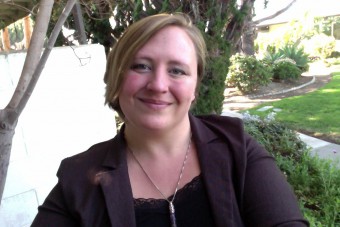
Yesterday, I spoke with Tanishka Moon Woman. I have known Tanishka’s work since I began the divine feminine app a decade ago. It was wildly popular. I believe she had about 400,000 in her facebook group. Tanishka has 27 years of writing books, hosting and teaching Red Tents amongst other online and in person offerings. She travels extensively between Australia, Bali and the UK.
But what if there was a space for the danger of dragon-ing? What if society expected it, welcomed it, and made room for our, women’s, subsequent growth? It might still be hard and risky, as is all growth and change. But as I believe Barnhill is trying to suggest, it might also be less traumatic, less splitting, and give us so much more space to be.
Knowing that I like dragons and feminism, a friend of mine recently recommended the book, When Women Were Dragons (2022) by Kelly Barnhill. I have been reading it (okay listening to it on audiobook, but that counts right?) all week. The premise of the book is that women dragon, as an act, and can do so by choice or spontaneously; and in the “Mass Dragon-ing of 1955” over 600,000 women flew away from American homes, “wives and mothers all” (Barnhill, 2022). But despite the destruction, eaten husbands and bosses, and destroyed homes that dragons leave in their wake, society, the government, and individual families do everything they can to forget it happened. The history is repressed. Individual memory is policed and repressed. The dragon-ing goes on.
Beginning this book the week before Mother’s Day, I found the recommendation timely, or even fateful, because with every chapter and hour that I listen, I find myself thinking of my mother. And I wonder if or when she would have dragon-ed if given the chance.
My grandparents, mother, father, sisters, aunts, uncles, cousins, nieces, nephews, godparents, a good many teachers, childhood friends, a former therapist, myriad internet strangers who felt compelled to try to divert the flames approaching my immortal soul, an astrologer I met once, innumerable people encountered on public transportation and sidewalks, all of my exes’ parents, and, of course, the Roman Catholic Church — an institution of such enormous weight as to have crushed frames far sturdier than my own.
In Part 2 we’ll complete our travels into Mountain Mother’s realms, as we explore female-centered economics and spiritualities as a means toward creating earth- and female-centered communities and small-scale societies.
Imagine living on Turtle Island prior to 1492. At that time Indigenous peoples had been living in respectful relationship to nature, tending her for thousands of years. European invaders and colonists were amazed by the abundance, but assumed they were seeing wild nature. These were subsistence societies! People’s needs were met by the Earth, her plants, animals, waters, and human efforts. No one charged a fee. Everything was a gift.
Growing up in the 1950s in the U.S. I was deeply immersed, trapped like so many girls and women, in capitalist, colonizing, patriarchy. I rescued myself in the 1970s when I jumped head first into the Women’s Liberation movement. I found that the currents pushing communities of women were wild at times, yet taking me where I wanted to go. At that time, it was possible to live one’s life, as I did, largely within this subculture and its women’s dances, bookstores, battered women’s shelters, women of color organizations, festivals, land groups and more. These female-centered and female-only spaces gave women a gut level knowledge of what a world without patriarchy could be like. We could imagine a female-centered world because we were, in many respects, living in one.
Thanks to a decades long assault by the right wing and other anti-feminist forces, women’s spaces became difficult to access. Now the grassroots women’s movement is making a comeback. Over 50 years of second wave feminist thought, research and organizing inform our work. Women’s communities are on the rise. These communities have the potential to become the base for an earth- and female-centered future, as I’ll discuss below.
She changes everything She touches and everything She touches changes. The world is Her body. The world is in Her and She is in the world. She surrounds us like the air we breathe. She is as close to us as our own breath. She is energy, movement, life, and change. She is the ground of freedom, creativity, sympathy, understanding, and love. In Her we live, and move, and co-create our being. She is always there for each and every one of us, particles of atoms, cells, animals, and human animals. We are precious in Her sight. She understands and remembers us with unending sympathy. She inspires us to live creatively, joyfully, and in harmony with others in the web of life. Yet choice is ours. The world that is Her body is co-created. The choices of every individual particle of an atom, every individual cell, every individual animal, every individual human animal play a part. The adventure of life on planet earth and in the universe as a whole will be enhanced or diminished by the choices we make. She hears the cries of the world, sharing our sorrows with infinite compassion. In a still, small voice, She whispers the desire of Her heart: Life is meant to be enjoyed. She sets before us life and death. We can choose life. Change is. Touch is. Everything we touch can change.
I am less concerned with the legitimacy or morality of public breast-feeding . . . rather I am asking what contributes to this strange binary of, on the one hand, social acceptability of near-porn-like images of breast used in advertising, i.e. Victoria Secret, while on the other hand, internal conflicts some feel when viewing a baby/child feeding at the breast?
Beyond the “war on women” initiated by the Republican party on women’s reproductive rights, the issue of women’s breast, or more specifically, the nursing breast, has been making itself know in the media. The recent Time magazine cover of Jamie Lynne Grumet breast-feeding her three-year-old son produced a flood of controversy centering on “attachment parenting,” which promotes, among other things, breast-feeding beyond infancy. Parent magazine recently profiled two military mothers breastfeeding in public while in uniform. For some, this perceived breach in social decorum is akin to urinating and defecating openly while wearing your uniform. Responding to the outcry, Air Force spokesperson Captain Rose Richeson states, “Airmen (sic) should be mindful of their dress and appearance and present a professional image at all times while in uniform.” In other words, it is suggested nursing military mothers pump and bottle-feed their babies when wearing their uniform in public spaces. And finally, Hadley Barrows of Minnesota was asked to leave the library by a security guard because her nursing in public was a form of “indecent exposure.” In this post I am less concerned with the legitimacy or morality of public nursing (although I have no issue with it), instead I am asking what contributes to this strange binary of, on the one hand, social acceptability of near-porn-like images of breast used in advertising, i.e. Victoria Secret, while on the other hand, internal conflicts some feel when viewing a baby/child feeding at the breast? Drawing from the work of Margaret Miles and her text, A Complex Delight: The Secularization of the Breast, 1350-1750, social attitudes and the public display of women’s breast can best be understood when the breast is viewed as a coded symbol that informs, through artistic representation, complex patterns of discourse.
Last week, once again, I had the good fortune to bring a small group of dancing friends to southern Morocco. As always, our travels there unfolded in a blessed and beautiful way, rich in experiences of ancient Berber/Amazigh culture and encounters with local women.
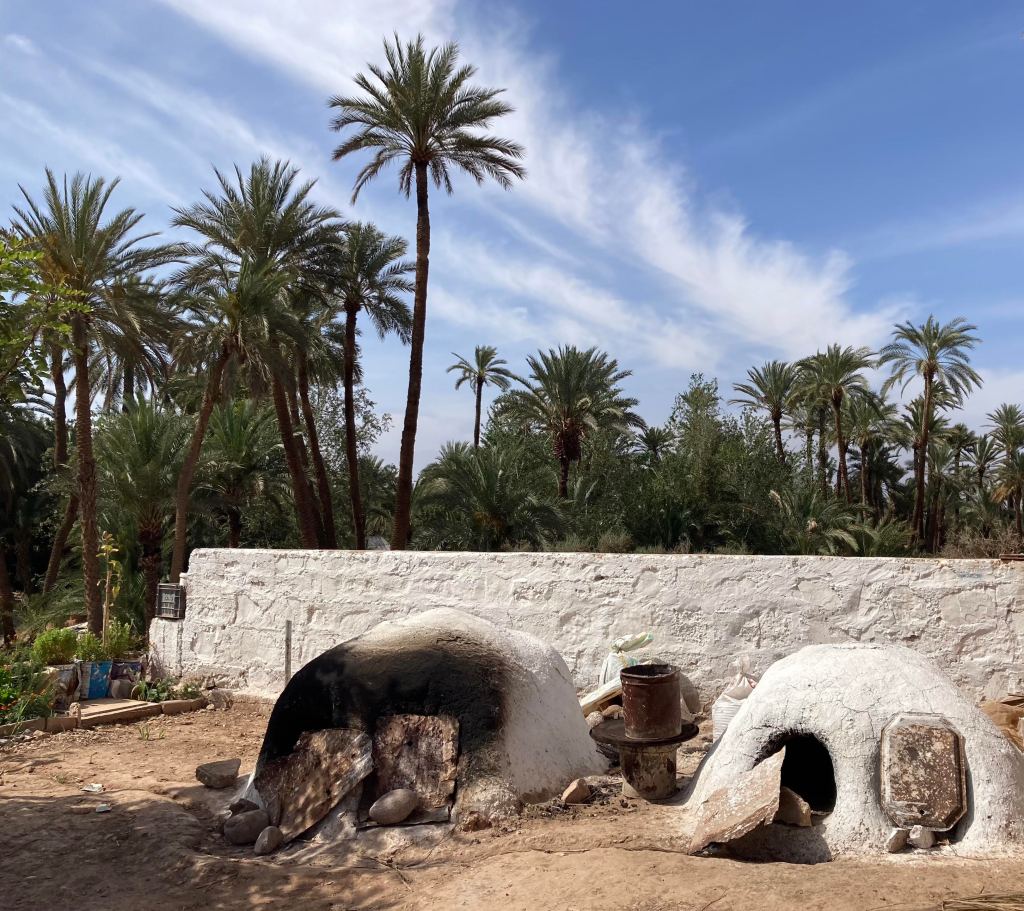
At Tioute oasis in the foothills of the Anti-Atlas mountains, we bought unleavened flatbread baked in rounded clay ovens.
Bread ovens at Tioute oasis, southern Morocco. Photo: Laura Shannon
What are the conditions necessary to foster an environment in which we can truly listen to one another across differences? Gathering insights from many perspectives[i], Alison Jaggar outlined the essential conditions for what she called Feminist Practical Discourse or FPD. These include: 1) the creation of opportunities for participants to talk about their own lives, stressing the importance of first-person narratives and of others listening; 2) the equal importance of each person’s experience; 3) an openness to reevaluating one’s perspective; 4) the inclusion of people whose lives are different from our own and each other’s, especially those whose public voices have been most marginalized; 5) a nurturant, rather than an antagonistic environment, while still allowing for respectful disagreement; 6) participant qualities of self-discipline, responsibility, sensitivity, respect, and trust; and 7) the motivation of care and friendship.








 Feminism and Religion