From the Archives: Sleeping Beauty: An ancient tale for these challenging times by Diane Perazzo

This was originally posted on April 24, 2021

Fairy tales are intwined in our imagination and our spirituality. As Jane Yolan writes, one of the subtlest and yet most important functions of myth and fantasy is to “provide a framework or model for an individual’s belief system.” (1)

In the Reclaiming spiritual tradition, we often use fairy tales in healing and self development work. These stories act as warp and weft as we weave and spin complex ritual arcs and other events that take place at extended Witch Camp sessions. In Twelve Wild Swans, Starhawk points out that fairy stories are “more than just encouraging and inspiring. They are also templates for soul healing from Europe’s ancestral wise women and healers. When the ancient Earth-based cultures of Europe were destroyed, these stories remained.” (2)

Continue reading “From the Archives: Sleeping Beauty: An ancient tale for these challenging times by Diane Perazzo”

From the Archives: Where Did the Gods Come From? by Barbara Ardinger

This was originally posted on June 10, 2012

A man in the group leaned forward and asked, “But how did the Goddess get overcome?” So I told him. Young “warrior heroes” came galloping out of the Russian steppes and the Caucasus Mountains, including Afghanistan, which no one (not even Alexander the so-called Great) has ever conquered. The boys were carrying their thunder-solar-sky gods with them.

Continue reading “From the Archives: Where Did the Gods Come From? by Barbara Ardinger”

Divinely Feminine Events to Change the World by Caryn MacGrandle

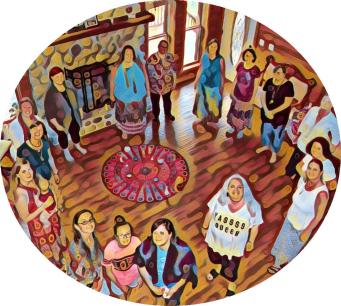
Morning Circle at Midwest Herbal Conference in 2017

In the bathroom at 4am in the morning, I hear the birds start to sing.  Instantly, I am transported back to my tent at Midwest Herbal Conference in Wisconsin to the excitement of starting a new day with the feeling of being in nature with fellow conmadres, amazed at the knowledge and wisdom the women around me hold.  Watching them go into the forest, bend down to see a plant, put it in their mouths and eat it.

Continue reading “Divinely Feminine Events to Change the World by Caryn MacGrandle”

From the Archives: The Deep Exhale by Chris Ash

This was originally posted on November 13, 2018

There’s this thing that happens to advocates when the world around us burns with injustice and fury and we shift into what we know, the holding-fighting, fierce-eyed, tender-hearted caring that pours out compassion and links lives with survivors, shedding trails of sweetness as it goes. It’s a professional skillset and personal practice — a vocation, even? — that girds our own hearts with the structure of listening skills, crisis response, and open-ended questions. We wrap ourselves in the safety of our modalities while we float steadily alongside others, occasionally sharing an oar when someone is stuck.

It is an act of ministry when we exhale-blow out-breathe hard into darkness, trusting in the moment when the deep inhale comes to re-inflate our lungs and faith.

~ inhale ~

Continue reading “From the Archives: The Deep Exhale by Chris Ash”

The Vows We Make, by Molly Remer

I make a vow of self-sovereignty,
a declaration of wholeness,
a promise to myself that I will keep:
I vow to listen to my heart,
to claim my power and my voice.
I vow to live my own magic,
to step into the center of my own life
and live from there.
I vow to live a life
that includes space for me,
to stand up for what I need,
to listen to my longings,
to honor my inner call,
to do my own work with trust.
I vow to never abandon myself.
I vow to inhabit my own wholeness
in all ways.

In February, I signed up for a Vow of Faithfulness class with WomanSpirit Reclamation. Guided by Patricia Lynn Reilly (of “Imagine a Woman” and A God Who Looks Like Me fame) and Monette Chilson, the class was based on Patricia’s book, I Promise Myself: making a commitment to yourself and your dreams. Structured as a seven week online women’s circle, the class took us on a deep dive into vow-making, culminating in a vow ceremony in which we made a public (to the class that is) declaration of our own vows to ourselves. As the class unfolded, I found myself reviewing past vows as well as sensing new vows bumping up against my consciousness, whispering to be heard.

Continue reading “The Vows We Make, by Molly Remer”

Mayflower Memories by Sara Wright

Introduction to MAYFLOWER MEMORIES (‘Blood – Root’)

For the past two weeks I have been obsessed by the thought of emerging bloodroot, a wildflower I have loved since childhood that grows just outside my door (among other places). This obsession, and I take each one seriously, always provokes the same question: what’s really going on here? Bloodroot does not bloom under four feet of snow, and my guess is that this year one of my favorite wildflowers won’t burst with white stars until June.

Today, I also remembered with astonishment that in the old ways, Mother’s Day occurred on March 25th, the time when ‘Becoming’ begins, long before the snow recedes. I’m struck by the difference between the two mothers’ days, this one seems so much more authentic, no room for sentimentality when we face this messy, muddy turning from winter to spring (at least in the Northeast).

Continue reading “Mayflower Memories by Sara Wright”

Legacy of Carol P. Christ: Can You Kill the Spirit? What Happened to Female Imagery for God in Christian Worship?

This was originally posted March 16, 2015

When I first began to think about female language and images for God I imagined that changing God-He to God-She and speaking of God as Mother some of the time would be a widespread practice in churches and synagogues by now. I was more worried about whether or not images of God as a dominating Other would remain intact. Would God-She be imaged as a Queen or a Woman of War who at Her whim or will could wreak havoc on Her own people?

Forty years later, very little progress has been made on the question of female imagery for God. I suspect that most people in the pews today have never even had to confront prayers to Sophia, God the Mother, or God-She. Most people consider the issue of female language in the churches to have been resolved with inclusive language liturgies and translations of the Bible that use gender neutral rather than female inclusive language.

Continue reading “Legacy of Carol P. Christ: Can You Kill the Spirit? What Happened to Female Imagery for God in Christian Worship?”

From the Archives: No Hope, No Problem: Reflections on Pesach, Time and Paradox.

Author’s note: This post was originally published on April 19, 2019.

In “Time Telling in Feminist Theory,” Rita Felski suggests that there are four main ways feminists discuss and use time: redemption, regression, repetition and rupture.  They are aptly named as they behave similar to their labels.  Redemption is the linear march of time, hopefully progressing step by step towards a redeemed, or at least better, future even if sometimes things get momentarily worse.  Regression is the want to go back in time or at least return to idyllic and/or imagined pasts: to matriarchy or to a time before patriarchy’s violent arrival.  Repetition is a focus on the cyclical nature of time in bodies, in daily chores, in seasons and so on. Rupture posits a break in time in a way what was before no longer makes sense or doesn’t exist.   Think utopia or dystopia.

Continue reading “From the Archives: No Hope, No Problem: Reflections on Pesach, Time and Paradox.”

From the Archives: The Hunger Games, Holy Week, and Re-imaging Ritual by Xochitl Alvizo

This was originally posted on April 3, 2012 and serves as a nice follow up to my recent posts, and to the Christian holy days being celebrated this week.

Being passive spectators of violence and injustice, even if mournfully so, is not just a thing of Panem, it is our everyday reality.

In The Hunger Games Suzanne Collins takes the reality of an unjust society and gives it an imaginative makeover. In Panem, most people are kept at such extreme levels of hunger that even when they do eat they cannot fill the hollowness that has settled in their stomachs, while others are deciding on the next cosmetic alteration they will undertake – whiskers, jewel implants, or green-tone skin color? The disparate conditions between the rich and the poor, the few and the many are absurdly and starkly portrayed but done so in a way that we can still recognize our world in theirs. And at the center of this world is the state imposed ritual of punishment and control, the yearly Hunger Games – a nationally televised competition that all the people of Panem are required to watch. The 12 districts watch mournfully as two kids from each of their districts compete to the death, and the wealthy watch gleefully, for the games are the height of their excesses and entertainment. The yearly Games conclude when one kid, the lone ‘victor’, is left standing. All while the nation watches.

Continue reading “From the Archives: The Hunger Games, Holy Week, and Re-imaging Ritual by Xochitl Alvizo”

Boundaries: A Poem Drawn from the Well of Jacob by Marcia Mount Shoop

kikuchi valley, waterfall and light lay in the forest, kikuchi, kumamoto, japan

Today is the day in the Christian church year that we remember Jesus’ last supper with his friends/chosen family before he was betrayed by some of those same friends/chosen family. He talked to his beloved circle that night about many things, including betrayal and their capacity to embody Divine Love in a broken world after his death. Just a few days later he was executed by the Roman government because his prophetic and compassionate life was a threat to the powers that be of his day–both governmental and religious. In honor of this day in my faith tradition, I share a poem I wrote about one of the women in Jesus’ life before he was executed by Empire. Since Jesus’ death, he was kidnapped again by multiple Empires who have used him to put an ecclesial and even divine seal of approval on systems of oppression and genocide. The woman at the well gives us a window into Jesus the liberator. May we have space to remember him today as another Easter Sunday approaches for Christians around the world.

Continue reading “Boundaries: A Poem Drawn from the Well of Jacob by Marcia Mount Shoop”