
A New Glossary for Crete: The Power of Naming and the Study of History by Carol P. Christ

carol-christThe words we use affect our thinking. In the case of ancient Crete the repetition of the terms “Palace,” “Palace of Knossos,” “King Minos,” “Minoan,” “Priest-King,” and “Prince of the Lilies” shape the way we understand history–even when we ourselves know these terms are incorrect. We must engage in “new naming.”

Ariadne. May have been a name of the Goddess of pre-patriarchal Crete. The ending “ne” signifies that Ariadne is not of Greek or Indo-European origin and thus predates the later Greek myths.

Ariadnian. The name I have given to the Old European pre-patriarchal culture of Crete, from arrival of the Neolithic settlers from Anatolia c.7000 BCE to the Mycenaean invasion c.1450 BCE. Arthur Evans named the Bronze Age (c.3000-1450 BCE) culture of Crete “Minoan” after King Minos of Greek mythology, son of Zeus and Europa, husband of Pasiphae, father of Ariadne, whose gift of the secret of the labyrinth to Theseus led to the downfall of her culture. Evans assumed that Minoan Crete was ruled by a King.

This image I call “Ariadne Dancing” could become the new “icon” of Ariadnian Crete.

minoan woman dancing

It could and should replace the “icon” of  the “Priest-King” Arthur Evans’ “imaginatively” reconstructed and named the “Prince of the Lilies.”
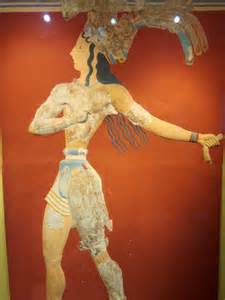
 prince of the lilies

Once we remove the crown which probably belonged to a Sphinx, the figure’s white color and athletic body suggests it was intended to portray a young female bull-leaper leading a bull. Continue reading “A New Glossary for Crete: The Power of Naming and the Study of History by Carol P. Christ”

Earth Connection & Healing the Bees by Jassy Watson

Jassy_Agora1-150x150

I’m an avid gardener. I must, need, long to have my hands in the soil. The sweet smell and feel of the earth connects me to something greater, to a sense of ‘other’; a source divine. I am interwoven, connected, at one and in reverence of a greater mystery.  When I think about my connection to the earth and its origins, I find it is a connection I have had my entire life. As a young girl I spent many hours, days, in fact years, exploring the Australian bush – it was my backyard. Some of my most prominent memories are the smell of Eucalypt and the crescendo of cicada song that would permeate my entire surroundings throughout summer. As a teen, time and time again, I bushwalked our families property that backed onto mountainous National forest. I often sensed the indigenous ancestral spirits of our land watching attentively.

It is this deep connection that I have to the earth that not only leaves me feeling exultant, it leaves me troubled. I am troubled by the continuing problems caused to the environment. I admit to feeling quite disturbed recently when I read a number of reports about the persisting problems with the Fukushima Nuclear plant – radiated water still leaking into the ocean. Birdlife and ocean animals found suffering from radiation burns. Should we even be eating fish from the pacific? I can’t begin to fathom the enormity of the repercussions from this disaster that will be seen for many generations to come. My inner activist wants to be out there on the frontline, riding the waves on the Rainbow Warrior, tied to an ancient tree in protest of lopping; but I know my place is here, nurturing my little ones. So what can I do with these troubled feelings, with the frustration and with the love I have for Mother earth and all her beings? Action starts from home. So I let it fuel my fire and I get creative. I paint, I write, I garden; with intention. My intention is to play a role, no matter how small, that aids in the healing of the planet. I hold hope that it inspires other to do the same. Continue reading “Earth Connection & Healing the Bees by Jassy Watson”