

“People spend so much time mocking Trump or waiting for him to be impeached. And the danger with that kind of obsession with a single person is that you don’t see the system that produced him.”
Arundhati Roy
Here at FAR, along with many other venues, we have borne witness to the depravities of this administration. This is important work as it is a main component of the mop-up that will eventually and hopefully lead to accountability and meaningful change. This post and the following one looks at the route of how we got here. I have long pursued this theme using the Bible as the foundational belief system underlying our culture. I love to explore how typical translations undermined older beliefs that connected traditions and peoples. In this post and the next I will look at some of the stops we’ve made along with way here in the US to get here to the present day. I will do this by looking at two books I read many years ago that have stayed with me for their poignance and revelations.
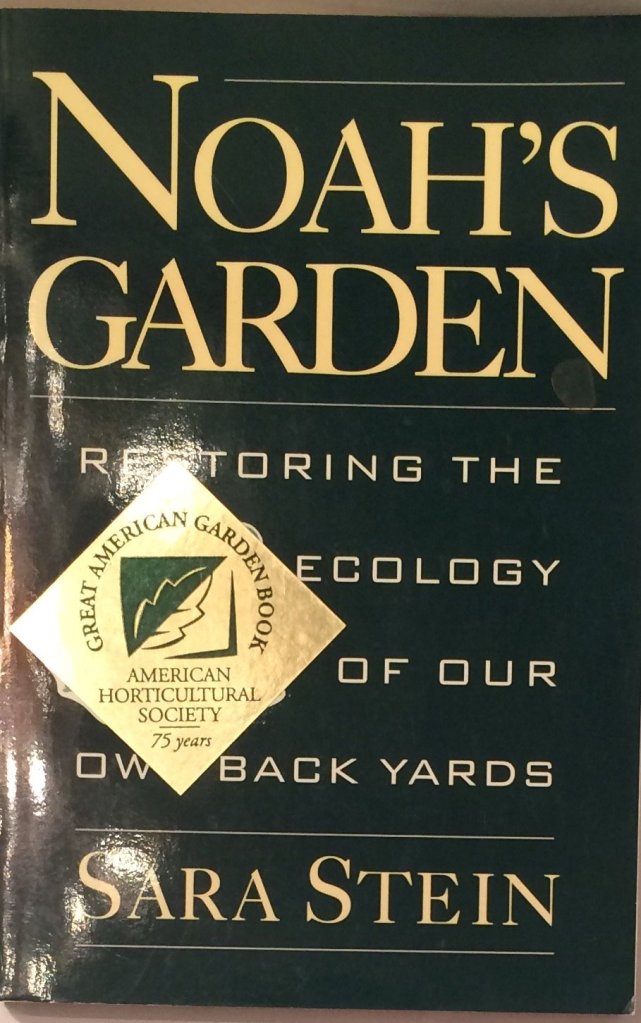
The first is Noah’s Garden by Sara Stein. The subtitle is “Restoring the Ecology of Our Own Backyards.” It was published in 1993.
This book really hits home for me because I live in ecologically sterile suburbs which are satellite to New York City. It pains me to see the lawns in my community which are not only all the same but lay outside the fronts doors like they were indoor carpeting. In other words, LIFELESS! Stein writes, “We spend $25 billion a year coddling this carpet that on an August day lies sprawled over 30 million acres of America, stupefied in the sun.”(151). As these figures are from over 30 years ago, I can say with confidence that the numbers of money and acreage are vastly larger today.
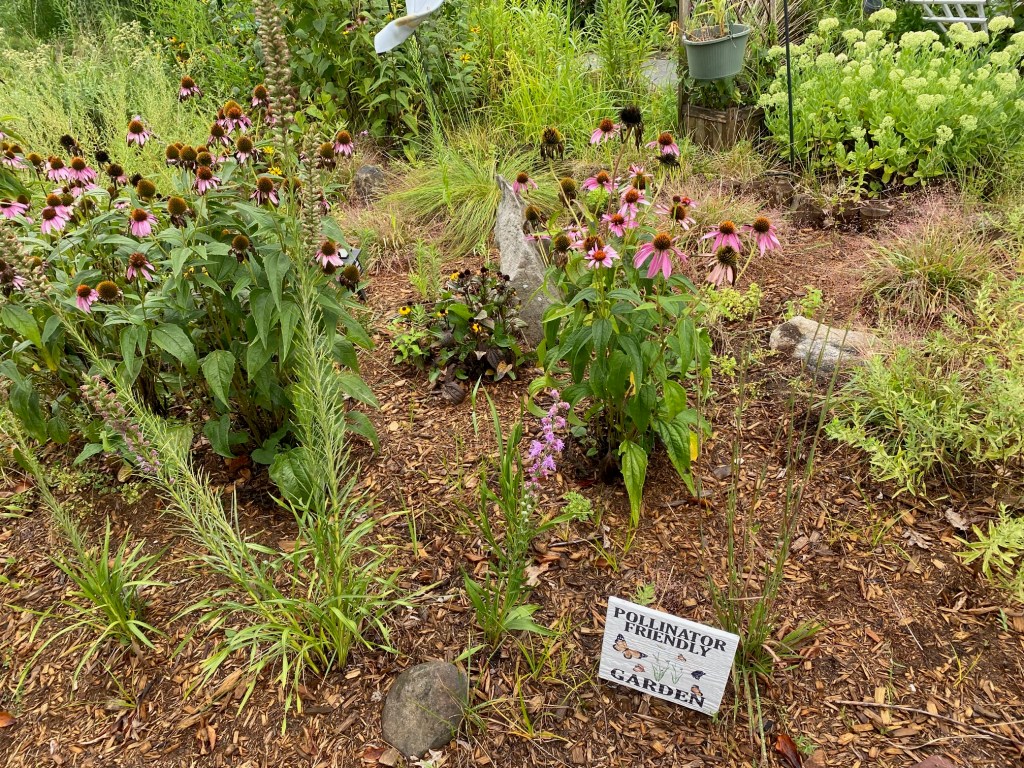
My own yard has been many years in the making as my husband and I have ripped out all our grass to make room for native plants. We completed it this year although there is still much work to be done. One third of my front yard is native plants, on third is purple love grass and the final third is wildflowers.
Sara Stein does a beautiful job of discussing the eco-systems of our own yards and how it all intertwines a larger picture of the interconnectedness of life and our own role in it. Even her chapter titles are lush “Unbecoming a Gardner,” “Who Gets to Stay Aboard the Ark?” “The Aphid on the Rose,” and “Frogs; In Memoriam,” to name a few. She also discusses at length how a soil base stays healthy in a vigorous ecosystem. It certainly isn’t by spraying pesticides onto the monoculture which ensure that everyone’s lawn looks the same.
In her own journey, Stein moved from the city to the country where she contemplated and experimented with differing landscapes. The first thing she and her partner did was to clear brush and dig beds. They removed undergrowth to create what she writes was “an expanse of landscaped grounds that seemed to us like Eden.” She goes on, “Then it hit, I realized in an instant the full extent of what we had done: we banished the animals from this paradise of ours.” (9)
I just adore that she points this out: “We can’t in fairness rail against those who destroy the rain forest or threaten the spotted owl when we have made our own yards uninhabitable.” (19)
Stein lays out how each garden creature and life form, including fungi and insects, some of which we view as unpleasant such as aphids, has a role to play. She goes on to note that we can’t choose one life form over another as everything is interconnected. “Each animal plays a role for which there is no understudy. And the whole witch’s brew of toads, snakes, bats, shrews, and spiders is as necessary in a workable ecology as is the gracefully swooping swallow.” (87-88)
As she was planning her landscaping she writes, “A question came up repeatedly is which animals I intend to live among us. People who readily accept songbirds and butterflies and understand their need for natural habitat nevertheless worry that busy undergrowth will provide breeding grounds for snakes and rodents. Thus a famous gardener cuts all her grass short to the very edges of her property to keep snakes away.
“But here is the problem: That practice in one stroke wipes out not only the reptile predator but also the habitat of its mammal prey and the prey’s soil excavation, seed dispersal, and insect control services, along with the owl that the famous gardener no doubt respects even she banishes its dinner. One cannot play favorites if the land is to be shared.” 76-77
I am a particular fan of her definitions of property wealth. She writes, “I want us as a culture to depart from the old tradition of evaluating land according to what can be extracted as a commodity or abstracted from it as a social asset and turn instead to toward a new tradition of valuing land by the life it harbors.
“Let’s imagine a goal: that at some time in the future, the value of a property will be perceived in part according to its value to wildlife. . . .Perhaps there will be formal incentives: tax abatements geared to the number of native species, deductions for the lots that require neither sprays nor sprinklers. A nursery colony for bats might be considered a capital improvement. (244)
This is a dream that is long in the future if at all. My own personal goal for now is get my own garden looking attractive enough so when I do sell this house, the new owners will want to keep them and not replace them with sod.
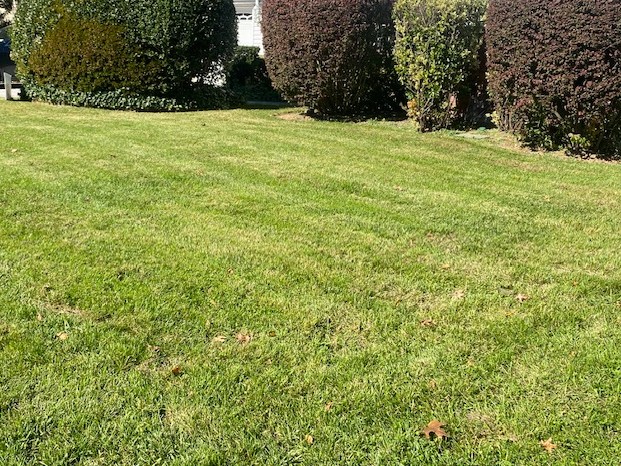
In general, my neighbors don’t appreciate my efforts. They have their gardeners cut, mow, spray, and lay down fertilizer and pest control substances. They also water incessantly which is degrading the water tables here on Long Island. We clearly have different definitions of beauty. A few people now and again tell me they like my native garden. There is an active ReWild chapter on Long Island which disseminates information, encourages native growth and works to get the word out about the importance of such work. I hope it is enough.
All these years after I first read this book, here is what I’ve come to understand: Manicured lawns laden with chemicals, watered, trimmed to uniform heights are a visual encroachment of patriarchy. Patriarchy has trained the eye to demand a standard of beauty that is expensive to maintain, uses up natural resources and severs us from our earthly roots. Literally, our roots in the earth which have nurtured us since the beginning of time are withering. I know that the birds who obtain their food from my small patch are getting an organic meal. Birds who procure worms from the properties that have chemicals spread on them could well be getting a poisoned meal.
The group-think of patriarchy has turned our precious Earth into a wasteland here in suburbia, one parcel of land at time. For a movement that gaslights us into believing they are “prolife,” they sure do spread the culture of death.
What does it take to get people to pay with both money and energy to poison the land they live on in order to achieve some nearly impossible aesthetic? As I saw once on a road sign, what does it take to get people to put poison on food crops to keep other species from eating the food that we plan to eat? Put this way it is crazy. And yet here is where we are today.
Tomorrow, another book that explores more of how we got here.
Discover more from Feminism and Religion
Subscribe to get the latest posts sent to your email.


