
2019: Hopefully a Happier New Year by Barbara Ardinger

We’re nearly a week into the new year. I almost wish I were a prophet and could predict with assurance that 2019 will be better than 2018—less filled with hate, name-calling, lies, and all-round trumpery (pun intended: “trumpery” is “worthless nonsense”).

When I wrote my daybook, Pagan Every Day, here’s how I began today’s essay:

The Saxons of northern Europe called the first Monday after January 6 Plough Day and honored Freya, “the Venus of the North.” As a goddess who engages in indiscriminate sex, Freya is the spirit of the earth’s fertility. Like Persephone, she is in the underworld during the winter, but early in January we already see hints that she might be rising. We’ll soon set our ploughs into the earth and plant our crops.

Yeager Empress

We can think of planting our crops in both literal and metaphorical ways, but my best guess is that we’d best think of them metaphorically, at least in the so-called developed world, because our part of the world is mostly urban now and if there’s literal planting, it seems to be mostly done by agribusiness. If we’re not farmers literally broadcasting seeds, how do we plant metaphorical crops for 2019?

We can start with numerology, which I studied back in the early 1980s about the same time I was reading books on metaphysical and occult topics, learning the tarot, and reading every book about the Goddess I could find. (There were already lots of them.) As you no doubt know, numerology is based on the meaning of numbers. Whether we’re working with a name, a birth date, or a situation, we use a chart (which you can find online) to convert letters to numbers, then we add the numbers and reduce them to one number that becomes a kind of prediction. It’s important to remember, of course, that true divination does not forecast a fixed and permanent future. Instead, it notes what is likely to happen if things keep going along the path they’re on.

According to my numerology teacher, 1 means creation and individualization; 2 means love, gentleness, service, harmony; and 3 means self-expression, personal creation, optimism, inspiration. One is also the beginning of a new cycle (year, life, experience, adventure), and 9 is “complete expression,” or the end of a cycle, life, experience, or adventure. It’s interesting that 9 + 1 = 10 = 1. The end always leads to what we call a new beginning.

So let’s do some numerology with 2019. We add the numbers and reduce them to one number that will characterize the year: 2019 = 2 + 1 = 3 + 9 = 12 = 1 + 2 = 3. This means that 2019 is a “3 year,” which can (and may) lead to self-expression, optimism, inspiration, talent, sociability, friendliness, and kindness. (Note that there are two 3’s in the calculation; maybe they reinforce the idea of 3-ness.)

Self-expression, optimism, etc. are good crops to be planting this month! These are crops that need to be growing here. If we think politically, as so many of us have been doing for two years, we can hope that the new diverse and Democratic majority in the House of Representatives will grow and harvest these crops and bring an end to trumpery. What do you think might happen this year? Where are these metaphorical crops best planted? How will we feed and fertilize them? How and where will they grow?

Motherpeace Empress

Several years ago, I moved into what I call tarot numerology. Our new year’s 3 corresponds to Card III of the major arcana: The Empress. You know of course that there’s a nearly infinite number of decks with their own illustrations, but most of them show Card III as The Empress. She is the Earth Mother, Mother Nature, the Great Goddess. My tarot teacher said The Empress advises, among other things, “as above, so below,” and when we get The Empress in a reading, she’s usually telling us that new things will be born, there will be productivity and creativity, there will be good crops.

Gaian Tarot Gardener

Our reading of 2019, therefore, is that we are possibly entering a new year of good crops—those metaphorical ones I listed earlier: self-expression, optimism, inspiration, talent, sociability, friendliness, and kindness. A couple months ago, we elected 100 women to a U.S. Congress that is more diverse than any Congress has ever been before. Can these women, perhaps individually, more likely collectively, embody the Goddess?

Rider-Waite-Smith Empress

I’m going to stop writing now because I want you all to finish this post for me. Give me—give us—your ideas and plans for planting new crops in 2019. How can we bring self-expression, optimism, inspiration, talent, sociability, friendliness, and kindness into our weary society? We can keep voting, of course, but what else? Organizing? Marching? Writing? Please think about this new year and then tell us what you’re thinking. What’s gonna happen??

Note: The cards are from the Tarot of Meditation, drawn by Marty Yeager; the Motherpeace Tarot, created by Karen Vogel and Vicki Noble; the Gaian Tarot, drawn by Joanne Powell Colbert; and the Rider-Waite-Smith Tarot, drawn by Pamela Coleman Smith (who did not receive any credit for her work for nearly a century. Oh, look—it’s the patriarchy in action again).


Barbara Ardinger, Ph.D. (www.barbaraardinger.com), is a published author and freelance editor. Her newest book is Secret Lives, a novel about grandmothers who do magic.  Her earlier nonfiction books include the daybook Pagan Every DayFinding New Goddesses (a pun-filled parody of goddess encyclopedias), and Goddess Meditations.  When she can get away from the computer, she goes to the theater as often as possible—she loves musical theater and movies in which people sing and dance. She is also an active CERT (Community Emergency Rescue Team) volunteer and a member (and occasional secretary pro-tem) of a neighborhood organization that focuses on code enforcement and safety for citizens. She has been an AIDS emotional support volunteer and a literacy volunteer. She is an active member of the Neopagan community and is well known for the rituals she creates and leads.

Celebrating the Winter Solstice by Barbara Ardinger

Even though Jesus was born during the reign of Augustus, first Roman emperor, the empire didn’t celebrate that birth until three centuries later when his birth date was moved to mid-winter to match the birth date of the sun god Mithra. The Romans already had a long tradition of celebrating the winter solstice. This celebration was called the Saturnalia. Here are three days in December, taken from my daybook, Pagan Every Day. (When I wrote this book in 2003, I wrote longer days. The publisher demanded that I reduce every day to 300 words. I edited them all down to 301 words.)

December 17: Saturnalia begins

Saturn, who was conflated with the Greek Titan, Cronus, was an ancient Latin agricultural god whose name may derive from satur, “stuffed,” or sator, “a sower”; in either case he stands for abundance. He was a working god who oversaw viniculture and farming, the king of Italy during the golden age. When Jupiter conquered him, he hid himself (latuit) in the region that came to be called Latium. The Romans said Saturn’s body lay beneath the Capitol in Rome. Because his reign brought prosperity to the city, the state treasury and the standards of the Roman legions were kept in his temple when the army was at home. Saturn’s statue was bound in woolen strips to keep him from leaving Rome.

Continue reading “Celebrating the Winter Solstice by Barbara Ardinger”

When the Gods Retire by Barbara Ardinger

Come with me in your imagination to an old land, a Demi-Olympus, a fabled and possibly invented land to the north of Mount Olympus, home and throne of the fabled Olympian gods. It is to this Other Olympus that the gods have retired. Now they reside in the Divine Rest Home whose proprietor is a black goddess. Not African black, She is as black as space, and if we look closely at Her, we can see galaxies and constellations and comets in Her. She is the Ur-Goddess, the Divine Creatrix, eldest of all, and She answers to the name Mama. (Note: many years ago, I actually saw this goddess after an all-day asthma attack that nearly killed me. She was in the ER with me.)

Helping Mama run the Divine Rest Home are Gaea, the mother of all life, and the Titans and Titanesses, who are older than all the gods who have come to the Divine Rest Home to…well…rest. The Titans and Titanesses held numerous important stations in the primeval universe and should probably retire, too, but they just keep going. That’s probably a good thing, as most of the retired gods need a great deal of attention.

Continue reading “When the Gods Retire by Barbara Ardinger”

What to do with Trump? by Barbara Ardinger

The United States used to get some respect. But now, except for the most gullible Trumpeters, people all over the world are seeing the damage the Troll-in-Chief is doing to our nation with his narcissism and corruption. What can a community like ours do? We can certainly vote next month and in 2020…and maybe we can also create some magic.

In her book The Cosmic Doctrine, originally written in 1923-24 as channeled from the Inner Planes, British occultist Dion Fortune (1890-1946) describes the Ring-Pass-Not, which is the ultimate outer limit of the universe. Fortune tells us that the Ring-Pass-Not (which was also described, but in a different way, by Madame H.P. Blavatsky) is a purely abstract ring of energy that protects our universe from the demons in other universes. Primal atoms also exist at the Ring-Pass-Not. It sounds like a highly useful place to send the Ogre-in-Chief so that, for once in his narcissistic life, he can clearly face the multitude of demons he embodies. Let us visualize a magical journey for him.

Continue reading “What to do with Trump? by Barbara Ardinger”

A Ritual to Bless Our Children by Barbara Ardinger

It was maybe twenty-five years ago that I first got addicted to the Sunday morning news/talk shows. I’d turn on the TV at 7 a.m., watch an hour of local news, then Stephanopoulos at 8 a.m., then MSNBC until noon or later. Not anymore. This morning, I turned the TV off at 10:00 and immediately got into the shower to wash off what I’d been hearing. I’m worn out by the news!

Now don’t get me wrong. I am totally against any “normalizing” of the Troll-in-Chief. In fact, I’m convinced we ought to pack him into capsule with about a hundred cheeseburgers and without his phone and fire him off to one of the outer planets. Maybe Saturn, which astrologically forces us to face ourselves and to get to work and learn our life lessons.

Continue reading “A Ritual to Bless Our Children by Barbara Ardinger”

Lessons from Candide by Barbara Ardinger

Candide, ou l’Optimisme (in English, Candide, or Optimism) is a satirical, picaresque novel published in 1759 by François-Marie Arouet, better known as Voltaire, who was possibly the smartest author of the Age of Enlightenment…but he annoyed so many courtiers and public officials that he was forever traveling around Europe to get away from their threats of arrest and bodily harm. A picaresque novel is an adventure novel with a clever, tricky hero who somehow survives and makes us like him. Voltaire wrote his novel primarily to criticize the optimism of the German writer Gottfried Wilhelm Leibniz, who said that because God is always benevolent, everything that happens is always for the best. This presumably includes the bloody Seven Years War (Protestant vs. Catholic, fought mostly in Germany and France) and the Lisbon earthquake of 1755, which occurs both in Lisbon and in the novel. Even though Voltaire was accused of blasphemy and heresy, among his other sins and crimes, Candide was enormously popular throughout Europe, a popularity that continues to this day.
In 1956, playwright and screenwriter Lillian Hellman (who had been persecuted by Sen. Joseph McCarthy and HUAC) proposed to composer/conductor Leonard Bernstein that they turn Voltaire’s novel into a Broadway musical. Bernstein composed some of the most beautiful music ever written for this show, which has been produced as an opera, an operetta, and a musical comedy. Hellman’s libretto turned out to be weak, so Bernstein turned to the poet Richard Wilbur and Stephen Sondheim, among others for new libretto and lyrics. It’s been through numerous revisions, and every time it’s staged, it’s different. I have four or five versions on DVD. My favorite is the New York Philharmonic staged concert written and directed by Lonny Price and broadcast on PBS in 2004. Continue reading “Lessons from Candide by Barbara Ardinger”

America’s Two National Goddesses by Barbara Ardinger

I bet almost no one knows this secret: the United States is being watched over by two goddesses! One of them stands on top of the Capitol dome in Washington, D.C. The other stands on an island in New York harbor.

The goddess standing above our congressional building is named Libertas, or Freedom. She’s a Roman civic goddess whose sisters are Concordia and Pax. Although the Romans hardly ever experienced freedom, civic harmony, or peace, they always kept their eyes on the possibilities. Libertas was sometimes merged with Jupiter, sometimes with Feronia, who was originally an Etruscan or Sabine goddess of agriculture or fire. In Rome, Feronia became the goddess of freed slaves. Libertas is shown on Roman coins as a matron in flowing dress and wearing either a wreath of laurel leaves or a tall pilleus, which is called a “liberty cap” and looks like a witch hat without the brim. And there’s also a bird—is it a raven?? She holds either a liberty pole (vindicta) or a spear, and in some paintings of her (she was a popular subject in the 19th century) there is a cat at her feet. Continue reading “America’s Two National Goddesses by Barbara Ardinger”

Toil and Trouble (Part 4) by Barbara Ardinger

Read Part 1, Part 2, and Part 3.

When the Amazons land in the capital city, they find themselves standing on the wide lawn in front of the Golden Tower in which El Presidente lives and rules. And look—El Presidente is still talking. Not having noticed the disappearance of twenty-seven princess, he’s still strutting, still emphatically gesturing, still addressing the fifty-four handsome, charming princes, who make up what he considers to be his people. (His fan club?)

Hippolyta, the Queen of the Amazons, adjusts her armor and walks across the sidewalk into the empty street. Her warriors follow her. “Now what?” she asks the air around her.

They hear a voice. “Greetings, Sisters! And be welcome! We haven’t met in many years. I’m glad to see you again.” Hippolyta looks a bit confused. “Don’t you remember Brunhilda?” the voice asks. Continue reading “Toil and Trouble (Part 4) by Barbara Ardinger”

Toil and Trouble (Part 3) by Barbara Ardinger

Continued from Part 2

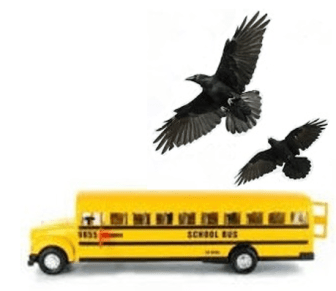
The magical school bus, carrying twenty-seven young women, drives across two or three states almost as quickly as the magic carpet flew a few days ago. The bus seems to fly, guided by Bunbury and Icarus as GPS and guards and Kahlil riding on the bus driver’s shoulder (well, not always; the driver keeps shrugging the heavy raven off, so Kahlil finally perches on the back of the first seat) and giving directions. (How the GPS ravens communicate with him is not to be disclosed.)

“So whaddaya think the magic’s for?” Kahlil asks the driver. “We’re guardin’ these here girls. Takin’ ’em somewheres safe.”

All the driver can do is keep driving. When the bus and its precious passengers arrive at the witch’s farm and the girls descend, everyone can see that the finery they’d been wearing to sit in El Presidente’s audience is no longer fine. Their silks and satins have turned into ragged T-shirts and crepe paper. Their priceless jewelry is now colored plastic straws strung together with string. Their exquisite hairdos are now lank and limp. And soon there are loud cries from the witch and her friends—these girls have black eyes and bruises all over their bodies. Some of them are missing chunks of hair or their front teeth. They are all barefoot, and their feet are filthy. And these twenty-seven former princesses—were they ever genuine princesses?—are scared. Continue reading “Toil and Trouble (Part 3) by Barbara Ardinger”

Toil and Trouble (Part 2) by Barbara Ardinger

Continued from Part 1.

“Mirror, mirror, on the table,
Show us all that you are able…”

The witch and her ad hoc coven and the ravens are leaning forward to see and hear more clearly what the mirror is showing them. The scarecrow wearing the human mask and his Gollumesque advisor are suddenly standing in a formal garden and addressing an audience that consists of a dozen rows of handsome but uncharming and self-important princes and (possibly) some princesses.

“Those girls are all captives,” Ella says. “Like I was until I started thinking for myself.” She gasps. “Oh, look—my sisters Annette and Darlene are there, too. When did they surrender?” As she begins weeping (she can’t help it), Mrs. Bezukhov pulls her into her arms. “Look, my Pierre is there, too,” she whispers. “He was always so kind, so smart…he spent his days helping other people. How could he stand among those, those—I don’t know what to call them.” Continue reading “Toil and Trouble (Part 2) by Barbara Ardinger”