The Erotic as Power, Notes on Audre Lorde by Janet Maika’i Rudolph

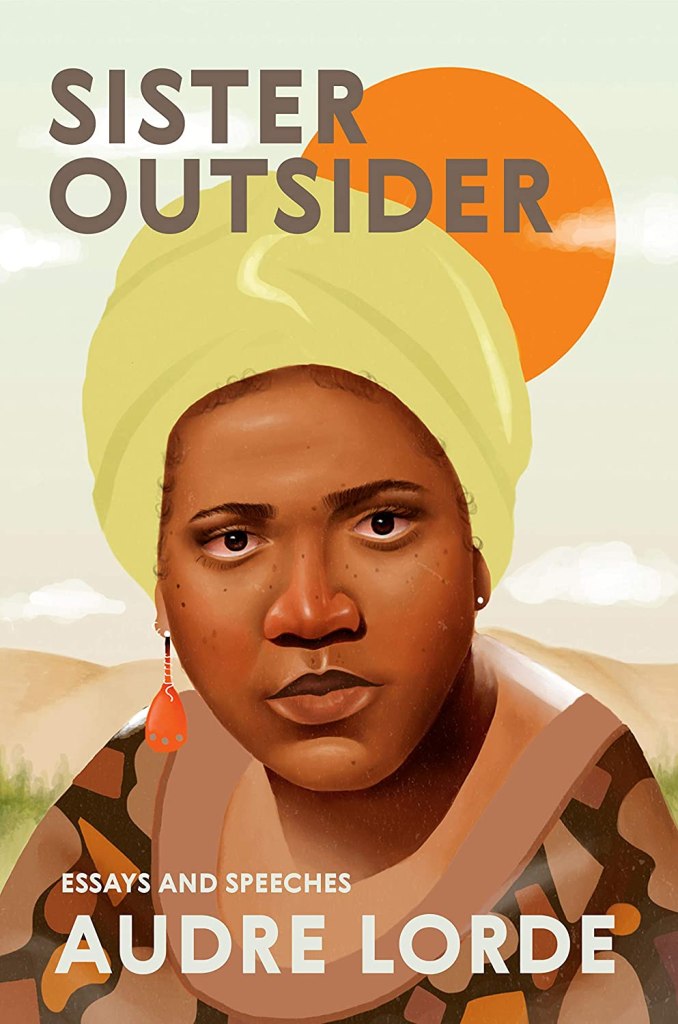
I’ve long kept a tract of Audre Lorde’s seminal piece The Uses of the Erotic near my computer. “The Erotic as Power” is her subtitle. If you haven’t read it, please do.  It is in her book Sister Outsider. And you can find it as a stand-alone here. It was written in 1978.

Lorde points out how the erotic is the opposite of pornography, in fact pornography is ultimately a denial of the erotic because it emphasizes sensation without feeling. “The erotic is a resource within each of us that lies in a deeply female and spiritual plane . . .” She goes on to note how it is through our bodies that we recognize and access this power. But she goes on, “We have been taught to suspect this resource, vilified, abused and devalued within Western society.”  In the hands of patriarchy this amazing and important resource often lies out of reach because it has become a source of shame and a sense of inferiority for women.[1]

I would add to the definition of patriarchy that one of its main goals is to damp down, even destroy, the erotic. We have seen this play out over thousands of years of history. Women are often viewed as either saints or sinners. Saints are denuded of this deep earthy power and sinners are those who flaunt it, or at least in the eyes of patriarchy.

Continue reading “The Erotic as Power, Notes on Audre Lorde by Janet Maika’i Rudolph”

Of Waterfalls and Wonder by Beth Bartlett

“A child’s world is fresh and new and beautiful, full of wonder . . . . If I had influence with the good fairy who is supposed to preside over the christening of all children I should ask that her gift to each child in the world be a sense of wonder so indestructible that it would last throughout life . . . .”[i]   – Rachel Carson

When I flipped my wall calendar on May 1st, the accompanying photo was of a waterfall.  My two-year-old grandson noticed it immediately, and said “waterfall!” I asked him if wanted to go see waterfalls, and ever since then we’ve been hiking local trails along rivers and streams in search of waterfalls.  Fortunately, we live in a city and surrounding area with a wealth of waterfalls, many within a few minutes of our home.  Each one is unique and changes with the volume of water as it varies from day to day.

I was lucky enough to be raised by parents with a love of waterfalls, so they were a staple of my childhood. We lived near waterfalls on the Cuyahoga River, where we would sometimes go for picnics and hikes, and our family vacations when I was young were often to visit waterfalls – Bridal Veil Falls in Yosemite, Tahquamenon Falls in the UP of Michigan, and of course, Niagara Falls.

Continue reading “Of Waterfalls and Wonder by Beth Bartlett”

Kedoshim: On Women, Patriarchy, and Respect.

The Torah portion for today’s blog is Kedoshim (Leviticus 19:1-20:27), which was read by Jewish communities yesterday, May 10, 2025.  Among scholars, it is part of what is often referred to as the Holiness Code, Leviticus 17-26 (Note 1).  Kedoshim covers all manner of topics: from what fabric to wear to how to treat one’s neighbor and from keeping Shabbat to when one can eat the fruit of newly planted trees.  These, what I will call prescriptions, all fall under the general reasoning that one does these things so that one can be holy like the deity is holy.  In a way, the Holiness Code then is an apt name for this section.  But, what can we take from this parshah from a (eco)feminist point of view?  To answer this question, I will be using the methodology I have laid out in a previous blog and ask three questions.

Continue reading “Kedoshim: On Women, Patriarchy, and Respect.”

A Healing Shrine by Joyce Zonana

From October 5, 2023. Joyce posted the blogpost which she titled: Nineteen months and Counting: Experiencing  the Web of Life

On February 28, 2022, I unknowingly drove into a deep snowbank, shortly after finding myself in  a strangely  unfamiliar landscape. Suspecting a TIA, my primary care physician  urged me to go to an emergency room for a possible CAT scan. There, a lesion in my right parietal lobe was quickly discovered.

Continue reading “A Healing Shrine by Joyce Zonana”

To Childless Cat Ladies by Janet Maika’i Rudolph

I feel you. In a patriarchy where women’s reproductive abilities determine our worth, to be childless is a curse. We can thank VP candidate JD Vance for revealing this truth in all its ugly fullness. He is a walking billboard for patriarchy. Bottom line: Patriarchy is all about women’s bodies, our reproductive abilities and men’s desire to control them. We saw this in the Dobbs decision where it was declared that women have no constitutional right to the basics of healthcare, in Texas where it’s pretty much illegal to have a poor pregnancy outcome, and in Ohio where raped children are expected to give birth to their abuser’s child. Its endless 

But it is JD who made it plainer than plain what this is all about. Besides childless cat ladies being an old trope, just think of the judgement involved. Who is JD to decide on anyone’s family constellation? Or their pets? He also made disparaging remarks about the “childless left,” who have no “physical commitment to the future of this country.” That is a statement that only a person who totally lacks empathy can make. He is making a sweeping generalization that people without children don’t care about the future. This statement is more confession than truth. He reveals that until he had children, he had no care about the future of our world. It’s beyond egocentric. If only his kids are the center of his “caring,” that shuts out most of the world’s other children.

Continue reading “To Childless Cat Ladies by Janet Maika’i Rudolph”

A Feminist Reading of Saint Wilgefortis by Sofia Meskhidze

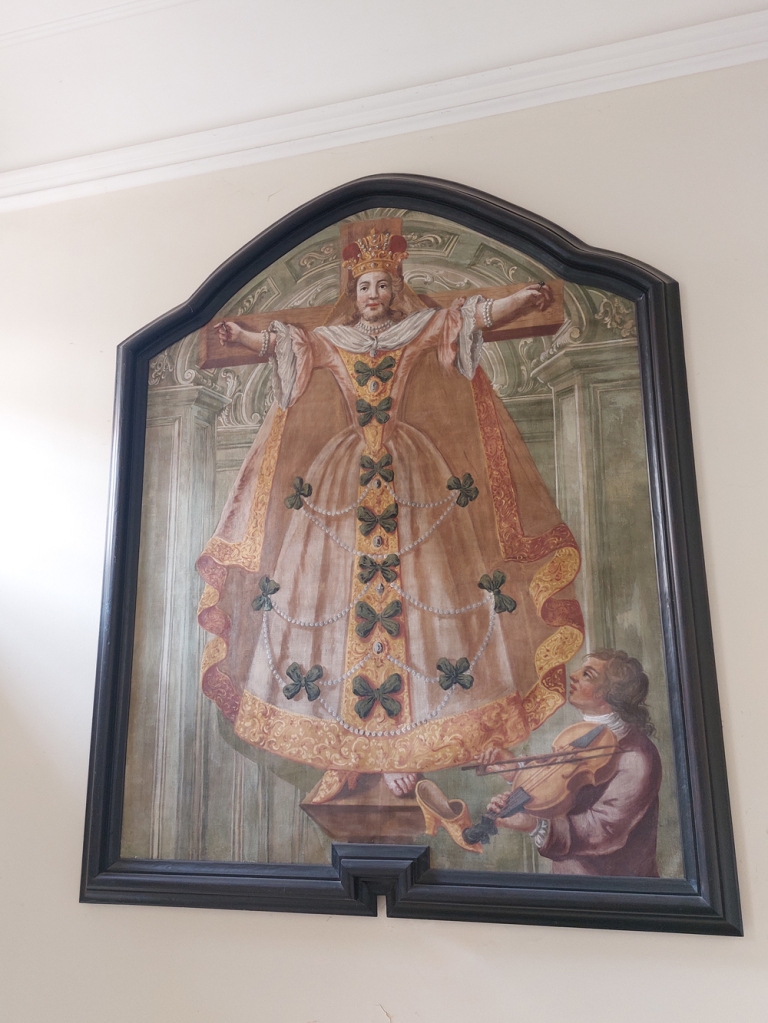
The legend of Saint Wilgefortis tells the story of a Christian woman who was martyred for her faith. While there are numerous women martyrs in the Christian tradition, Wilgefortis is distinguished by her gender non-conformity. She is often referred to as female Christ[1] and is almost always depicted with a beard, in a dress, and nailed to a cross. According to the legend, she was a Christian princess from Portugal whose father had promised her to the pagan king of Sicily. Wilgefortis, refusing to marry, prayed all night for God to make her unmarriable and as a result miraculously grew a beard, causing her father’s rage, after which he had her tortured and crucified[2]. The origin of the legend is thought to be the Volto Santo sculpture in Lucca, Italy, one of the most well-known examples of a clothed crucifix[3]. Misinterpretation or not, it is without doubt that the legend spread wide and Wilgefortis was in medieval times venerated almost as much as the Virgin Mary. In fact, this popularity displeased the Catholic Church, who actively discouraged it and even removed Wilgefortis from the official list of saints in 1969[4]. Here I argue for the importance of Wilgefortis to feminist theology, feminist and queer Christians, and her potential as a non-binary/gender non-conforming icon.

Continue reading “A Feminist Reading of Saint Wilgefortis by Sofia Meskhidze”

Mountain Mother: Symbol from the Past, Beacon for the Future by Jeanne F. Neath

Dreaming of and working toward creating an earth- and female-centered future is proving to be my best strategy for surviving and enjoying the ecologically and politically problematic present. Current realities and predictions for the future, such as those made by climate scientists, are certainly grim. What else can we expect in a global society that puts male power and profit above the needs of people and planet?

Those in power cannot possibly undo today’s polycrisis as they are too invested, personally and financially, in the status quo. They cannot even begin to dream of the transformations called for. This is something that we women can do that they cannot. We are the ones who give birth, create new life. We can certainly dream up and create new ways of living.

Continue reading “Mountain Mother: Symbol from the Past, Beacon for the Future by Jeanne F. Neath”

Archives from the FAR Founders: We are Worth the Time it Takes to Create a Practice by Xochitl Alvizo

Incarnation, Goddess spirituality, Xochitl Alvizo, god became fleshThis was originally posted on September 10, 2014. It seems relevant to me these days as I continue to develop practices for my groundedness, community, and well-being. 

Recently, in response to the excellent conversation following Nancy Vedder-Shults’ post on the goddess Kali, Carol Christ commented to Nancy, “I too love our conversations, wish there was more in depth talk on our blog [FAR], maybe there will be.” Carol’s comment* struck a deep chord within me. One of the main objectives that the FAR co-founders had in creating Feminism and Religion was that it be a place where we could and would engage with one another across a diversity of feminist issues and the broad range of feminist passions and work – where we could discuss, critique, and build upon on each other’s efforts.

So two things came to mind as I reflected on Carol’s comment. The first was my personal lament that I have not been as actively participating in the discussions that follow the FAR blog posts as I did when we first started Feminism and Religion. FAR has such rich and valuable material – it really does provide a great opportunity for conversation and dialogue – and sadly I have been a passive participant as of late. I read and learn from the discussions, but I have not been joining in. I lament that. FAR is definitely a place where I could engage with others in deep conversations, but how actively am I actually doing this? Continue reading “Archives from the FAR Founders: We are Worth the Time it Takes to Create a Practice by Xochitl Alvizo”

ESCORT SERVICE by Esther Nelson

These days, I spend most of my time in Roanoke, Virginia.  I moved here—a three-hour drive west—from Richmond, Virginia.  One of the ways I’m settling into my new community is by volunteering as an escort at Planned Parenthood.

The job is straight-forward:  Greet people as they exit their vehicle when they arrive at the medical facility’s parking lot.  Usually, there are several protestors in front of the building, and clients must drive past them before turning right into the driveway.  Protestors wave pink, plastic bags filled with anti-abortion literature as well as pamphlets that outline a specific, Christian view of “salvation.”  Not many drivers stop.  If they do, I walk over to the line that divides Planned Parenthood property from public space and wave the cars forward.  The drivers are grateful.  So many clients are nervous, upset, and unsure of protocol.  One woman asked me if I was associated with “those people out there,” pointing to the protestors.  “Not at all,” I assured her.  She smiled with relief.

Continue reading “ESCORT SERVICE by Esther Nelson”

Reclaiming Forgotten Voices by Freia Serafina

Marduk fighting Tiamat

Last night I found myself crying over Tiamat. Tiamat is one of the most ancient Babylonian Creatress Goddesses. She is known as the Goddess of the Salty Sea and is considered the primordial Creatress in Sumerian religion. Tiamat was slaughtered in the vilest of ways to demonstrate the death of the Goddess and the rise of the God. She was defiled and written about in such a way as to discredit women and provide justification for the slaughtering, defiling, and enslavement of “enemy” women abroad and “bad” women at home.

As I was reading Carol Christ’s Rebirth of the Goddess, I found myself shaken to the core at the ways in which Tiamat was defiled and destroyed in the “epic” called the Enuma Elish. As someone who is well aware of the ways in which the Goddess and women have been usurped throughout time and space, I was still so broken down after reading it that I had an actual ugly cry in my living room. I want to tell you to read the Enuma Elish to understand why I feel this way, but I also want to warn you about the way you might feel afterwards. It is a difficult read.

Continue reading “Reclaiming Forgotten Voices by Freia Serafina”