Opening Our Hearts Through Armenian Dance by Laura Shannon

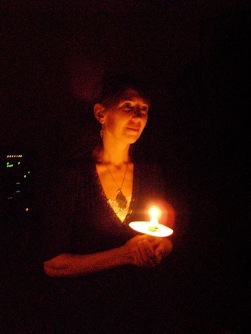
The candle represents the light of love, compassion and connection kindled in our hearts as we dance.
In these challenging times, one of the hardest things to do is to keep our hearts open. Grief and despair tend to shut them down. And even among close friends, colleagues, family members, and people with whom we share worship, when we clash over differing political opinions, trust can swiftly erode. These kinds of losses and sorrows can make us just want to close the doors to our hearts.
Yet hardened hearts and minds are not going to help us overcome conflicts and affirm connections. Only if we can open our hearts to one another, holding the fullness of our (and others’) feelings in a compassionate way, can we weather the storms which threaten to divide us further. And only if we are united can we find our way together through those storms.
One of the best ways I know to connect with others and to open my heart is through the joyful experience of traditional circle dance, particularly Armenian dances. I have written previously on this blog (The Dance of MemoryThe Wishing Tree) about Armenian dances and their ancient roots, their links to the pre-Christian Goddess, and how they affirm survival throughout the traumas of history. I have also written about my friend and colleague Shakeh Major Tchilingirian and her inspiring Circle of Life project, which brings Armenians, Turks, Kurds, Assyrians, and other survivors of atrocities and genocide to dance together for reconciliation.

Continue reading “Opening Our Hearts Through Armenian Dance by Laura Shannon”

A Rescue Remedy, Part I by Barbara Ardinger

A year, now. It has been a full year since the phony election that put El Presidente in the Golden Office. A year since people began leaving the capital and the nation’s other large cities. While some of the refugees emigrated to quasi-democratic nations, most of them settled in the small towns and on the farms across the countryside, where they began building new, rural lives. A year ago, it was a flood of refugees. Now fewer people are able to escape.

A year, now, and even though she has studied and practiced, the wicked witch is no wickeder than she ever was. Nowadays she even forgets to put on the wicked-witch mask that she used to think scared people. But it’s easy for everyone to see that, masked or not, she’s just an ordinary woman practicing an old-time religion. She’s never fooled anyone, not the sixty or so refugees who now live on her farm, especially not the various ravens who drop by regularly for snacks in exchange for gossip.

Continue reading “A Rescue Remedy, Part I by Barbara Ardinger”

Difficult Dialogues by John Erickson

Let’s have a conversation about men and feminism and how we can continue to abolish the patriarchy together rather than writing mean, hurtful comments online.

logo-CCWA few months ago Governor Jerry Brown appointed me to be the first man on the prestigious California Commission on the Status of Women and Girls. I am so excited and honored by this amazing opportunity to continue the great work that California is doing to tackle issues such as pay equality, advancing more girls in the STEM field, creating more opportunities for women in leadership positions across California, and a host of other hot topic issues.

From the moment I started telling people, the responses were extremely positive. People were very excited that we could have a conversation about how men can be included in creating change to better impact the lives of women and girls from all walks of life.  It felt great to see such a positive response from so many people that I love, trust, and admire. However, while much positivity still remains, it has come to my attention that some people are not so thrilled about my appointment. However, what these people and groups online do not realize is that I fully expected and am happy to see such conversations occurring about men in feminism.

Continue reading “Difficult Dialogues by John Erickson”

How Do We Heal Rape Culture? Part 2: How to Help Men Become Safer by Trelawney Grenfell-Muir

In Part 1, I presented a spectrum of male behaviors and attitudes, from violently misogynistic to safe ally. Next it is time to think about how we – as women, male allies, and society – can help men move up that scale to become increasingly safer for women. The strategies will differ depending on where a man starts out. However, using current research about change theory, we can find some concrete strategies to help us start to make progress.

The Research

Social scientists have conducted many studies about persuasion and social change, and I encourage everyone to follow these research trends. For this piece, I will focus on a few simple ideas about what works. I’m gearing this advice mainly toward men who want to become safer and to help other men become safer, but some of it applies to women as well. It also applies to religious communities – if they prioritize this issue, the men who attend will learn to be safer.

Continue reading “How Do We Heal Rape Culture? Part 2: How to Help Men Become Safer by Trelawney Grenfell-Muir”

Sisterhood, Service, Sovereignty: The Living Spirit of Avalon by Elizabeth Cunningham

Like so many women, I read Marion Zimmer Bradley’s The Mists of Avalon and got caught up in her vision of the Holy Isle and the priestesses who knew how to navigate those mists and travel between the worlds. Like so many women, I wished Avalon existed still.

In fact, Avalon does exist, because Jhenah Telyndru did more than wish. In 1995 she founded The Sisterhood of Avalon. Twenty-two years later, the Sisterhood is going strong and growing, attracting members from all over the world. I urge you to explore their website where the Sisters speak eloquently about their vision, structure, and purpose.

Continue reading “Sisterhood, Service, Sovereignty: The Living Spirit of Avalon by Elizabeth Cunningham”

Fostering Conversation and Connection in Community by Katie M. Deaver

I recently began a new job as the Associate Director of Admissions for the Lutheran School of Theology at Chicago, one of the seminaries of the Evangelical Lutheran Church in America.   This week was orientation for our new and returning students and much of the time has been focused on getting to know one another as well as getting to know the corner of Chicago in which we are located.  There have been so many life giving conversations as well as so many questions!

Our mornings featured speakers who helped us to engage one another in conversation as well as to start thinking about the unique reality of our place within not only the LSTC community but also within the rest of the Chicago community and the larger world.  Throughout these presentations  and getting to know you activities my thoughts continued to be pulled back to the question of how to have life-giving conversations in a time when so many of us feel emotionally and spiritually drained by the world around us.

Continue reading “Fostering Conversation and Connection in Community by Katie M. Deaver”

Breaking Down the Concept of Arranged Marriages by Vibha Shetiya

13327613_10208448645447348_6913754683590458893_nOne of the first things my American friends and family ask me when they learn I used to be married to an Indian man is: was it an arranged marriage? I understand the intrigue, the bewilderment and even horror that the phrase “arranged marriage” can conjure up in unfamiliar Western minds. Images of forcing women to marry strangers encountered upon the street or child betrothals or women being dragged to the wedding site to be married off to mustachioed men are likely to flash before one’s eyes. While such incidents may have occurred from time to time, and in the past, as with child marriages, the long-established concept of “arranged marriage” is very different and not as frightening as may seem.
Traditionally speaking, proposals materialized through word-of-mouth – family and friends recommended a good alliance, or a parent would approach someone directly or indirectly to ask for a daughter or son’s hand in marriage. Even then, personal histories were well researched into, before both parties decided to “see” each other. Marriages in India continue to be alliances between families, and so it is important to check into family background – what are the parents’ and siblings’ occupations? How much does the prospective groom earn? After all, he may be the sole earning member of his family and may not be able to provide for his own family once he starts one. Is there a history of crime or mental illness? This investigation makes perfect sense in a society that is community and family-oriented, and wherein joint family situations are still the norm, especially in smaller towns and villages. It is thus imperative that everyone try and get along. “Arranged marriage” is certainly not synonymous with an “Oh-let’s-just-get-rid-of-our-daughter” arrangement.

Continue reading “Breaking Down the Concept of Arranged Marriages by Vibha Shetiya”

Eros, Caritas, and Relationship by Chris Ash

Christy CroftIn 2011, the Anglican Theological Review published arguments for and against same-sex marriage. “A Theology of Marriage including Same-Sex Couples: A View from the Liberals,” co-written by Deirdre Good, Cynthia Kittredge, Eugene Rogers, and Willis Jenkins, presents a rationale for same-sex marriage that is surprisingly traditional, grounded in scripture and doctrine, understood and interpreted “in the company of patristic interpreters as well as in the company of readers long silenced by the tradition.” Part of the liberal view explores the relationship between eros and caritas, and how the marriage vows, which “mark marriage as an arduous form of training in virtue,” teach us to love and “offer a means by which God may turn eros into charity.”

As someone for whom eros is both a modality of intimate communion and manifest expression of divine love, the idea that it would need to be transformed into something less sensual, more socially acceptable, seems an arbitrary sanitization that positions eros as untamed and dangerous, in need of redemption by sexless ideals of Christian charity. Admittedly, my aversion to scrubbing eros of its rawness likely comes from my own understanding of the word, which might differ from that of traditional Christian theology, and which is inherently tied to the ways in which I’ve known the divine more deeply through expansive, mystical, erotic experiences that engaged my every sense in the coolness of rivers and grazing touch of mountain breezes.

We know through the body; we sense through our skin and parts and cells and perceive through nerves and fibers and tissue – seismic shocks of color and sound reverberating through our beings in the abstract, or the specific, deep, and warming awareness of divine love washing over our grief, fear, or loneliness. Each of these teaches us about the nature of the universe and of love, about bodies and subjectivity, and (by extension) about God and God’s action in the cosmos. My experience of eros – of the sensual explosion of erotic energy that makes me tremble, lays gooseflesh across every inch of me, and takes my breath as it rises inside my chest and belly – is not limited to sexuality, but comes through nature, art, song, movement, and touch. It is my primary way of experiencing divine love, and needs no purification. Continue reading “Eros, Caritas, and Relationship by Chris Ash”

The Social Structures of Religious Identity and the Decision to Leave or Stay by Carol P. Christ

Reflecting on our different choices to “stay or leave” the religions of our upbringings while writing Goddess and God in the World with Judith Plaskow, I was prompted to think again about the social and ethnic structures of denominationalism. One of the things Judith has been saying to me since we began discussing this question years ago, is that for her being Jewish is an identity that deeply affects her choice to stay within her religion.

Here on FAR both Gina Messina and Mary Hunt have stated that for them being Catholic is so closely tied to their Italian and Irish identities that they cannot think of themselves anything other than Catholic. For Gina, this recognition led to a renewed commitment Catholicism as a religion. She considers herself “faithfully feminist” and expresses her hope that Pope Francis will transform the church. Mary, on the other hand, feels strongly disaffected from the Church hierarchy and traditional Catholic teachings and does not think Francis will change the Church in significant ways. At the same time, she does not disavow her Catholic identity.

Black feminist theologians, especially those who are Protestant, often speak about black Christianity as inseparable from their identity. White Protestant feminist theologians may feel similarly tied, but they are less likely to say so publicly. Continue reading “The Social Structures of Religious Identity and the Decision to Leave or Stay by Carol P. Christ”

Is Evil Winning? by Michele Stopera Freyhauf

If you are li15036682_10154709860681591_8947505383481702342_nke me, today (and most days lately) it is difficult to be positive in a world that seems so full of hate.  In fact, I struggled with a topic to write about because, in all honesty, it is hard to see the greener grass from where I sit – with all of the hatred spilling out in neighborhoods, churches, schools, and college campuses – even between family and friends.  As I scrolled through Facebook, I came across a video and was struck by its message – we must be relentless in our kindness otherwise evil will win.

“Relentless” is a word that currently echoes through the United States –on both sides of the aisle.  We have been relentless in raising our voice – writing, calling, e-mailing, visiting, marching – expressing our unhappiness with the current President and all that is happening in the White House.

Instead of struggling to find the words, I share  the video and offer a transcript.

Continue reading “Is Evil Winning? by Michele Stopera Freyhauf”