Big Mama by Arianne MacBean

Big Mama at sunset

I used to tell my dance students that the dance floor was like a Big Mama, aways there to catch them, always there to sink into, always there to press back. This was my way of teaching them to trust the floor, that it was not a place where they needed to fear crashing into, but a place that wanted to take them in, hug them, love them. As dancers, we spend much time focused on the floor, how to release into it with control, how to push off it, even how to defy it and manipulate it. It becomes our partner in all dances, this blanket beneath us. But I haven’t been in a dance studio for a few years and so I have found myself looking up, instead of down.

Continue reading “Big Mama by Arianne MacBean”

Ariadne’s Dancing Floor by Arianne MacBean

As the story was told to me, my parents were listening to composer Claudio Monteverdi’s Lamento d’Arianna when my name was decided. I would be called Arianne, after mythical Ariadne’s melancholy refrain, sung to the heavens after being abandoned on a deserted island by her lover, Theseus. Raised on the Greek myths as bedtime stories, my father regaled me nightly with tales of gods, goddesses, and mortals twirling in the maelstrom of life. I was in awe of Cyclops and Sirens, but it was the myth of Ariadne and the Minotaur that I requested most often.

Continue reading “Ariadne’s Dancing Floor by Arianne MacBean”

A Recipe for Dancing Your Soul Home

When you hear the word ‘soul’, what is your first association? 

Soul is a complex and much-debated word, that often brings up strong feelings. Without going into religious or philosophical discourse, it is often associated with the breath, and with that mysterious spark of life force that animates the body. I discussed soul in a previous post Untangling the Triad of Life Force, Spirit and Soul. Today I write about soul as a fluid concept, an essence that can get dispersed and also retrieved, and propose a light self-retrieval through dance as remedy that you can do by yourself. 

Continue reading “A Recipe for Dancing Your Soul Home”

Collective Joy as Our Birthright by Mary Gelfand

One of two pieces on Joy, part 2 tomorrow.

Joy was not a conspicuous presence in my childhood home.  My parents were kind and loving, but both had been raised in the Protestant conservatism of rural Alabama during the Depression years.  Laughter, contemporary music, dancing, drinking—none of these were part of my growing up years.  Attending church was our primary social activity.   I started middle school in the mid-1960s having never heard of the Beatles, Chubby Checker, or the Twist. 

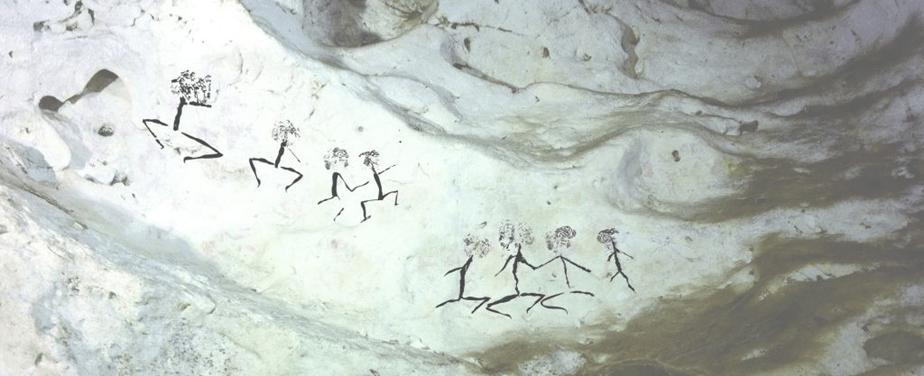
2000 year old cave art from Borneo

Instinctively, I felt that there must be more to religious experiences than the dull passivity of listening to an old white man lecture on details of an antiquated religious text.  Psalm 100 in the Hebrew Bible instructs us to “Make a joyful noise unto the Lord,” but I couldn’t find joy anywhere in my home church.  Even my relationship with Jesus, which felt sacred and special, was dimmed by the constant focus on Jesus’ suffering and death and my concurrent obligation to avoid sin at all costs.

Continue reading “Collective Joy as Our Birthright by Mary Gelfand”

From the Archives: Oakness as a Metaphor for the Wild Soul: the Dance Between Life Force, Personality and Original Nature by Eline Kieft

This was originally posted June 16, 2022

The process of fitting in and learning what is required to participate in society teaches us many useful skills such as math and language. All too often, this happens at the expense of developing expressive and intuitive abilities and trust in our unique contributions and points of view, or what I call the ‘Wild Soul’. This represents our original blueprint or essential spark that makes us into who we are.

Continue reading “From the Archives: Oakness as a Metaphor for the Wild Soul: the Dance Between Life Force, Personality and Original Nature by Eline Kieft”

Woman’s Sacred Hand – and Handkerchief by Laura Shannon

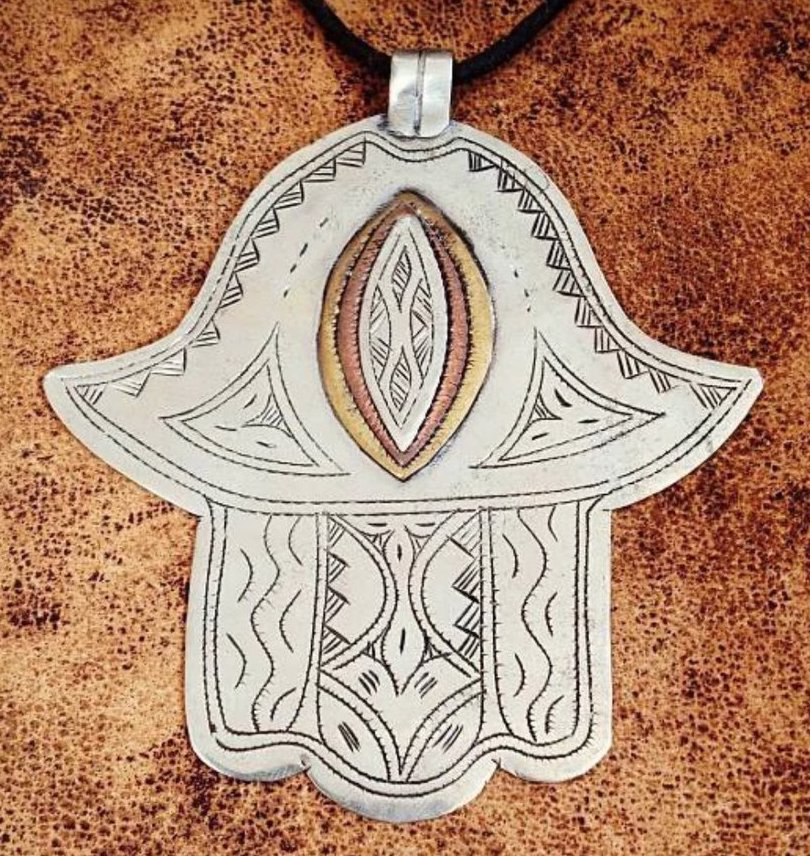
Berber Hamsa. Photo: public domain.

In my recent post ‘Forty Days After Childbirth, Mary Returns to the World,’ I wrote that ‘the woman’s power to bless and protect, as well as to create, is shown in the symbol of her hand.’ We see expressions of this power in the Orthodox Christian icon of the Three-Handed Madonna, whose third hand is over her womb, and the Hamsa, the hand-shaped talisman common to Jewish, Christian, and Islamic traditions. Also known as the Hand of Fatima, Miriam, or Mary, the Hamsa often incorporates eye or vulva motifs, which also offer protection.

Hand, womb, and eye all signify female creative power, personified in the image of Goddess and revered in Neolithic Old Europe. This life-giving principle is expressed in many ways apart from childbearing: as Carol Christ affirms, early technologies of spinning, weaving, pottery, and agriculture, along with Neolithic religion, were most likely invented by women. 

Continue reading “Woman’s Sacred Hand – and Handkerchief by Laura Shannon”

Upon Rising: Poems Call Out by Margot Van Sluytman

Moderator’s Note: Margot reads each of her poems aloud. They can be heard through the links in the titles.

“And what then is poetry?” We ask this time and time and time again. And poetry HERself answers. SHE needs no descriptor. Mimetic sagacity spells HER clarity.
~~~
Dreams be Fed

I am a body that remembers

The joys of falling into hues of

Brilliant blues and greens.

I am a soul that trades in
Cinnamon and spices.

Elevating chance.
Caressing mystery.
I am a will that conceives fat
Ebullient Moon as
Golden Goddess. Divine.

SHE who feeds our dreams.
SHE who teaches us

To tend our fires.
©Margot Van Sluytman

Continue reading “Upon Rising: Poems Call Out by Margot Van Sluytman”

9 Ingredients for Building New Narratives by Eline Kieft

There have been a few intriguing posts recently on creating new narratives (by Carolyn Lee Boyd, whose ‘dollops of mud’ inspired the title of this post), and reinterpreting existing ones that are deeply embedded in the fabric of our cultures (such as Moses and Rambo by Janet Rudolph). I distinguish re-creating personal and collective narratives as two aspects of this fascinating task.

The first aspect addresses our capacity to rewrite our personal narrative. What story do we tell about our lives? One of my teachers, Ya’Acov Darling Khan, says ‘we humans are story tellers by nature, so we better tell a good one!’ This doesn’t mean ‘making up’ a story, embellishing the facts, or putting sugar over shit, but exploring our own hero/ine’s journey, overcoming obstacles with courage, seeking help from allies, daring to go into the darkness and emerging with new insights, and most of all, what I call the skill to ‘harvest the wisdom gifts’ of life’s experiences. I look forward to writing more about this another time.

Continue reading “9 Ingredients for Building New Narratives by Eline Kieft”

Exploring Dance as Spiritual Practice by Eline Kieft

Image Credit: Ben Cole

Nature and dance are my gateways to the mystery, where I can bring my worries, exhaustion, prayers, celebrations and gratitude. These gateways open to places deep within and far beyond my perception and imagination. They create an impromptu sacred space that emerges, flexes, stretches, and nurtures, and always ‘meets’ me regardless of my emotional state.

In this post I reflect on the possibilities of danced spirituality in relation to the overarching theme of Feminism and Religion. How does dance relate to our sense of personal expression, freedom and take on life as gender-aware people, and our experience of spiritual intimacy?

Dance is a versatile practice to move through life in an empowered way and to strengthen our connection with the numinous. I truly believe that everyone can dance, and one of my roles as a ceremonial dance facilitator is to help people re-connect with the dancer inside them.

Continue reading “Exploring Dance as Spiritual Practice by Eline Kieft”

Oakness as a Metaphor for the Wild Soul: the Dance Between Life Force, Personality and Original Nature by Eline Kieft

The process of fitting in and learning what is required to participate in society teaches us many useful skills such as math and language. All too often, this happens at the expense of developing expressive and intuitive abilities and trust in our unique contributions and points of view, or what I call the ‘Wild Soul’. This represents our original blueprint or essential spark that makes us into who we are.

Drawing on the well-known metaphor of the acorn that already carries the majestic fullness of the oak tree inside it, I distinguish three characteristics in the process of acorn becoming oak:

Continue reading “Oakness as a Metaphor for the Wild Soul: the Dance Between Life Force, Personality and Original Nature by Eline Kieft”