white femininity: whitemalegod’s secret weapon By Christena Cleveland, PhD

For the first several weeks of my walking pilgrimage, I debated whether to visit the famous Black Madonna of Orcival. It wasn’t the walking distance that deterred me; She lived in a gorgeous Romanesque cathedral nestled in a charming medieval mountain town only fifteen miles away. Rather, I was hesitant to visit Her because I knew that, after a thousand years of being Black, She had undergone a mid-twentieth-century “renovation and restoration” process that whitened Her skin. I knew from photos that Her once gorgeous melanated skin was now a ghastly beige-ish pink. The incredible Black Madonna of Orcival now appears to be a white woman.

Continue reading “white femininity: whitemalegod’s secret weapon By Christena Cleveland, PhD”

Carol P. Christ’s Legacy: THE LABRYS: A RIVER OF BIRDS IN MIGRATION

Moderator’s Note: Carol Christ died from cancer in July, 2021. Her work continues through her non-profit foundation, the Ariadne Institute for the Study of Myth and Ritual and the Goddess Pilgrimage to CreteThis blog was originally posted July 29, 2013. You can its original comments here.

labrys seal ring

“There’s a river of birds in migration, a nation of women with wings.” Goddess chant, Libana

On the Goddess Pilgrimage to Crete, I explain that many of the names given to “Minoan” (c. 3000-1450 BCE) Cretan artifacts and architecture are products of patriarchal and Eurocentric imaginations, and as such, are misleading.  For example the name “Minoan” was given to the culture of Bronze Age Crete in honor of “King Minos,” who was said to have ruled in Crete a few generations before the Trojan War–several hundred years after the end of the culture to which his name was attached.  In fact, despite his eagerness to find evidence that King Minos ruled at Knossos, the excavator Sir Arthur Evans finally had to concede that the best he could do was to produce a fresco of a “Prince of the Lilies” which he identifed as the image of the male ruler of the culture he called “Minoan.”  Evans’ Prince had white skin, a fact that Evans conveniently overlooked–because according to his own interpretation of “Minoan” iconography, white skin would mark the figure as female.  Mark Cameron, who reviewed Evans’ reconstruction of the fresco, suggested that the Prince is more likely to be a young woman who is perhaps leading a bull to take part in the bull-leaping games.  He also stated that the “crown” belonged to another fresco altogether.

Continue reading “Carol P. Christ’s Legacy: THE LABRYS: A RIVER OF BIRDS IN MIGRATION”

Carol P Christ’s Legacy: Gratitude and Sharing: Two Fundamental Principles of Goddess Spirituality

Moderator’s Note: Carol Christ died from cancer in July, 2021. Her work continues through her non-profit foundation, the Ariadne Institute for the Study of Myth and Ritual and the Goddess Pilgrimage to Crete. This blog was originally posted February 4 2013. You can read it along with its original comments here.

The more I practice the spirituality of the Goddess, the more I understand that earth-based spiritualities are rooted in two fundamental principles:  gratitude and sharing.  We give thanks to the earth for the gift of life. As we recognize our interdependence and interconnection in the web of life, we are moved to share what has been given to us with others. *

When I first began to lead Goddess Pilgrimages in Crete, I was inspired by a line in Homer to begin a pilgrimage tradition of pouring libations of milk, honey, water, and wine on ancient stones. At first I knew the form, but not its deeper meaning.  It gradually dawned on me as I thought about the large number of pouring vessels in the museums, the altar stones, and the Procession Fresco from Knossos, that an important part of Minoan rituals involved processions in which people offered first fruits back to the Mother whose body had produced them, and poured libations on altars.

Continue reading “Carol P Christ’s Legacy: Gratitude and Sharing: Two Fundamental Principles of Goddess Spirituality”

From the Archives: Genderqueering by John Erickson

Moderator’s note: Today’s blogpost was originally posted March 24, 2015. You can visit the original post here to see the comments.

This post is a response to a recent blog entry titled “Who is Gender Queer?” on this site from Carol Christ. It was posted yesterday. I want to thank my friend, advocate, and upcoming scholar Martha Ovadia for reasons only she knows!  Stay brave, speak up, be heard!

Leelah Alcorn, Ash Haffner, Aniya Knee Parker, Yaz’min Shancez

It is terrifying to know that something is wrong but not be able to speak truth to power.

Continue reading “From the Archives: Genderqueering by John Erickson”

Carol P. Christ’s Legacy: Who Is Gender Queer?

Moderator’s Note: Carol Christ died from cancer in July, 2021. Her work continues through her non-profit foundation, the Ariadne Institute for the Study of Myth and Ritual and the Goddess Pilgrimage to Crete. This blog was originally posted March 2, 2015. You can read its original comments here. It is being paired with an archive post tomorrow from Dr. John Erickson who responded to Carol with his own blogpost.

“It seems to me that calling oneself queer can be a way of affirming the parts (or all) of oneself that do not fit into the heteronormative paradigm. In my case, though I am white and straight, I am too tall, too smart, too assertive, too strong, too bold, too flashy, too unwilling to be controlled by men to fit the heteronormative paradigm of woman as in every way a little less than man–not as tall, not as smart, not disagreeing too much, not putting herself forward too much, not taking too many risks, not standing out in a crowd, and at least letting men think they are in charge. From this perspective, a whole lot of women are queer.”*

Continue reading “Carol P. Christ’s Legacy: Who Is Gender Queer?”

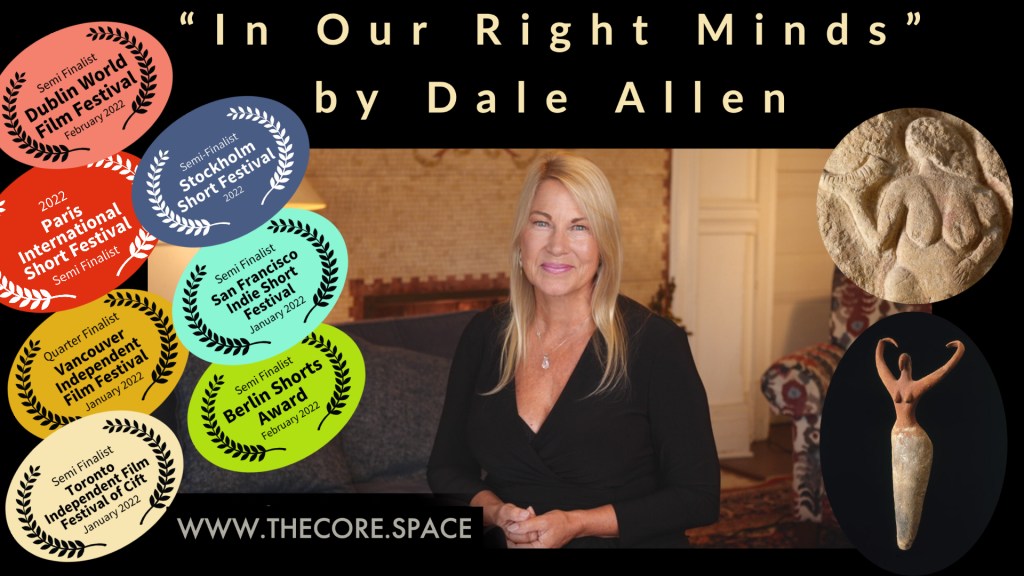
My Goddessy by Dale Allen

I am passionate about sharing the image, essence and energy of the sacred feminine.  Having presented this material to thousands of men and women at universities, conferences, corporations, expos and theaters across the US, Canada, from Kauai to Dubai, to the Parliament of the World’s Religions, and twice to the UN Commission on the Status of Women, I have humbly witnessed its healing effect.  (I return to UNCSW on March 21, and welcome you to join this free online event, which you can find here.

When I first encountered the word, “Goddess,” I didn’t like it.  Using it felt strange, and I wondered why I should bother.  The word “Goddess” felt uncomfortable and unnecessary.

Continue reading “My Goddessy by Dale Allen”

From the Archives: Through the Eyes of the 21st Century Bird Goddess by Carolyn Lee Boyd

Moderator’s note:Today’s blogpost was originally posted March 14, 2018. You can visit it here to see the original comments.

When I raise my eyes to a bird soaring over me in flight, I am no longer bound to the Earth by gravity. I stop my round of daily tasks and widen my vision to view myself and our world from above through birds’ eyes. For just a moment, as I observe beyond my usual narrow horizon, I perceive truths about myself and others that have been hidden and grasp wisdom that has previously eluded me.

From Neolithic times onwards in cultures stretching across the globe, as described by Judith Shaw, bird-shaped goddesses have embodied life, death, rebirth, and more. More recently, as noted by Miriam Robbins Dexter, these beautiful winged beings were perceived of as monsters and flying through the air was one of the accusations made against the women persecuted as witches in the Burning Times. What greater demonstration could there be of the intense terror this powerful relationship between women and birds creates in those who demand dominion over women’s bodies and souls?

Continue reading “From the Archives: Through the Eyes of the 21st Century Bird Goddess by Carolyn Lee Boyd”

Carol P. Christ’s Legacy: Does Belief Matter?

Moderator’s Note: Carol Christ died from cancer in July, 2021. Her work continues through her non-profit foundation, the Ariadne Institute for the Study of Myth and Ritual and the Goddess Pilgrimage to Crete. This blog was originally posted December 10, 2012. You can read it long with its original comments here.

In recent days I have been pondering the fact that some people and some feminists seem to see the issues of religious faith and belonging to be rooted in birth, family, and community, while for others the question of belonging to a religious community hinges on belief and judgments about the power exerted by religious institutions.  What accounts for this difference in the way we view religious belonging?

Recently I watched The Secret History of Sex, Choice and Catholics, a film featuring Roman Catholic feminists and ethicists who dissent from the Roman Catholic hierarchy’s views on contraception, abortion, and homosexuality.  At the beginning of the film those interviewed state almost univocally that for them being Catholic stems from having been born Catholic. These Catholic dissidents continue as Catholics, even though they disagree with major portions of Roman Catholic teaching.  It may have been because they were not asked, but most of them did not name reasons of belief for remaining Catholic.

Continue reading “Carol P. Christ’s Legacy: Does Belief Matter?”

From the Archives: Buddhist Misogyny Revisited – Part I by Barbara McHugh

Recently, I wrote a novel about the Buddha’s wife disguising herself as a man to join his religious community. When I showed the manuscript to a Buddhist friend, whose knowledge and practice I respect greatly, he expressed apprehension that it violated the basic myth of Buddhism. I assumed he meant that my storyline of gender deception strays too far from the versions of the Buddha’s life as recorded in the traditional canon, which adherents regard as the Buddha’s inviolable teachings. The last thing I wanted to do was to misrepresent these teachings.

What does it mean “to violate a myth”?  If I had portrayed the Buddha as a psycho-killer or wife-beater, I could appreciate this charge, but I had presented an enlightened Buddha whose values were in alignment with standard scripture and the mores of his day. The change I made was to tell the story from a woman’s point of view, and to do so, I modified some of the traditional legends and created new material to make my choices plausible. Predictably, my modifications came up against many of the stories’ misogynistic elements.

For instance, in the canon, the Buddha initially refuses to admit women to the monastic order.  Eventually his attendant Ananda persuades him, but then the Buddha adds 104 extra rules for nuns, eight of which (the Garudammas) clearly put women in an inferior position.  One rule states: “A nun who has been ordained even for a hundred years must greet respectfully, rise up from her seat, salute with joined palms, do proper homage to a monk ordained but that day.” The Buddha also told Ananda that thanks to the admission of women, the Dharma (the teachings and practices of Buddhism) would die out after only 500 years.

Continue reading “From the Archives: Buddhist Misogyny Revisited – Part I by Barbara McHugh”

Carol P. Christ’s Legacy: Women Are Not Sluts, Rush, Douch-Bag Is Not Funny, Jon, And Sexism Is More Than “Inappropriate,” Mr. Whitehouse Spokesperson! by Carol P. Christ


Moderator’s Note: We here at FAR have been so fortunate to work along side Carol Christ for many years. She died from cancer in July, 2021. Her work continues through her non-profit foundation, the Ariadne Institute for the Study of Myth and Ritual and the Goddess Pilgrimage to Crete. To honor her legacy, as well as allow as many people as possible to read her thought-provoking and important blogs, we are pleased to offer this new column to highlight her work. We will be picking out special blogs for reposting.This blog was originally posted March 12, 2012. You can read it long with its original comments here.

Why is it OK to insult women, our bodies, and our sexuality in ways that it is no longer OK to insult other groups?

The recent controversy over Rush Limbaugh’s rant about Sandra Fluke would not be so important if Limbaugh were not the “voice” allowed to say things that Republican politicians cannot say in public. Republican politicians wish to appeal to men who would say exactly what Rush said, while watching Fox News or over a beer with their buddies.

The Virgin-Whore split is alive and well in our culture. Sandra Fluke  finally did get to testify in a hearing called by Nancy Pelosi.  She  assumed a woman’s right to choose when and with whom we have sex and whether and when we will have children, but she did not focus on sexual freedom. One of her examples was a married woman who could not afford birth control and another was a woman who needed birth control pills for reasons having nothing to do with sex or sexual activity. She did not appear in Congress in a mini-skirt (though she should have had every right to do so) but in a business suit. Yet she was called a slut and a prostitute and asked to post porno films of herself on the internet.

Continue reading “Carol P. Christ’s Legacy: Women Are Not Sluts, Rush, Douch-Bag Is Not Funny, Jon, And Sexism Is More Than “Inappropriate,” Mr. Whitehouse Spokesperson! by Carol P. Christ”