In my current trajectory linked to community development — via both activism and my professional field — I’ve learned that popular education is a very useful practice and methodology to decentralize all types of knowledge. Since I embraced Islam, part of my activity has focused on creating spaces for the production, discussion, and appropriation of religious knowledge for women at the grassroots. Religion is not separated from the daily life of believers, therefore, each of them carries knowledge that has been deliberately obliterated by hegemony.
The feminist hermeneutic of Islam is a paradigm that aims to provide Muslim women with skills and concepts that allow them to boost their agencies in their respective contexts, encouraging a transformation in the understanding of religious phenomena and its trajectory towards gender justice. For this transformation to be possible, knowledge must be accessible in language, methodology and location.
Paulo Freire’s pedagogy of liberation is a tool I consider to be critical and necessary for feminism, including Islamic feminism, at a time when debates about decolonization are very fashionable in academia. Freire’s methodology is democratizing because it allows, on one hand, to transfer knowledge from privileged circles to the margins and, on the other, to make visible the experiential knowledge produced in the periphery — to include them in the spectrum of what we understand and as such subvert, in this way, the dynamics of power, representation and discourses.
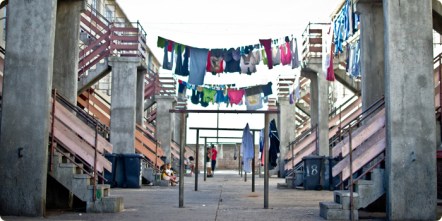
During my time in South Africa, I have engaged with popular education on topics related to Islam and Gender with Muslim women from the Cape Flats. These women have different backgrounds, races, life trajectories, and religious journeys. They exist in the geographic, cultural and epistemological margins of the social reality of Cape Town. Their experiences as Muslims do not appear in academic journals, nor are they even “noticed” by their highly androcentric communities of belonging.
For the past 7 months, I have met with them on a regular basis to talk about Gender and Islam. “Talk” is a methodological definition that means that we are placed in equal and interchangeable positions of teacher-student during our dialog — assuming than rather than learning something new, we are facilitating for each other a way to communicate things we already know. Muslim women of the Cape Flats know, indeed. But they have been told that they do not know by a system of privilege formed for the ulemas, for academia, or for the Islamic institutions. Continue reading “Talking Gender and Islam at the Grassroots by Vanessa Rivera de la Fuente”


 While the world is falling apart all around me, I have been slowly engaged in a major cleaning and cleansing of my home.
 On a trip to Ireland several years ago, I was fortunate to have been able to see the Sheela-na-gigs in the National Museum of Dublin. Two of these Sheelas including the one removed from the Seir Kieran Church of County Offaly, pictured below, are currently on display. They stand at the doorway of a room dedicated to items from the medieval period and easily missed. As there was little interest in them and they are not in cases, I was able to silently commune without interruption.
 Today I am finishing the last bit of the honey I hand-carried home from my most recent trip to Trentino. Sun yellow in color, it is made from the nectar of mountain flowers. Its label tells its origin—di montagna, of the mountains, and its type — mille fiore, often translated as “wildflowers.” Literally, however, it means “a thousand flowers.”
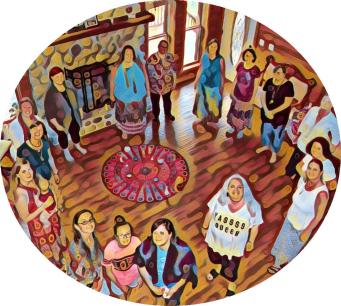 tapestries, their faces are turned towards me, waiting expectantly. We are here for our first overnight Red Tent Retreat, our women’s circle’s second only overnight ceremony in ten years. We are preparing to go on a pilgrimage. I tell them a synopsis version of Inanna’s descent into the underworld, her passage through seven gates and the requirement that at each gate she lie down something of herself, to give up or sacrifice something she holds dear, until she arrives naked and shaking in the depths of the underworld, with nothing left to offer, but her life.
 While the Republicans in Congress and in state legislatures across the country are working to repeal and restrict a woman’s right to control her own body, the Democratic Party has decided not to “insist” that the right to abortion is a basic human right.
 He said, “Look up.” So, I looked up, and I saw the most beautiful stars. They were like Hubble Space Telescope Images, but I could see them with my own unaided eyes. All the colors were there, close enough to touch, yet glittering and dancing against the black of space, each one twinkling its own unique light. I was kneeling in the dream, but the sight was so beautiful it knocked me backward, the backs of my thighs now folding onto my calves. I began to cry, and that is when I woke up.
 Feminism and Religion