Kassiani: Placing a Woman at the Center of the Easter Drama by Carol P. Christ

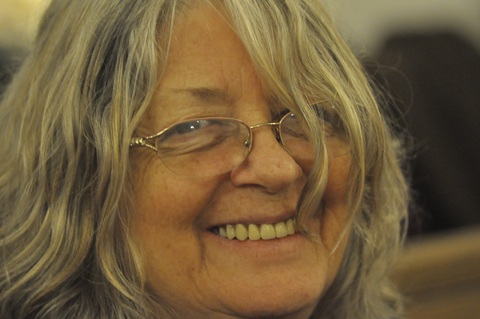
Carol in Crete croppedFor many years I been told of the beautiful Hymn of Kassiani, sung only on Easter Tuesday night, but I had never heard it until this week. For many this song is the high point of Easter week.

Kassiani, also known as St. Kassia, was a Greek woman born into a wealthy family in Constantinople (now Istanbul) about 805 to 810 AD. According to three historians of the time, she was intelligent and beautiful and selected as a potential bride for the Emperor Theophilos. The chroniclers state that the Theophilos approached her and said: “Through woman, the worst,” referring to the sin of Eve. Clever Kassiani responded, “Through woman, the best,” referring to the birth of the Savior through Mary.

Apparently unable to accept being put in his place by a woman, Theophilos chose another bride. Kassiani founded a monastery in Constantinople becoming its first abbess. She was an outspoken theological advocate of icons during the iconoclastic crisis (for which she was flogged). One of only two women to publish under her own name during the Byzantine Middle Ages, Kassiani wrote both poetry and hymns. Up to 50 of her hymns are known today, with 23 of them being part of the Greek Orthodox liturgy. Continue reading “Kassiani: Placing a Woman at the Center of the Easter Drama by Carol P. Christ”

I Come From a Long Line of Beautiful, Strong and Capable Women by Jassy Watson

JassyIn 2014 I wrote about the passing of my dear Pop and the painting that burst forth when I was told very clearly that Pachamama had come to accompany him on his return. It is with a very heavy heart that I now write with news of the recent passing of my dear Nanna. The anchors of our family now both gone. When I was told of her passing, I envisioned her being carried by angels; at peace and free of pain.

The last time I saw her she told me the spirits had been visiting. “I’m not scared,” she declared. This was not surprising for Nan always had a close relationship with spirit. I remember her telling me of a ghostly experience she had many years ago. It was very late one night and someone had come knocking at the door. Out of bed she got and answered it only to be greeted by her brother who had died many years before. He asked her to come with him and she told him it wasn’t time yet. Nan swore it wasn’t a dream. It had really happened. This is just one of many otherworldly encounters she told me about over the years.

Much of my childhood and early adulthood was spent at Nanna’s house so there are plenty of fond and funny memories of her. Her obsession with ghost and horror stories stands out as one of them. When we were children, she would get my sister and me to stay up late with her and watch all kinds of mystery murder shows. I remember watching The Hounds of Baskerville with her and being scared witless. The bonus however was getting to cuddle up in bed with her for the night.

Reading was one of her greatest passions, and she read everything from Shakespeare to Stephen King. I believe it was Nanna who inspired my love of history and over the years we swapped and shared numerous historical books. Her knowledge of Old Britain was astounding, and I remember many a discussion over the fate of Mary Queen of Scots – Nanna was always a bit anti-English, and we often wondered how history may have unfolded if Mary hadn’t been de-throned and exiled. In fact the last book she sent for me to read was another about her.

Stargazing was another one of her loves and is something she will be dearly remembered for. Many evenings were spent out on the deck looking to the night sky. Nan knew where all the constellations and zodiac signs were and she rarely missed an astronomical event. Whenever I have looked to the stars I have thought of Nanna, but now when I look to them, she is one of them. Shining down on us brighter than ever.

I dedicated my latest painting to Nanna. For me, painting is how I can process my thoughts and feelings and is also a way to find clarity and understanding on matters such as the nature of life and death. From the moment I made the first marks on the canvas I kept hearing “your ancestors are behind you.” I knew I was being guided by them and tried my hardest to connect in with Nanna’s spirit to see and feel who guided her home. Nanna had strong ancestral ties so it was only fitting to feel them so strongly here. The two younger women standing in front are the gatekeepers, standing at the threshold to the other side. The woman in the centre came with the message that Nanna is at peace – she is peace. She is pictured smelling the roses that were one of Nanna’s favourite flowers to grow. The firebird symbolizes transformation and the flight of her spirit that is seen to the left leaving, heading back to the cosmos from whence she came.

"Suddenly all my ancestors are behind me. Be still they say. Watch & listen. You are the result of the love of thousands." She is at Peace, by Jassy Watson
“Suddenly all my ancestors are behind me. Be still they say. Watch & listen. You are the result of the love of thousands.”
She is at Peace, by Jassy Watson

Death is surreal and it still hasn’t quite sunk in that I will never see her again. Nanna was a strong and caring woman who loved her family deeply. Her legacy is one of love, and while the circle feels broken in the sense that she is no longer physically here, it remains unbroken for her spirit lives on forever in our hearts.

I am the daughter of Ramona Cherise Lane, the granddaughter of Ailsa Aileen Rollings and the great granddaughter of Ruth Harrison. I come from a long line of beautiful, strong and capable women stretching back to the dawn of humankind. I honor them and give thanks for all that they have taught and shown me.

Nanna taught me about my ancestors.

She taught me about the importance of storytelling.

She taught me about mystery and history.

She taught me to love books.

She showed me how to crochet and knit.

She showed me how to play cards.

She showed me spirit.

In life and death Nanna has taught me of unconditional love and acceptance.

“Death leaves a heartache no one can heal, love leaves a memory no one can steal”

(Irish Headstone)

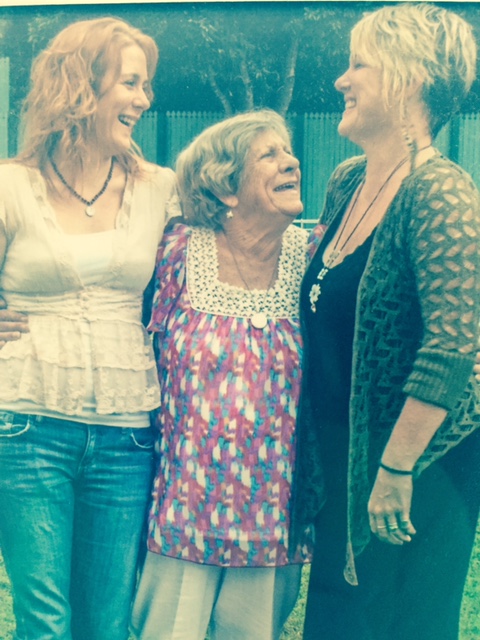
My sister Carissa, Nanna (Ailsa) and me

Jassy Watson, who lives on the sub-tropical coast of Queensland Australia, is a Mother of four, passionate organic gardener, Intuitive/Visionary & Community Artist, Teacher, Intentional Creativity Coach and a student of Ancient History and Religion at Macquarie University, Sydney. She is the Creatress of Goddesses Garden, Studio & Gallery; a school for the Sacred Creative Arts. Jassy teaches regular painting workshops in person, nationally and internationally, and online based around themes that explore myth, history, earth connection and the Goddess. Regular creative events and presentations are also held that have included visits from international scholars, artists and musicians. Visit http://www.goddessesgardenandstudio.com to read more about her and the work she creates. 

The Inalienable Right to Life, Liberty, and the Pursuit of Happiness vs. the Right to Religious Freedom by Carol P. Christ

carol p. christ photo michael bakasIn his speech announcing that he signed the Religious Freedom Restoration Act, Governor Mike Pence of Indiana did not mention the issue of the so-called “right” to refuse service to gays, lesbians, and transgendered individuals as one of the reasons this bill came to his desk. However, the idea that bakers could be “coerced” into baking cakes for gay weddings, photographers “required” to photograph them, and venue owners “forced” to provide space for them was frequently mentioned in discussions of this and similar bills. Governor Pence’s evident defensiveness during his press conference, and his repeated assertion that “this is not about discrimination” made it clear that an elephant was very much in the room.

Instead of defending the alleged “right” of religious individuals to discriminate against gay, lesbians, and transgendered individuals, Governor Pence invoked the right of employers to refuse to provide contraception to women as part of employee insurance plans, mentioning the Hobby Lobby and University of Notre Dame cases. If anyone has forgotten, in the Hobby Lobby case the Supreme Court decided that employers with a deeply held conviction that birth control is wrong do not have to offer it to their employees as required by federal law if “less restrictive” ways of providing it can be found.

Governor Pence apparently thought that openly defending the so-called “right” to discriminate against women is less controversial in his state than openly defending the so-called “right” to discriminate against lesbians, gays, and transgendered individuals. In fact, these two issues are linked in the minds of the people like Governor Pence. Continue reading “The Inalienable Right to Life, Liberty, and the Pursuit of Happiness vs. the Right to Religious Freedom by Carol P. Christ”

Genderqueering by John Erickson

We find our versions of home in these communities and it is within these spaces where our home not only begins to define who we are but we, as a reflection of that space, begin to outwardly redefine the spaces we exist in. If we slowly begin, through our experiences to shape our homes based on privilege and power without self-reflection and acknowledgment of others, then we are no better than those oppressive forces we say we’re against.

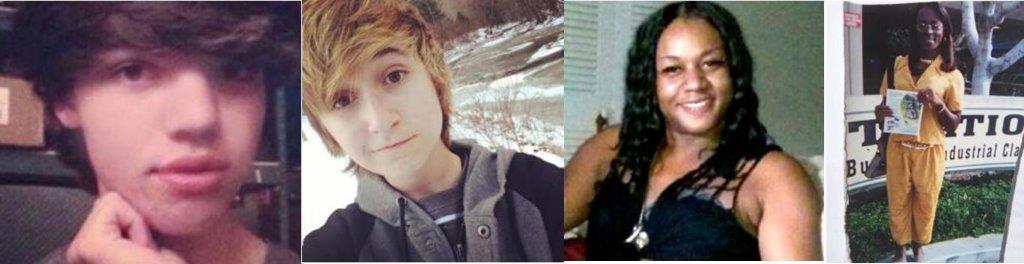
Leelah Alcorn, Ash Haffner, Aniya Knee Parker, Yaz'min Shancez
Leelah Alcorn, Ash Haffner, Aniya Knee Parker, Yaz’min Shancez

This post is a response to a recent blog entry titled “Who is Gender Queer?” on this site from Carol Christ.  The post can be read by clicking here.  I want to thank my friend, advocate, and upcoming scholar Martha Ovadia for reasons only she knows!  Stay brave, speak up, be heard!
_________________________________________

It is terrifying to know that something is wrong but not be able to speak truth to power.

It is even more terrifying to know something is wrong, be able to speak to it, and then silence those voices that do not have that same privilege, power, or position.

The struggle that many of us in positions of privilege and power face is not just that of being ostracizing and essentializing forces—it is that we, as allies, members of communities, or even those dedicated to a cause, can ourselves participate in the oppression we are fighting against and can do harm.

It’s taken me a long time to not only be comfortable with who I identify as, but also how I go about fighting and defining my life based on said identity and experience. However, the one thing that I have the ability to do is choose that identity more freely than others. Unlike Leelah Alcorn, Ash Haffner, Aniya Knee Parker, or Yaz’min Shancez pictured above, I did not have to face the types of oppressions they did, to which they sadly lost their lives, as a result of the fact that we exist in a society that can’t deal with the inability to leave things undefined or to allow people to define who they are on their own terms.

It is vital that although my lived experiences could never meet nor match the same types of oppression that these brave individuals had to face, I, as a white, cisgendered gay male, do not become part of their oppression through my own position and privilege.

As a man who exists in the world of feminism and within various women’s communities, I walk a daily tightrope of privilege and power to insure that I do not silence those that I consider allies, friends, mentors, or colleagues. As a man who exists in the world of the LGBTQ community, I walk an additional tightrope to additionally not take away from or diminish the experiences of those members of our community that do not have the same type of lived experiences as myself.   Even within minority communities, there are positions of hierarchy and within these hierarchies of knowledge, identity, or power, comes a responsibility to insure that the oppressed do not become the oppressors.

We find our versions of home in these communities and it is within these spaces where our home not only begins to define who we are but we, as a reflection of that space, begin to outwardly redefine the spaces we exist in. If we slowly begin to shape our homes based on privilege and power without self-reflection and acknowledgment of others, then we are no better than those oppressive forces we say we’re against.

I can’t speak for what identity feels like –I can only speak for what essentializing does, and what it does is reflected in the deaths of Lelah, Ash, and the many others who die nameless.   It is our responsibility, as allies, members of communities, and those fighting to end sexist, patriarchal, and, even now, homonormative oppression, to make sure that no more deaths occur on our watch or that truth is spoken to power even when power is masquerading around as truth.

John Erickson is a Ph.D. Candidate in American Religious History at Claremont Graduate University. He holds a MA in Women’s Studies in Religion; an MA in Applied Women’s Studies; and a BA in Women’s Literature and Women’s Studies.  He is a Non-Fiction Reviewer for Lambda Literary, the leader in LGBT reviews, author interviews, opinions and news since 1989 and the Co-Chair of the Queer Studies in Religion section of the American Academy of Religion’s Western Region, the only regional section of the American Academy of Religion that is dedicated to the exploration of queer studies in religion and other relevant fields in the nation and the President of the University of Wisconsin Oshkosh’s LGBTQA+ Alumni Association.  When he is not working on his dissertation, he can be found at West Hollywood City Hall where he is the Community Events Technician and works on policies and special events relating to women, gender, sexuality, and human rights issues that are sponsored or co-sponsored by the City of West Hollywood. He is the author of the blog From Wisconsin, with Love and can be followed on Twitter @JErickson85

Role Play: In Search of the Authenticity of My Being by Elise Edwards

Elise Edwards“I stood in the authenticity of my being: Black, preacher, Baptist, woman. For the same God who made me a preacher made me a woman, and I am convinced that God was not confused on either account.”
– Reverend Dr. Prathia Hall

These words came across my Facebook feed on Sunday in celebration of International Women’s Day. Reconciling Ministries Network put the statement on its Facebook page, along with a picture of Prathia Hall preaching from the pulpit, in remembrance and honor of women leaders who contributed to the US Civil Rights Movement. This past Sunday, March 8, when the quote was displayed, marked the 50th anniversary of Selma’s Bloody Sunday. Prathia Hall was a leader in the Student Non-Violent Coordinating Committee (SNCC) and one of the activists on the Edmund Pettus Bridge who were attacked as they began to march from Selma to Montgomery, Alabama. Later in her life, she became an ordained minister, professor, and womanist theologian.

For me, this past weekend was about remembrance through many forms. While there were many events commemorating Selma and the important events that unfolded there 50 years ago, my family and I were focused on a more intimate form of remembrance. On Saturday, we held a dinner and informal memorial service for my godfather who passed away last month. I got the news of his death on a day when I’d been doing some deep soul-searching and reflecting about the image I present to the world and its correspondence with who I am and desire to be. Just a few days prior, I’d spoken to my godfather about his health and subsequently, I had been questioning how I might be more connected to him. We lived several states apart, and I wondered how I could be a good goddaughter to him despite the distance. Those questions are left unanswered in the wake of his death. Continue reading “Role Play: In Search of the Authenticity of My Being by Elise Edwards”

Ancestor Connection and DNA Testing by Carol P. Christ

carol p. christ photo michael bakasIf like me, you view ancestry research as a spiritual quest, you may be wondering if it is worthwhile to have your DNA tested. I found out about The Seven Daughters of Eve, the female ancestors of most Europeans, some years ago. Through my mtDNA (passed from mothers to children) and my father’s YDNA (passed from fathers to sons) tests, I discovered my connection to a woman who lived in Old Europe about 18,000 years ago and to a man who was among the Indo-European invaders thousands of years later.

I became aware of atDNA (autosomal) tests for ethnicity while watching the PBS American ancestry programs created by Harvard historian Henry Louis Gates. In considering ethnicity, it is important to remember that 99.9% of human DNA is shared. AtDNA testing focuses on the .1% that is not. This type of DNA testing can locate African DNA geographically, and it also can reveal Native American and Jewish ancestry. When the test recently became less expensive, I decided to try it. I was particularly interested to see if my 3x great-grandmother Gertrud Zimmerman might have been Jewish. Continue reading “Ancestor Connection and DNA Testing by Carol P. Christ”

Patriotism and Religion: Speaking Complexly about Complex Issues by Carol P. Christ

carol p. christ photo michael bakasFormer Mayor of New York Rudy Giulaini recently questioned the American President’s patriotism when he asked if Obama had been “brought up the way you were brought up and I was brought up, through love of this country.” When Chris Hayes discussed the furor surrounding Guiliani’s statement on MSNBC with James Peterson of Lehigh University, I would say that they both missed the point. Their defense of the President was to insist that he is a dyed in the wool patriot. Should anyone be a dyed in the wool patriot these days? What does and should patriotism mean? These were questions not asked.

Asked to clarify his comments, Giulani opined that Obama speaks from the perspective of “socialism” and “perhaps anti-colonialism” rather than good old American patriotism. Again Hayes and Peterson dropped the ball. They were quick to agree that the American Colonialists should be considered anti-colonialist given that they rebelled against the colonial power of England. What they failed to say was that the American Colonialists were colonialists too. Though they threw England out, they had no compunction in asserting their right to take the land, the resources, and the very lives of earlier inhabitants of what became the American land.

I heard Giuliani’s statement in a different way. When Giuliani spoke of being brought up to love his country, I heard echoes of my own childhood. Like many Americans, Giuliani included, I was taught to love my country right or wrong. Indeed I was taught that my country was never wrong. From the perspective of my current understanding of the world, I now feel that the way I was brought up to love my country was itself wrong.

The American nation has been wrong on many things. First we must consider the idea our forebears held that the American land was theirs for the taking. No matter what degree of relation immigrant Americans had to the Native Americans, they all were taught that the Indians were barbarians who had no right to the land being claimed by civilized Europeans. Next we can ask why slavery was not outlawed and women were denied the vote at the time of the founding of the American nation. If we look at the truth of the matter, there are many reasons not to feel as proud of our country as “we” were taught to do.

And then of course there are the many wars—from the Pequot War to the Iraq and Afghanistan wars. How many, if any of them were just wars? And how many of them should rightly give us reason to temper any patriotism we have with the double eye that sees both the good and the bad that our nation has done?

If Chris Hayes had been interviewing me, I would not have been so quick to defend patriotism and the American nation. Rather I would have asked what patriotism means and whether anyone should defend any nation right or wrong. This would not have extricated Obama from Giuliani’s criticism, but it might have instigated deeper and more complex questioning of Giuliani’s premise.

In recent programs on MSNBC Lawrence O’Donnell opened a complex discussion of religion in general and Islam in particular, following Obama’s (now controversial) assertion that the terrorism of the Islamic State is not “the real” Islam and his statement that Christians were also guilty of atrocities during the crusades.

It was clear to me that the context of Obama’s statements is the feeling of many Americans that “Islam” is to blame for the terrorist activities of jihadists acting in its name, along with the conclusion they draw from this that “Islam” is a violent religion while “Christianity” is not. Obama was trying to make two related points: not all Muslims are violent jihadists; and Christianity is not all good and Islam is not all bad. Obama was immediately attacked for comparing Christianity and Islam for both having violent histories.

O’Donnell (unlike Hayes) resisted any knee-jerk temptation he might have had to defend Obama in any simple way from his critics. Rather O’Donnell (revealing the power of Roman Catholic theological education), began a more complex conversation about what constitutes “the real” Islam and “the real” Christianity.

Not one to mince words, O’Donnell asserted that Catholicism “was once the most murderous force on the face of the earth.” I was more interested in the statement of Asra Q. Nomani, the author of Standing Alone: An American Woman’s Struggle for the Soul of Islam, that the President was wrong to say that Islamic State is beyond the pale of Islam. Rather, she asserted, Islamic State represents, “a very serious interpretation of Islam in the world that is wreaking havoc on all of us.” Though Normani does not agree with Islamic State’s interpretation of Islam, she argues that well-meaning scholars, journalists, and politicans, along with progressive Muslims, are simply burying their heads in the sand if they refuse to recognize that the Islamic State’s understanding of Islam is rooted in Islamic texts and in Islamic history.

This discussion of what is or is not “the real “Islam” and “the real” Christianity reminds me of debates feminists were having a few decades ago about whether or not “the real” Christianity or Judaism are sexist or not. Along with Mary Daly, Rosemary Radford Ruether, Judith Plaskow, and others, I engaged in this debate for a period of time.

In the end, I came to see that the question of what constitutes “the real” Judaism or Christianity is a moot point. Whatever good or bad exists in the past of any group is subject to interpretation by actors and groups of actors in the present: they are the ones who will determine which texts and which history they will consider normative and which parts they will transform or discard. From this perspective we can see that both jihadists and progressive Muslims are engaged in interpretation of Islam in the present, and that they are struggling with each other about which interpretation of Islam will be brought into the future.

It is not easy to initiate complex discussions of complex issues, but these are the very discussions we most need to have—about patriotism and about religion. It is clear that these discussions are related. Guiliani criticized Obama’s patriotism in part because Obama dared to criticize Christianity. Many people on both sides of the discussions about religion and politics are are convinced that their country is right because their God is on their country’s side.

I commend Lawrence O’Donnell and Asra Normani for showing us that complex discussions of religion are possible in public spaces, even when the political stakes are high. I hope this discussion will continue, and that a more complex discussion of patriotism and love of country can be initiated as well. No religion and no country is all good nor is any religion or country all bad. Blind faith in religion or country, on the other hand, is never a good thing.

Carol leads the life-transforming Goddess Pilgrimage to Crete (facebook and twitter)–space available on the spring and fall 2015 tours.  Carol’s books include She Who Changes and and Rebirth of the Goddess; with Judith Plaskow, the widely-used anthologies Womanspirit Rising and Weaving the Visions; and forthcoming next year, Goddess and God in the World: Conversations in Embodied Theology. Photo of Carol by Michael Bakas.


All We Are Saying Is Give Greece a Chance by Laura Shannon

Laura Shannon square cropTen years ago, I went to live in Greece. I knew I would love living in a culture where everyone dances, and so it turned out. I also loved the generosity, hospitality, connection, mutual support, and positivity embodied by the dance, a set of values which goes back thousands of years to Old European culture as articulated by Marija Gimbutas, Carol P. Christ, and Riane Eisler. When the economic crisis struck in 2008, I saw firsthand how Greek people used these values to help each other survive.

On Sunday, Jan 25th, 2015, the Greek people decisively voted into power the anti-austerity party Syriza (SEER-ih-zah), after six years of intense suffering under brutal austerity measures imposed by the IMF, the EU and the European Central Bank.

These three powers together are known as the ‘troika’. The austerity measures required by them in return for the so-called ‘bailout’ loans have been devastating, causing soaring rates of poverty, hunger, unemployment, sickness, and suicide. Times are harder in Greece than in the US during the Great Depression, though you won’t hear the details in the mainstream media. And the cost of this humanitarian crisis is not being counted by anyone.

Continue reading “All We Are Saying Is Give Greece a Chance by Laura Shannon”

Has the Vatican Discovered that Women Should Be Running the World? by Carol P. Christ

So it is a [female] generativity that .. is … giving life to social, cultural and economic structures that are inspired by values, ideas, principles and practices oriented to the common good …

carol p. christ photo michael bakasThe above statement from the Pontifical Council’s document on “Women’s Cultures: Equality and Diffference” is a response to Pope Francis’s call for a discussion of “feminine genius” and its role in the Church. If in fact women are  “oriented to the common good,” then this is the best reason I can think of to elect a woman pope. And if a women are in fact hard-wired to think about the good of all, wouldn’t a woman pope’s first act be to dissolve the hierarchy that elected her? Is this why the Vatican is so afraid of the power of women?

From February 4-7, 2015 the Pontifical Council on Culture made up of 32 voting members (29 male clerics and 3 laymen) with the advice of non-voting Consultors (28 men and 7 women), discussed the role and place of women in the church and the world in relation to the preliminary document said to have been prepared by a group of unnamed women cherry-picked by the Vatican. Continue reading “Has the Vatican Discovered that Women Should Be Running the World? by Carol P. Christ”

Relationship, Freedom, Change, and Interdependence in the Web of Life by Carol P. Christ

carol p. christ photo michael bakasMarjorie Suchocki says that feminist theology needs a metaphysics, a coherent world view that can hold together what we might otherwise be seen as a series of unrelated assertions made by feminists. Metaphysics is one of those terms that make most people cringe. If they have any idea at all what the word means, they might categorize metaphysics as the most abstract and out of touch with reality aspect of philosophy. In the Platonic tradition where ideas precede reality, metaphysical truths are revealed by rational contemplation of transcendent principles that precede the world. “I think, therefore, I am,” Descartes said. This notion of metaphysics makes me cringe too.

In process philosophy metaphysics refers to the fact that the world is governed by and expresses certain fundamental principles. This does not mean that ideas are more important than reality. Quite the opposite, metaphysical principles are conclusions reached through paying close attention to the world. Continue reading “Relationship, Freedom, Change, and Interdependence in the Web of Life by Carol P. Christ”