The New Feminist Revolution in Religion by Gina Messina-Dysert

Gina Messina-Dysert CGUThis week I will be attending the American Academy of Religion/Society of Biblical Literature (AAR/SBL) Conference in Baltimore Maryland.  In celebration of the second anniversary of Feminism and Religion and the continued efforts of feminists in the field within the digital world, Xochitl Alvizo and I will lead a roundtable discussion on the intersection of feminism, religion, and technology – or what I refer to as the new feminist revolution in religion.

Reflecting on two years of blogging and engaging in dialogue within a global community reveals how powerful a platform social media can be.   Small gatherings in living rooms, classrooms and coffee shops have grown into global conversations.  Borders are being expanded and new frontiers are being built as the feminist revolution in religion continues to grow and evolve. Continue reading “The New Feminist Revolution in Religion by Gina Messina-Dysert”

GIVING BACK TO THE MOTHER by Carol P. Christ

carol-christOne of the inspirations for the Goddess Pilgrimage to Crete was the spiritual power and energy I felt at the monastery of Paliani with its Sacred Myrtle Tree.  The Panagia, She Who Is All Holy, is said to live in the tree, and the nuns who tend the tree follow customs far older than Christianity.  When I first visited Paliani, I asked Her to heal my broken heart and help me find my true love.

panagia palianiOver the years, I have offered many other prayers:  for my books and tours, for health, for citizenship that would enable me to stay in Greece.   I tell other pilgrims that the Panagia of Paliani has performed many miracles and repeat the story of the doctors who desperately wanted to have a child, who had tried everything, and who had a son a year to the day after making a prayer at Paliani. I point to the many “tamas,” including gifts of precious jewelry, crutches and body braces that have been given in honor of the power of the Panagia of Paliani.

In the fall of 2012 one of our members prayed that a heavy flow of menstrual blood that often lasted for more than half of every month be stopped so that she would have the strength to participate fully in the pilgrimage. She had been bleeding for 5 weeks when she came on the tour, and her bleeding stopped the moment she touched the tree.  Continue reading “GIVING BACK TO THE MOTHER by Carol P. Christ”

“THE DIVINE MYSTERY”? by Carol P. Christ

carol-christ“The mystery of God in feminist theological discourse” is the subtitle of Elizabeth Johnson’s widely read She Who Is. The notion that God is “a mystery” is rarely questioned in feminist theologies. But maybe it should be.

Although it is true that the finite cannot encompass the infinite, and that all knowledge is rooted in particular standpoints, I do not agree that the first and last thing to be said about the divine power is that it is “a mystery.” Indeed as I will argue here, speaking about God as “a mystery” obscures more than it “reveals.”

christina's loveThe notion that Goddess or God is “a mystery” is rooted in notions of “a God out there” that most spiritual feminists reject. Goddess or God “in” the world is, I suggest, not unknown, but known, not hidden, but revealed–in the beauty of the world and in ordinary acts of love and generosity.

The notion that God is “a mystery” is a well-worn trope in Roman Catholic theology. Protestants make similar claims when they speak of  the hiddenness of God Continue reading ““THE DIVINE MYSTERY”? by Carol P. Christ”

Saudi Women Drive by amina wadud

Amina Wadud 2 I am Muslim, by choice, practice and vocation

Saudi Women Drive

So what’s the big deal in that? Thanks for asking.

I have been actively spreading the word, giving support and showing my enthusiasm for the Saudi women’s initiative to be permitted to drive their own cars.  I celebrate with them the success of this latest initiate on October 26th which was without government backlash.  About 60 women took to the wheel. None were arrested, detained, fired from their jobs, harassed in the streets, or banished from their communities.  We call that progress.  Continue reading “Saudi Women Drive by amina wadud”

“MERMAID, GODDESS OF THE SEA” by Carol P. Christ

carol-christOn the recent Goddess Pilgrimage to Crete, I visited the Historical Museum in Heraklion where I saw a beautiful embroidered silk panel of a mermaid identified only as having come from Koustogerako, a village in western Crete. As it is unlikely that a man in a Cretan village would have been talented in embroidery, in this case “Anonymous” most definitely “was a woman.”

In this thread painting a mermaid surrounded by fish is holding the anchor of a ship in one hand and a fish in the other. In Greece the mermaid is the protectress of sailors. In a well-known legend, a mermaid said to be the sister of Alexander the Great, emerges from the sea in front of a ship during a storm and asks: “Is Alexander the Great still living?” If the sailors answer, “Yes, he lives and reigns,” the ship is saved.

mermaid greek0001

In this image the mermaid–who does not much resemble “the little mermaid” of recent lore—is identified by the woman who embroidered her as: “GORGONA, H THEA TIS THALASSIS,” MERMAID GODDESS OF THE SEA.” Assuming that the woman who created this embroidery was probably a Christian, I was surprised to see that she nonetheless referred to the mermaid as a Goddess. Was this phrase passed on to her down to her from pre-Christian times? Did she see any contradiction between her Christian beliefs and the “Goddess of the Sea?” Continue reading ““MERMAID, GODDESS OF THE SEA” by Carol P. Christ”

IS THE SPIRIT OF GREAT GENEROSITY IN CRETE A SURVIVAL OF ANCIENT MATRIARCHAL VALUES? by Carol P. Christ

carol-christAt a coffee shop in Agios Thomas, Crete last month a perfect stranger offered to pay for the coffees and sodas of the 16 women on the Goddess Pilgrimage to Crete. This spirit of great generosity is rarely experienced in the United States or other parts of Europe, but it is still common in rural Crete and some parts of Greece.

 In fact our group was in Agios Thomas because our bus driver Babis, also in a spirit of great generosity, insisted on stopping to show us his village when we were passing nearby. He guided us to see Roman rock cut tombs and arranged for the early Byzantine church to be opened. At the end of the our pilgrimage, Babis stopped the bus at a wooded glen beside a small church where he offered us his own homemake raki, wine, and olives, accompanied by local sheep cheese he had purchased while we were climbing a mountain. After every meal that we ate in local tavernas, we were offered bottles of cold raki, fruit, and sweets.

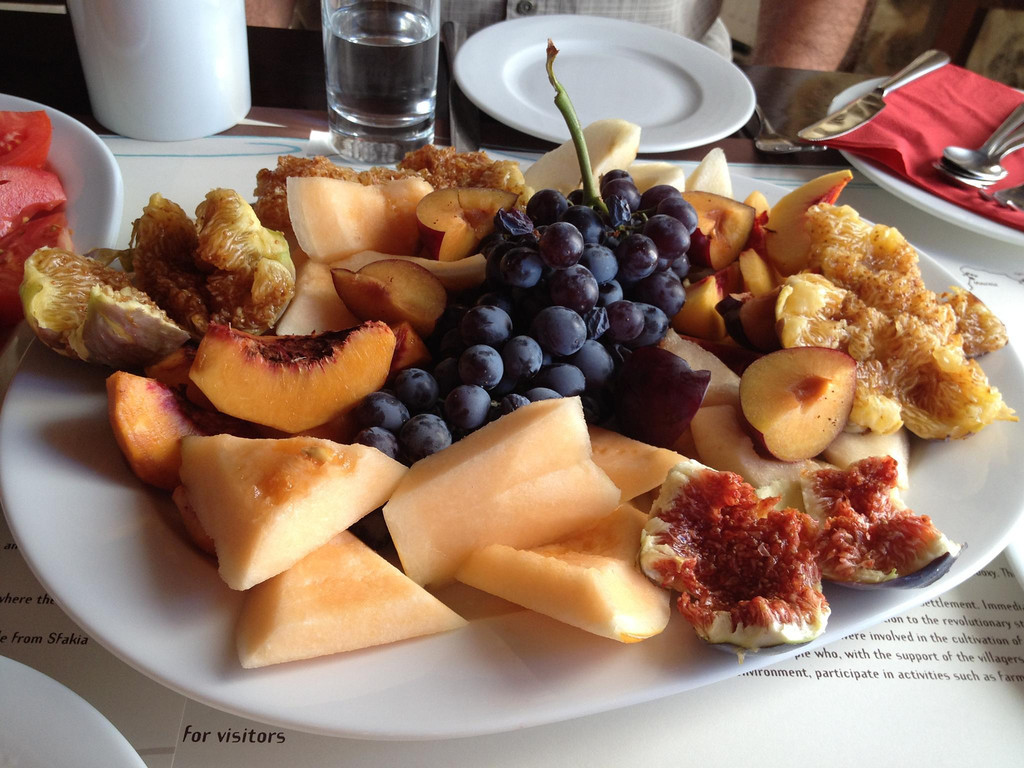
crete fruitsThis spirit of great generosity has long been commented on by travelers in Greece, who often speak of it as unexpected (for them) hospitality to the stranger or traveler. That it is, of course. Through the work of Heidi Goettner-Abendroth, I now understand that the famous Greek hospitality to the stranger has deep roots in matriarchal cultures. According to Goettner-Abendroth, equality of wealth is assured through the widely-practiced custom of gift-giving in matriarchal cultures. Continue reading “IS THE SPIRIT OF GREAT GENEROSITY IN CRETE A SURVIVAL OF ANCIENT MATRIARCHAL VALUES? by Carol P. Christ”

Feeding the Dead by Deanne Quarrie

Deanne QuarrieMost people really love this time of year and I share much of that.  Living in South Central Texas we actually only have two seasons, with a perhaps two to three weeks in between what we laughingly call spring and fall.  Because the winters are not harsh here, the step into spring feels different from those whose winters are frozen for months on end.  We do experience some relief when our temperatures finally drop a bit in October. Even then those drops are only teasers.  When we do finally get a briskness in the air in the wee, early morning hours of dawn but when the sun rises overhead, any memory of that coolness is forgotten.  This morning at 5:30 am, when I woke, it was 54 degrees. I stepped outside to smell and feel the air, so clean and cool.  And yet, now it is 85 degrees and rising, it once more feels like summer. We don’t have the sudden frosts that turn our trees to vibrant reds, yellows and browns.  Yes, the leaves eventually turn and fall to the ground, but we have no heavy freeze and so our colors are pale compared to those in the North and colder climates.

Many Texans think the emotional feel for our two seasons is backwards, believing that summer, with its blazing sun, is the time to withdraw.  Then in winter, when the weather is mostly mild, that’s the time to come out to play.  This is a reversal of pagan thinking about the seasons in North America. Continue reading “Feeding the Dead by Deanne Quarrie”

Hajar: of the desert by amina wadud

Amina Wadud 2 I am Muslim, by choice, practice and vocation

This week the Islamic pilgrimage or Hajj was completed.  For those not gathering on the dusty plains of the desert in Arabia, we have the celebration of the Feast of the Sacrifice, commemorating the exchange of a lamb for the blood of the son of Abraham.  This story is coated with patriarchy, and so it is with some fascination that Hajar (biblical Hagar) configures so significantly in the Islamic telling of it.

According to the same patriarchal twist, it is Abraham’s first son that is pivotal to the story’s continuation and the salvation of a people, yet to be born.  That his first son, Ishmael, was born of a slave woman—some say of African origins—is not without extreme symbolism for African-American women, mostly Christian.  That she is the mother of the tribes of Arabs is also not without some extreme genealogy along with that symbolism. But that she a single female head of household, whose sojourn in the desert still, has a central ritual re-enactment in the Hajj, that I turn to here. Continue reading “Hajar: of the desert by amina wadud”

Early Marriage and Early Islam by amina wadud

Amina Wadud 2 I am Muslim, by choice, practice and vocation

This week, in the state where I am living, Kerala, India:

“…nine prominent Muslim (sic) organizations have decided to approach the Supreme Court to exclude Muslim women from the law prescribing a minimum marital age.  According to them, the present Prohibition of Child Marriage Act, 2006, which prescribes 18 as women’s legal age and 21 for men, violates Muslims’ fundamental right to practice their religion.”

Let me try to step back and formulate this in plain English.

India is a secular democratic nation-state, with a population of over 1 billion, a poverty rate at best estimated at 22%.  It ranks as the 55th worst country with regard to its maternal mortality rate with estimates as high as 450 per 100,000, and has an infant mortality rate of 44-55 per 1000. All the above factors have a direct corollary to child marriage: poverty, maternal mortality (think babies having babies), and thus, infant mortality is directly related to the national age of marriage.

Thus, one way to eradicate poverty, save mothers, and save infants is to prevent child marriage.  It is no wonder preventing child marriage is a leading strategy for development organizations, human rights organizations and even the World Bank.  In 2006, India passed the Child Marriage Act which states, “This legislation is armed with enabling provisions to prohibit child marriages, protect and provide relief to victims and enhance punishment for those who abet, promote and solemnize such marriages” (pg 1).  Continue reading “Early Marriage and Early Islam by amina wadud”

“JC” by amina wadud

Amina Wadud 2 I am Muslim, by choice, practice and vocation

It’s been more than three decades, and certainly most of the influential time of my own theological/social justice career, since I was first introduced to Joseph Campbell (may he rest in “bliss”).  He was still alive then, and my husband and I were like geeks following his PBS series on Myths and Metaphors, and reading all his books.  We called him “JC”, an intentional play on initials and Jesus Christ.  Both of us Muslims by choice, we embrace the Gospels as part of the divine legacy of revelation and accept that they come from the same Source as the Qur’an, the Torah, and other sacred texts, but we fall short of the divination of Jesus.  The grey area of this is hard put for some Christians because “accepting Christ” means to accept the story of his birth, death and resurrection as formula bringing salvation.

We accept his extraordinary divine mission.  Our sacred text not only recaps the virgin birth but also gives Jesus the gift of speech from the cradle where he confirms that his unmarried mother was not a loose woman, but rather the bringer of a Divine miracle, and as such, a miracle herself.  Maybe at another time I will discuss how Mary configures so uniquely in my own feminist theology as read through the Qur’an, but, today I have in mind something about the transformation I went through with Joseph Campbell, starting with the virgin birth.  Continue reading ““JC” by amina wadud”