Into the Light by Beth Bartlett

I looked for my friend, Pamela’s email the morning after she died. Every morning I have looked forward to her email from the day before — the last one sent at 4:37 on the Tuesday afternoon before Thanksgiving. Did she ever see my response sent at 6 AM the next morning – my wish for her to know joy this Thanksgiving, my sending much love? The bulk of it was full of mundanities. How differently might I have written it had I known it would be the last she would see?  Our ongoing call and response email conversation — now without response, forever without response. 

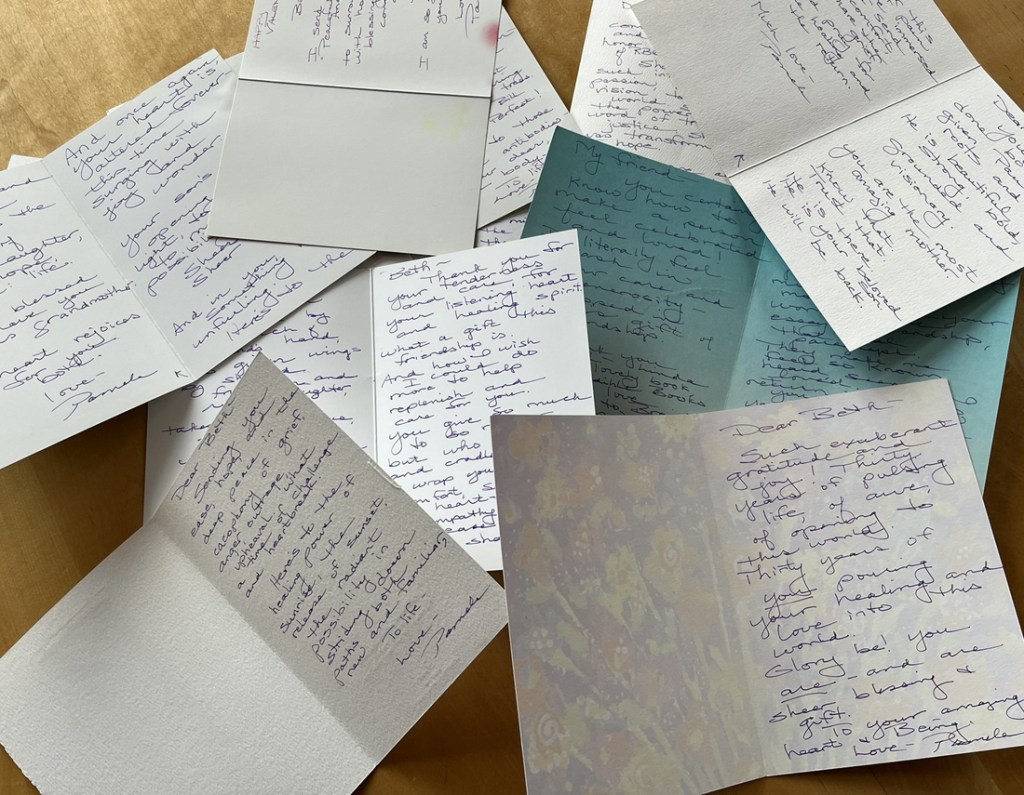
Ours was a friendship of words — words in the cards she has given me over the years, in her detailed responses to my blog posts, in the thousands of emails passed between us over several years. I’ve saved them all.  They were too precious ever to delete. How we both loved words — their poetry, their capacity to communicate, convey, confound, console, comfort. I eagerly anticipated her words every day. For years I have entrusted my daily thoughts, worries, joys, activities, hopes, and the occasional dream to her tender care, always knowing her response would be a mirror, reflecting me back to myself, she reflecting on all I had written – giving witness and testimony, always with the deepest of care and affirmation. As Adrienne Rich wrote in the poem we both loved — “Phantasia for Elvira Shatayev” – I have never seen/my own forces so taken up and shared/and given back.   Yes, this – the immensity, the intensity, the profound reciprocity of our sharing.

Continue reading “Into the Light by Beth Bartlett”

Herstory Profiles: Persistence and Endurance by Anjeanette LeBoeuf

I do not know how else to endure these past few weeks except to continue the fight, to continue to resist, and to continue to speak truth into power. We must once again look to our ancestors, our foremothers, our pillars of human rights, dignity, and compassion. This month’s Herstory Profiles looks at two courageous and unwavering women involved in U.S. politics; Susan Shown Harjo and Patsy Takemoto Mink.

Suzan Shown Harjo (1945-)

Suzan is a Cheyenne Citizen, Cheyenne & Arapaho Tribes, and Hotvlkvlke Mvskokvlke, Nuyakv and a Native American Activist. She is a poet, writer, speaker, policy advocate, and curator. She helped to recover and reclaim more than one million acres of Native Lands. Suzan served as the Congressional Liaison for Indian Affairs for President Jimmy Carter. She held the Presidency of the National Council of American Indians. She is active in the Morning Star Institute that advocates for sports teams to drop names and mascots that contain negative stereotypes towards Native Americans. She received the Presidential Medal of Freedom in 2014 from President Obama. In 2022 Suzan was inducted into the American Philosophical Society.

Continue reading “Herstory Profiles: Persistence and Endurance by Anjeanette LeBoeuf”

Harris Could Not Outrun 2000 Years of Patriarchy by Janet Maika’i Rudolph

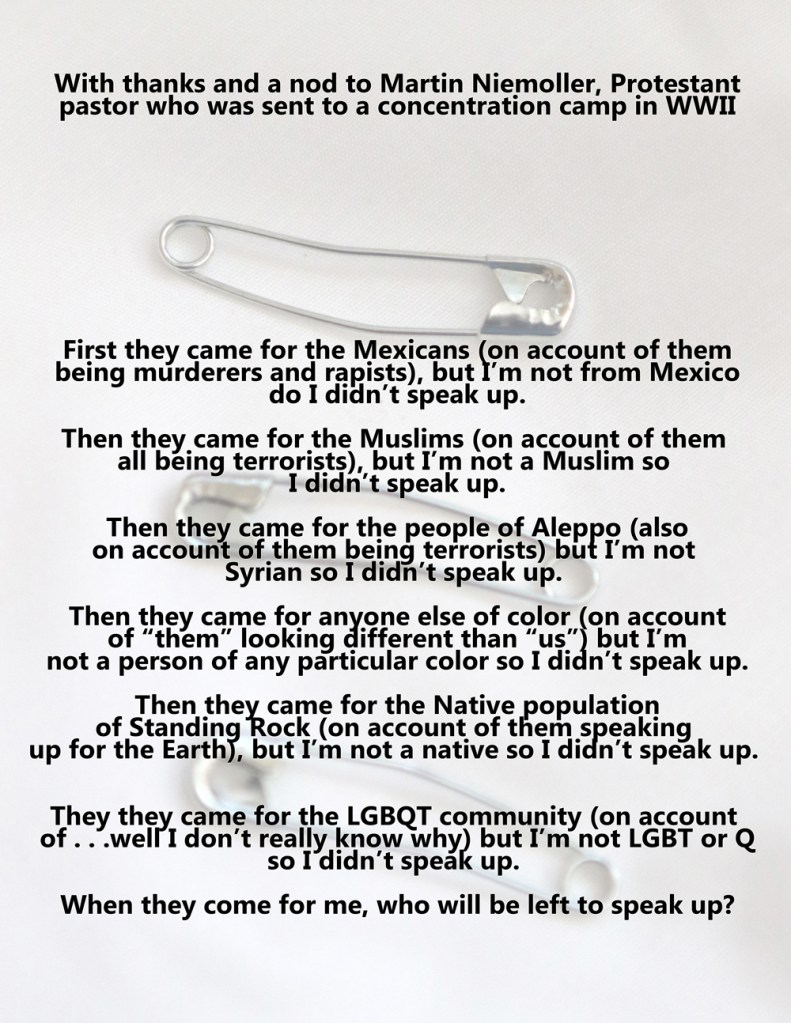
I made this poster 8 years ago and am devastated to have to dust it off again. The safety pins came from a British idea when Brexit was passed. People would wear the safety pins on their clothes to let anyone feeling vulnerable know that they would be “safe” with them.

The political finger pointing for Harris’ loss is beyond noxious. I have heard all manner of scapegoats; Biden, the Obamas, VP candidate Walz, Harris for saying too much of one thing, not enough of another, the progressives, Liz Cheney and even George Clooney. . . .blah blah blah

How can we make sense of a world where women voted for a misogynistic abuser. Black and brown people voted for a white supremist. Latinos voted for a policy of mass deportations targeting their brethren. Youth voted for a climate denier affecting their future. And so on. Think of all the women who voted for a world where they, their daughters and their granddaughters can be denied basic healthcare. It’s a true-to-life Cinderella scenario whose stepmother cut the toes off her own daughters to please a prince. Or Chinese mothers who would bind their own’s daughter’s feet, thereby crippling them in the service of marriage.

Continue reading “Harris Could Not Outrun 2000 Years of Patriarchy by Janet Maika’i Rudolph”

The Wisdom of the Beguines: The Forgotten Story of a Medieval Women’s Movement by Laura Swan, part 1 by Theresa C. Dintino 

Moderator’s Note: This piece is in co-operation with The Nasty Women Writers Project, a site dedicated to highlighting and amplifying the voices and visions of powerful women. The site was founded by sisters Theresa and Maria Dintino. To quote Theresa, “by doing this work we are expanding our own writer’s web for nourishment and support.” This was originally posted on their site on July 5, 2022. You can see more of their posts here. 

Around 1200 AD in Europe, communities of women often called beguines began to form. These women were not nuns, they were devout and devoted to the tenets of Christianity but did not belong to any church. They were independent communities of women who often created their own industry, trade or other means to produce income. They were self-sufficient and generally concerned with helping the poor, especially women. They lived in convents. This was the origin of that word.

“These women were essentially self-defined, in opposition to the many attempts to control and define them. They lived by themselves or together in so-called beguinages, which could be single houses for as few as a handful of beguines or, as in Brugge, walled-in rows of houses enclosing a central court with a chapel where over a thousand beguines might live—a village of women within a medieval town or city”(2).

Continue reading “The Wisdom of the Beguines: The Forgotten Story of a Medieval Women’s Movement by Laura Swan, part 1 by Theresa C. Dintino “

Witch Power? part 2 by Sara Wright

You can read part 1 here

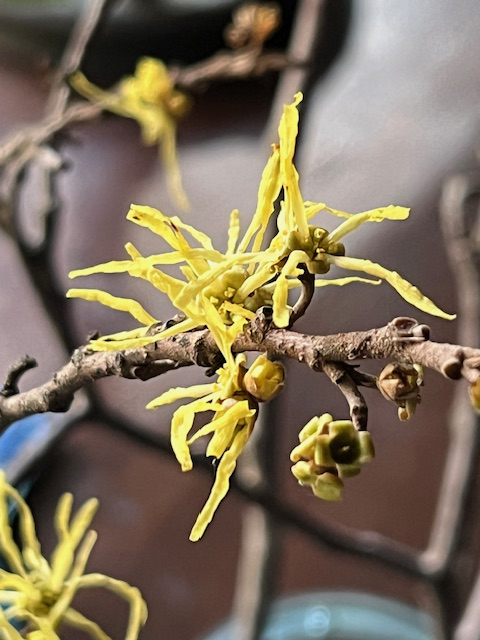
Witch hazel flower

After being nailed as a witch I separated myself from the word and witch power in general. The word witch had a very dark side and could be used in the same frightening manner as it had been during medieval times to label and to expel any woman who lived on the edge (source of my original sense of unease). Especially one who lived alone in the woods and loved animals like I did.

 Why had I been singled out? I was an outsider whose crime was to animate nature. Anything associated with nature was suspect if not ‘evil’.

 Feminists beware. If you claim to be a witch – recall that the word is loaded. Personally, I think the label has backfired reducing our overall power as women. Perhaps making us more suspect than we already are.

Continue reading “Witch Power? part 2 by Sara Wright”

Witch Power? part 1 by Sara Wright

Witch hazel flower

On my grandparent’s farm witch hazel trees were common, sprouting up around old fieldstone walls at the edges of the forest. I loved these trees that bloomed in the fall after all the leaves had fallen. Masses of buttery yellow spindles covered bare twigs. Clusters of blossoms stood out starkly against the trunks of most of the hardwoods – hickory, beech, maple and oak.

As a child I carefully inspected each clump of blossoms. On some branches I found empty seed capsules which I learned much later expelled their seeds all at once the year before. Even these bird beaked pods looked to me like a kind of flower. I also saw little round balls that I later learned were next year’s buds already formed and that the identical looking flowers were either male or female. If I stood beneath a tree, the tangled shapes of the branches wove a loose string -like tapestry above me, one that was often mirrored by a cobalt blue sky.

Continue reading “Witch Power? part 1 by Sara Wright”

Herstory Profiles: The Season of the Witch by Anjeanette LeBoeuf

Throughout the modern ages there have been stories, legends, myths, and historical accounts of threatening people, mainly women, who have been linked with the supernatural, with containing powers, engaging with elements that go beyond the natural world, and who decentralize, shake up, and counter mainstream patriarchal systems and groups. And the predominate word which can be translated and transcend languages is that of WITCH. And since we are in the month of October, when it becomes somewhat acceptable for people to deck their houses with items long been associated with witchcraft, this month’s herstory profiles is diving into all things witchy.

So, lets deconstruct what witches do and how they function in history and in modern times. When we look at the origins of magic – at the very core- is the manipulation of the natural world for supernatural outcomings. Those outcomes can be a range – from conversing with supernatural beings, healings, prophecy, alchemy, transformation, and to even holding secret knowledge. The word magic has origins in Ancient Persian and Proto-Indo-European languages with concepts of “being able to” and to “have power.” If we look at ancient cultures, civilizations, and religions we found multiple variations of people and roles being able to contain, control, and weld magic.

Continue reading “Herstory Profiles: The Season of the Witch by Anjeanette LeBoeuf”

Asking For What You Really Want…by Mary Gelfand

As no doubt everyone reading this knows, this election season is full of twists and turns and highly unpredictable.  I struggle daily with ways to manage my stress without destroying my health.

As a practicing Wiccan, my faith does not encourage me to curse or ill-wish anyone, no matter how tempted I may be.  In response to that, I wanted to create something I could do on a daily basis to promote the electoral outcome I desire from a spiritual perspective.  A long-forgotten quote from Rumi provided me with the key to what I want.  “The breeze at dawn has secrets to tell you.  Don’t go back to sleep.  You must ask for what you really want.”

“You must ask for what you really want.”   As a woman reared in the south in the 1950s, I am not really accustomed to asking for what I want.  So Rumi quote liberated me.  I can ask for what I really want as the outcome of this election.  Although I completely support the only feminist candidate, what I really want is a president that embodies certain traits and characteristics that, from my perspective, make a strong and creative leader.  So I’ve created a simple little ritual that anyone can do that gives me a framework to ask for what I really want—to spread my prayers and intentions to the cosmos.

Continue reading “Asking For What You Really Want…by Mary Gelfand”

Queering Herstory Profiles by Anjeanette LeBoeuf

We are back with a new volume of uncovering and focusing on extraordinary persons. We start our first post of Volume II with 4 figures who in many ways throw history, narrative, and the status quo off their axis. All 4, if alive in 2024, would find solidarity and kinship with the Queer Community. So let us being.

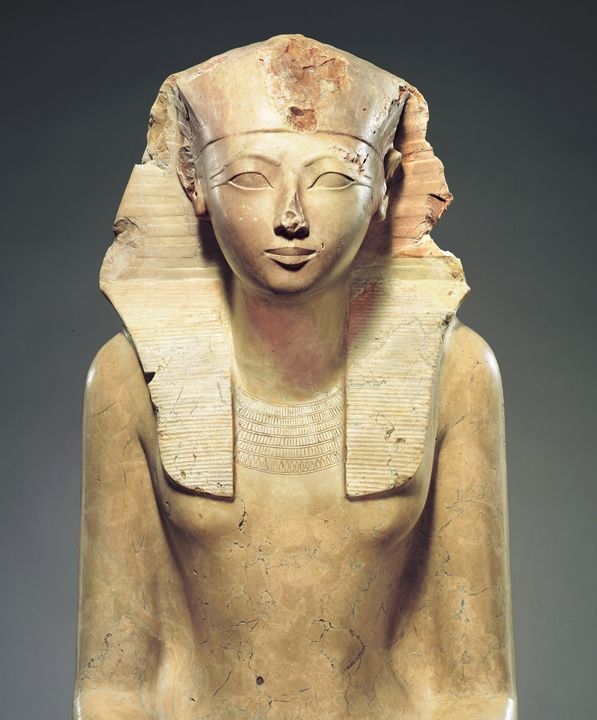
Hatshepsut (1508-1458 BCE) Egyptian Pharaoh.

Hatshepsut was the daughter of Thutmose I, wife to Thutmose II, and stepmother to Thutmose III. Her husband died while his heir was too young to ascend the throne. Hatshepsut became not only the acting regent but full fledge ruler. She would reign for 21 years as the 5th Ruler of the 18th Dynasty of Egypt. Her reign was prosperous including funding for art, statues, and monuments that have stood the test of time and active destruction. Deir –el-Bahari became a significant temple for Hatshepsut.

Continue reading “Queering Herstory Profiles by Anjeanette LeBoeuf”

From the Archives: “Is the Divine the Unknowable Unknown? A Feminist Take.”

Author’s note: This blog was originally published on October 16, 2022. As we have just entered the month of Elul, I urge us to consider how the way we understand the divine influences the High Holy Days as well as our approaches to self-reflection, self-doubt, self-blame, wrong-doing and our behaviour in general.

I know it’s a little early, but l’shanah tovah.

I attended a number of High Holy Days services (online) over the past couple of weeks. In one of them, one of the rabbis said that the divine is the unknowable unknown. I cannot remember what the Rabbi said to contextualize or explain their train of thought; I think I was too intrigued by the idea that I got lost in my own thoughts. In fact, I have been thinking about the unknowable unknown ever since.  

As I write this, I’ve come to this conclusion: if the divine is present among us and the world around us, then there is much we can intuit. In addition, there is much that we can experience the more we interact with other humans and nature.  On the other hand, if the divine is understood as a detached, distant being of a completely different essence than humanity, of course, what can we really know about such a divinity?  How would we even know if that divinity even existed? We probably wouldn’t.  Here is the difference between a  feminist understanding of the divine as this-worldly and empowering and a patriarchal conception of a distant divinity wielding power-over. Yet, interestingly, even the most patriarchal image of the divine has insisted on being relatable to human beings. Nonetheless, how we imagine the divine does matter.

Continue reading “From the Archives: “Is the Divine the Unknowable Unknown? A Feminist Take.””