

July and September’s Herstory Profile will be centered on a true champion, leader, activist, and humanitarian Judy Heumann. Her life is one that everyone should aspire to. Judy is considered the Mother of the Disability Rights Movement in the United States and potentially even the world. Her entire life is one of activism, progress, and equality. She is the embodiment of strength, courage, determination, tenacity, and spirit. What Judy was able to accomplish, create, and push for is so incredible that two posts are needed to do her justice.
Continue reading “Herstory Profiles: Changing the Landscape for All Bodies and People Part One by Anjeanette LeBoeuf”Tag: Feminism
Archives from FAR Founders: Rosemary Radford Ruether’s Quests for Hope and Meaning by Gina Messina-Dysert
This was originally posted on December 18, 2013. This is part of a project to highlight the work of the four women who founded FAR: Xochitl Alivizo, Caroline Kline, Gina Messina, and Cynthia Garrity-Bond

Rosemary Radford Ruether is one of the most brilliant theologians of our time and her newly released autobiography, My Quest for Hope and Meaning, is a gift to those of us who have been so touched by her work. In this intimate and beautiful piece, Ruether shares her personal journey in feminist scholarship and activism. The autobiography opens with a profound forward by Renny Golden (that is also shared here on Feminism and Religion) and continues with an introduction and six chapters where Ruether guides us through an exploration of the influence of the matriarchs in her life, her interactions with Catholicism, her continued exploration of interfaith relations, her family’s struggle with mental illness, and her commitment to ecofeminist responses to the ecological crisis.
Ruether states that “Humans are hope and meaning creators” (xii), and her autobiography details her own quests for hope and meaning. She reflects on the incredible impact made by the female-centered patterns in family and community in her life. According to Ruether, these “matricentric enclaves” grounded and shaped her interest in feminist theory and women’s history. She also describes the spiritually and intellectually serious Catholicism that she received from her mother and articulates her continued frustration with Vatican leadership that has undermined the efforts of Vatican II. For Ruether, her ongoing affiliation with feminist theological circles is crucial as she continues to work toward shaping an ecumenical and interfaith Catholicism.
Continue reading “Archives from FAR Founders: Rosemary Radford Ruether’s Quests for Hope and Meaning by Gina Messina-Dysert”Legacy of Carol P. Christ: Gender, Friendship, Collaboration, and Unacknowledged Authorship
This was originally posted on April 20, 2015 and was updated by Carol on August 23, 2019
In recent weeks Judith Plaskow and I have been revising the manuscript of our new book Goddess and God in the World in preparation for sending it to the publisher. Yes, we have a publisher. We signed a contract with Fortress Press a short time ago. The book should be out in 2016.
We have been hard—and I mean very hard—at work revising the four chapters in the book that are jointly written. The versions have been going back and forth and forth and back as we revision what we want to say and revise each other’s revisions of the drafts we have. We both want the final manuscript to say things just right and it is very hard not to make one more set of (alleged) improvements.
In the process we have realized that while we often disagree on words and wording, we have come to think alike on a wide variety of issues to the point that it becomes hard to say who had the ideas first. In addition we have both become so familiar with each other’s positions that we can each easily articulate both sides of our dialogue on the issues on which we disagree.
Continue reading “Legacy of Carol P. Christ: Gender, Friendship, Collaboration, and Unacknowledged Authorship”Future of Mifepristone by Winifred Nathan
Today is the one year anniversary of the Dobbs decision.

The alarm grows louder. How far will the antiabortion lobby restrict women’s reproductive health care before they are satisfied? If they successfully secure a complete abortion ban, will they stop? Or will they go on to control women’s dress, education, travel, etc.?
Reportedly, Dobbs v Jackson overturned Roe v Wade so the states could set the legal boundaries of abortion through the democratic process. But on November 18, 2022, the US District Court of Northern Texas delivered Alliance for Hippocratic Medicine et al. v US Fodd and Drug Administration et al., a decision that stops medical abortion in all fifty states by ending FDA approval of mifepristone. The Supreme Court has stayed (paused) the Texas order as the appeal works its way to their docket. Mifepristone continues to be available, but for how long? Will the Supreme Court eventually side with the plaintiffs?
Continue reading “Future of Mifepristone by Winifred Nathan”The Legacy of the Goddess: Heroines, Warriors and Witches from World Mythology to Folktales and Fairy Tales by Rachel McCoppin
Part 2, Part 1 was posted yesterday
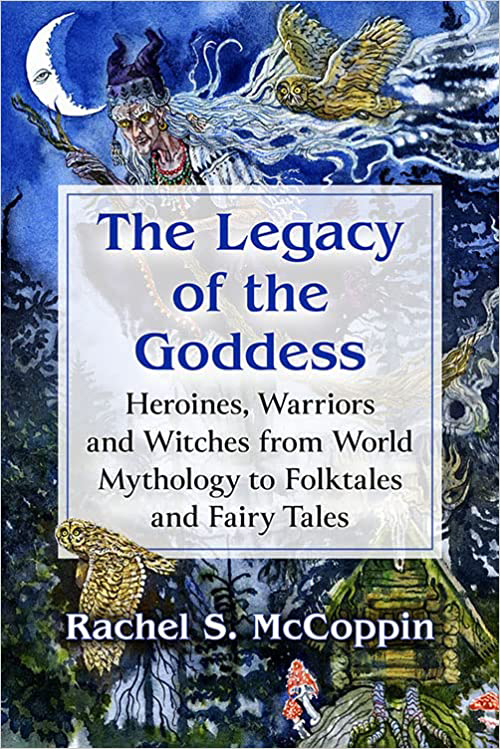
Chapter 4, “Monstrous Females and Ghost Women,” “traces the many female characters within folktales and fairy tales who appear as monstrous, materializing in the forms of giantesses, succubi, mermaids, rusalki, etc. Just as in many ancient myths, even though these monstrous women appear in folktales and fairy tales as hindrances to the quest of the hero, they ultimately serve to educate male heroes about the true meaning of their quest, which again often aligns with concepts associated with mythic goddesses. The many ghost women who appear in folktales and fairy tales around the world are also discussed in this chapter, as they often serve as agents to teach male heroes about how they, particularly as females, have been wronged by males or by patriarchal systems, and thus have been thwarted from completing their own heroic quests” (McCoppin, p. 9).
Though most myths around the world display male heroes partaking on heroic quests, and seldom focus on heroines who participate in their own heroic journeys, this is not at all the case with folktales and fairy tales, as hundreds of folktales and fairy tales portray strong, independent female heroines who indeed partake on their own heroic quests. Therefore, the second half of Legacy of the Goddess focuses on the formidable heroines found in many folktales and fairy tales from around the globe.
Continue reading “The Legacy of the Goddess: Heroines, Warriors and Witches from World Mythology to Folktales and Fairy Tales by Rachel McCoppin”From the Archives: (((Israel))) by Ivy Helman
Author’s note: I first published this piece on June 12, 2016. Last week, I returned from a three-week stay in Isreal. After everything I saw and experienced there, I agree with this piece even more; Israel needs to exist. As does peace and safety for all the inhabitants of the land. I will write more about my experiences there and in Jordan soon. Until then, I hope you find this piece thought-provoking.
The BBC just ran a story about white supremacist and neo-Nazi groups targeting Jews by signaling each other to their presence on various social media sites through the use of (((this symbol))). Of course, this is all based on the assumption that a “typically” Jewish last name signifies the bearer is also Jewish. Through a Google app (since removed) that could recognize patterns such as ((())), these Jewish people began to receive anti-Semitic comments. There has been a general outcry of disgust among Jews and other minority groups as to the problematic targeting of Jews in this fashion.
The same cannot be said about the BDS movement and people’s willingness to call it out for what it is. This to me is hypocritical! According to its website, the BDS movement, or Boycott, Divestment and Sanctions, seeks to end what it understands to be the colonialism, apartheid and oppression of Palestinians in Israel through various financial, commercial and international means. It accuses Israel of human rights violations, genocide, ethnic cleansing and other war crimes as well as illegal occupation (of the Palestinian lands, not just the occupied territories).
Continue reading “From the Archives: (((Israel))) by Ivy Helman”Herstory Profiles: The First amongst many, Afong Moy and Anna May Wong by Anjeanette LeBoeuf
This month’s Herstory Profiles are going to be on two extraordinary, courageous, and underrepresented Chinese Women. Afong Moy was the first Chinese Immigrant to America who found fame and ridicule. Anna May Wong was the first Chinese American Actress who was at the forefront of the ever-changing media and silver screen. These two women are trailblazers, revolutionaries, and have long been regulated as footnotes.
Continue reading “Herstory Profiles: The First amongst many, Afong Moy and Anna May Wong by Anjeanette LeBoeuf”ESCORT SERVICE by Esther Nelson
These days, I spend most of my time in Roanoke, Virginia. I moved here—a three-hour drive west—from Richmond, Virginia. One of the ways I’m settling into my new community is by volunteering as an escort at Planned Parenthood.
The job is straight-forward: Greet people as they exit their vehicle when they arrive at the medical facility’s parking lot. Usually, there are several protestors in front of the building, and clients must drive past them before turning right into the driveway. Protestors wave pink, plastic bags filled with anti-abortion literature as well as pamphlets that outline a specific, Christian view of “salvation.” Not many drivers stop. If they do, I walk over to the line that divides Planned Parenthood property from public space and wave the cars forward. The drivers are grateful. So many clients are nervous, upset, and unsure of protocol. One woman asked me if I was associated with “those people out there,” pointing to the protestors. “Not at all,” I assured her. She smiled with relief.
Continue reading “ESCORT SERVICE by Esther Nelson”The Daughter, the Alliance-Maker (Women in the Book of Daniel, part 2) by Liz Cooledge Jenkins
Note: This is the second in a two-part series reflecting on women in the biblical book of Daniel. For part 1, see here.

The second female character I noticed while taking a deep dive into the book of Daniel appears even more briefly. Daniel 11:6-7 includes her story: “The daughter of the king of the South will go to the king of the North to make an alliance, but she will not retain her power, and he and his power will not last. In those days she will be betrayed, together with her royal escort and her father and the one who supported her. One from her family line will arise to take her place” (NIV). It is a brief story—and not a happy one, in the end. But I think it’s worth reflecting on.
In this chapter of Daniel, an unnamed supernatural messenger gives Daniel a detailed account of a long series of violent power struggles between various kings. Empires accumulate and then are broken up (vv. 3-4). One king is strong, but his commander proves stronger and overtakes him (v. 5). Attacks are victorious, and valuables are seized and carried off (vv. 7-8). Retreats are made (v. 9). Great armies are assembled (v. 10). Kings “march out in a rage” toward battle (v. 11). Armies are carried off, and thousands are slaughtered (v. 12). You get the idea. Everything is violent. Everything is bloody. Everything is one brutal war after another, one brutal kingdom after another, one brutal ruler after another. It all starts to blur together.
Continue reading “The Daughter, the Alliance-Maker (Women in the Book of Daniel, part 2) by Liz Cooledge Jenkins”From the Archives: Recognizing Abuse by Karen Tate
This was originally posted on March 8, 2019

I’ve been thinking a lot about abuse. Of course, most of us know about the domination, exploitation and need for control meted out by patriarchy, but I wonder if we have actually normalized many abuses? Abuse in the home, in the workplace, in our culture. Perhaps we accepted it unconsciously because so many of us are conditioned by religions that tell us to make noble sacrifice and tolerate suffering silently. I wonder if we’re calling it out when we see it – often and loudly – or if we’ve become conditioned to quietly accept the abuse with little push back.
My intent is not to offend anyone with this. I want to find common ground and defeat the polarization we find around us, but our President is the poster child for abusive behavior. Do we recognize his lies and fear-mongering and so many of the ideas he gives credence and license to as abuse? Not only is he eroding our democratic institutions but he poisons the political, social and cultural arena with negativity, fear and hate, rather than uplifting us and encouraging us to evolve and be the best version of ourselves. I equate him to poison in a well from which we must all drink.
Continue reading “From the Archives: Recognizing Abuse by Karen Tate”
