‘Someone needs to gather the stories, to keep the cauldron,’ said the late Goddess feminist artist Lydia Ruyle during one of the last times we spoke, at the 2014 Glastonbury Goddess Conference. I had hinted at my concerns around conducting doctoral research in the presence of ongoing conflict within the Glastonbury Goddess community (especially when my broadly-stated site of interest is ‘politics’), and in reply she had stressed the need to ‘hold space’ for the different voices and perspectives in the UK Goddess movement, and that conflict would be inevitable. ‘There needs to be a weaver,’ she said.
The following day I recorded an interview with Lydia and some of her friends at Café Galatea on the High Street, which she had been keen to ensure since the previous summer—with poignant foresight, given her death in March 2016. I’m not sure if she was expecting that I should fully take on the role of this ‘weaver’—there are more stories than one PhD thesis can claim to encompass—but the theme is present in my writing. Her words lead me to reflect on the weaving together of politics with memory and storytelling, and on the need to honour the plural histories of the British Goddess movement. Continue reading “Goddess Politics and the Cauldron of Memory by Kavita Maya”
I’ve been asked by both academics and Pagans what inspired me to pursue doctoral research on the British Goddess movement: of the many ways that people first click with feminist politics, a story entwined with a ‘spiritual’ impulse might seem unusual, given the slow-to-change secular assumptions of mainstream feminism.
When I reflect on my history, two threads at the core of my early feminist identity leap out: one, the value of thinking and asking questions; the other, ‘feminist spirituality’, which for me describes a profound emotional, intellectual and creative investment in the struggle for a fairer, more inclusive world. Two early ‘click’ moments: as a child, asking persistent questions about the sexist gender roles modeled by those around me (and being told “You’ll understand when you’re older,” which I now recall with a grim irony), and—perhaps unusually—coming across the concepts of patriarchy, feminism and the Goddess by way of 1990s teen fiction about witches. Continue reading “Reflections on Researching the Goddess Movement in Britain by Kavita Maya”
In recent years “the Sacred Feminine” has become interchangeable with (for some) and preferable to (for others) “Goddess” and “Goddess feminism.” The terms Goddess and feminism, it is sometimes argued, raise hackles: Is Goddess to replace God? And if so why? Does feminism imply an aggressive stance? And if so, against whom or what?
In contrast, the term “sacred feminine” (with or without caps) feels warm and fuzzy, implying love, care, and concern without invoking the G word or even the M(other) word–about which some people have mixed feelings. Advocates of the sacred feminine stand against no one, for men have their “sacred feminine” sides, while women have their “sacred masculine” sides as well.
Nothing lost, and much to be gained. Right? Wrong.
Perseus with the Head of Medusa: Sacred Masculine and Sacred Feminine?
When Goddess feminism emerged onto the scene early in the feminist movement, it had a political edge. It was about women affirming, as Meg Christian crooned in “Ode to a Gym Teacher,” that “being female means you still can be strong.” Goddess feminism arose in clear opposition to patriarchy and patriarchal religions. It was born of an explicit critique of societies organized around male domination, violence, and war; and of the male God or Gods of patriarchal religions as justifying domination, violence, and war. In this context, “the sacred masculine” was not understood to be a neutral or positive concept. To the contrary, the male Gods of patriarchy were understood to be at the center of symbol systems that justify domination.
The terms “the masculine” and “the feminine” were floating around and sometimes evoked in early feminist discussions, but when examined more closely, they were rejected by most feminists as mired in sex role stereotypes. The psychologist Carl Jung, for example, associated the masculine with the ego and rationality and the feminine with the unconscious. True, he argued that modern western society had developed too far in the direction of the masculine and needed a fresh infusion of the feminine in order to achieve “wholeness.” This sounded good, but when feminists looked further, they discovered that Jung and his followers harbored a fear of the uncontrolled feminine.
Jungians consider the unconscious to be the repository of undisciplined desires, fears, and aggressive feelings that require the rational control of the ego. Though strong and intelligent women were among Jung’s most important followers, Jung and his male companions retained a fear of independent women, speaking of women who developed their rational sides fully enough to argue with men and male authorities as “animus-ridden,” a term not meant as a compliment.
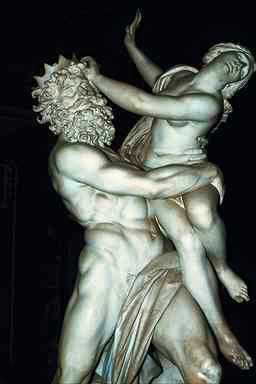
Hades Abducting Persephone: Marriage of Sacred Masculine and Sacred Feminine?
Jungians, following Erich Neumann, understand the progress of history through an evolutionary model in which humanity began in a matriarchal stage in which the unconscious reigned. This period of culture, which spawned the image of the Great and Terrible Mother, was primitive and irrational. Matriarchy was naturally superseded by patriarchy, in which the individual, the ego, and rationality emerged. In the patriarchal stage of culture, male Gods and heroes were the primary symbols, and rationality reigned supreme.
The patriarchal stage of culture had its limitations, which were revealed in the two World Wars of the twentieth century and the nuclear and environmental crises that followed. Rational man, Jungians argued, had come to the point where he needed to reconnect with his feminine side. The unconscious feminine was now understood to be a nurturing matrix that included the body, nature, and feeling, from which rational man should and could never fully separate himself.
The great archaeologist Marija Gimbutas also spoke of two cultures within Europe, an earlier matrifocal one she called Old Europe and a later patriarchal one. The Jungian Joseph Campbell endorsed Gimbutas’ work, leading some to assume that Gimbutas and Jungians hold similar theories of human history. In fact they do not: Gimbutas did not subscribe to an evolutionary theory of culture. She would never have said that the earlier matrifocal culture “had to be superseded” by the later patriarchal culture “in order for civilization to advance.” The clear conclusion to be drawn from Gimbutas’ work is that the patriarchal culture was in almost every way inferior to the one it replaced.
For Gimbutas, the agricultural societies of Neolithic Old Europe were peaceful, egalitarian, sedentary, highly artistic, matrifocal and probably matrilineal, worshiping the Goddess as the powers of birth, death, and regeneration. These societies did not evolve into a higher stage of culture, but were violently overthrown by Indo-European invaders. The culture the Indo-Europeans introduced into Europe was nomadic, patriarchal, patrilineal, warlike, horse-riding, not artistic, worshiping the shining Gods of the sun as reflected in their bronze weapons. Gimbutas did not look forward to a new “marriage” of matrifocal and patriarchal cultures. Rather she hoped for the re-emergence of the values of the earlier culture. Her theories had a critical edge: she did not approve of cultures organized around domination, violence, and war.
This critical edge is exactly what is lost when we begin to substitute the terms “sacred feminine” for “the Goddess” or “Goddess feminism” and “sacred masculine” for “patriarchy” and “patriarchal Gods.” When we allege that we all have our “masculine and feminine sides,” and that it is important “to reunite the masculine and the feminine,” it is easy to forget that in our history, the so-called sacred masculine has been associated with domination, violence, and war.
If we hope to create societies without domination, violence, and war, then we must transform the distorted images of masculinity and femininity that have been developed in patriarchy. We must insist that domination, violence, and war are no more part of masculinity or male nature than passivity and lack of consciousness are part of femininity or female nature. It may feel good to speak of reuniting the masculine and the feminine, but feeling good will not help us to transform cultures built on domination, violence, and war.
A link to a talk called “Moral Behavior in Animals” by Franz de Waal recently found its way into my email inbox. I am a big fan of Franz de Waal because his findings confirm what I always believed—that animals are intelligent. I followed the link and other suggested links and spent most of the evening listening to de Waal.
De Waal began his studies of animal behavior at a time when instinctual behaviorism was academic orthodoxy: the idea that animals can think and feel was “poo-pooed” by “scientists.” As de Waal observed ironically, everyone who has a pet knows better than that. But academic researchers continued down this path, expressing contempt for ordinary people who thought their pets were intelligent and the likes of de Waal who suggested that scientists might be colossally wrong.
In my Ecofeminism class we have been discussing essentialism because some feminists have alleged that other feminists, particularly ecofeminists and Goddess feminists, are “essentialists.” They argue that essentialist views reinforce traditional stereotypes including those that designate men as rational and women as emotional. I too find essentialism problematic, but I do not agree that Goddess feminism and ecofeminism are intrinsically essentialist.
Goddess feminists and ecofeminists criticize classical dualism: the traditions of thinking that value reason over emotion and feeling, male over female, man over nature. We argued that the western rational tradition sowed the seeds of the environmental crisis when it separated “man” from “nature.”
Goddess feminists and ecofeminists affirm the connections between women and nature in an environmental worldview that acknowledges the interconnection of all beings in the web of life.
Is Goddess feminism an old religion or a new creative synthesis? Can it be both? Goddess feminism draws on the feminist affirmation of women’s experiences, women’s bodies, and women’s connection to nature; the feminist critique of transcendent male monotheism as the symbolic expression of male domination of women and nature; and 19th and early 20th century discussions of Goddesses and matriarchy.
Most Goddess and other spiritual feminists have experienced Wiccan rituals, which are often simply called Goddess rituals. For many of us, elements of Wiccan practice strike a chord of knowing, while other aspects seem odd or strange or even just plain weird. What are the roots of Wiccan ritual?
My religious views have changed over time, but the spirituality I learned from my grandmothers has remained constant. I have been Protestant, Catholic, a lover of Judaism, an admirer of Christian Science, and a Goddess feminist. I have always loved life.
I was born in Huntington Hospital just before Christmas in 1945 and brought to my grandmother’s home on Old Ranch Road in Arcadia, California. Peacocks from the adjacent Los Angeles County Arboretum screeched on the roof. There was another baby in the house, my cousin Dee, born a few months earlier. My mother and her sister were living with their mother. The war was over, and they were anticipating the return of their husbands from the Pacific Front. My earliest memory, recovered during healing energy work, is visual and visceral. I am lying crossways in a crib next to the other baby. There is a soft breeze. The other baby is kicking its legs, and I am trying to do the same. I look up and see three faces looking down at us. Although the faces are blurry in the vision I see, I feel them as female and loving. I got off to a good start. Continue reading “LOVING LIFE* by Carol P. Christ”
Blessing the Source of Life harks back to the time when shrines were built near springs, the very literal sources of life for plants, animals, and humans.
The prayer “As we bless the Source of Life, so we are blessed,” based on a Hebrew metaphor which refers to a water source and set to music in a Jewish feminist context by Faith Rogow, has become one of the bedrocks of my Goddess practice.
In Minoan Crete, seeds were blessed on the altars of the Goddess and the first fruits of every crop were returned to Her. The ancient Minoans piled their altars high with barley, fruits, nuts, and beans, and poured libations of milk and honey, water and wine, over the offerings they placed on altars. Evidence of these actions is found in the large number of pouring vessels stored near altars.
Recreating these rituals on the Goddess Pilgrimage to Crete, and singing together, “As we bless the Source of Life, so we are blessed,” again and again, we begin to understand that the gestures of our ancestors were based in gratitude for Life itself. They understood that the fruits of the earth, the grain, the wine, and the oil, the cherries, the peas, the olives, and everything else that we eat, are gifts of bounteous Mother Earth. Continue reading ““AS WE BLESS THE SOURCE OF LIFE, SO WE ARE BLESSED” by Carol P. Christ”
Mary was not alone in her work to bring an avatar to the planet, nor was she a passive vehicle for this process. That is my scholarly conclusion after devoting my dissertation and first two books to an exploration of the concept of divine birth in Western antiquity.
A founding mother of the study of women and religion and feminist thealogy, Carol has been active in social justice, anti-war, feminist, anti-nuclear, and environmental causes for many years. Her books include She Who Changes and Rebirth of the Goddess and the widely used anthologiesWomanspirit Rising and Weaving the Visions.
In my last blog I wrote that the image of God as a dominating other who enforces his will through violence–found in the Bible and in the Christian tradition up to the present day–is one of the reasons I do not choose to work within the Christian tradition. To be fair, there is another image of God in Christian tradition that I continue to embrace. “Love divine, all loves excelling” is the opening line of a well-known hymn by Charles Wesley. Charles Hartshorne invoked these words and by implication the melody with which they are sung as expressing the feelings at the heart of the understanding of God that he wrote about in The Divine Relativity.
Love divine, all loves excelling also expresses my understanding of Goddess or as I sometimes write Goddess/God. Though I am no longer a Christian, but rather an earth-based Goddess feminist, I freely admit that I learned about the love of God while singing in Christian churches. Hartshorne wrote that he knew the love of God best through the love of his own mother, and I can say that this is true for me as well. My mother was not perfect, and she did not understand why I wanted to go to graduate school, my feminism, or my adult political views, but I never doubted her love or my grandmothers’ love for me. (I count myself lucky. I know others did not have this experience.) Like Hartshorne, I also learned about the love of God through the world that I always understood to be God’s body. Running in fields and hills, swimming in the sea, standing under redwood trees, and encountering peacocks in my grandmother’s garden, I felt connected to a power greater than myself. Continue reading “Love Divine, All Loves Excelling By Carol P. Christ”


 ‘Someone needs to gather the stories, to keep the cauldron,’ said the late Goddess feminist artist Lydia Ruyle during one of the last times we spoke, at the 2014 Glastonbury Goddess Conference. I had hinted at my concerns around conducting doctoral research in the presence of ongoing conflict within the Glastonbury Goddess community (especially when my broadly-stated site of interest is ‘politics’), and in reply she had stressed the need to ‘hold space’ for the different voices and perspectives in the UK Goddess movement, and that conflict would be inevitable. ‘There needs to be a weaver,’ she said.
 I’ve been asked by both academics and Pagans what inspired me to pursue doctoral research on the British Goddess movement: of the many ways that people first
  ears “the Sacred Feminine” has become interchangeable with (for some) and preferable to (for others) “Goddess” and “Goddess feminism.” The terms Goddess and feminism, it is sometimes argued, raise hackles: Is Goddess to replace God? And if so why? Does feminism imply an aggressive stance? And if so, against whom or what?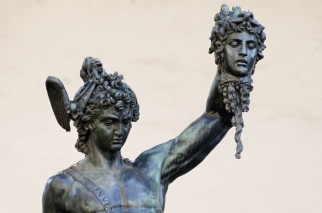
 A Serpentine Path: Mysteries of the Goddess


 Feminism and Religion