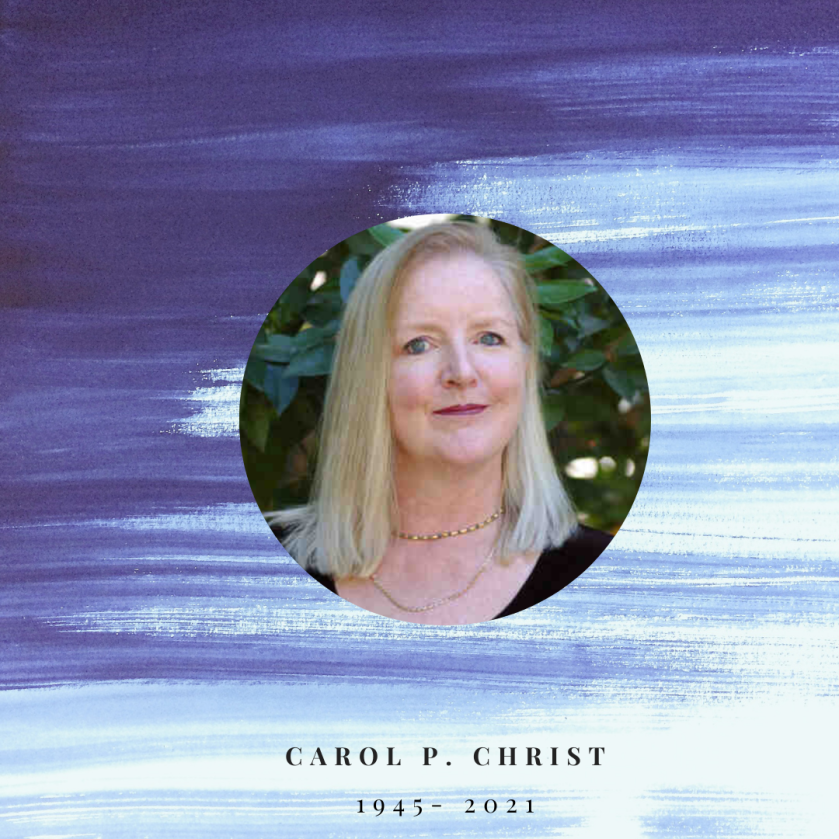
Legacy of Carol P. Christ: Green Solutions To The Greek Economic Crisis: We Are The 99%!

This post was originally published on May 28th, 2012

A green solution to the economic crisis insists that people and the environment can be saved together. We must dare to envision prosperity in conjunction with sustainability, social justice, nonviolence, and participatory democracy.

A rational analysis would make it clear that the Greek people did not “create” the economic crisis. Yet the poor and middle classes are being asked to “pay” for it. There is massive corruption in the public sector in Greece. But this should not blind us to the fact that the Greek people do not bear the major responsibility for creating the crisis. Those responsible include:

Legacy of Carol P. Christ: Time to Dismantle the Myth of the Nation State?

This was originally posted on February 25, 2019

I am a citizen of two countries currently being torn apart by popular nationalism. In Greece, the cry is “Macedonia is only Greek,” while in the United States a nation of immigrants is being told that it must fear being invaded by immigrants. The truth is that the idea of a nation state is a fiction created in the nineteenth century. It is high time to dismantle it.

Here is the Greek case. Phillip of Macedon invaded from the north and created a federation of Greek states in 338 BCE. His son Alexander the (so-called) Great conquered territories extending as far as India before his death in 323 BCE, establishing the seat of his empire in the newly founded city of Alexandria in Egypt. Phillip and Alexander are claimed as Greek, but in fact Phillip forced independent Greek-speaking city states into union under his rule.

Continue reading “Legacy of Carol P. Christ: Time to Dismantle the Myth of the Nation State?”

Return to Mountain Mother[1] by Jeanne F. Neath

Mountain Mother, I hear you calling me.
Mountain Mother, we hear your cry.
Mountain Mother, we have come back to you.
Mountain Mother, we hear your sigh.

Lyrics by Carol P. Christ [2]. Sung to the tune of “Ancient Mother.” (origin unknown)

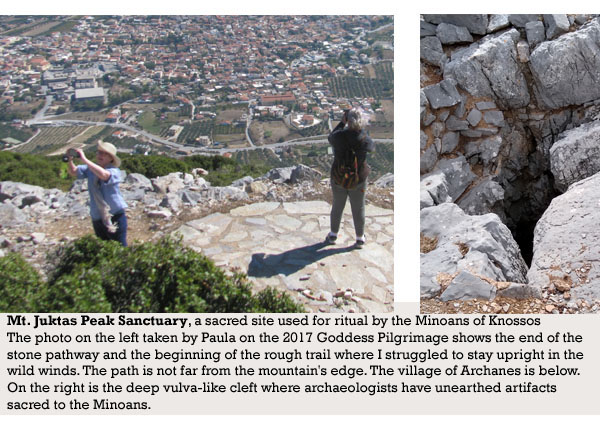
What do a bunch of feminist women do while riding a tour bus around the Mediterranean island of Crete? If they are on the Goddess Pilgrimage started by Carol Christ and continued by Laura Shannon, they sing songs honoring the Goddess. The song that drew me most from the first time I heard it on the fall 2022 Goddess Pilgrimage was “Mountain Mother.” Not surprising since the rocky, sparsely vegetated, yet hauntingly beautiful mountains of Crete surrounded us much of the time as our trusty bus wound its way up and down and around the island.

Continue reading “Return to Mountain Mother[1] by Jeanne F. Neath”

TRAVELOGUE INTO HISTORY: MY BIG FAT GREEK ODYSSEY (Part 2) by Sally Mansfield Abbott

Part 1 was posted yesterday. You can read it here.

Arriving in Heraklion on Crete, I was enlivened by the sea air and the informal “island” vibration. My sister and I made our way through its labyrinthine streets, following Daedalus, a pedestrian street named after the legendary creator of the labyrinth at Knossos, the prototype of the artist, who Joyce names as his stand-in in Portrait of the Artist as a Young Man and Ulysses. Our hotel was on Theotokopolous Street. (They’d call you El Greco too if your name was Domenikus Theotokopolous.) Nikos Kazantzakis was also from Heraklion, a city noted for its artists.

Knossos was a small, contained place circled by pine trees, unlike the sprawling sun-drenched expanse of a typical archeological site. There were restored ocher columns, four storeys to the palace, open courtyards for bull leaping, and cisterns that had been used for self-purification. Its red clay and turquoise frescoes were so familiar to me, with their vivid colors and playful lines that Matisse could have envied. No wonder it was the prototype of a work of art!

Continue reading “TRAVELOGUE INTO HISTORY: MY BIG FAT GREEK ODYSSEY (Part 2) by Sally Mansfield Abbott”

TRAVELOGUE INTO HISTORY: MY BIG FAT GREEK ODYSSEY (Part 1) by Sally Mansfield Abbott

My sister and I arrived in Athens midafternoon on Lamas, the feast day of the first harvest. A blast of dry heat greeted us as we left the airport and surveyed the barren brown hills. It transported me to my childhood when I’d lived in distant and exotic climates, and I felt the old excitement of being abroad again.

Going to Greece had long been a dream of mine. It was a spiritual pilgrimage, a Hajj to be undertaken at least once in a lifetime. Greece figured prominently in the college classes on the Goddess I had taught for ten years, but I’d only known it through the books and slides I lectured from. I longed to see its sacred sites in person.

Our hotel was at the base of the Acropolis, within a block of the Acropolis Museum, a stunning work of modern architecture that quotes the structure of the Parthenon.  The Parthenon and Erechtheon had been stripped of their bas reliefs and engravings—even the famed Karatydids– were now housed in the museum, either already or soon to be replaced by copies on the temples.

Continue reading “TRAVELOGUE INTO HISTORY: MY BIG FAT GREEK ODYSSEY (Part 1) by Sally Mansfield Abbott”

Remembering Carol P. Christ: Online Memorial Gathering, December 20, 2021

Dear FAR community,

It’s been wonderful to read so many posts remembering Carol Christ. The FAR community was so important to Carol: as has been pointed out, she not only offered her own posts each Monday, she also read and responded to every post, every day. Through the FAR ‘family’ I feel comforted by connecting with others who knew and loved her and miss her as as I do.

Online Memorial Gathering On December 20, Carol’s birthday, all friends of Carol and friends of FAR are warmly invited to an online Memorial Gathering and ritual in Carol’s honour. Many of Carol’s friends will share cherished memories (please email me if you would like to say a few words) and I will show some photographs from her personal archive. (If you have photos of Carol you would like to share, please email them to me at laura@laurashannon.net.) We’ll also talk about the future of Carol’s Goddess Pilgrimage in Crete. Please register with your email address at this link.

Continue reading “Remembering Carol P. Christ: Online Memorial Gathering, December 20, 2021”

On Snakes by Ivy Helman

imageIn the ancient world, snakes represented fertility, creativity, rebirth, wisdom and, even, death.  They were often closely connected to female goddesses, priestesses and powerful human females who were the embodiment of such powers.    For example, there is the Minoan goddess/priestess holding the two snakes in her outstretched arms.  She is closely linked with fertility and domesticity.  Similar figurines, with similar associations and dating to approximately 1200 BCE, have also been founded in the land of what once was Canaan, where Israelites also lived.  Medusa, in whose hair lived venomous snakes, turned men who looked at her to stone.  Ovid’s account of the creation of Medusa credits the Greek goddess Athena with Medusa’s lively hair.  Another Greek legend says Perseus, after killing Medusa, gave her head to Athena who incorporated it into her shield.  Athena, the goddess of wisdom, is portrayed often with snakes wrapped around her as a belt and/or on the floor next to her. Continue reading “On Snakes by Ivy Helman”
When I Dance I Am I Greek by Carol P. Christ

Carol Molivos by Andrea Sarris 2When I first moved to Greece I spoke of being attracted to a culture in which people express their emotions easily and do not hold on to anger. In the part of American culture I know, the opposite is often the case: people do not express their emotions easily and hold onto their anger. When I joined a therapy group in Greece, my therapist said that I made the right decision to move to Greece. “You needed to learn to live from here,” she said touching her belly, “and this is where Greeks live.”
During the first years I lived in Greece, I often said that I wanted to become Greek. Like others had done before me, I romanticized Greece and the Greeks. Then one winter I learned that family violence is as prevalent in Greece as it is in every other country. The cultural ability to express emotion does not stop Greek men from beating their wives or Greek women from hitting children. Indeed the more expressive nature of the Greek culture may make it easier for Greeks to resort to physical violence. On the other hand, violence stemming from withheld feelings can be cruel and unpredictable. Continue reading “When I Dance I Am I Greek by Carol P. Christ”

Is There a Such Thing as a Code of Ethics in Academia?  by Michele Stopera Freyhauf


One of things that has dismayed me since I began graduate school and started focusing my study on the Bible, is how much sensationalism exists. We are told in the academy not to use Wikipedia or watch the History Channel. The first, as we know, is unreliable due to the fact that anyone can enter information and make changes. The other caters to the general public. What compounds this problem is the fact that scholars, many times – even reputable ones – appear on these shows. Sometimes creative licenses are exercised by the producer distorting or otherwise shifting the message of what the scholar was trying to explain. Other times, scholars will just give the producers and the public exactly what they want to hear and thus perpetuating myths rooted in literalism.

Alpocalypse_Cave
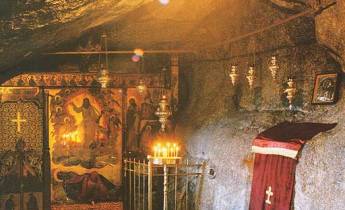
Cave in the Church of the Apocalypse in Patmos, Greece

This is not the only time this issues manifests.  The other time I encountered this is when I travel to sacred or holy sites in the Middle East.  The people in charge of sites may want raise money and increase tourism – so they give the people what they want.  What do I mean by this?  Walking into a place that has a story whether true or not provides pilgrims a sense of awe and wonder.

Certainly I am not saying that this experience should be diminished or should be taken away. What I am saying is that we should be a bit more truthful in our descriptions and remove the shroud of literalism that seems to fuel tourism and not faith. What was difficult for me when visiting Patmos is the rhetoric surrounding the island. It may or may not have been where John had his visions, but certainly the mystique surrounding the Church of the Apocalypse seems to perpetuate the literalism that surrounds the Book of Revelation as being prophetic in dealing with the end times.  Moreover, the vendors around the Church certainly focus their merchandise to support this myth.  However, while I study the Book of Revelation and teach that it is something other than prophetic, a person visits the island and the church, are told that it is prophetic – who is a person to believe?   Me or the religious order running the Church or the vendors living on the island?

This also happens at dig sites.  If a tourist is led by a guide or lead at a holy site being excavated and they tell them what they want to hear so they come back and tell their friends, who has more creditability – me or the person who guides on the site?  When scholars like myself, write about a topic that seems to gel with what the commonly held view of the academy, and goes against literalism or fundamentalist beliefs, we become heretics in relation to the information being fed by the sensationalism on the History Channel and the tourist industry.  So the popular view does not change and the academic view is left on the margins and Biblical literalism wins.

Continue reading “Is There a Such Thing as a Code of Ethics in Academia?  by Michele Stopera Freyhauf”

The Unelected and Unaccountable Men Who Decide Our Fate by Laura Shannon

Bas relief of Atropos, shears in hand, cutting the thread of life

In Greek myth, the Fates, the Moirai, are three sisters – Clotho, Lachesis, and Atropos –  who spin, measure and cut the thread of life for every person born. Their rule is law; even the gods, so the legend has it, have no power to bargain with the one who cuts the thread and ends the life. Her name, Atropos, means ‘she who cannot be turned’.

In Greece today, others are making the life-or-death decisions. It is not the three sisters of ancient folklore, but a bunch of men in suits now wielding the power to uplift or cast down an entire nation and its millions of citizens. I would like to shine a little light on just two of these groups of (mainly) men who have had the most impact on the recent decisions to bring Greece to the brink of bankruptcy, default and catastrophe. Continue reading “The Unelected and Unaccountable Men Who Decide Our Fate by Laura Shannon”