Feminists of Faith, It Is Time to Light Our Lamps by Laura Shannon

3500
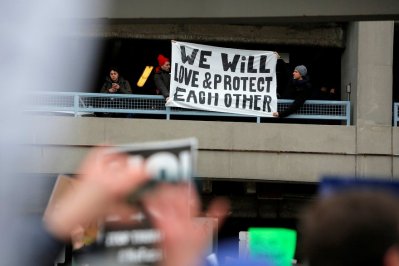
Banner at JFK Protests Photo by Andrew Kelly/Reuters

Last Saturday morning I boarded a plane at London’s Heathrow Airport. During the ten-hour flight to Miami, I got up several times to ease my back and stretch my legs, observing my fellow passengers with interest and curiosity. I chatted with a Brazilian woman who has lived for 20 years in Switzerland, on her way back to Manaus for a few weeks to help her mother through an operation. I observed the tender care with which a well-dressed woman my age assisted an elegant older lady I took to be her mother, both in neatly pinned headscarves. I enjoyed the mixture of different accents and language I overheard as I strolled around the cabin, flowing like the gentle murmuring of a brook. Here were passengers from India, from Asia, from Africa, from numerous European countries, of all ethnicities, nationalities, religions and colours. This is the melting-pot planet I love to live on.

That flight left at 9 am. If it had departed a few hours later, very likely some of those travellers would have been prevented from boarding or removed from the plane, as happened all over the world after Trump signed his executive order banning travellers from seven Muslim-majority countries – Iran, Iraq, Libya, Somalia, Sudan, Yemen and Syria – from entering the United States. The ban applies even to valid visa holders, workers with green cards, dual nationals and legal residents as well as refugees who had gone through the arduous 2-year vetting process and had already been approved. Continue reading “Feminists of Faith, It Is Time to Light Our Lamps by Laura Shannon”

Drawing the Four Together: Rosh Hashanah, Yom Kippur, Sukkot and Immigration.

10953174_10152933322533089_8073456879508513260_oLast Sunday, the Czech Republic’s Narodní Divadlo (National Theater) had its opening celebrations. The National Theater is a big thing here sort of like America’s Hollywood where actors, actresses and directors are household names. The opening celebration is even broadcast on television by Česká Televize (Czech TV, the national television company).

This year, Narodní Divadlo and Česká Televize have decided to dedicate all of the profits of the day’s long events to one organization: Organizace pro Pomoc Uprchlíkům (Organization for Aid to Refugees). It is the longest running and the most well-known NGO in the Czech Republic helping refugees, immigrants and asylum seekers. In addition, it also happens to be where my partner is a lawyer and Head of the Legal Department. So I have a personal connection.

As the High Holy Days begin tomorrow evening, I’ve been thinking a lot about their connection to immigration and Sukkot. My reflection starts with the fact that we too were once refugees. We too were once persecuted and forced into slavery. We too escaped and wandered in a foreign land even though sometimes we yearned for the comfort of the familiar. The sukkah is supposed to remind us of this history. At the same time, we have also been unwelcomed by many, been seen as suspicious and have even been expelled from the many lands we once called home. We have been murdered in mass numbers too many times to count. All of this is to say, that we know the situation of the down-and-out, because we have been there. Likewise, we have in many places overcome it and have a mission to help others in similar situations.

Continue reading “Drawing the Four Together: Rosh Hashanah, Yom Kippur, Sukkot and Immigration.”

The Feminization of Poverty: The Impact on Migrant Mothers in the U.S. by Michele Stopera Freyhauf

Freyhauf, Durham, United Nations, Feminism and Religion, John Carroll, UrsulineI had the honor of speaking at the United Nations during the Commission for the Status of Women this past March about the Feminization of Poverty and the Impact on Migrant Mothers.  Below is the text of my speech delivered.  By posting my speech, it is my hope to use social media to help draw attention to this problem and use our resources to find solutions.

Over the last thirty years, rich countries have grown much richer, and poor countries have become, in absolute and relative terms, poorer. Global inequality in wages are striking and poor countries are turning to the IMF or World Bank for loans, which require “so-called” structural adjustments of devaluing currency, cuts in support for “noncompetitive industries,” and the reduction of public services such as healthcare and food subsidies, which has provided disastrous results for the poor, especially women and children.

The feminization of poverty not only means that more of the world’s poverty is born by women, thanks in large part to globalization of the world economy, but includes a denial of access to fundamental human rights, including health, education, nutritious food, property, representation, etc. Feminized poverty encompasses more than matters of individual suffering – it ensnares a vicious cycle of poverty that impacts their entire family.

Feminization of poverty has no singular cause. The United Nations Development Fund for Women identified 4 key dimensions that indicated a heightened rate of poverty for women:

First is called “the temporal dimension,” which means that women are often the primary caretakers of children and household duties. Women who live in developing nations may also have agricultural or physical responsibilities. With these demands, less time is available to devote to paid employment causing them to earn a smaller income even though they effectively do more work than their male counterparts.

Second is “the valuation dimension” which is defined as unpaid labor that women perform to take care of family members and other household chores. Work that is considered “less than” because formal education or training is not required.

Third, is “The employment segmentation dimension.” Women are natural caretakers and thus corralled into “women’s work”, such as teaching, working with textiles, or domestic servitude that includes caring for children or the elderly.

Finally, “the spatial dimension.” When employment is non-existent or difficult to find, women may have to migrate to other areas to find work temporarily. If a woman has children, she may refuse to take the job and stay to care her family. However, Some opt to leave their families behind, to secure what they consider a better life – a means of support – but this choice often comes a great cost. Continue reading “The Feminization of Poverty: The Impact on Migrant Mothers in the U.S. by Michele Stopera Freyhauf”

Can Secular Immigrant Assimilation Promote Equality? Pt. 2

Andreea Nica, pentecostalismI often wonder how my life would have been different if I had undergone a secular immigrant assimilation process. My former faith within Pentecostalism not only shaped my identity, but augmented my ability to assimilate into the American culture. Subsequently, this led me to explore how nonreligious narratives help immigrants better acculturate to western society. Despite my interests originating in personal exploration, emergent studies within religion and sociology show that there are many factors that come into play when considering social and cultural assimilation.

Following up on my most recent post, Liberations of Immigrant Women in Western Religious Conversion, I will draw on a comparative analysis to consider secular immigrant assimilation processes. Women’s experiences during their migration process contribute to their cultural and social identity formation. Many studies point to the established idea that religion is a key variable in influencing immigrant assimilation, particularly among the Latino community. “Faith plays an important role in their lives: 74 percent of Latinos say religion provides a ‘great deal’ or ‘quite a bit’ of guidance for them” (Philanthropy Roundtable). Continue reading “Can Secular Immigrant Assimilation Promote Equality? Pt. 2”

Liberations of Immigrant Women in Western Religious Conversion by Andreea Nica

Andreea Nica, pentecostalismThe prolonged debate around feminist subjectivity and religious participation continues to evoke much compelling discussion in academia, political arenas, and public space. There have been a number of academic studies around the intersection of gender, religion, and migration, specifically on how gender and immigration assimilation is constructed and managed within western religious systems.

I am currently researching the trajectories of immigrant assimilation and conversion, and how gender relations and religious identities are managed within these processes to further develop my proposal for doctoral study. I find this area of research fascinating as it’s so diverse and pertinent to the progression of gender equity amongst religious participants. Continue reading “Liberations of Immigrant Women in Western Religious Conversion by Andreea Nica”

THE CARELESS SPIRIT OF ANNIE CORLISS: TRUMPING DESPAIR IN THE NEW WORLD by Carol P. Christ

Annie Corliss was my great-great-grandmother. The Corliss name, also spelled Corlis, Corless, Corlies, Corlers, and Carlis, is derived from “careless” meaning someone who is “carefree” or “happy-go-lucky.”

Annie Corliss was the daughter of James and Mary Corliss, both born in Ireland. Her parents may have been tenant farmers, but given that their surname could refer to someone who doesn’t settle or own property, they may have been Irish Travellers– itinerant craft persons and traders, sometimes called tinkers because they mended cooking pots and farm implements.  “Irish Travellers are a traditionally nomadic people of ethnic Irish origin, who maintain a separate language and set of traditions. … Irish Travellers have their roots in a Celtic (and possibly pre Celtic) nomadic population in Ireland.” Continue reading “THE CARELESS SPIRIT OF ANNIE CORLISS: TRUMPING DESPAIR IN THE NEW WORLD by Carol P. Christ”

I am Beginning to Understand by Carol P. Christ

Elizabeth Kelly Inglis died in 1927 at age 62 from complications of a stroke. Secondary causes were malnutrition and exhaustion.

When I was a child, my father, though he was very close to his own parents and sister, spoke very little about his ancestors. I knew that both of his parents lost their fathers when they were small children. I was told that the Christs were German and the Inglises were Scottish and Irish. My grandmother Mary Inglis Christ was as Irish as the day is long. She prayed to the blessed Virgin and took me to church with her in the early mornings where she lit candles and whispered the rosary while fingering faceted lavender beads. She voted for Kennedy because he was Irish and Catholic—to the horror of my father and his father who had no use for the Democrats. My grandmother sometimes cried when she showed us photographs of her family, especially when she pointed to her sister Veronica, called Very. I sensed that my grandmother felt sad to have left her family in New York when she moved with her husband and children to California during the depression, but I was too young to understand fully. As far as I know, I never met any of the relatives from her side of the family, even when I moved to “back east.” Continue reading “I am Beginning to Understand by Carol P. Christ”