Offerings to the Labyrinth on Papoura Hill, excerpt from the novel by Sylvia V. Linsteadt

Sylvia’s discussion of Papoura Hill was posted yesterday; read it here.

I have so many words I want to pour out of my vessel of milk and honey upon Papoura Hill, on the big scar in Crete’s earth where the airport is being carved, on all the places slated for the construction of electricity pylons, and into so many other scars left by millennia of conquest and occupation, but for today what follows is just one song to her. These words are not full of fighting rage or defiance, but of praise, and softness, and memory. Of motherlines that cannot die, and fatherlines almost lost, but not quite. These words come from the beginning of a novel that I began writing during my first season living in Crete almost seven years ago now, a novel that has metamorphosed with me across these many years, shedding skins and growing new ones— both me, and the novel. The book is still in process, close to being born, but here is one of her many skins, laid at the center of the labyrinth on Papoura Hill with my love.

Moonrise Over Old Crete
an excerpt

The earth tilted toward dusk.
Along the shores of Crete, the Aegean turned for a moment to gold.

Women flocked down to the sea like dark birds to pour jugs of oil and wine into the water. Amphitrite of the cockle crown, they murmured, Aphrodite mother of vessels, mother of the foam and deep, bring our men home safe. The sun lowered under the edge of the world, leaving the last light along the coast. Threads of it pooled in sea-caves and in the inlets where fishermen kept their summer boats. The old storytellers said that in lost times, when the queen was called the Ariadne and her king the Bull, the women of Crete could gather up the last light from the sea onto their distaffs and take it home to spin golden thread for their skirt hems and finest vests.

Continue reading “Offerings to the Labyrinth on Papoura Hill, excerpt from the novel by Sylvia V. Linsteadt”
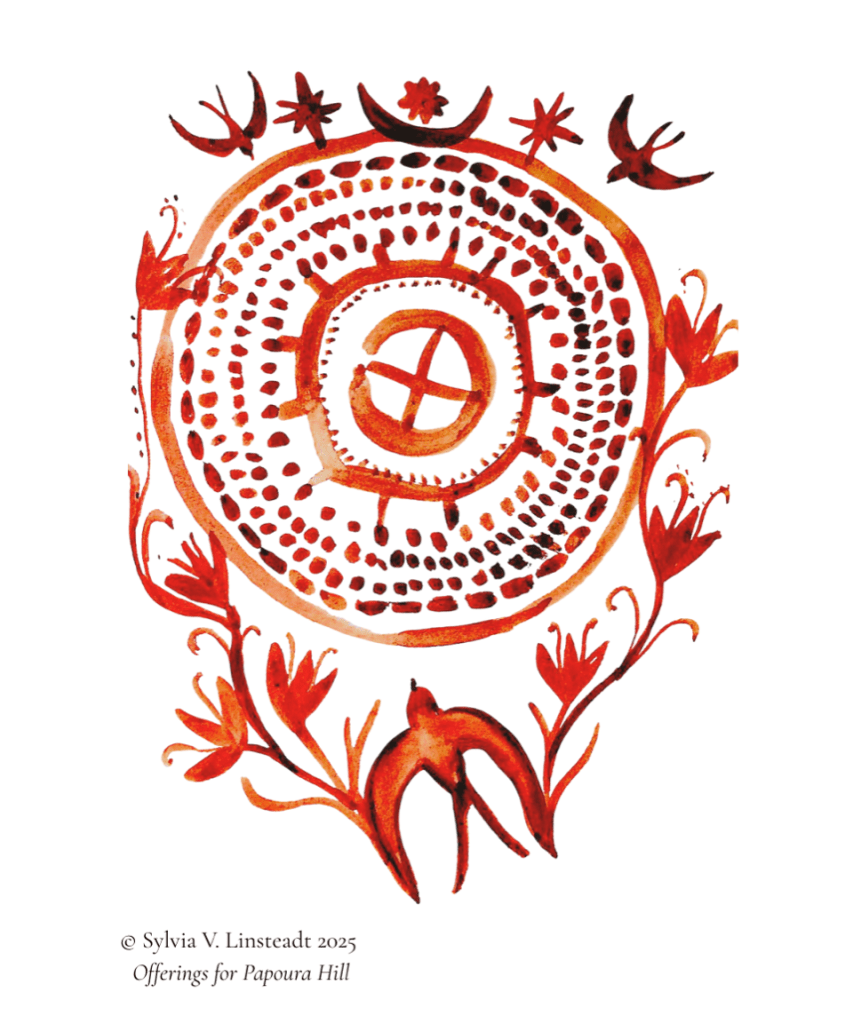
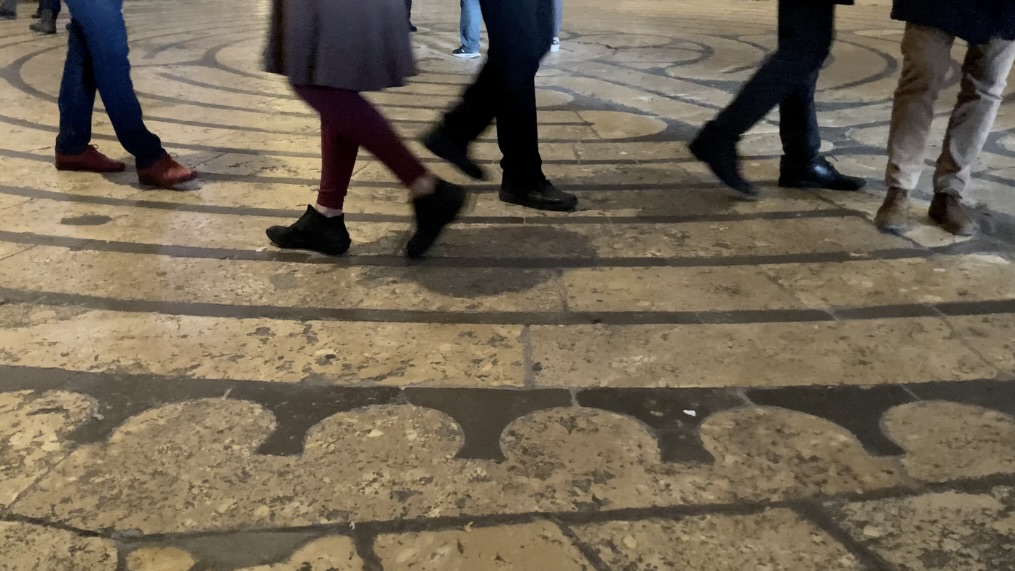
Offerings to the Labyrinth on Papoura Hill by Sylvia V. Linsteadt

Rhea, mother of Demeter, is coming down upon the seven mountain ranges of her Crete. Ariadne, granddaughter of Rhea, is coming up from her ten thousand perfect caverns inside those mountains with clear water in her arms. They have been quiet a long time, but they are not quiet now. Between them comes Demeter across the wide plateaus where her stones and soil are being stripped for profit, where her bees are dying from pesticide use in their hives, where her grain and oil are sold out from under her, the farmers who grew them cheated by countries with fatter economies and shinier marketing schemes.

They are gathering on Mt. Juktas and Mt. Dikti and Mt. Ida and on Papoura Hill, on all the old holy mountain places where nereids and kouretes were born, where midwives danced, and the dead were buried, and the priests and queens held night-long vigils to take divinations from the procession of the stars. From those divinations they turned the wheel of Crete’s festivals so that they continued year by year as precisely as Earth turned around her axis, so that Earth knew that she and her gifts were respectfully received, and truly loved.

Continue reading “Offerings to the Labyrinth on Papoura Hill by Sylvia V. Linsteadt”

Ariadne and Me – The .5% by Arianne MacBean

When I travelled to Crete on a Goddess Pilgrimage last year, we were asked to introduce ourselves by our matrilineal lines. I am Arianne, daughter of Bernadette, granddaughter of Helen and a long line of women, known and unknown, stretching back to Africa. Many of the women in the group were able to intone long lists of names in their matrilineal lines. I was not able to go further than my Grandmother, Helen. No one in my mother’s large Polish family could remember my Great Grandmother’s name.

My journey toward Ariadne has been as circuitous as the labyrinth itself. In many ways, I have been searching for her since those first bedtime stories my father used to tell me as a child, when Theseus was the main character and Ariadne, merely a stop on his road. I longed for her, even then, to have her own heroine’s journey. I tried to imagine what that might look like but, without models, could not conjure anything beyond holding the red thread so others could triumph. Later, I began a more conscious search for Ariadne as I became curious about the connections between her choices, feelings, expressions and my own longings, betrayals, and outbursts. Since then, there have been moments when I let myself fantasize about being connected to her in some real way, beyond being named after her, or feeling and acting as she may have. In these fleeting moments when I imagine we are bonded, I am awash in an intense sense of belonging, something I never felt as an only child of divorced parents. But then in a flash, my mind takes a sharp turn, as in a labyrinth, and I negate those feelings with logic. You want to be connected to Her, so you are finding ways to make it true.

Continue reading “Ariadne and Me – The .5% by Arianne MacBean”

Walking the Chartres Labyrinth

The Chartres Cathedral, located southwest of Paris, is rich in symbolism and history. Featuring stunning stain-glass windows, a famous labyrinth, and a shrine to “Our Lady of the Pillar”, it offers a profound meditation experience. Exploring the labyrinth’s symbolism and personal reflections amidst everyday distractions, the author shares a transformative journey.

Let me take you on a pilgrimage to Chartres Cathedral, share about the ancient symbolism of the labyrinth, and ponder on how to interpret signs and symbols we receive along the way…

Continue reading “Walking the Chartres Labyrinth”

Snapshots from the Parliament of World Religions by Janet Maika’i Rudolph

The Parliament of World Religions ran from Aug 14th to the 18th  in Chicago.  I returned with my head spinning having met new people, connected with inspiring beliefs, discussed fascinating ideas, watched meaningful performances, engaged in sacred play, danced, sang, cried, ate, and mostly experienced . . . just experienced. It is still overwhelming to sort out individual experiences. I am going to write up a few of my impressions, snapshot style. They scratch the surface, not only of my individual experience but of the Parliament in general where upwards of 7,000 people attended. It was incredible

Setting the tableau: As I was going down the escalator, a woman was followed by 2 groups were heading up. The woman was beautiful and young in full Mayan dress with white blouse, long orange skirt along with headdress and belt with Mayan symbols. Her thick dark hair was flowing down her back.

She was followed by five Sikh men who were dressed head to foot in white. Their heads and hair were covered by white turbans.

They were followed by two Buddhist nuns dressed in grey robes carrying beads. Their heads were shaved.

Such scenes were common.

Continue reading “Snapshots from the Parliament of World Religions by Janet Maika’i Rudolph”

The Magic of the Labyrinth by Janet Maika’i Rudolph

Labyrinths are magical. I’ve always been drawn to them. About two years ago, a local Episcopalian Church rebuilt their beautiful outdoor labyrinth and opened it to the public. In concert with them, I have been delighted and honored to offer guided walks there. Doing these walks, both in leading them and in walking myself, have given me the opportunity to reflect deeply on what they mean from many perspectives: historical, personal, spiritual, philosophical, experiential.

When I walk a labyrinth, it feels like I am mirroring the universe while expanding my internal journey. Teresa of Avila agrees with me (or, more accurately, I with her). She wrote, “If we learn to love the earth, we will find labyrinths, gardens, fountains and precious jewels! A whole new world will open itself to us. We will discover what it means to be truly alive.”     


Continue reading “The Magic of the Labyrinth by Janet Maika’i Rudolph”

The Heart of the Labyrinth by Daniel Cohen

This is how they tell the story.

They tell that the Minotaur was a monster, half man, half bull, who dwelt in the labyrinth. They tell that Theseus was a brave youth who determined to kill the Minotaur. They tell that Ariadne was a princess who fell in love with Theseus and gave him a thread to guide him. They tell that Theseus marched unfearingly into the labyrinth, braving the bellowing monster at its heart, and that he met the Minotaur and slew it. They tell that he emerged a great man who in later years won the love of many women and gloriously conquered many lands.

This is what they do not tell us. Continue reading “The Heart of the Labyrinth by Daniel Cohen”