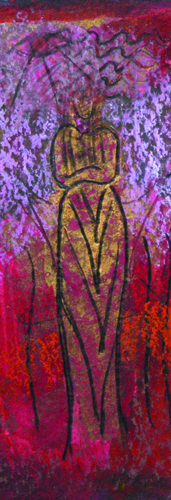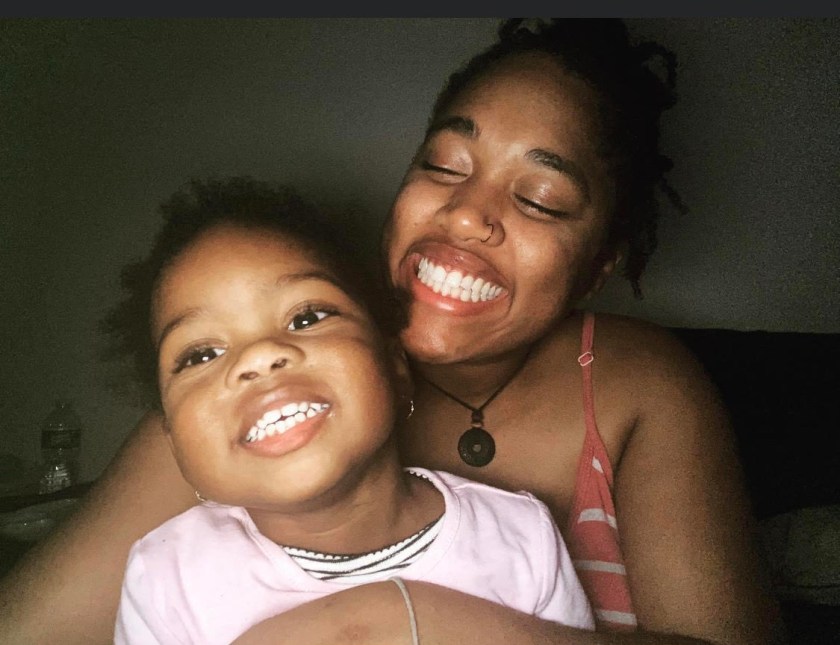
Gardens Bloom Between our Wombs by Chaz J.

For years, I have dedicated my life to empowering and uplifting all women in all ways. I have loved women as mothers, aunties, sisters, friends, cousins, teachers, mentors, daughters, God, and most recently myself. The depth of sweetness and emotion for women runs as deep as my life’s work. My life’s work centers and finds a deep well of inspiration in women and women’s lived experiences. My feelings concerning women were confusing for a long time and for a long time I have loved women in every way, except two: sexually and romantically. Giving myself permission to love women in every way has been one of the most liberating personal experiences of my life. It is one of my most radical revolutions. It is self-acceptance and self love in totality. 

The object of my desires is fluid and delicate. She is intuitive  and evasive. She is real and ethereal. She is Wombman. She created and is the fundamental elements that constantly gives birth to the world around us. She has given birth to all of us. She is fire and fury. She is Mother Gaia. She is the winds of change. She is water’s depth and grace. She is the sunlight after a storm. She IS the storm purging impurities. She is a creator and she is destruction. She simply IS…

Continue reading “Gardens Bloom Between our Wombs by Chaz J.”
The Legend of Istehar by Jill Hammer

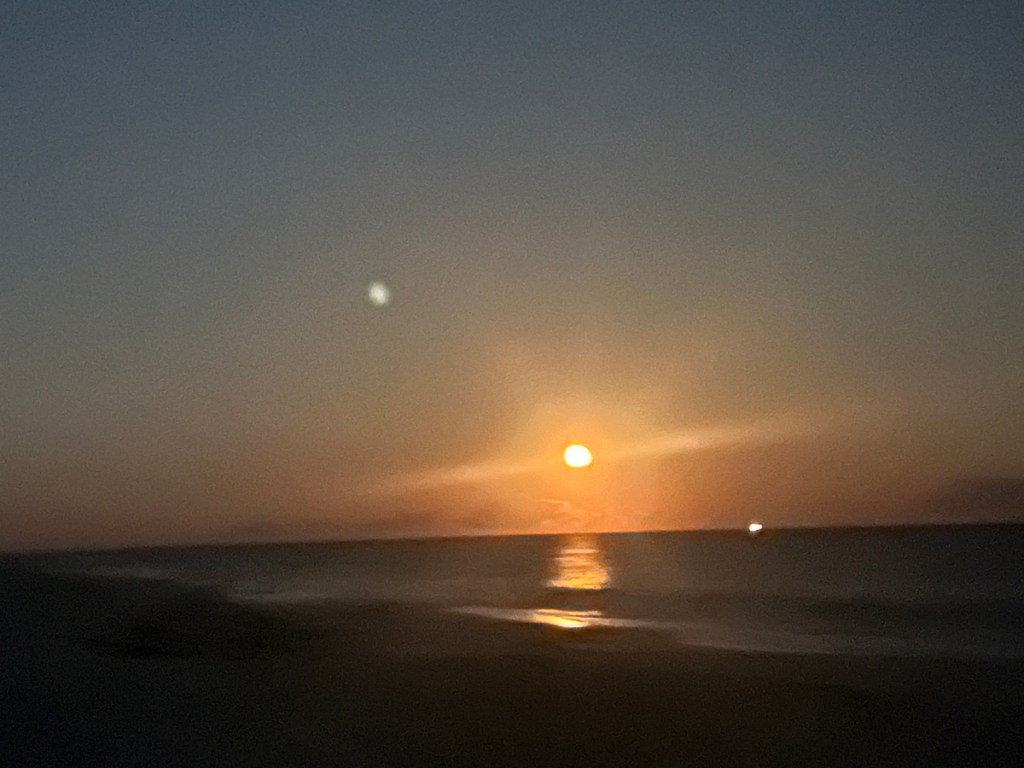
Blue supermoon 2024

This summer I had the opportunity to travel to Fire Island, New York, which is a long sand bar full of small beach towns with no cars. Fire Island’s been a haven not only for beachgoers but for queer folk for many decades. We stayed in the town of Cherry Grove with friends, and one night we went out to look at the supermoon/blue moon. The moon rose over the horizon, red and a little scary, a sight like none of us had ever seen. Not far from the moon was a star so bright it came out in the photographs. I wondered if that was the morning star.  Venus, in our current understanding. Inanna or Ishtar, among some of the ancients. And that made me think of Istehar.

Istehar, in Jewish legend, is a maiden who became one of the Pleiades. Her legend is unusual among Jewish legends because it reads like a Greek myth. It takes place during the time when some angels had descended to earth because they desired human women. One of these angels, Shemhazai, noticed a certain woman named Istehar, and desired her and wanted to be intimate with her.  Istehar wished to flee this angel, and so she said: “I won’t accept you as a lover until you give me your wings and teach me the Divine Name that allows you to fly to heaven.” The angel gave her his wings and taught her the Divine Name.  Istehar immediately uttered the Name and flew up to the sky, thus escaping the angel. God was impressed by her virtue and decided that she would be placed among the seven stars, in the constellation of the Pleiades, “that humans might never forget her.” (Legends of the Jews I:4:11).

Continue reading “The Legend of Istehar by Jill Hammer”

Lilith: Evil Demon or Feminist Role Model?

Today, we celebrate Simchat Torah (the Joy of the Torah) which marks the end of a cycle of Torah readings and the beginning of a new one.  Therefore, the Torah portion for October 14, 2023 is Bereshit (Genesis 1:1-6:8), the first parshah of the Torah.  This parshah is most known for its myths surrounding the beginning of the world, including, within it, two creation stories, the first one running from 1:1 to 2:3 and the second from 2:4 to 2:25.  These accounts of creation are followed by a story about Adam, Eve, a snake, and the Tree of the Knowledge of Good and Evil.  The parshah concludes with the happenings of Cain and Abel, the descendants of Adam and Eve, and Noah, a man who found divine favor.

I wrote briefly about this parshah in the midst of the pandemic.  The writing there mirrors the chaotic and often difficult nature of that time.  Thus, I want to revisit the parshah now.  Interestly, I am drawn to comment on the same topic: Lilith. 

Continue reading “Lilith: Evil Demon or Feminist Role Model?”

Embracing the Dark Goddess – Empowering Paradigm Shifts, Part 2 by Judith Shaw

 The Dark Goddesses, with qualities that are mysterious, magical, chaotic, destructive, violent and transformational bring a wholistic understanding of ourselves and of nature. They are wild and untamed.  Today I finish up my initial dive into the Dark Goddesses which began yesterday with the publication of Part 1. Look for a more detailed look at these goddesses and more in the coming months.

Erishkigal, Underworld Goddess

Dark goddesses are wild, free, and sexual – Lilith, Erishkigal and Medb

Lilith and Erishkigal
Long before the rise of civilization, people lived together in very different ways and Goddess was understood as the force that encompasses all life – the light and the dark. It’s very interesting that two of the world’s oldest dark goddesses – Lilith and Erishkigal –  are found in the creation story of Sumer, considered as the world’s first civilization.

Continue reading “Embracing the Dark Goddess – Empowering Paradigm Shifts, Part 2 by Judith Shaw”

Write on Lilith! (Write on Eve!) by Ivy Helman

Over the past few months, I’ve been struggling to write posts.  This month is no different.  I am currently sitting with four different half-drafts on three semi-related topics, none of which I seem to be able to complete.  I’ve gone back to each of them numerous times.  I write.  I erase.  I rewrite.  I copy bits of one into another to save for some other time.  I’m left with one sentence:  this week’s Torah parshah is Bereshit (Genesis 1:1-6:8).  Great.  Glad to know that.  Now what?  

When writing, I often find myself in one of two camps given the current state of the world.  Either, I have so much to say that I have no clear idea where to start, so I write three pages of more or less nonsense.  Or, I find myself just so inundated with information that I don’t know where my opinion begins and another’s ends.  I write another 3 pages of completely different nonsense.  I get fed up with both.  I start praying better thoughts will just write themselves.  They don’t.  

Continue reading “Write on Lilith! (Write on Eve!) by Ivy Helman”

Yes There are Goddesses in the Bible, Part 3

This blog post is the 3rd in a series of looking for female deities in the bible who have been translated out of easy reach or otherwise hidden within its words. In my last blog post I discussed bird imagery and the bible. It is available here

 You can’t complete a discussion about birds without also bringing up Lilith. She appears by name only in one place in the bible; Isaiah 34:14. Isaiah uses the word liyliyth as a feature in a hellish landscape. Although it is also a name, liyliyth is treated as a common noun. The most prevalent translation is “screech owl” although others have included such names as night creature, night monster, night hag, and she-vampire. Continue reading “Yes There are Goddesses in the Bible, Part 3”

Painting Lilith, Queering Lilith by Angela Yarber

angelaLilith has been a misunderstood, appropriated, and redeemed woman throughout the ages. Many feminists claim her as an empowering figure in Jewish mythology, her story reclaimed by contemporary artists such as Sarah McLachlan, who created the all-women music tour, “Lilith Fair.” Some queer scholars have surmised that Lilith had a romantic relationship with Eve. Others have claimed that Lilith was a demon who seduced men and strangled children in the night. Quite a disparity, isn’t it?

The first time I painted her, I wrote about my subsequent leaving of the church here on Feminism and Religion. Based almost entirely on Judith Plaskow’s beautiful midrash, “The Coming of Lilith,” I’ve painted a second Holy Woman Icon rendition of Lilith. In the Jewish tradition, midrash is akin to climbing inside the story—inside the Torah—and imagining what happened in the places where the text offers no description; it is the space between the letters, the creative imagination within the narrative that makes the story come alive.

According to Plaskow’s midrash, God created Adam and Lilith from the same earth. Tired of Adam demanding that she be subservient to him, Lilith left the Garden of Eden. She was later befriended by Eve and her legacy of empowering women continues today. Adding a queer twist to this feminist midrash, some claim that Lilith and Eve became lovers, as well. Continue reading “Painting Lilith, Queering Lilith by Angela Yarber”

November, A Silent Month? by Barbara Ardinger

Barbara ArdingerNovember, which begins with All Saints Day (yesterday) and All Souls Day (today), gives us a quiet, welcome break between the loud make-believe of Halloween and the incessant caroling of the winter solstice season with its popular holidays. In the Northern Hemisphere, the days are noticeably shorter and darker now. Where I grew up, it’s gray, cloudy, and often rainy. It has always seemed to me that people are turning inward and the month is closing in on itself. Even today in southern California, I feel a delicious melancholy composed of silence and rest from hard work.

giant head

For two millennia, the standard-brand churches have admonished women to be silent. As it is written, “Let the woman learn in silence with all subjection. But I suffer not a woman to teach, nor to usurp authority over the man, but to be in silence” (1 Timothy 2: 11-12).

Let’s say that today is a typically gloomy November day. The sun is lazy and clouds are floating mysteriously across the sky. Look, they’re gathering over there in the east. As clouds often do, they begin to assume shapes. Let’s look closer…and we begin to see a fiery mountain. Above that fiery mountain floats a giant head. Listen! The head is speaking. “I am One, the Great and Powerful. Thou shalt not take My Name in vain. Thou shalt have no other gods before me for I am a jealous God—”

But the silence of this gloomy November day is suddenly broken as the women standing in the mud at the foot of the fiery mountain suddenly begin to shout back at the preaching giant head. “There’s been plenty of gods before you,” one woman shouts. “And even more goddesses came before you,” calls another woman. Continue reading “November, A Silent Month? by Barbara Ardinger”

Painting Lilith, Leaving Church by Angela Yarber

 Lilith has been a misunderstood, appropriated, and redeemed woman throughout the ages.  Many feminists claim her as an empowering figure in Jewish mythology, her story reclaimed by contemporary artists such as Sarah McLachlan, who created the all-women music tour, “Lilith Fair.”  Others have claimed that Lilith was a demon who seduced men and strangled children in the night.

Based almost entirely on Judith Plaskow’s beautiful Midrash, “The Coming of Lilith,” this new Holy Woman Icon with a folk feminist twist has empowered me to reject the sexism and heterosexism that was rendering me broken.  So, she joins Virginia Woolf , the Shulamite, Mary Daly, Baby Suggs, Pachamama and Gaia, Frida Kahlo, Salome, Guadalupe and Mary, Fatima, Sojourner Truth, Saraswati, Jarena Lee, Isadora Duncan, and Miriam as powerful women who have done holy and remarkable things.  First, her story.  Then—if I may—my own.

Continue reading “Painting Lilith, Leaving Church by Angela Yarber”