What is the Cause of Violence? A Response to Karen Armstong by Carol P. Christ

 “So, when we in the West talk about religion as the cause of this violence, how much are we letting ourselves off the hook, and using religion as a way to ignore our role in the roots of this violence?” Karen Armstrong, author of Fields of Blood
carol p. christ photo michael bakasThis statement was made by scholar of religions Karen Armstrong in an interview in Salon magazine in response to characterizations of Islam as a violent religion by Bill Maher and others. Speaking in the context of the rise of anti-Islamist prejudice in Europe, Armstrong said that Maher’s demonization of “the other” was the kind of talk that could lead us back to the concentration camps.

Bill Maher makes blanket statements against religion in general and Islam in particular. Maher clearly does not have a nuanced view of any religion. He is fueling anti-Islamic sentiment when he singles out Islam as a violent religion. If religions are going to be criticized as violent, then we must not limit ourselves to criticizing Islam, but must begin closer to home, by discussing the relation of religion and violence in the Bible, in Christianity, and in Judaism. My rule of thumb is always to begin with Christianity because it is the hegemonic religion of western cultures. Continue reading “What is the Cause of Violence? A Response to Karen Armstong by Carol P. Christ”

An Archaic Trinity of Goddesses? Not Necessarily. by Barbara Ardinger

Barbara ArdingerIn her comment following my last post which was about mythology, my friend, Carol Christ, expands on my paragraph about how the so-called “ancient triple goddess” was really invented in 1948 by Robert Graves in his book, The White Goddess. (Thanks, Carol.)

Back in the 1970s and 1980s, when the Goddess movement was just getting up on its feet and our ovular books were being published, the idea arose that if “they” have a holy trinity, “we” have one, too. And ours is older and holier. We see it in the three phases of the moon, new (Virgin), full (Mother), and dark (Crone). Here’s a tiny sample of these books that changed the lives of so many women and men:

  • Woman’s Mysteries Ancient and Modern by M. Esther Harding (1971, but first published in 1933)
  • The Goddesses and Gods of Old Europe (1974) by Marija Gimbutas
  • When God Was a Woman (1976) by Merlin Stone
  • Lost Goddesses of Early Greece: A Collection of Pre-Hellenic Myths (1978) by Charlene Spretnak
  • The first edition of The Spiral Dance (1979) by Starhawk
  • The Chalice and the Blade (1987) by Riane Eisler
  • Laughter of Aphrodite (1987) by Carol P. Christ
  • The Holy Book of Women’s Mysteries (1989) by Z. Budapest
  • The Reflowering of the Goddess (1990) by Gloria Feman Orenstein
  • Whence the Goddesses: A Source Book (1990) by Miriam Robbins Dexter

Triple goddess? ’Tain’t so. Our beloved triple goddess is one of our foundational myths. It’s nice and it’s perhaps inspiring, but it’s only a myth. Anyone who looks at a calendar or almanac—or up into the sky every night for a month—can easily see that the moon doesn’t have three phases. It has four: waxing, full, waning, and dark. And since the late 20th century, women have lived long enough to go through more than three stages of life. Continue reading “An Archaic Trinity of Goddesses? Not Necessarily. by Barbara Ardinger”

When Baby Girls and Old Crones Ruled by Jeri Studebaker

Jeri Studebaker

The data came as somewhat of a shock to me.  I stumbled across it one day in The Civilization of the Goddess, a mammoth book by the late Lithuanian-American archaeologist Marija Gimbutas about what Gimbutas dubbed “Old Europe” – a culture area in southeastern Neolithic Europe that she maintains was centered around female deity.

Until she had the temerity to suggest that people at some point in the past might have worshipped goddesses rather than gods, Gimbutas had a sterling reputation among academics, even being hired to teach at two of the most prestigious of all  American archaeology departments, Harvard’s and UCLA’s.  After presenting her goddess theory of Old Europe, however, Gimbutas came under attack by a few powerful male archaeologists, after which her reputation among academics began to plummet (see Spretnak 2011 for a good accounting of Gimbutas’ fall from grace).

Marija Gimbutas
Marija Gimbutas

Before I get to the data that so startled me, I need to tell you a bit about archaeologists.  Like the members of many academic disciplines, they disagree with each other – sometimes vehemently (and perhaps even somewhat more vehemently than scholars in other disciplines).  One thing however they all agree on is this: the higher the quality and quantity of grave goods buried with an individual, the higher that individual’s status in her or his society. Continue reading “When Baby Girls and Old Crones Ruled by Jeri Studebaker”

Dance of the Bees: Reading the Language of the Goddess by Carol P. Christ

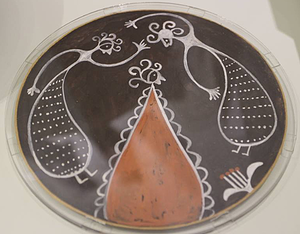
bee women dancing croppedThe image from an ancient Cretan bowl (c.1700 BCE) from the Sacred Center of Phaistos pictured here has often been interpreted as an early depiction of Persephone’s descent or rising. But are clues from later Greek mythology pointing in the right direction in this case?

Recently, my colleague Mika Scott posted the Phaistos bowl image on our Goddess Pilgrimage Facebook site in conjunction with the bee pendant from Mallia. This juxtaposition led me to think again about the importance of bees and pollination in agricultural societies and to offer an alternative reading of the symbolism on the bowl. Continue reading “Dance of the Bees: Reading the Language of the Goddess by Carol P. Christ”

Has the Phaistos Disk Been Cracked? by Carol P. Christ

Carol Christ in LesbosRecent headlines in the international press announced that the enigmatic language of the ancient Cretan “Phaistos Disk” has been translated—in part—by the Welch-Cretan scholar Gareth Owens. Owens states that the Phaistos Disk records an ancient hymn to a Mother Goddess. More specifically he claims that one side is dedicated to a Pregnant Goddess and the other to a Birth-Giving Goddess.

All of this is very exciting, but is he right? Continue reading “Has the Phaistos Disk Been Cracked? by Carol P. Christ”

BARBARA LEE SPEAKS FOR ME by Carol P. Christ

carol christWhile I was in Crete on the Goddess Pilgrimage teaching about and experiencing a Society of Peace where violence and domination were neither celebrated nor encouraged, another war broke out in Iraq, breaking my heart, breaking all of our hearts—yet again. When will we ever learn, oh when will we ever learn?

Barbara Lee was the only member of Congress to vote against the US war powers authorized after 9/11 which were used to launch war in Afghanistan; she also voted against authorization for the Iraq war in 2002. Hillary Clinton voted for the Iraq war, despite clear indications that the US administration was lying about weapons of mass destruction—which were never found in Iraq. I voted for Barack Obama because he opposed this war. Then he listened to General Petraeus and expanded the war in Iraq. Barbara Lee speaks for me. Hillary Clinton and Barack Obama do not.

The Iraqi people are once again living in fear of their lives as reports surface that armies and militias are engaging in mass executions of their so-called “rivals.” Is there any cause that could justify this? Continue reading “BARBARA LEE SPEAKS FOR ME by Carol P. Christ”

Curiosity About Everything and the Language of the Goddess by Carol P. Christ

carol christMy recent discovery of Marija Gimbutas on Youtube rekindled my admiration for her work. In her slide-lecture “The World of the Goddess” Marija Gimbutas allows us to follow the line of reasoning she used to decipher the “language of the Goddess” in Old Europe.

Careful attention to her lecture shows that Gimbutas did not close her eyes, dream, and then attach her own ideas and intuitions to the artifacts she later discussed. Rather, she catalogued groups of images with similar symbolism and used her knowledge of nature (what does a water bird or an owl look like?) and folklore (she collected thousands of songs connected to the agricultural and life cycles in her native Lithuania in the 1930s) to unlock the meaning of ancient symbols.

I suspect that most of the critics of Gimbutas lack the knowledge she gained through her wide curiosity about life. Do other archeologists as a group know what specific species of water birds or owls really look like? Do they have the same kind of knowledge of folklore and folk traditions that Gimbutas had?   Continue reading “Curiosity About Everything and the Language of the Goddess by Carol P. Christ”

Women’s Ritual Dances: The Dancing Priestess of the Living Goddess by Laura Shannon

Laura ShannonKyria Loulouda calls to her sister to help her wind the yards of woven girdle around and around my waist. Kyria Stella’s aged fingers, still strong, tuck the sash ends in tightly, smoothing down the fabric she and Loulouda wove themselves. The snug embrace of the sash supports my back and encourages me to stand proudly upright.  As they help me with the intricate tucks and pleats of the festival dress, and the careful tying of the flowered headscarf, I see their tired, careworn faces come alight with joy and expectation. When they are satisfied, they turn me towards the mirror, smiling.

We gaze at ourselves, a row of three women, dressed alike. Like the butterflies embroidered in bright silks on the dark cloth of the bodice, we too are transformed. The food is prepared, the housework is done, the animals taken care of for the night; the other women await us in the square where, by tradition, they will open the dance with their own singing as they have done countless times throughout their lives. We are in the village of Pentalofos in Greek Thrace in the early twenty-first century, living a timeless scene which has been repeated through the generations for hundreds, perhaps thousands of years. Continue reading “Women’s Ritual Dances: The Dancing Priestess of the Living Goddess by Laura Shannon”

“Immanent Inclusive Monotheism” with a Multiplicity of Symbols Affirming All the Diversity and Difference in the World by Carol P. Christ

carol-christIn recent years monotheism has been attacked as a “totalizing discourse” that justifies the domination of others in the name of a universal truth. In addition, from the Bible to the present day some have used their own definitions of “exclusive monotheism” to disparage the religions of others. Moreover, feminists have come to recognize that monotheism as we know it has been a “male monotheism” that for the most part excludes female symbols and metaphors for God.  With all of this going against monotheism, who would want to affirm it?

In response to some or all of the above critiques, many modern pagans define themselves as polytheists, affirming at minimum, the Goddess and the God, and at maximum a vast pantheon of individual deities, both female and male, from a single culture or from many, including divinities with animal characteristics.  Other pagans define themselves as animists, affirming a plurality of spirits in the natural world. A group of Christian feminists have argued that the Christian Trinity, the notion of God Three-in-One, provides a multiple and relational understanding of divinity.

While also rejecting exclusive monotheism and male monotheism, Jewish poet, ritualist, and theologian Marcia Falk provided a definition of inclusive monotheism that I find compelling.

Monotheism means that, with all our differences, I am more like you than unlike you. It means that we all share the same source, and that one principle of justice must govern us equally.  . . Continue reading ““Immanent Inclusive Monotheism” with a Multiplicity of Symbols Affirming All the Diversity and Difference in the World by Carol P. Christ”

“MERMAID, GODDESS OF THE SEA” by Carol P. Christ

carol-christOn the recent Goddess Pilgrimage to Crete, I visited the Historical Museum in Heraklion where I saw a beautiful embroidered silk panel of a mermaid identified only as having come from Koustogerako, a village in western Crete. As it is unlikely that a man in a Cretan village would have been talented in embroidery, in this case “Anonymous” most definitely “was a woman.”

In this thread painting a mermaid surrounded by fish is holding the anchor of a ship in one hand and a fish in the other. In Greece the mermaid is the protectress of sailors. In a well-known legend, a mermaid said to be the sister of Alexander the Great, emerges from the sea in front of a ship during a storm and asks: “Is Alexander the Great still living?” If the sailors answer, “Yes, he lives and reigns,” the ship is saved.

mermaid greek0001

In this image the mermaid–who does not much resemble “the little mermaid” of recent lore—is identified by the woman who embroidered her as: “GORGONA, H THEA TIS THALASSIS,” MERMAID GODDESS OF THE SEA.” Assuming that the woman who created this embroidery was probably a Christian, I was surprised to see that she nonetheless referred to the mermaid as a Goddess. Was this phrase passed on to her down to her from pre-Christian times? Did she see any contradiction between her Christian beliefs and the “Goddess of the Sea?” Continue reading ““MERMAID, GODDESS OF THE SEA” by Carol P. Christ”