BARBARA LEE SPEAKS FOR ME by Carol P. Christ

carol christWhile I was in Crete on the Goddess Pilgrimage teaching about and experiencing a Society of Peace where violence and domination were neither celebrated nor encouraged, another war broke out in Iraq, breaking my heart, breaking all of our hearts—yet again. When will we ever learn, oh when will we ever learn?

Barbara Lee was the only member of Congress to vote against the US war powers authorized after 9/11 which were used to launch war in Afghanistan; she also voted against authorization for the Iraq war in 2002. Hillary Clinton voted for the Iraq war, despite clear indications that the US administration was lying about weapons of mass destruction—which were never found in Iraq. I voted for Barack Obama because he opposed this war. Then he listened to General Petraeus and expanded the war in Iraq. Barbara Lee speaks for me. Hillary Clinton and Barack Obama do not.

The Iraqi people are once again living in fear of their lives as reports surface that armies and militias are engaging in mass executions of their so-called “rivals.” Is there any cause that could justify this? Continue reading “BARBARA LEE SPEAKS FOR ME by Carol P. Christ”

Curiosity About Everything and the Language of the Goddess by Carol P. Christ

carol christMy recent discovery of Marija Gimbutas on Youtube rekindled my admiration for her work. In her slide-lecture “The World of the Goddess” Marija Gimbutas allows us to follow the line of reasoning she used to decipher the “language of the Goddess” in Old Europe.

Careful attention to her lecture shows that Gimbutas did not close her eyes, dream, and then attach her own ideas and intuitions to the artifacts she later discussed. Rather, she catalogued groups of images with similar symbolism and used her knowledge of nature (what does a water bird or an owl look like?) and folklore (she collected thousands of songs connected to the agricultural and life cycles in her native Lithuania in the 1930s) to unlock the meaning of ancient symbols.

I suspect that most of the critics of Gimbutas lack the knowledge she gained through her wide curiosity about life. Do other archeologists as a group know what specific species of water birds or owls really look like? Do they have the same kind of knowledge of folklore and folk traditions that Gimbutas had?   Continue reading “Curiosity About Everything and the Language of the Goddess by Carol P. Christ”

Women’s Ritual Dances: The Dancing Priestess of the Living Goddess by Laura Shannon

Laura ShannonKyria Loulouda calls to her sister to help her wind the yards of woven girdle around and around my waist. Kyria Stella’s aged fingers, still strong, tuck the sash ends in tightly, smoothing down the fabric she and Loulouda wove themselves. The snug embrace of the sash supports my back and encourages me to stand proudly upright.  As they help me with the intricate tucks and pleats of the festival dress, and the careful tying of the flowered headscarf, I see their tired, careworn faces come alight with joy and expectation. When they are satisfied, they turn me towards the mirror, smiling.

We gaze at ourselves, a row of three women, dressed alike. Like the butterflies embroidered in bright silks on the dark cloth of the bodice, we too are transformed. The food is prepared, the housework is done, the animals taken care of for the night; the other women await us in the square where, by tradition, they will open the dance with their own singing as they have done countless times throughout their lives. We are in the village of Pentalofos in Greek Thrace in the early twenty-first century, living a timeless scene which has been repeated through the generations for hundreds, perhaps thousands of years. Continue reading “Women’s Ritual Dances: The Dancing Priestess of the Living Goddess by Laura Shannon”

“Immanent Inclusive Monotheism” with a Multiplicity of Symbols Affirming All the Diversity and Difference in the World by Carol P. Christ

carol-christIn recent years monotheism has been attacked as a “totalizing discourse” that justifies the domination of others in the name of a universal truth. In addition, from the Bible to the present day some have used their own definitions of “exclusive monotheism” to disparage the religions of others. Moreover, feminists have come to recognize that monotheism as we know it has been a “male monotheism” that for the most part excludes female symbols and metaphors for God.  With all of this going against monotheism, who would want to affirm it?

In response to some or all of the above critiques, many modern pagans define themselves as polytheists, affirming at minimum, the Goddess and the God, and at maximum a vast pantheon of individual deities, both female and male, from a single culture or from many, including divinities with animal characteristics.  Other pagans define themselves as animists, affirming a plurality of spirits in the natural world. A group of Christian feminists have argued that the Christian Trinity, the notion of God Three-in-One, provides a multiple and relational understanding of divinity.

While also rejecting exclusive monotheism and male monotheism, Jewish poet, ritualist, and theologian Marcia Falk provided a definition of inclusive monotheism that I find compelling.

Monotheism means that, with all our differences, I am more like you than unlike you. It means that we all share the same source, and that one principle of justice must govern us equally.  . . Continue reading ““Immanent Inclusive Monotheism” with a Multiplicity of Symbols Affirming All the Diversity and Difference in the World by Carol P. Christ”

“MERMAID, GODDESS OF THE SEA” by Carol P. Christ

carol-christOn the recent Goddess Pilgrimage to Crete, I visited the Historical Museum in Heraklion where I saw a beautiful embroidered silk panel of a mermaid identified only as having come from Koustogerako, a village in western Crete. As it is unlikely that a man in a Cretan village would have been talented in embroidery, in this case “Anonymous” most definitely “was a woman.”

In this thread painting a mermaid surrounded by fish is holding the anchor of a ship in one hand and a fish in the other. In Greece the mermaid is the protectress of sailors. In a well-known legend, a mermaid said to be the sister of Alexander the Great, emerges from the sea in front of a ship during a storm and asks: “Is Alexander the Great still living?” If the sailors answer, “Yes, he lives and reigns,” the ship is saved.

mermaid greek0001

In this image the mermaid–who does not much resemble “the little mermaid” of recent lore—is identified by the woman who embroidered her as: “GORGONA, H THEA TIS THALASSIS,” MERMAID GODDESS OF THE SEA.” Assuming that the woman who created this embroidery was probably a Christian, I was surprised to see that she nonetheless referred to the mermaid as a Goddess. Was this phrase passed on to her down to her from pre-Christian times? Did she see any contradiction between her Christian beliefs and the “Goddess of the Sea?” Continue reading ““MERMAID, GODDESS OF THE SEA” by Carol P. Christ”

IS THE SPIRIT OF GREAT GENEROSITY IN CRETE A SURVIVAL OF ANCIENT MATRIARCHAL VALUES? by Carol P. Christ

carol-christAt a coffee shop in Agios Thomas, Crete last month a perfect stranger offered to pay for the coffees and sodas of the 16 women on the Goddess Pilgrimage to Crete. This spirit of great generosity is rarely experienced in the United States or other parts of Europe, but it is still common in rural Crete and some parts of Greece.

 In fact our group was in Agios Thomas because our bus driver Babis, also in a spirit of great generosity, insisted on stopping to show us his village when we were passing nearby. He guided us to see Roman rock cut tombs and arranged for the early Byzantine church to be opened. At the end of the our pilgrimage, Babis stopped the bus at a wooded glen beside a small church where he offered us his own homemake raki, wine, and olives, accompanied by local sheep cheese he had purchased while we were climbing a mountain. After every meal that we ate in local tavernas, we were offered bottles of cold raki, fruit, and sweets.

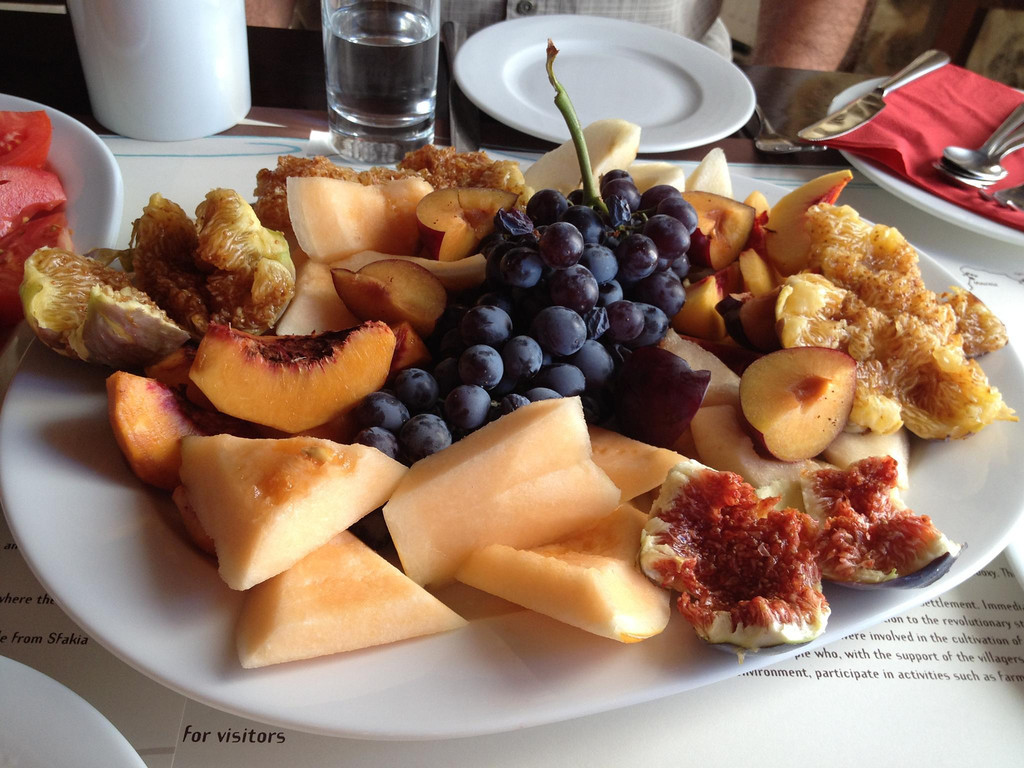
crete fruitsThis spirit of great generosity has long been commented on by travelers in Greece, who often speak of it as unexpected (for them) hospitality to the stranger or traveler. That it is, of course. Through the work of Heidi Goettner-Abendroth, I now understand that the famous Greek hospitality to the stranger has deep roots in matriarchal cultures. According to Goettner-Abendroth, equality of wealth is assured through the widely-practiced custom of gift-giving in matriarchal cultures. Continue reading “IS THE SPIRIT OF GREAT GENEROSITY IN CRETE A SURVIVAL OF ANCIENT MATRIARCHAL VALUES? by Carol P. Christ”

WOMEN ARTISTS AND RITUALISTS IN THE GREAT CAVES: THE BEGINNING OF THE END OF INDOLENT ASSUMPTIONS by Carol P. Christ

carol-christIn an earlier blog, I suggested that women might have blown red ocher around their hands to leave their marks in prehistoric caves.

At the time I thought this was a rather bold suggestion.

Had I been asked why I thought the images were made by women, I might have said that people have understood caves to be the womb of the Great Mother, the Source of All Life, from time immemorial. I might have added that those who performed rituals in the caves cannot have been performing simple “hunting magic,” but must also have been thanking the Source of Life for making life possible for them and for the great beasts they hunted.  Still I am not certain that I imagined women as the artists in the Paleolithic caves.

handprint peche merle cave

In recent days the news wires have been carrying a story titled “First Cave Artists May Have Been Women, New Study Suggests.”   According to retired anthropological archaeologist Dean Snow, the handprints made by Paleolithic ancestors 40,000-20,000 years ago may have been made primarily by women. Snow spent a decade gathering and analyzing photographs of the handprints left in caves. The scientific fact that women’s first and ring fingers are generally of the same length, while men’s ring fingers are generally longer their index fingers, led him to the conclusion that ¾ of the handprints in the caves were made by women! If women were painting their hands on the caves in larger numbers than men, then isn’t likely that they were also painting the images of the great beasts on the walls of the caves? Continue reading “WOMEN ARTISTS AND RITUALISTS IN THE GREAT CAVES: THE BEGINNING OF THE END OF INDOLENT ASSUMPTIONS by Carol P. Christ”

A New Glossary for Crete: The Power of Naming and the Study of History by Carol P. Christ

carol-christThe words we use affect our thinking. In the case of ancient Crete the repetition of the terms “Palace,” “Palace of Knossos,” “King Minos,” “Minoan,” “Priest-King,” and “Prince of the Lilies” shape the way we understand history–even when we ourselves know these terms are incorrect. We must engage in “new naming.”

Ariadne. May have been a name of the Goddess of pre-patriarchal Crete. The ending “ne” signifies that Ariadne is not of Greek or Indo-European origin and thus predates the later Greek myths.

Ariadnian. The name I have given to the Old European pre-patriarchal culture of Crete, from arrival of the Neolithic settlers from Anatolia c.7000 BCE to the Mycenaean invasion c.1450 BCE. Arthur Evans named the Bronze Age (c.3000-1450 BCE) culture of Crete “Minoan” after King Minos of Greek mythology, son of Zeus and Europa, husband of Pasiphae, father of Ariadne, whose gift of the secret of the labyrinth to Theseus led to the downfall of her culture. Evans assumed that Minoan Crete was ruled by a King.

This image I call “Ariadne Dancing” could become the new “icon” of Ariadnian Crete.

minoan woman dancing

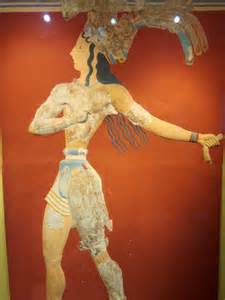
It could and should replace the “icon” of  the “Priest-King” Arthur Evans’ “imaginatively” reconstructed and named the “Prince of the Lilies.”

 prince of the lilies

Once we remove the crown which probably belonged to a Sphinx, the figure’s white color and athletic body suggests it was intended to portray a young female bull-leaper leading a bull. Continue reading “A New Glossary for Crete: The Power of Naming and the Study of History by Carol P. Christ”

Earth Connection & Healing the Bees by Jassy Watson

Jassy_Agora1-150x150

I’m an avid gardener. I must, need, long to have my hands in the soil. The sweet smell and feel of the earth connects me to something greater, to a sense of ‘other’; a source divine. I am interwoven, connected, at one and in reverence of a greater mystery.  When I think about my connection to the earth and its origins, I find it is a connection I have had my entire life. As a young girl I spent many hours, days, in fact years, exploring the Australian bush – it was my backyard. Some of my most prominent memories are the smell of Eucalypt and the crescendo of cicada song that would permeate my entire surroundings throughout summer. As a teen, time and time again, I bushwalked our families property that backed onto mountainous National forest. I often sensed the indigenous ancestral spirits of our land watching attentively.

It is this deep connection that I have to the earth that not only leaves me feeling exultant, it leaves me troubled. I am troubled by the continuing problems caused to the environment. I admit to feeling quite disturbed recently when I read a number of reports about the persisting problems with the Fukushima Nuclear plant – radiated water still leaking into the ocean. Birdlife and ocean animals found suffering from radiation burns. Should we even be eating fish from the pacific? I can’t begin to fathom the enormity of the repercussions from this disaster that will be seen for many generations to come. My inner activist wants to be out there on the frontline, riding the waves on the Rainbow Warrior, tied to an ancient tree in protest of lopping; but I know my place is here, nurturing my little ones. So what can I do with these troubled feelings, with the frustration and with the love I have for Mother earth and all her beings? Action starts from home. So I let it fuel my fire and I get creative. I paint, I write, I garden; with intention. My intention is to play a role, no matter how small, that aids in the healing of the planet. I hold hope that it inspires other to do the same. Continue reading “Earth Connection & Healing the Bees by Jassy Watson”

Hidden Meanings in the Rituals of the Assumption by Carol P. Christ

carol-christ“[T]he Old European sacred images and symbols were never totally uprooted; these persistent features in human history were too deeply implanted in the psyche.  They could have disappeared only with the total extermination of the female population.” Marija Gimbutas, The Language of the Goddess, 318.

August 15 is known to Greek Christians as the date of the Koimisi, “Falling Asleep” or Dormition of the Panagia, She Who Is All Holy.  December 25 is a minor holiday in the Orthodox tradition, while Easter and August 15 are major festivals.  The mysteries of Easter and August 15 concern the relation of life and death.  In Orthodox theology, both Easter and August 15 teach that death is overcome:  Jesus dies and is resurrected; Mary falls asleep and is assumed into heaven.  These mysteries contain the promise that death is not the final end of human life.  Yet this may not be the meaning of the rituals for many of those who participate in them.

In Christus Victor, Gustaf Aulen argued that Eastern (Orthodox) and Western (Catholic and Protestant) traditions understood salvation differently.  The Western Church focuses on salvation from sin, while the Eastern Church focuses on transcending death.  This contrast is not absolute, as for the Western Church sin is the cause of death and when sin is overcome, immortal life is restored.  While Orthodoxy has strong ascetic and monastic traditions, it does not teach ordinary Christians to focus on sexual purity and impurity as Western traditions have done.  Nor is there a strong emphasis on transforming collective sin in movements for social justice.  Significantly, though Roman Catholics and others consistently refer to the “Virgin Mary,” Orthodox Christians prefer “Panagia,” She Who Is All Holy.

In Greece the ordinary rhythms of life are disrupted at Easter and in August.  During lent, many women (and some men) fast, while in August women named Mary and Panagiota–as well as others who wish to honor or petition the Panagia–wear black for two weeks.
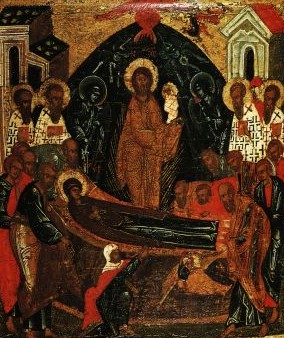
Assumption1Throughout the first 2 weeks of August, Greek Christians focus on the death of the Panagia.  According to theology, her Son appears after her death and “assumes” her into heaven.  The Orthodox icon depicts Mary surrounded by the Apostles, while Jesus holds the assumed body of Mary depicted as an infant wrapped in swadling clothes.

When she first saw this icon, my friend Naomi Goldenberg commented that it is an example of the widespread attempt on the part of men to appropriate the power to give birth.  The icon reverses the symbolism of the nativity where the baby wrapped in swadling clothes is held in the hands of his mother.  Christian baptism described as re-birth through the Father, Son, and Holy Spirit is another version of “male birth.” Continue reading “Hidden Meanings in the Rituals of the Assumption by Carol P. Christ”