From the Archives: Fireless Altars and Crone Encounters By Barbara Ardinger

This was originally posted on Nov 10, 2021

We’ve just entered November, the beginning of winter, the season of darkness. Twenty-odd years ago, I led a group of students through the Wheel of the Year in a class I called Practicing the Presence of the Goddess. (I also wrote a book with the same title.

At Imbolc (February 1), we held a divination party at Louise’s house. At Beltane (May 1), we met at Rose’s house, painted our faces, created wreaths of fresh flowers to embody our summer wishes, and then carried our wreaths of flowers through the streets of Huntington Beach to the ocean, where we cast them into the tide. At Lammas (August 1), we harvested our gardens and cooked a feast in my kitchen.

Continue reading “From the Archives: Fireless Altars and Crone Encounters By Barbara Ardinger”


Hospicing Hope Continued by Sara Wright

Part 2, You can read last week’s post here.

Lucy relaxing

Walking over to Hope’s gravestone early the next morning, I immediately noted the passionflower was still open. Very Unusual. But then, crucifixion and abandonment by someone this dog loved characterized the last two months of Hope’s life, the dark side  associated with the mysterious power that permeates this wild vine and flower. When this passionflower started blooming profusely in the house months before ki’s time, I felt the threat looming…

A few minutes later after the sun cast her fire over the hillside where Hope’s body lay, masses of golden swallowtails dipped and soared around her grave. Oh, that’s when I felt Hope surrounding us with love. I am well she told me and flying with the butterflies as you can see…

 The earth moved beneath my feet.

  One month later swallowtails continue to fly around Hope’s grave.

Continue reading “Hospicing Hope Continued by Sara Wright”

Hospicing Hope by Sara Wright

9/30/2012 – 6/11/2025

  6/12

Part One

Hope in March 2025

Hope’s black eyes pierced my soul- body as she stood staring through me, ears erect. It was time. Are you sure? Yes. She lay back down. I immediately got up.

 Walking helps me to process what I must do. A half an hour later I called.

A numbing drive, walking into a room lit with three candles, and a brief wait before the two kindly women appeared.

Hope washed my tearful face as I held her, reminding me that we would never be separated. For thirteen years she had showered me with kisses beginning each day and again at night before we slept. A long low sigh, before Hope took her last breath. Her body suddenly felt limp, heavy in my arms. I didn’t need anyone to tell me that her heaped up overflowing heart had ceased to beat.

  Lucy, her twelve year old adopted sister peered anxiously at me as I looked down at her, eyes perplexed. Seconds later Lucy’s pencil thin tail went limp as the knowing seeped in. As usual we conversed beneath words.

A blurry drive home.

Continue reading “Hospicing Hope by Sara Wright”

Legacy of Carol P. Christ: What Was Your Childhood Religious Tradition And Do You Still Follow It?

This post was originally published on Nov. 26th, 2012

Recently, in an interview with the Women’s Living History Project of Claremont Graduate University, I was asked: What religious tradition did you identify with as a child and how did it impact your childhood? and: Is your tradition the same today that you had when growing up?

I was surprised that the interview questions didn’t ask anything about feminism, experiencing exclusion in patriarchal religions, or belief.  My religious and political convictions, which are intertwined, have alienated me from family members.  Therefore, I was suspicious of questions that seemed to have been formulated by someone for whom religion and family go together, and for whom believing or not believing (!) did not seem to be an important issue.

After expressing criticism of the questions, I agreed to work with them.  My answer to the first question was that I did not have a single religious tradition as a child. I had four.  Continue reading “Legacy of Carol P. Christ: What Was Your Childhood Religious Tradition And Do You Still Follow It?”

Pedukei: A Complex Interplay of Human, Divine, and Nature.


The Torah portion for March 29, 2025 was Pekudei.  Quite often this parshah is read with Vayakhel.  In fact, I have written about the double parshah Vayakhel-Pekudei before, but focused on only Vayakhel.  Now, it is Pekudei’s turn.  

Like parshot Vayakhel and Terumah as well as other parts of the book of Exodus, Pekudei focuses on haMishkan, the Tent of Meeting or Tabernacle.  We read about calculations concerning the costs of the constructions, instructions for the high priest’s garb, ritual washing of hands and feet, when to construct and when to deconstruct the traveling tent, and the divine presence as cloud and fire.  In Pekudei, we have no mention of women and no mention of any Israelite men barring the religious elite: Moses, Aaron, and Aaron’s sons.  Therefore, in this commentary, I want to discuss contradictions in the text that speak to (1) a consistent divine presence that seems to argue against animal sacrifices and (2) the ways in which the natural world and Israelite religion went hand-in-hand.

Continue reading “Pedukei: A Complex Interplay of Human, Divine, and Nature.”

On Terumah: (Eco)Feminist Reflections on the Tent of Meeting.

The Torah portion for March 1, 2025 is Terumah, consisting of Exodus 25:1-27:19. Terumah in Hebrew means contribution, and the parshah begins with the deity requesting donations from the willing hearts of men (yes, only men) of precious metals and stones as well as dyes, linens, wools, and skins.  Terumah then provides the instructions for how to build the Tent of Meeting and all of its components.  In this post, I want to focus on four aspects of the post from the perspective of ecofeminism and feminism: beauty; the misuse of nature, the concept of home, and the indwelling or immanence of the divine.

Continue reading “On Terumah: (Eco)Feminist Reflections on the Tent of Meeting.”

The Grandfathers, part 2 by Sara Wright

Yesterday’s post which you can read here, ended with this line from the Grandfather, “The young people will become confused and when all is finally lost then the Creator will return to restore not just the Tewa but all tribal peoples to the land.”

I experienced wild hope surfacing… I had heard words to this effect before but assumed that the people needed that story to go on. Suddenly I wasn’t so sure… something about the way this man talked to me made me believe him. He exuded a complex sense of deep humility, knowledge and authority. I thought about the ravages of Climate Change and the disgusting cross-cultural belief that the Earth’s job was to serve humanity. My rational brain went on overload giving me a thousand reasons why what he predicted couldn’t be true, almost as if it needed to win this round (ah, Patriarchy exposes itself – if you don’t win you lose). Yes, it was true that we were in a state of breakdown… he didn’t deny it but he also made it clear that this was not the end. First we had to survive the breakdown, and living through it is a challenge that some like me live with every day. These are dark times.

Continue reading “The Grandfathers, part 2 by Sara Wright”

From the Archives: Tree of Life: The Festival of the Trees in an Age of Treefall by Jill Hammer

This was originally posted on January 22, 2019

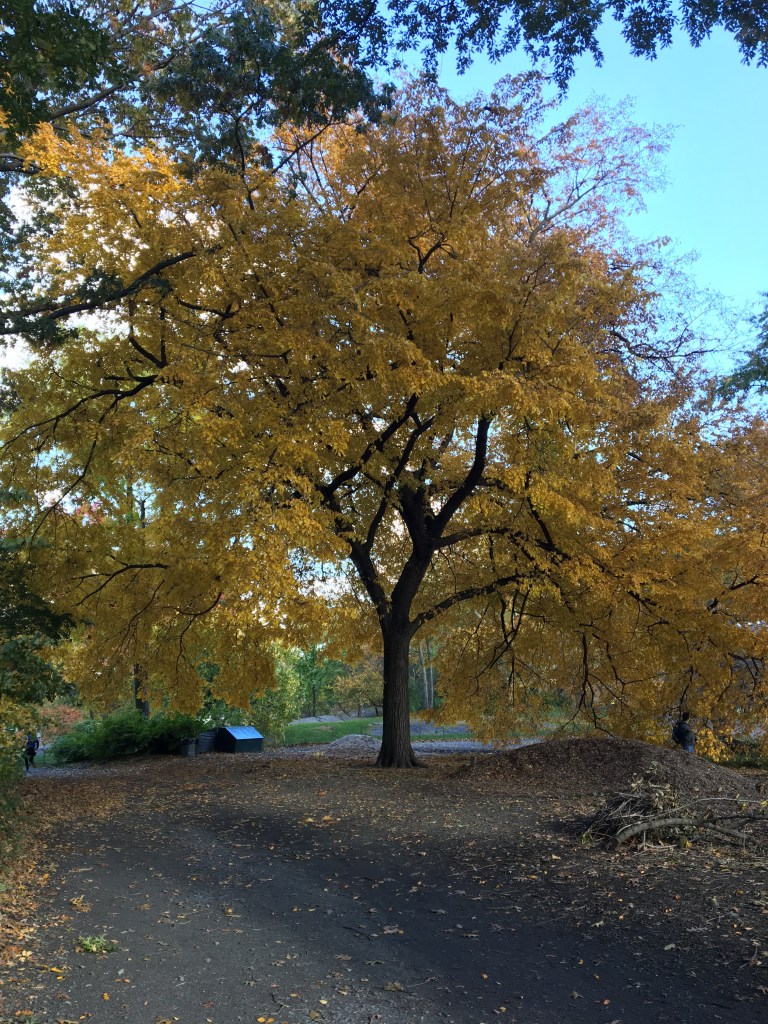
Almost every day, I walk in Central Park.  There are certain trees there I’ve come to know: the gnarled cherry trees by the reservoir, the bending willows and tall bald cypress by the pond, the sycamores that drop their bark each summer, the hawthorn not far from Central Park West.  Lately I’ve been taking photos of the trees to try to capture their essence, their posture in the world.  The trees around me feel like friends, which is what an ancient midrash (interpretation/legend) called Genesis Rabbah says about trees: that they are friends to humankind.  To me, they’ve always been a central manifestation of Mother Earth.

Currently, the national parks in the United States have no staff because of the government shutdown. Some people have taken the opportunity to cut down the rare and endangered Joshua trees in the Joshua Tree National Park—just for fun, I guess, or as a trophy of some kind.  Meanwhile, President Bolsonaro of Brazil recently has indicted that he wants to remove protection for the rainforest, in order to allow development.  It appears that my friends the trees have enemies.  Sometimes the enmity is for personal/corporate gain, and sometimes the enmity seems to have no reason at all.

Continue reading “From the Archives: Tree of Life: The Festival of the Trees in an Age of Treefall by Jill Hammer”

The Story of Changing Woman, part 2 by Sara Wright

Part 1 was posted December 7th. You can read it here.

Commentary:

I love this story because it demonstrates the evolutionary and eternal nature of Woman; her intimate relationship to Nature, her ability to give birth, to mother, to let go, her ability to endure, her need for animals and plants as companions and her willingness to stand her ground until she is able to get what she needs. Changing Woman matures from a passive figure who is acted upon by the forces of Nature into a self-directed female power who knows what she wants, and one who finds peace in choosing relationships with animals, plants and humans on her own terms.

Initially, Changing Woman is impregnated by the wind – the power of the spirit moving across the land – and not through sexual intercourse. Spirit and the Body of the Earth are the two equally creative aspects involved in her birth. The same holds true for her children, who are male, but conceived and birthed in a similar manner without the need for male insemination (no room for Patriarchy to enter here), suggesting to me that all three are parts of one spiritual/bodily whole that cannot be separated. As creative principles (beyond gender stereotypes) they work together as a triad to rid the world of monsters, to make the Navajo world a safe place, and to secure the matrilineal line. According to Navajo mythology securing the matrilineal line is primarily how Changing Woman saves the world.

Continue reading “The Story of Changing Woman, part 2 by Sara Wright”

Witch Power? part 2 by Sara Wright

You can read part 1 here

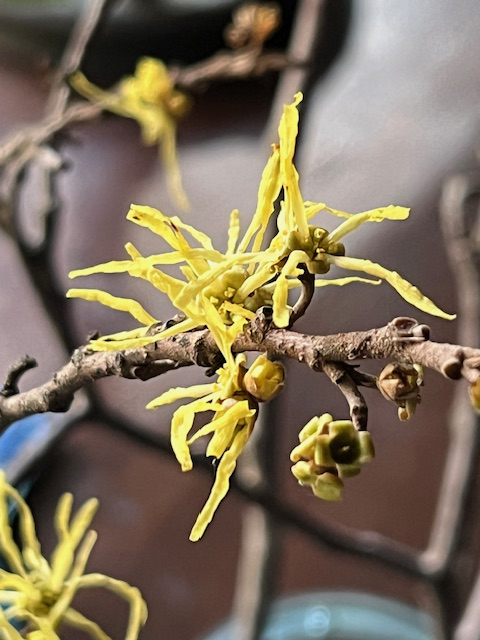
Witch hazel flower

After being nailed as a witch I separated myself from the word and witch power in general. The word witch had a very dark side and could be used in the same frightening manner as it had been during medieval times to label and to expel any woman who lived on the edge (source of my original sense of unease). Especially one who lived alone in the woods and loved animals like I did.

 Why had I been singled out? I was an outsider whose crime was to animate nature. Anything associated with nature was suspect if not ‘evil’.

 Feminists beware. If you claim to be a witch – recall that the word is loaded. Personally, I think the label has backfired reducing our overall power as women. Perhaps making us more suspect than we already are.

Continue reading “Witch Power? part 2 by Sara Wright”