We’ve just entered November, the beginning of winter, the season of darkness. Twenty-odd years ago, I led a group of students through the Wheel of the Year in a class I called Practicing the Presence of the Goddess. (I also wrote a book with the same title.
At Imbolc (February 1), we held a divination party at Louise’s house. At Beltane (May 1), we met at Rose’s house, painted our faces, created wreaths of fresh flowers to embody our summer wishes, and then carried our wreaths of flowers through the streets of Huntington Beach to the ocean, where we cast them into the tide. At Lammas (August 1), we harvested our gardens and cooked a feast in my kitchen.
The wheel of the year is turning us once again toward the dark half of the year. Here in the United States, the bright, shining days of youth and achievement receive the most attention. Death and darkness are rarely honored and often feared.
But the ancient Celts had a completely different view of their place in the world. With a strong belief in reincarnation, the Celts saw death as simply a point of transition in a very long series of lives. People honored the darkness of both night and winter as starting points. In the Celtic worldview a day began at sunset, not sunrise, and the New Year began on Samhain, October 31—the midpoint between Fall Equinox and Winter Solstice.
Samhain, one of the four great fire festivals of Celtic tradition, might have begun long before the Celts arrived in Ireland under the influence of an ancient goddess, Tlachtga (tclak ta). She was most likely from the time of the Fir Bolgs, (fair bolak) the Bronze Age inhabitants of Ireland from the East, and later incorporated into the Celtic pantheon.
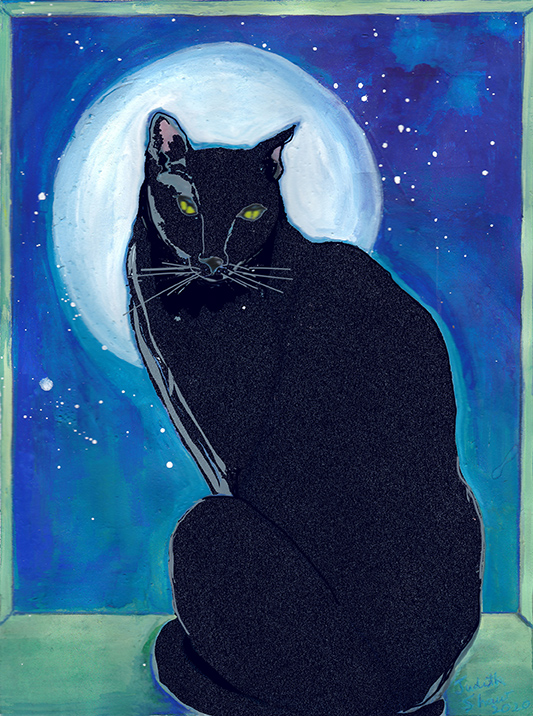
Tlachtga, Celtic Goddess of Sun & Lightning, gouache on paper
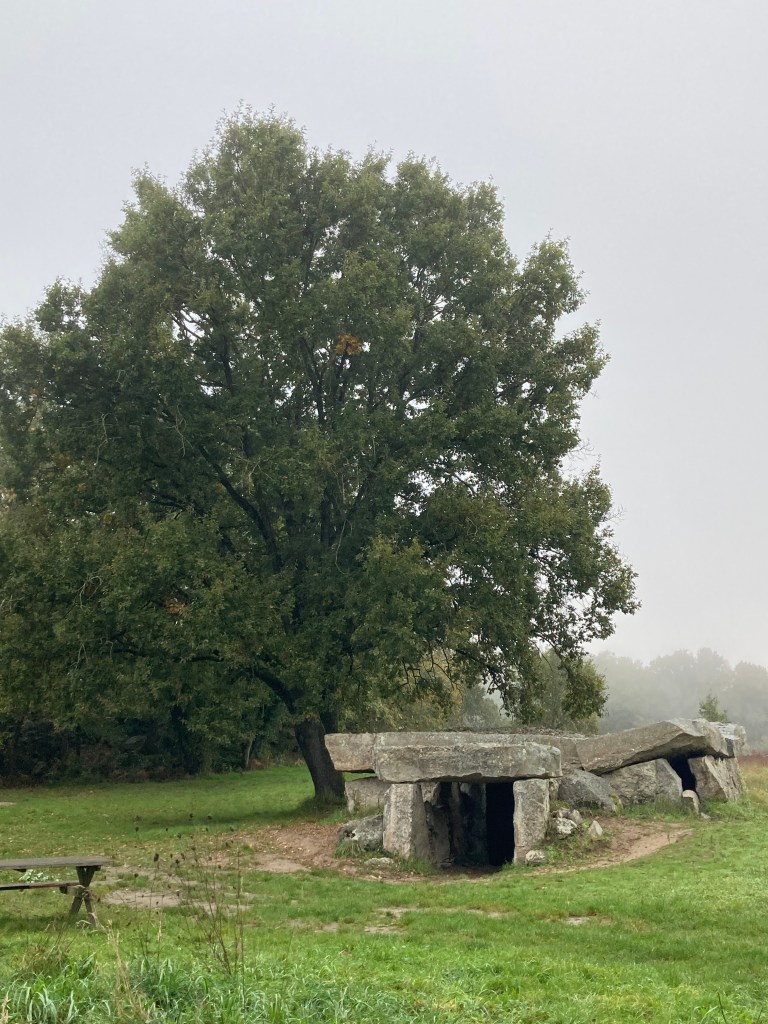
In preparation for my hysterectomy, I decided to spend a night in a dolmen at Samhain last year, to seek guidance and healing. I chose Dolmen de Bajouilière in Saint-Rémy-la-Varenne, in Northern France, a site I had discovered by chance the previous year on my local explorations.
This well-preserved structure, with its spacious square divided into two rooms, felt inviting and safe for an overnight ritual. Though I am accustomed to spending nights in neolithic monuments, mostly in the UK, I felt some hesitation, partly due to my intermediate French and unfamiliarity with the local spirits.
Nevertheless, I recognized this resistance as part of the ego’s fear of the unknown, and I gave myself permission to retreat if needed. If I would feel too vulnerable, it wouldn’t serve my body and spirit ahead of the surgery. Please join me on my overnight Samhain Ceremony full of deep imagery and transformation as I shed my womb three times…
On Samhain we are given the opportunity to come together in community to grieve our losses. We grieve for all those we have known personally who have passed over. But this year we also grieve for all those who lost their lives and homes in Hurricanes Helene and Milton and in the many other disasters around the world. We grieve as well for the other losses that occurred—of homes, of jobs, of community, of pets (many of whom also died or were separated from their owners). The losses are so enormous and overwhelming that we need the support that community provides to cope with them. We need to bind together in the strength of community to express our sorrow. Being aware of the death from so many natural disasters helps us to listen to the earth to see what She is telling us, to hear Her crying because She is weakened and out of balance, breaking apart under the strain.
Feeling the earth’s grief from the hurts inflicted upon Her enables us to take stock of our policies, to change our course while we still can. As we float downstream on our raft, we can ignore what we see around us until we see the rapids ahead and say to ourselves, before we plunge over them, “Why didn’t we change course earlier?”
Moderator’s note: While Samhain is past for this year, we are still in the section of the Celtic calendar which makes this blogpost, and its part 2 which will be posted tomorrow, relevant.
Samhain is an ancient Celtic festival, in fact the most sacred celebration in the Celtic year. Samhain is the New Year of the Celtic calendar. It is one of the eight holidays of the Celtic year—the solstices, equinoxes, and cross-quarter days—all of which mark the turnings of the seasons. Samhain is a time when the harvest had been completed; all the grains and late-maturing vegetables have been gathered in; the fields have been cleared, the old cast off, the fields lying fallow over the cold and dark of winter in order to make room for the eventual springing forth of new life. The New Year, begins in darkness at Samhain, is a reminder that all life emerges from the darkness, that death precedes rebirth. It is a time when the veil between the worlds of the dead and the living thinned, so that the presence of those who have gone before us is more clearly felt or even seen. It is a time to remember the ancestors as well as those newly departed—to grieve our losses, to let go so that we can move forward.
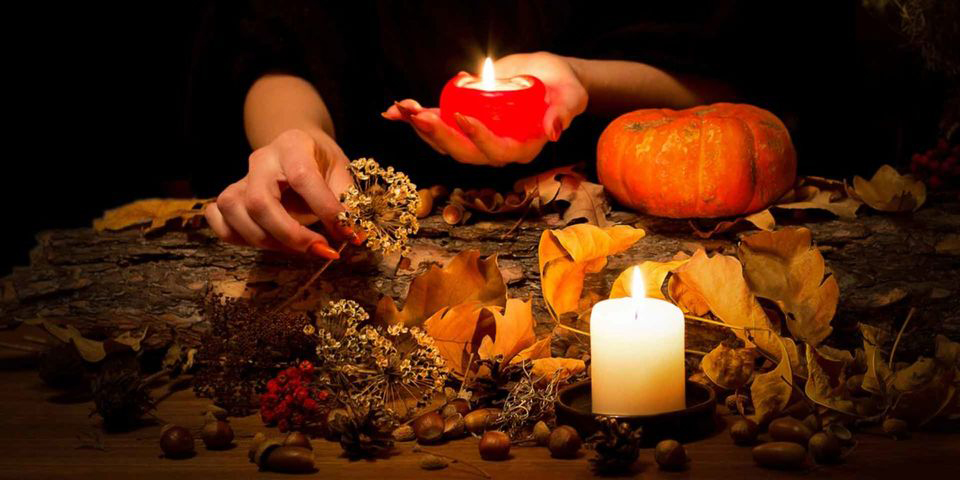
Samhain is the precursor of our Halloween. It was brought to this country by Irish immigrants during the potato famines in the 19th century. They brought their Celtic customs with them, but by that time Samhain was known as Hallows Eve, since the Irish were good Catholics. It struck a responsive chord with the American people, who called it Halloween. They adopted many of its customs, including lighting candles in gourds or pumpkins and dressing in costume. Today Halloween is celebrated as a spooky and fun time, observed with trick-or-treating and mischief-making, but originally it was a solemn holiday—a time to commune with the beloved dead, to honor the ancestors with food and drink, and to acknowledge death as part of a never-ending cycle of birth, death, and rebirth.
Halloween, with its Celtic pagan roots in the sacred day of Samhain, which later morphed into a Christian holiday, is now mainly a nonreligious celebration in Europe and North America. It’s enjoyed by both young and old with scary outdoor decorations, parties, spooky costumes, haunted houses, carved pumpkins, and candy-giving.
“Ritual has the power to end our alienation from the earth and from each other. It allows us to enter a world where we are at home with the trees and the stars and other beings, and even with the carefully hidden and protected parts of ourselves that we sometime contact in dreams or in art.” –Margot Adler
Margot Adler died of cancer on July 28, 2014. A Pagan priestess, she asked for memorial events to be held in the season of Samhain, also known as Halloween. At this time of year, the rituals of many religious traditions remind us that we are all connected, the living, the dead, and those to come, one continuous communion. In this spirit, I offer a tribute to the late Margot Adler.
Samhain, the Witches ‘New Year’ was a busy time for me. I did a workshop at a local large artist facility Lowe Mill Arts in Huntsville, Alabama. I watched and participated in a releasing burning ceremony the next night at the same artist site. There is so much we are needing to release especially with where we are in the world right now.
And then the following night, I was in charge of a Fire Circle at the Witches Ball at Mill Kat Healing Arts Center where I host my weekly circles.
I admit to some trepidation hosting the very public Fire Circle. I live in the deep south of Alabama most definitely not known for its open mindedness. A friend told me that she shared the Witches Ball event on her facebook page and received the comment, ‘that is how they indoctrinate you.’
Oh my.
But we are not in a time to be deterred by fear. I have been called to share this magic. And people need it.
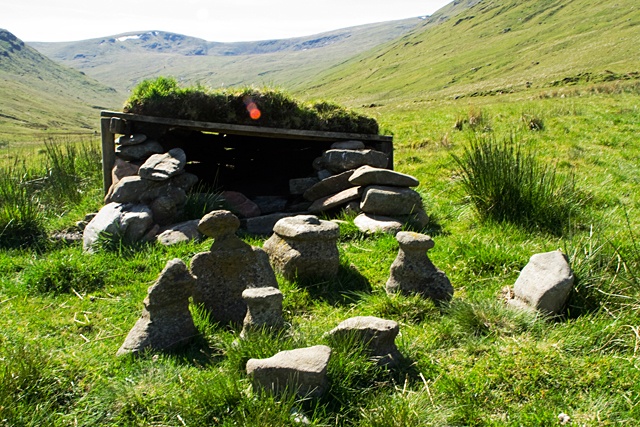
Tigh nan Cailleach, House of the Cailleach, Glen Lyon, Scotland
Samhain is the beginning of winter according to the Celtic calendar. On this day, people brought their livestock in from the pastures and settled by their hearths to survive the coming cold until the magical renewal of spring. Here in New England, leaves are beginning to blaze red-gold, plants to brown as nutrients fill their roots, and animals to nestle underground to hibernate. Across the northern hemisphere, we should once again begin our own retreat below the the busyness of our lives to re-energize and plan for the fruition of spring works.
I’ve usually thought of winter as a time of withdrawal from other beings and the world, but maybe Celtic tradition offers us a more nuanced way of perceiving this season. A wonderful Scottish Samhain story has made me rethink of winter as a time to also reconnect and re-vitalize each other and chart our course to spring’s promise together. I cannot say what the story means to those from whose land it emerged, but I can share the thoughts it evokes in me. Settle in, get comfy, and listen…
We’ve just entered November, the beginning of winter, the season of darkness. Twenty-odd years ago, I led a group of students through the Wheel of the Year in a class I called Practicing the Presence of the Goddess. (I also wrote a book with the same title.



 Feminism and Religion