Winter Solstice Drama by Sara Wright

Last year I attended a bonfire on the night of the winter solstice at a friend’s house. As my companion and I walked towards the ledge where the fire had been the year before we were both astonished. Where was everybody? We stood in the dark confused. Minutes passed.

After suggesting we leave, my companion remarked with annoyance, “What the hell is going on here?” A Rhetorical question. I sure didn’t know.

Sudden hooting split the night and some dissonant musical sounds seemed to be coming from out of the bushes below us.

Following the sounds we descended the steep hill and discovered that the fire was at the river’s edge, and that a few people were already gathered there.

Unbeknownst to either of us the location had changed, and from our vantage point on the hill we couldn’t see the fire or hear any sounds. I had been looking forward to this celebratory turning, and liked the idea of sharing it with friends. Yet, now I felt uneasy.

Continue reading “Winter Solstice Drama by Sara Wright”

Becoming Scrub by Sara Wright

In the precious hour before dawn I walk down to a river that no longer empties into the sea – the circle of life has been broken – the earth’s veins and arteries are hopelessly clogged by human interference (stupidity) – the birds and animals that used to be able to rely on the river waters for food and resting places can no longer do so because dams control the water flow and westerners “own” the water. This morning black stone sculptures appeared overnight because the water level has been dropped another foot. And yet, acknowledging the flowing waters in their death throws seems like an important thing to do. For now, at least, the river turns crimson, reflecting the raging beauty of a pre dawn sky, and I am soothed by water rippling quietly over round stone.

I open the rusty gate to enter the Bosque, a place of refuge, for the cottonwoods and for me. Now I am surrounded by desert scrub and graceful matriarchs arc over my head. As I traverse the well  – trodden path I enter a meditative state without effort. Soon I am walking in circle after circle passing through the same trees and desert scrub hearing voices.

Continue reading “Becoming Scrub by Sara Wright”

Navajo Night Chant and the Sacred Dark by Sara Wright

With Winter Moon’s passage and the approach of the winter solstice just a little less than a week away I am much aware of the (potential healing) dwelling place that I inhabit that also characterizes these dark months of the year.

Unfortunately, even those who acknowledge our seasonal turnings rarely honor the dark as sacred. At the winter solstice the emphasis is still on light.

As Carol Christ writes so succinctly we manage to celebrate light at both solstices – at its apex and at its return.

This attitude reveals to me an inability to be present to dark, in both its generative and non-generative aspects. The original inhabitants of this country honored the dark months of the year very differently than westerners do. Their most important ceremonies occurred during the winter months. Both aspects of the dark were acknowledged and explicated through ceremony. What follows is a history of one of the Navajo healing ceremonies that occur only during the winter months of the year. Continue reading “Navajo Night Chant and the Sacred Dark by Sara Wright”

 The Circle of Life and Death by Sara Wright

This morning the sky was on fire before dawn even as I approached the river whose ripples reflected a purple so deep it was almost inked in charcoal – In the Bosque I noticed that one mule deer had used a juniper to scrape his antlers. Otherwise the Earth emanated precious predawn stillness except for the sound of receding river waters slipping over cobbled stones. It was mild; I thought today might be the day…
The greens I had tipped in prayer and gratitude on ‘the mountain where bears live’ were waiting to be woven into wreaths, and by afternoon the temperature was warm enough for me to sit on the porch under a milky December sun with my clippers and bag of greens. 

The sweet scent of pinion wafted through the air as I began to weave my circle of life with pinion, fir, and spruce. I wove carefully cutting smaller fronds without thinking about what I was doing, but beneath my quiet mind an intention was being set to weave a new kind of wholeness back into the trees, back into our broken Earth; S/he who is crying out to be heard through each raging fire, crackling drought, mud ridden flood. My greatest fear is that no one is listening. 

My intention is that I will listen; I will be present for the trees. Continue reading ” The Circle of Life and Death by Sara Wright”

The Feast of Santo Tomas by Sara Wright

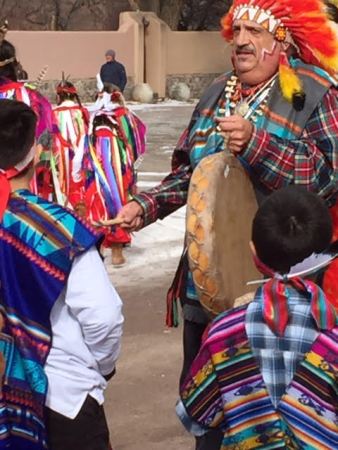
This morning I went up to the village plaza in Abiquiu to watch the dancers parade around the church with their saint who is also honored at this village festival held every year at the end of November.

This is one of the two Native American festivals that is honored each year by the genizaros who are mixed Spanish and American Indian people who embrace and practice the Catholicism that was once forced upon them.

This eclectic community is made up of descendants of Native American slaves. Those captured in warfare were brought here, converted to Catholicism, taught Spanish and held in servitude by New Mexican families. The young women and female children endured the usual atrocities perpetuated on captive females including rape at the hands of their captors. Some New Mexican male genizaros gained their freedom by serving as soldiers to defend frontier villages like Abiquiu from Indian raids. By the late 1700s, genizaros comprised one-third of the population of New Mexico. Ultimately these non – tribal peoples were assimilated into New Mexican culture.

The dances are beautiful to witness with the smallest female children dressed in predominantly white regalia some wearing a rainbow of ribbons, the young girls were dressed in red and white and had red circles of war paint inscribed on their cheeks, some of the older women also wore red, many carried turkey or eagle feathers in their hands. Most wore face paint.

Continue reading “The Feast of Santo Tomas by Sara Wright”

The Pomegranate by Sara Wright

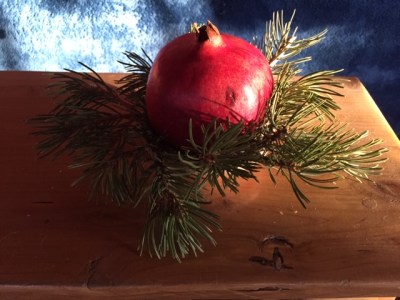
It is mid November and shiny crimson Pomegranates catch the discerning eye in food markets; even Walmart carries them!

Why do these beautiful and very ancient fruits appear during this dark time of the year?

One answer to this question is that in the northern hemisphere the fruit of this deciduous shrub ripens anywhere from September to February. The reverse is true in the southern hemisphere when the fruits ripen during March, April and May. It is important to remember that in the southern hemisphere the seasons are reversed, so in both northern and southern parts of the globe these fruits appear in the fall, during the darkest months of the year.

Pomegranates are native from Iran to northern India and have been cultivated throughout the Middle East, Asia and the Mediterranean region for millennia. (Today they are also grown in California and Arizona, so they no longer need to be imported). The shrub was domesticated as early as the 5th millennium BC. Pomegranates were the first trees to be domesticated in the Mediterranean.

Continue reading “The Pomegranate by Sara Wright”

 Persephone Rises by Sara Wright

While researching Minoan Crete I learned that each autumn young girls once gathered blue violet saffron crocus to leave as an offering for the Wild Crocus Goddess as they prepared for adolescent female initiation rites. I was intrigued by the reference to autumn because I associate flowers more with spring than any other season. From other sources I discovered that in Minoan Crete young girls also gathered bright yellow crocus to celebrate the Great Goddess and the return of the growing season and that yellow was the color associated with the Great Goddess because of the golden color of the dye made from the precious saffron crocus. Later in Greece during the Lesser Mysteries, flowers, especially yellow crocus were also picked to celebrate Persephone’s return from the Underworld. I was particularly delighted by the reference to Persephone picking bright yellow crocus because my relationship with this goddess has been a somber one; I have always associated her with death. And yellow is a joyous color that I associate with early spring.

 I felt a wild sense of hope as a volcanic fire erupted inside me when I first imagined Persephone picking spring flowers because of my uncomfortable relationship with this mythical figure and also because I love flowers. Continue reading ” Persephone Rises by Sara Wright”

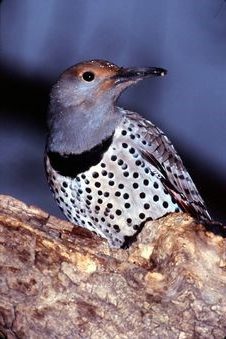
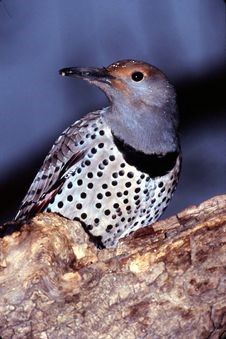
Firebird’s Song by Sara Wright

In response to Carol Christ’s latest post

She came on the wings of the Owl
flew out of the crack of our imagining,
swooped low over the underground forest
hooing, hooing, hooing
screeching and clacking –
Haunting the night with her song.

I almost didn’t recognize her
inside the feathery brown cape with bars.

On Starry nights while the white moon sleeps
the cloak falls away and behold!
She steps out
in all her Firebird splendor.
Burning, crimson, gold, she crackles — turns blue
white light torching
the fire turned star.
Beaming second sight
she rises out of Earthen ashes Continue reading “Firebird’s Song by Sara Wright”

Mother – Daughter Betrayal by Sara Wright

(1)

Today is my mother’s birthday and although she has been dead for more than a decade I still think of her almost every day. At the time of her death I had not seen her for twelve years. Not by choice. After my father’s sudden demise my mother chose my children, her two adult grandsons to be her protectors, and dismissed me from her life, permanently.

When she died, my mother divided her assets evenly between my children and me, forcing her only daughter to live beneath the poverty level for the remainder of her life.

The final betrayal.

At the time of her death I was teaching Women’s Studies at the University.

Continue reading “Mother – Daughter Betrayal by Sara Wright”

The Man with the Hat by Sara Wright

I met a man on a rumbling train who had hooks in his hat.

A fisherman, I thought with the usual dismay – brutal images of dying fish gasping for air exploded in thin air. Memories of my grandmother who took her eight year old granddaughter fly fishing also flooded my mind (my grandmother was a professional fly fisherwoman). I caught my first fish in the brook – a six inch trout. After landing the desperate creature my grandmother said, “ now we must kill it so the fish does not suffer.” And she looked for a stone.

“Hit it over the head” she instructed handing me a rock she picked up nearby, and I did.  Tears welled up. It broke my child’s heart to murder such a shimmering rainbowed creature.

When we got home that day, my grandmother praised me lavishly for my catch, promptly gutted the fish and fried it in a pan for me to eat. I forgot the anguish I had experienced, basking in my grandmother’s approval. The fish tasted delicious, and to this day I eat fish and other seafood.

As a lobsterman’s wife I learned quickly how to cook crustaceans by sticking their heads in boiling water so they would die almost instantly.

Continue reading “The Man with the Hat by Sara Wright”