Goddess Prominence & Nature Participation through time
Today I reflect on the presence or absence of the goddess in religion and society, and how we view humanity and participate in nature as a result.
This post is inspired by “The Myth of the Goddess. Evolution of an Image” by Anne Baring and Jules Cashford, and especially by its final chapter “The Sacred Marriage of Goddess and God: the Reunion of Nature and Spirit.” This dance of integration of apparent opposites is essential to my work.
When you hear the word ‘soul’, what is your first association?
Soul is a complex and much-debated word, that often brings up strong feelings. Without going into religious or philosophical discourse, it is often associated with the breath, and with that mysterious spark of life force that animates the body. I discussed soul in a previous post Untangling the Triad of Life Force, Spirit and Soul. Today I write about soul as a fluid concept, an essence that can get dispersed and also retrieved, and propose a light self-retrieval through dance as remedy that you can do by yourself.
The process of fitting in and learning what is required to participate in society teaches us many useful skills such as math and language. All too often, this happens at the expense of developing expressive and intuitive abilities and trust in our unique contributions and points of view, or what I call the ‘Wild Soul’. This represents our original blueprint or essential spark that makes us into who we are.
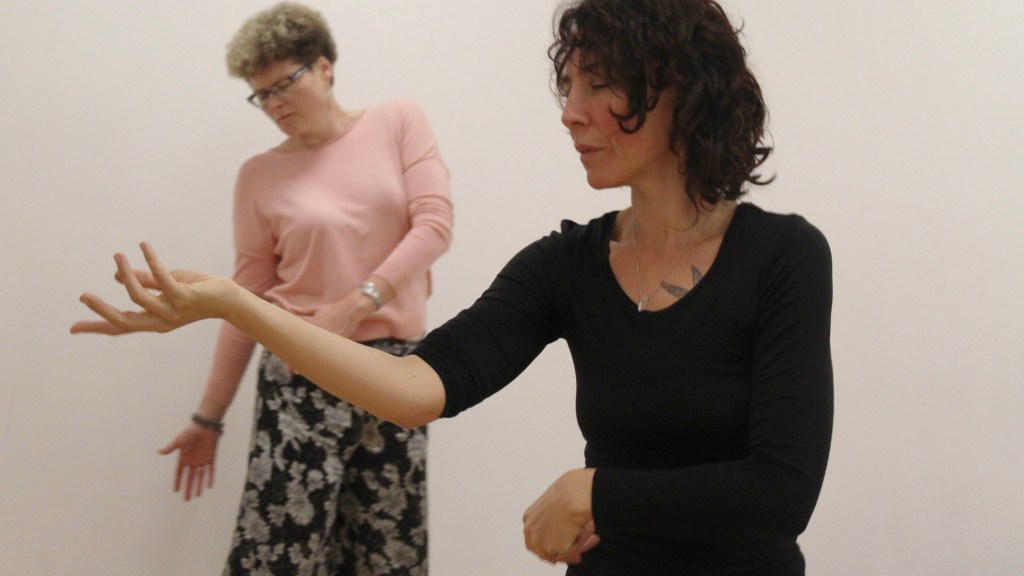
Calling Home at the Sealskin Soulskin Workshop 2018. Image Credit Justyna Skowronek
Most cultures recognize an animating ‘life force energy’, such as chi, qi, ki, kundalini, n/um, ruach, prana and mana. Life force is very closely related to ‘soul’, and often indicates vitality, original nature, instinct, intuition or inner compass. Another term is ‘spirit’, and I must say, it confused me for a long time how they are related, and how they are different. In this article I explain how I understand the nuances between these terms.
Shamanic paradigms consider ‘spirit’ as the animating life force both in our bodies and in the animist world around us. In Traditional Chinese Medicine, this concept is called ‘Qi’, or life force energy. This can be affected by ongoing stress or other health concerns that sap our vitality, but while we live it’s always there.
‘Soul’, in shamanic views, refers to an original essence that makes us who we are. This metaphysical part of us is in direct relationship with the sublime. The soul “continues beyond death and into eternity and into infinity. We could literally say that our soul has a body, much more than saying that our body has a soul” (Villoldo, 2018). This soul essence can be damaged: parts of it can ‘leave’ following traumatic events.
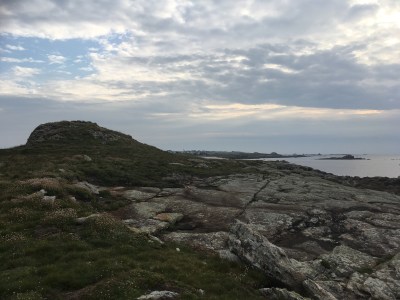
As I hang the laundry back home, I remember how just 24 hours earlier I arrived back on the beach after an incredible time at the ancestral burial mound where I spend the night in ceremony at the Autumn Equinox.
Ile Carn is a neolithic passage grave on a small tidal island in Finisterre, Brittany. I had visited there the summer before, and found that the other world was strongly accessible. When places become very touristy, like Stonehenge or Mont St. Michel, it sometimes appears as if the spirits retreat and the potency of the place thins. I asked them then if I could come back for ceremony, and when the answer was yes, I promised to return.
So here I was, on the Autumn Equinox, or Mabon. This is a time of balance, when the days and nights are equally long. A time in which the harvest has been gathered and we can start to prepare for a time of gestation and growing in the dark womb of winter, before the light is reborn again next year. My personal aim was three fold: I wanted to celebrate this year, especially to give thanks for my life, which had been on a precarious knife-edge earlier in May. I also wanted to ask for guidance for both my budding business and for my academic work in terms of re-discovering our own indigeneity in the west.
Pay attention to your footfalls, make sure you are landing correctly, breathe and count…
Breathe in deep… fill your lungs… and breathe out the stress and the heaviness.
Over the last few weeks I have been trying to get back into running. A few years ago I discovered that I loved running. I loved being alone with my thoughts, focusing only on how my feet hit the ground and continuing to breathe as I ran far more consecutive miles than I ever would have imagined possible. I even ran a half marathon, which I never would have believed I would be capable of… but, somehow, I was… and actually it wasn’t too bad, I looked forward to doing it again and even started to day dream of the possibility of one day running a full marathon.
In the typical day to day busy-ness of life I hadn’t been able to run much last fall and then this winter I took a bad fall on the ice that left me barely able to hobble along at a walk let alone run any distance. After many months of physical therapy and (mostly) sticking to my stretching and strengthening routine, I finally decided I was brave enough (and trusted my knee enough) to try and get back into my running groove.
I attended a service at Congregation Shalom in Chelmsford, MA two Fridays ago. During the service, Rabbi Shoshana Perry spent a few minutes addressing the last word of a Hebrew prayer found in the Reform siddur, Mishkan T’filah. It was translated in the siddur as “God rested” but the Hebrew word used was vayinafash, which comes from the word nefesh, or soul. The prayer emphasizes on the seventh day that God did not rest as much as God took time out to re-soul. Rabbi Perry believes that our Shabbat should be spent doing things that help us also re-soul.
Initially, I spent quite a long time considering why God would need to re-soul and what exactly God would do to re-soul. When I realized the futility of trying to sort that out, I moved a little closer to home: what do I do on Shabbat to re-soul? I was quite overwhelmed trying to answer this question as well.
Traditionally, Shabbat is about study, rest, prayer and family among other things. In fact, many Jews avoid creative processes like writing, cooking, painting, driving and working because God rested from creative work on the seventh day. (Incidentally, our creativity is also how we are considered to be made in the image of God). Part of the reason this idea struck me so deeply is because I often find painting, cooking and writing rejuvenating. Continue reading “RE-SOULING ON SHABBAT BY IVY HELMAN”



 Feminism and Religion