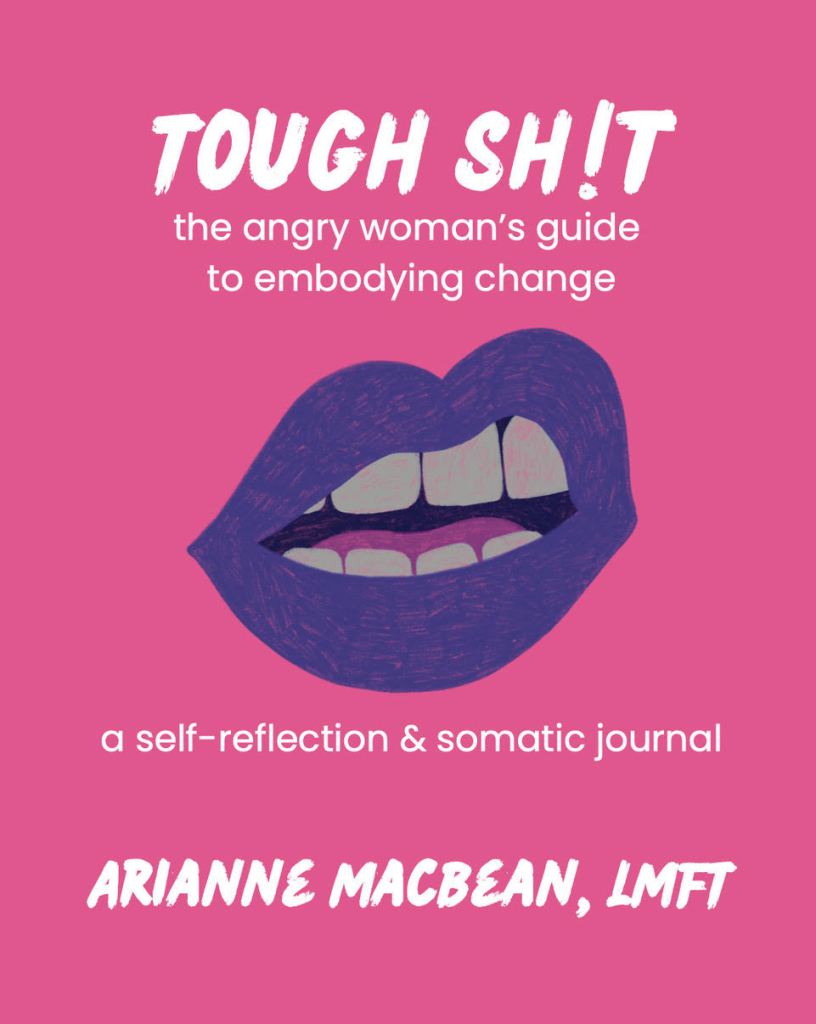
tough shit – a few words by Arianne MacBean

Cover Design by Kathleen Henrion

Before I knew what form my self-reflection and somatic journal for women would take, I knew what its title had to be. Through my work as a somatic psychotherapist, I understand how repressed anger, fear, sadness and hurt affects the psyche and the body. At best, suppressed emotional pain can show up as sensations that limit pleasure in daily life. At worst, unprocessed trauma can lead to chronic and debilitating illness. I wanted to create a journal that was not only anti-oppressive but also subverted the misnomer that divisive feelings are negative and should be stifled. Mostly, I wanted to expose how emotional censorship has its roots in its chief proponent: patriarchy.

Tough Shit. – the angry woman’s guide to embodying change is a journal that supports consciously tracing difficult feelings to understand one’s true self and make positive change. The title isn’t about being provocative or crass. I chose it because the phrase “tough shit” has a long history related to gender stereotyping and dominance—all of which my journal actively challenges. But the phrase is not just cultural; it’s personal. An iteration of this phrase was used against me growing up. As the concept of the journal became clearer, I felt my body insist on throwing “tough shit” back out, not as a degrading echo, but as a reclamation—a fierce refusal to silence valid emotional pain.

Continue reading “tough shit – a few words by Arianne MacBean”

Devi* Has a Sense of Humour by Terry Folks

photo credit: Sonika Agarwal

(*Devi is the feminine principle in Hinduism, the goddess counterpart to Deva, the male aspect.)

I live alone.

I put a small stool on the bathroom floor beside a kitchen chair next to the vanity counter top. My plan was to step on the stool then up on to the chair, then up on to the counter so I could stand and put a hook in the ceiling.

When I finished, I carefully turned around to make my way back down from counter to the chair. As I was stepping down, I felt unstable so I instinctively reached for the towel bar on the wall. The towel bar gave way and I fell directly left side down on to the high back of the chair, bringing the chair down to the floor with me beside the empty stool.

Continue reading “Devi* Has a Sense of Humour by Terry Folks”

CrossFit, Spirituality, and Trauma: An Introduction by Stephanie Arel with Ashleigh Gibb

We met online. Saram College hosted a theology and trauma workshop that Stephanie taught. Ashleigh asked a question. An immediate connection emerged.

The connection consists of mutual interest and passion around bodies, their strength, their vulnerability; around the spirit, its expressions and its intrinsic materiality; and trauma, what violations to our bodies cause to disrupt and annihilate us. Our interests intersect. Stephanie teaches Scripture and the Human Response to Trauma at Fordham; Ashleigh is a Crossfit Coach and Personal Trainer currently pursuing her PhD. She has nine years of experience working with survivors of trafficking and sexual violence. Together, we recorded a few YouTubes on CrossFit and Spirituality, on Crossfit and Community, and one forthcoming with a topic in the works.

Continue reading “CrossFit, Spirituality, and Trauma: An Introduction by Stephanie Arel with Ashleigh Gibb”

Memorializing Grief and Trauma by Stephanie Arel

On Monday, March 18th, I joined a webinar developed by Dr. John Seitz and Sonia de Silva Monteiro at Fordham University. The panel included myself, Dr. Layla Karst, Assistant Professor of Theological Studies from Loyola Marymount, and Dr. Alana Harris, Reader in Modern British Social, Cultural and Gender History at King’s College London. All offered valuable insights to the topic: “Memorializing Clergy Sexual Abuse: An Interdisciplinary Conversation about the Ethics, Means, and Meanings of Sex Abuse Memorials.” The panel represented one of a series you can follow here.

My presentation featured some things I learned from researching my last book Bearing Witness: The Wounds of Trauma at Memorial Museums. The text focuses on memorial museums, illuminating methods of memorializing human suffering, suffering that penetrates workers’ personal lives. In fact, people preserving painful memories and histories often labor (physically and emotionally) from a place of personal wounding. From nine sites across the globe, 82 interviews revealed that 35% of the people engaged in memorializing mass trauma in a museum setting are survivors of the event they commemorate; 35% are family members of those who suffered or died; and the remaining signify community members, who are not impacted directly by the event or events commemorated but care deeply about those who were.

Continue reading “Memorializing Grief and Trauma by Stephanie Arel”

Keeping an Open Heart: My Ode to Father Ted by Janet Maika’i Rudolph

***Trigger Warning: Discussion includes sexual violence***

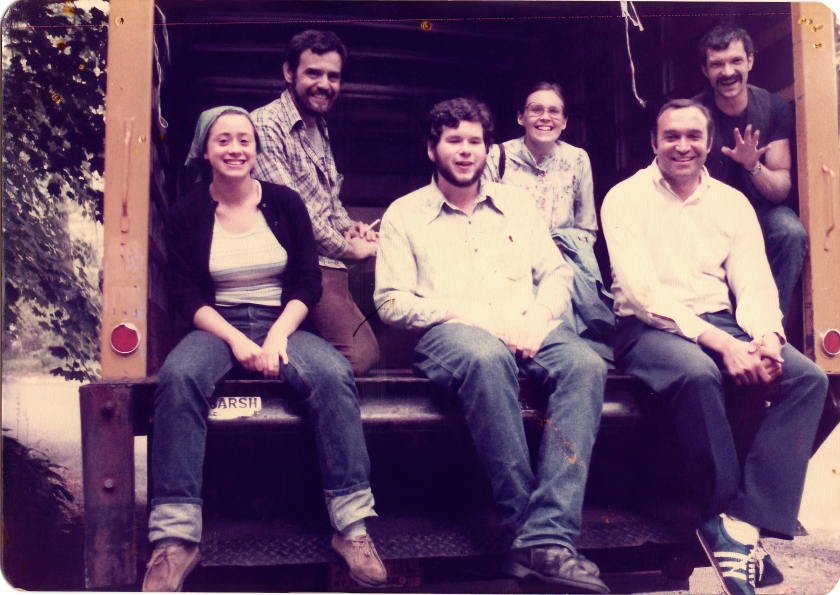
Father Ted and his friends helped me move in 1978. I have a bandanna on my head and Father Ted is behind me.

In early 1977 when I was 21 years old, I was followed into a building and attacked with a knife. I was raped. It is hard to express the rent in your soul when something like that happens.  And yet it is a common trauma in our patriarchal world, used as a weapon of war and, in general, to control women’s bodies. When I think of Israeli women being raped even as they were murdered, I don’t even know how to process that level of evil. As for myself, I was an easy mark as victim because I had been groomed to be meek by childhood abuse.

Continue reading “Keeping an Open Heart: My Ode to Father Ted by Janet Maika’i Rudolph”

Archive of Silence by Sara Wright

It is well documented by conservative science how a human being deals with trauma.

Trauma first overwhelms and then destroys the body’s nervous system.

It affects cognitive ability –

 the ability to translate experience into meaning

 it steals the ability to imagine a different way of being in the world.*

Trauma affects memory creating blanks – holes in the fabric that cannot be recovered except perhaps through dreams visions, sensing, intuiting, having experiences with Nature that the rational mind does its best to resist.

Continue reading “Archive of Silence by Sara Wright”

We Endure Abuse to Survive, Part 2 by Karen Tate

Part 1 was posted on December 18. You can read it here.

But what was the straw that broke the camel’s back in my case? What hurled me into that dark abyss I described earlier? The paranoia, the anxiety, the nightmares and sleeplessness. Not opening my closet in three years or not caring about much of anything. The fear of being alone in a place or in a crowd of strangers.  Fear of going to unfamiliar places. Of driving myself across town. Did it start with the collective trauma and abuse mentioned earlier? I can’t be sure, but therapy definitely points to my attack by an inebriated young woman wielding a stun gun. She looked to be college age. One would never have guessed her capable of such a senseless assault. I told few people about it but it was years before I realized how that event stifled my voice. Yet “they” – the authorities in society – say if we don’t talk about assault right away it must not be true. Or we’ve waited too long to talk. They want us to talk on their timetable about damage done to us when there might not be visible wounds or we even understand the psychological scars that might not have surfaced yet. It was a few years after the attack that I finally sought the help of a therapist and was diagnosed with the PTSD or post traumatic stress disorder that changed my life. 


Continue reading “We Endure Abuse to Survive, Part 2 by Karen Tate”

We Endure Abuse to Survive, Part 1 by Karen Tate

I considered myself savvy and educated and an advocate for peace, fairness and equality.  I thought abuse was something that happened to others, not me.  But it was happening to me.  It had happened to me and I didn’t see the danger signs as my life careened off the road.  I became aware abuse and the resulting trauma can happen to anyone.  I came to realize we have to examine all aspects of our lives for both blatant and insidious abuse.  We must recognize it and take steps to eradicate abuse from our lives and society.  That’s where I’ve been on for the last five years and I’m only now able to begin to share that journey.  To write a new book, Normalizing Abuse, and bring my radio show, Voices of the Sacred Feminine, back on the air after a long hiatus.

Part One

If you knew me before my unraveling, you might remember I was the hostess of the Voices of the Sacred Feminine podcast for more than a decade where I had the privilege of interviewing some of the most prominent thought leaders in spirituality, politics and academia. I’d published six books, gave talks at the Parliament of World Religions, the Academy of Religion and various other public and private associations. I had done dozens of interviews and was all over YouTube. I was out there and then gradually I wasn’t. I faded away and became a shadow of my former self.  And for a time I don’t think I cared if I ever came back. I had no motivation or inspiration.  I didn’t open my closet for three years. I didn’t care if I bathed or brushed my teeth. I was dreaming someone was trying to push me into a dark hole in the wall of a building. I’d hear floorboards creaking and feared the foundation of the house I was living in would collapse. I’d wake up with heart palpitations because the latest dream was one where our home had no ceiling or roof. I’d think cars slowly driving by my house were surveillance. 

Continue reading “We Endure Abuse to Survive, Part 1 by Karen Tate”

Aging and the Ancestral Dark? by Sara Wright

Unfortunately, an inner darkness has been with me all fall hiding in the corners of my mind and disturbing my body creating headaches and stomach troubles during the day. Although I attempt to protect myself from a culture that I cannot control by not listening to news, watching television, movies or perusing social media I am painfully aware of the fact that politicians on an international level cannot even agree to discuss what to do about climate change – this after 30 years of doing absolutely nothing – creating in me a mindless fury that leaves me in black despair. The time of acting locally and thinking globally is long past. Thinking and doing must occur on a global level. Novelist Richard Powers states the obvious: “People can better imagine the end of the end of the world before the end of Capitalism”. Then we can move to the moon.

I have also been forced to acknowledge how difficult this year has been on a personal level. Aging is affecting my energy level, increasing the severity of depressed states, my sense of inner and outer balance. I am vulnerable and know it although I do my best to begin each day with gratitude as I first peer out at my beloved trees, a little nuthatch or chickadee, gaze at a silver crescent, or celebrate a pale pink dawning.

Continue reading “Aging and the Ancestral Dark? by Sara Wright”

“Calculated Emotional Violence” and Abuse: Memories of ‘Mother Days’ by Sara Wright

I took the above phrase from a post on FAR (published 5/6/22) after it triggered memories of mother abuse. Like Sedna I was a daughter who was thrown into the sea, her fingers cut off one by one (but not by my father). Abandoned and left to die, Daughter sank to the bottom of the sea. The classic Handmaid’s Tale. In the Inuit story the abused daughter survives, transforming into Mistress and Mother of the Animals. As a woman I have followed in Sedna’s footsteps in that I became a dedicated naturalist with a fierce love for all non-human creatures (and plants), but I have yet to transform my unfortunate family history.

With Mother’s Day approaching, I am forced against my will to think about my calculating, deceitful mother who had little use for women in general, and spent her life criticizing and eventually deleting her only daughter permanently from her life. Trashed.

My first crib memory is one of raw terror – a bewildered baby crying out for a mother that never came. Comfort, compassion, love were withheld. Now at 77 I ask myself: what was wrong with this woman?

Continue reading ““Calculated Emotional Violence” and Abuse: Memories of ‘Mother Days’ by Sara Wright”