

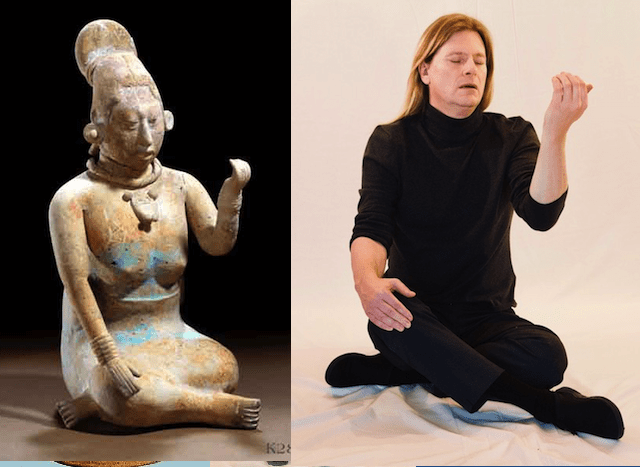
This is part 2 of a blogpost based on an interview I did with Laura Lee at the Cuyamungue Institute. Yesterday’s post concluded with the concept of natural body positions and how these inspired the founder, Dr. Felicitas Goodman. She was also inspired by yoga postures. Laura describes Dr. Goodman’s thinking.
With yoga postures, even sitting in them for five minutes, we can note some interesting physiological reactions. Non-invasive tests were done such as galvanic skin response, breath rate, motility of the intestines, with just sitting in a yoga posture. Interestingly, many of our postures that we see from around the world look like yoga postures. These can be sitting cross legged or kneeling with your hands and arms in a specific configuration in your lap. Goodman had the idea, ‘I should add that to my ritual.’ She started to experiment with postures. And indeed, that pushed it from, let’s have a trip with some drumming, to, oh my gosh — now here we’re touching the hem of something larger than ourselves.
Laura described more of Dr. Goodman’s fascinating journey:
When she was teaching anthropology at Denison University, in Ohio, Dr. Goodman had bought a summer home in Santa Fe. She was very taken by the Pueblos and the spirituality of the place. She was an anthropologist, so, of course, she was interested in other societies and their means of accessing this. As always, she began to seek what did they all have in common. She was part of a study by her mentor, Erika Bourguignon, a well-known cultural anthropologist that was sponsored by the National Institute of Mental Health, [NIMH]. Erika, in the 1960s, was asking the question, ‘when these many indigenous societies say that they are hearing voices, they’re seeing visions, do they mean that literally?’
They noticed how we’ve lost the language to really speak about these experiences. Western science, and western culture, tends to label everything outside its narrow blinders as a problem or a pathology. Erika asked, what is this phenomenon of accessing ecstatic states? In the 1960s, that was a very legitimate question. She gathered up 488 ethnographies from around the world. Because Goodman spoke and wrote eight languages, in fact, her earlier career was as a medical linguist, she was tapped to translate many of these. And along the way, she started to question, ‘what did all these various traditions have in common?’ She found the answer in ritual. They all held it as a sacred trust. They all recognized ritual as healing. This is fundamental to our culture; this is the core of who we are. This is how we develop right relations — within ourselves, our community, and the universe at large. This was a sacred practice. This was a normal capacity for the human being. They recognized how it was our society, we modern Westerners, who had lost that way. In the 1960s, this was a pivotal study. And it was confirmed from a physical point of view, Goodman in lab tests at the universities of Munich and Vienna in the 1980s, that with our use of ritual body postures, cortisol decreases, and the well-being hormones, the beta-endorphins surge.
Laura went on to describe her own insights regarding the postures.
I loved radio. I got to do maybe 3,000 interviews with whoever I wanted, the rich gamut of movers and shakers, leading edge thinkers in all fields, from the arts to the sciences, and everything in between. And I felt, okay, got my education there. But now it was time to go deep into one practice. And I really felt, let the spirits teach me. Let whatever this is, teach me and be my tutor. Let me go deep into the source. And it was as though this new story emerging, of the 14 billion years that the universe has been around, that it too is on an evolutionary journey. The stars themselves have died and been reborn, heavier matter coagulated, became planets, that carry the dust of that as we become life. WE are part of this grand evolution. We’re not just 200,000 years old as the human species. We’re 14 billion years old, as a member of this whole ecosystem of the whole universe. And I thought, that’s who we truly are. And this is the way to get in touch with that. To speak to that, to speak on that level. That there is — I don’t know what you call it, a force, a field of consciousness, love? — that wants to engage us on that level.
It’s surprising how many of us have had mystical experiences. I think it’s just part of what Goodman is saying. This is for all of us. Mystical moments, are all of our heritage. And indeed, the body wants them so much, finds it so healing, that it can enter into that state spontaneously. Goodman spent her lifetime seeking that doorway. And that’s what she found. And I think — it’s not surprising. I think this is a benevolent universe, that offers us many, many doorways to enter in. Those doorways are right here within us, and with a sincere knock on the door, you are granted passage.
When Laura describes what her vision working with this material is, I see a parallel to the work of FAR. She says,
One of my missions is to bring this into the mainstream, and to say, ‘you know, in the long history of humankind, the ability to expand this bandwidth, to call upon a wider spectrum of modalities of thinking beyond just the linear and the rational that we so highly prize, to use our intuition, be in dialogue. It is to be tapping what those very sages of the ages were tapping, for their wisdom, that is so honored and respected, and has lasted through the ages. Why? Because it rings with an eternal truth. This is for all of us — direct experience. I think it’s such an important message. And I think that perhaps one of the reasons that it has been overlooked is because it’s a bit dangerous to our society, to be so self-empowered, and self-actualized, to listen to that inner voice, as opposed to ‘let me just sign up for somebody else’s authority over me.’
And isn’t that what feminism in general and FAR specifically is all about? It is about owning ourselves, our voices and our own pathways of life. When we write about these experiences, we spread their message, to empower ourselves and be our own “authority,” the authors of our own lives. If we are able to have direct experiences of the numinous, the mysterious, the spiritual, we can learn to trust ourselves better. For our culture to change, it needs people who can think for themselves, who aren’t taken in by the allures of patriarchy (that new cell phone, a bigger car, better living through plastic, etc . . .). In my neighborhood political power has been taken over by those stoking fear. That can’t happen to the same degree when the populace is self-empowered. Politics tend to divide us. Work, such as the Institute does, connects us because it is not based on one culture’s beliefs or practices. It is universal and reveals our ties to other cultures as well as to our ancestors. These are roots that, when established, are hard to pull up.
Personally, I have found this work with ecstatic poses to be a wonderful and powerful practice that nurtures religious, spiritual, ecstatic experiences without the need for formalized religion. The work is done through our bodies which is also important in honoring our earthwalk. This is not to say that formalized religion doesn’t have meaningful pathways of their own, but I feel it’s important for us to know that there are many journeys of the spirit to find our own bliss. Thank you for keeping this work alive, Paul and Laura.
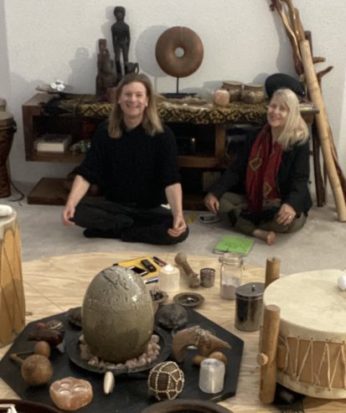
The full interview will eventually be able to be seen via video and text on their website at Cuyamungue Institute.com. You can also get more information about the poses and register to attend their weekly sessions which are free.
Discover more from Feminism and Religion
Subscribe to get the latest posts sent to your email.

 Feminism and Religion
Having read both of these posts now, I have to say that pictures of those statues do give me a sense of well-being, which is what I am sure is meant to be a core ingredient of life on Earth. I am learning to walk again in new shoes after recovering from an ankle fracture and some leg trauma which is still healing. When it happened I realize now that I had slipped into working with a goal-orientated mindset instead of using the mind through the heart which is what I know brings me ease, comfort, and that calm sense of well-being, as well as energizing goals in a stress-free way. I slipped into busyness pushed by commercial beliefs. But the ensuing period of enforced immobility afforded me time to reflect deeply on my life, as my earth walk continued in the inner world. Then came the star pictures from the Webb telescope, printed in the Sunday Times magazine. My experience of looking at them was one of wonder coupled with ease and well-being, which leads me to believe that this is indeed our birthright. The telescope is an example of technology being used for good, to point towards our origins in the first starlight of cosmic dawn. We have come a long way from those statues yet both the statues and the technology are showing us the same thing. I experimented with the poses from one of your earlier blogs Janet and found them both comfortable and energizing.
LikeLiked by 1 person
Beautifully stated Iona, I am glad you are healing. It is amazing how our bodies will pull us back to the present (sometimes harshly) if we stray too far from our hearts. I am also glad you are able to find lessons and beauty. I haven’t seen the star photos from the Webb telescope here in the US. I will do an internet search.
Yes, we have come a long way from the statues in terms of history but they still resonate so deeply in our beings. Its wonderful to be able to have this resource to connect.
May your earthwalk be nurturing and beautiful!
LikeLike
Thank you Iona for pointing this out. Incredible! A window into creation. https://www.nasa.gov/feature/goddard/2023/webb-celebrates-first-year-of-science-with-new-image
LikeLike
Thanks Janet for the 2-part important post. Love this: “And isn’t that what feminism in general and FAR specifically is all about? It is about owning ourselves, our voices and our own pathways of life. When we write about these experiences, we spread their message, to empower ourselves and be our own “authority,” the authors of our own lives.” Yes, absolutely right. So often, we give away our own power (not in the domination sense) over to others and our lives become full of “shoulds” and “oughts.”
LikeLiked by 3 people
Thank you Esther for emphasizing that point about owning our own voices and empowering ourselves. Its frightening how easy it is to fall into “shoulds” and “oughts.”
LikeLiked by 3 people
“If we are able to have direct experiences of the numinous, the mysterious, the spiritual, we can learn to trust ourselves better. For our culture to change, it needs people who can think for themselves” WE DESPERATELY NEED PEOPLE WHO CAN THINK OUTSIDE THE BOX, and inhabiting our bodies with awareness can help us do this… I agree that these images and postures speak to the power alive in body…
LikeLiked by 1 person
Sara, Amen to that!
LikeLiked by 1 person
Thank you for this wonderful 2-part post about Cuyamungue and the work of Felicitas Goodman. I am happy to know that the work is being stewarded so faithfully. I have been greatly inspired and influenced by Felicitas Goodman’s book and work for thirty years. Janet, I know you mention Santa Fe, but even more remarkable, is that I believe that her home and institute were in Los Alamos, New Mexico or closeby. I have always felt her work was a wonderful curative to the devastastation originating from and wrought there at the “Atomic City.” It is interesting to ponder as the film “Oppenheimer” comes to the theaters now. Thanks again for your work, and for bringing it to a wider audience.
LikeLiked by 1 person
Thank you Catherine, I find Felicitas Goodman inspirational as well. As far as I know, her land was originally in Santa Fe but I don’t know the full history. I can ask. Paul and Laura work out of Sedona Arizona.
Whether or not she was near Los Alamos, her work is definitely an antidote to many things, including atomic devastation as you point out.
LikeLike
Oppenheimer is a film worth seeing…it humanizes the horrors except for those of Native Peoples on whose land it occurs.
LikeLike