


FAR was founded in June 2011 by four women, Xochitl Alvizo, Cynthia Garrity-Bond, Caroline Kline, and Gina Messina. They are and have been revolutionary thinkers in the world of feminism. Below is a portion of what they write on our “About” page
“There is no single definition of feminism and this is a place of many voices. Important work in women’s studies in religion continues as more attention is paid to the intersection between gender, race, culture, and sexual identity, within feminism and religion.” They go on to say: “We establish this blog in the hope that feminist scholars of religion — and all who are interested in these issues — will use this forum to share their ideas, insights, and experiences, so that this community of thinkers will be nurtured as we explore diverse and new directions.”
In the 12 years since FAR began, definitions have changed and expanded. We have also seen the emergence of voices from communities of liberation movements and the trans-community. FAR is now preparing to move forward and that means confronting challenging social issues that affect not only the feminist community but everyone who associates themselves or who is interested in such issues.
As I tend to do, I look at issues through the lens of shamanism. As we at FAR prepare new definitions for words such as “feminists” and “feminist community” along with new policies for FAR, I would like to lay some groundwork.
For this I turn to myth. There is a lovely Irish song called the Song of Amergin or Amairgin. Its origins are shrouded in history. Amergin is credited with naming the Island of Ireland in mythic fashion. There were three queens of the Tuatha Dé Danann (Banba, Ériu and Fódla) who gave permission for Amergin and his people to settle in Ireland. But each required Amergin to name the island after themselves. In this way, Ériu or Erin became the primary name. The other two are used in poetry.
Amergin’s lovely song was written in Old Irish. It has been hard to pick which of its translations to share. Here is a link that explores many beautiful ones: https://connfitzgibboncounselling.ie/the-song-of-amergin/
Gods & Fighting Men, Lady Gregory, Part 1 Book 3
I am the wind on the sea;
I am the wave of the sea;
I am the bull of seven battles;
I am the eagle on the rock
I am a flash from the sun;
I am the most beautiful of plants;
I am a strong wild boar;
I am a salmon in the water;
I am a lake in the plain;
I am the word of knowledge;
I am the head of the spear in battle;
I am the god that puts fire in the head;
Amergin is the forerunner of Taliesin the Welsh bard/poet/shaman of Britain. Taliesin was said to have lived in the 6th century CE.
In Taliesin’s similar story of transformation, he began life as a boy named Gwion who was tasked with stirring the cauldron of the goddess Cerridwen. As it boiled a bit of the liquid spurt out of the pot onto Gwion’s finger, burning him. He quickly put his finger in his mouth and in this way ingested the liquid which was said to contain the wisdom of the stars. Here is an accounting of what happened next:
After Gwion had accidentally eaten of the astral, fiery dew of the cauldron, Ceridwen was furious, for she felt she had been robbed of her bounty and her labors. Gwion ran away but she chased him relentlessly. He changed himself into a rabbit, but she became a greyhound. He jumped into a river and became a fish, but she became an otter to continue the chase. He became a bird, but she became a hawk. Just as she was about to swoop down to take her vengeance, Gwion saw a bale of wheat. Jumping into the wheat pile, he turned into a grain of seed. She became a hen, pecked through the pile, found him, and ate him. In this manner, Ceridwen became pregnant. When she delivered him nine months later, she could not bring herself to kill him and so wrapped him in a leather bag to cast him into the sea. After a long time, he was found by a Welsh prince named Elphin who fished him out of the waters and named him Taliesin, the Welsh term for shining brow, for indeed he was glowing.
Both of these stories illustrate a basic shamanic teaching; we need to experience the full range of earthly life in order to be complete human beings. Some systems talk about past lives, some feel we can do with work in our present lives through shamanic practices and meditations. I believe in present life work.
There is a human angle to this concept which I first learned from my mentor/friend, the brilliant Rachel Pollack who died in April of this year. She spoke about the Greek Tiresias (also known as the blind seer of Thebes). There are many origin stories of Tiresias but the one I first heard Rachel tell was this:
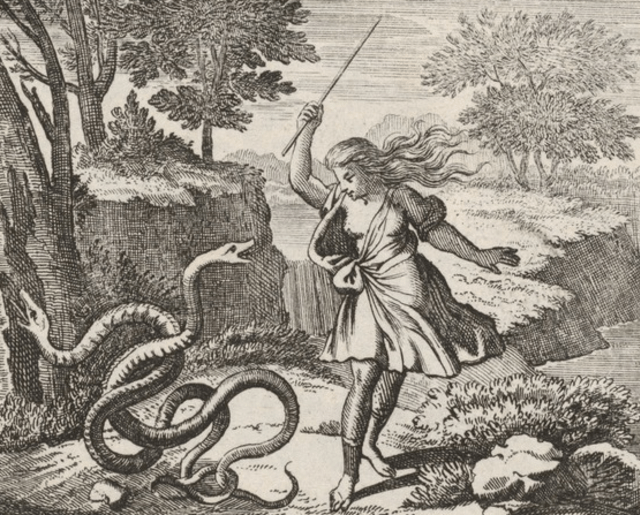
When Tiresias came upon a pair of copulating snakes, he hit the pair with his stick. This angered Hera who punished Tiresias by transforming him into a woman. Tiresias became a priestess of Hera, married and even had children. After seven years, Tiresias again found mating snakes. It is not sure whether she left the snakes alone or hit at them again but the myth recounts that she was released from her “curse” and became male again.
I remember Rachel’s giggling glee when she told another story of Tiresias. Rachel herself was trans and so felt a special connection. Tiresias was drawn into an argument between Hera and Zeus about who had more pleasure in sex, men or women. He did, after all, have the experience of being both. Tiresias replied, “Of ten parts a man enjoys one only.”This infuriated Hera (not quite sure why) who struck him blind. Since Zeus could do nothing to reverse her curse, he bestowed Tiresias with the gift of prophecy.
I believe Hera’s anger along with the punishments to be later patriarchal overlays to an older story. Tiresias’s tale is the human version of Amergin and Taliesin. In all these tellings, we are directed to understand in the fullest ways possible all the kaleidoscopic aspects of what it is to live on the Earth. Shamanic wisdom teaches us of the importance of understanding humanity[1] in all its forms. Amergin and Taliesin teach us about the elements and the animals, Tiresias brings it into the human realm. The key to “seeing” as Tiresias does is to know and experience aspects of both male and female in our own multi-faceted lives. We here at FAR don’t have all the answers but we do want to explore these topics especially in regard to the more vulnerable communities among us. We are working to write a policy of solidarity and are using these concepts as a baseline. Our default is to err on the side of solidarity.
[1] The term “humanity” in shamanic parlance means all of life on earth, not just human life.
Discover more from Feminism and Religion
Subscribe to get the latest posts sent to your email.

 Feminism and Religion
A wonderfully stimulating piece Janet, thank you! I love the weaving of Amairgin’s song, shamanism and feminism into a tapestry of solidarity and humanity-in-all-forms. YES!
LikeLiked by 3 people
Thank you Eline, and well said, “humanity-in-all-forms.”
LikeLike
Beautiful Janet – oh what a blessed community…. reading these stories the woman in me that is a student of world mythologies sees again and again that the stories overlap – myth is a kind of truth that allows us to enter other realms reminding us that we are all related as One.
LikeLiked by 1 person
I so agree Sara, I think mythologies hold a key to reminding us of the mystery and magic of humanity in all its fullness. Thank you.
LikeLike
Janet, it is warm and inviting to get to know you through your writing. I hear your voice, and it is soothing. Thank you for sharing this piece with us. This might be one of the kindest ways to get to know someone.
LikeLiked by 1 person
Thank you so much Terry, not only for reading but for understanding and acknowledging. For me, being heard is a wonderful gift and I thank you for it.
LikeLike